


The Tangled Web Behind AI’s Gold Rush
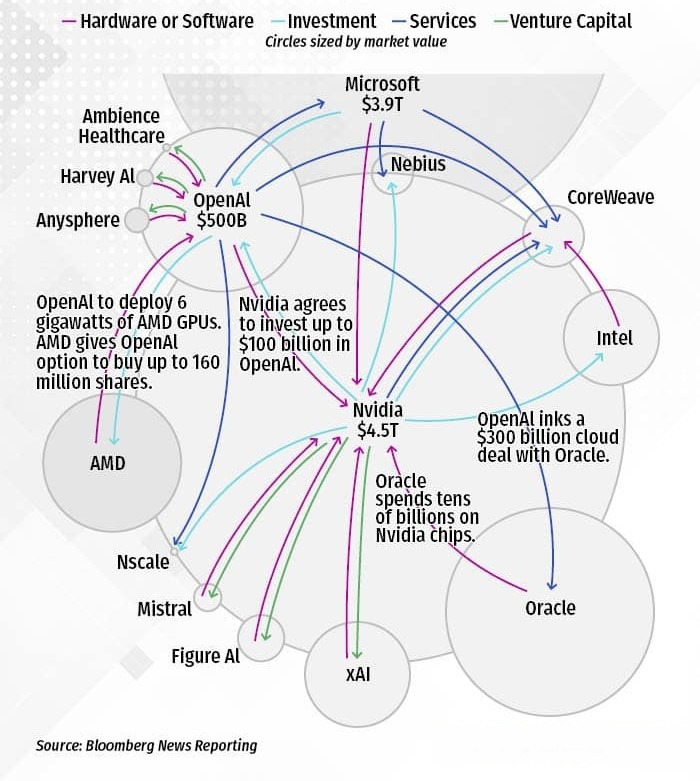
Artificial intelligence is no longer just a word, it’s a financial ecosystem, and companies like Nvidia and OpenAI sit right at its center. An image from Bloomberg illustrated this tangled web: billions of dollars flowing among hardware makers, cloud providers, and AI startups, each feeding the other’s valuation in a self-reinforcing loop.
Nvidia (~$4.5 T) powers nearly every AI data center. OpenAI (~$500B) depends on Nvidia’s GPUs for its models like GPT-5, while also linking multi-billion-dollar partnerships with Microsoft, Oracle, and AMD. The result? A network where investment, services, and hardware all overlap, creating the “AI money machine.”
How the Loop Works
Let’s simplify the circle:
- OpenAI uses Nvidia GPUs for model training.
- Microsoft invests billions in OpenAI while hosting it on Azure.
- Oracle signs a $300 billion cloud deal with OpenAI, while also spending billions on Nvidia chips.
- AMD provides GPU alternatives and offers OpenAI an option to buy up to 160 million shares.
- Nvidia, in turn, invests back into OpenAI, reportedly up to $100 billion.
Every arrow in this system points toward more spending and higher valuations. The more GPUs OpenAI orders, the more Nvidia’s market cap rises, encouraging more investment into AI-startups dependent on Nvidia hardware. It’s a feedback loop that looks eerily similar to past tech booms.
Michael Burry’s Warning and the “Bubble” Question
Famous investor Dr. Michael Burry, known for predicting the 2008 financial crisis, has reportedly taken positions shorting Nvidia, suggesting he sees the current AI euphoria as unsustainable. His reasoning aligns with a growing view among skeptics: valuations are rising faster than real-world adoption.

Jerome Powell, however, recently pushed back on the idea of an “AI bubble,” saying that productivity from AI could justify current market valuations. But market data paints a more uneven picture: while the “Magnificent 7” (Nvidia, Microsoft, Apple, Amazon, Meta, Alphabet, Tesla) continue to soar, the rest of the S-&-P 500 has stayed mostly flat or declined. The AI tide, it seems, isn’t lifting all boats.
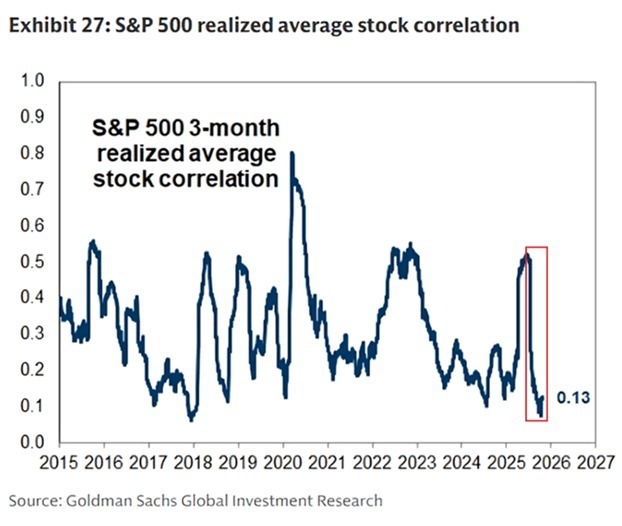
This metric measures how individual S&P 500 components move relative to the index.
Overvaluation and the Illusion of Infinite Growth
At the heart of the concern is valuation detachment, the gap between narrative and profit. Nvidia’s revenue from AI chips has grown massively, but investors are pricing in decades of uninterrupted demand. The same was true for dot-com companies in the late 1990s that assumed endless internet growth.
Unlike the dot-com era, today’s AI infrastructure has real demand. Yet, many of these profits depend on a narrow group of players, OpenAI, Anthropic, Google DeepMind, and a handful of chip suppliers. If corporate adoption slows or AI costs don’t fall fast enough, the web of mutual dependencies could unravel.
The State of Today’s Altcoins, Especially AI & AI-Agent Alts
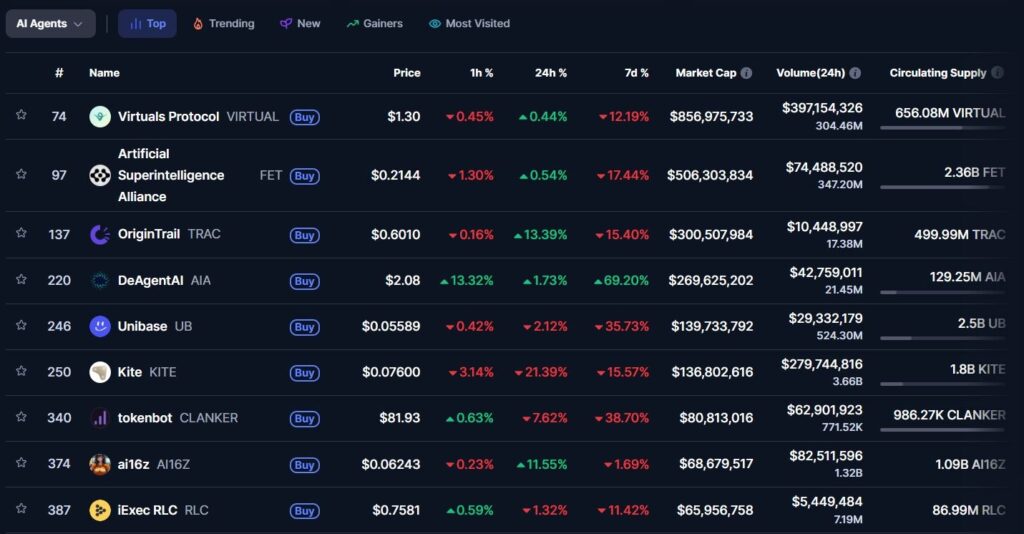
Here’s where it gets interesting for crypto. The altcoin market is under pressure, yet a sub-sector around AI and AI-agent tokens is attracting attention. According to recent data:
- The “AI and AI Agents” crypto category (tokens that enable decentralized autonomous systems and blockchain-based AI agents) has a market cap around $3.9 billion.
- Analysts describe “AI agent” crypto tokens as systems where autonomous software programs live on the blockchain, perform tasks, take decisions, and interact with users or other protocols.
- Despite modest size compared to top-tech equities, this niche is seen as high growth. Use cases include staking, governance, tokenised AI agents, and ecosystems that reward agent-builders.
That said, broader altcoins (outside of AI-focused ones) are still lagging. A recent market outlook notes that altcoins are “under pressure as capital rotation favours Bitcoin”, and the Altcoin Season Index sits near 23 (low), meaning risk appetite for non-BTC, non-ETH coins remains subdued.
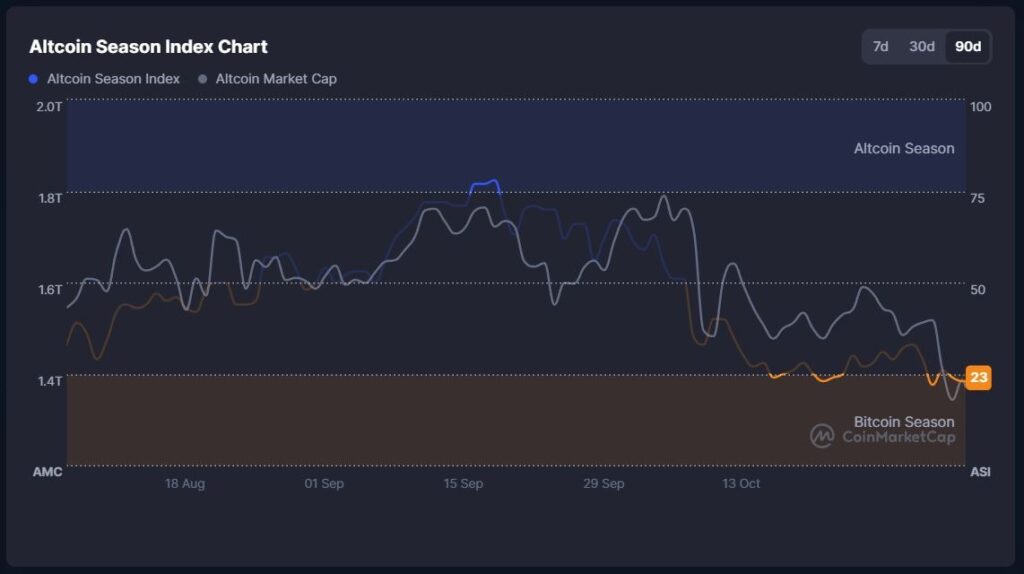
So we have a two-tier situation:
- The AI/agent altcoin sub-segment has a narrative, rising interest, and some early adoption.
- The wider altcoin market remains flat or struggling, while capital stays concentrated in a few dominant tech/crypto names.
This is relevant because the dominant tech loop (Nvidia/OpenAI) fuels interest in tokenised AI ecosystems. But the risk is: if the core loop fails, the speculative spike in AI altcoins could collapse even faster.
The Dependency Problem, On Two Fronts
This web creates both synergy and fragility. If one pillar weakens, many linked pieces feel it.
In the tech world:
- OpenAI depends on Microsoft’s cloud and Nvidia’s chips.
- Microsoft depends on OpenAI to keep Azure relevant.
- Nvidia depends on both to keep GPU demand high.
- Oracle and AMD depend on these partnerships to stay competitive.
In the crypto-altcoin world:
- AI/agent tokens depend on genuine adoption (agents running on-chain).
- Their value often ties to hype rather than revenues.
- Broader altcoin sentiment depends on capital rotation into risk assets.
If AI infrastructure growth slows, or if broader altcoin markets don’t regain momentum, both tech and finance sides may see harsh corrections.
What Comes Next
So, is it a bubble? Possibly, but not a simple one. The AI economy is producing real breakthroughs in productivity, automation, and software design. Yet the pace of financial speculation around it (multi-hundred-billion valuations built on inter-company deals rather than profits) suggests a structural risk.
For the altcoin space: growth in AI/agent tokens is promising, but size is still small and chances of speculative blow-up are high. The wider altcoin market still waits for a sustained rotation of capital.
Markets have seen this before: when network effects turn reflexive, growth feeds on growth until reality catches up. Nvidia and OpenAI’s intertwined dominance may define the next decade, but it also mirrors every historical pattern that precedes correction.
This article is for informational purposes only. Always perform your own research before investing.
Explore more insights on blog.millionero.com and trade Spot or Perpetuals securely on millionero.com, where simplicity meets smart trading.