



A Surprising Rally in a Weak Market
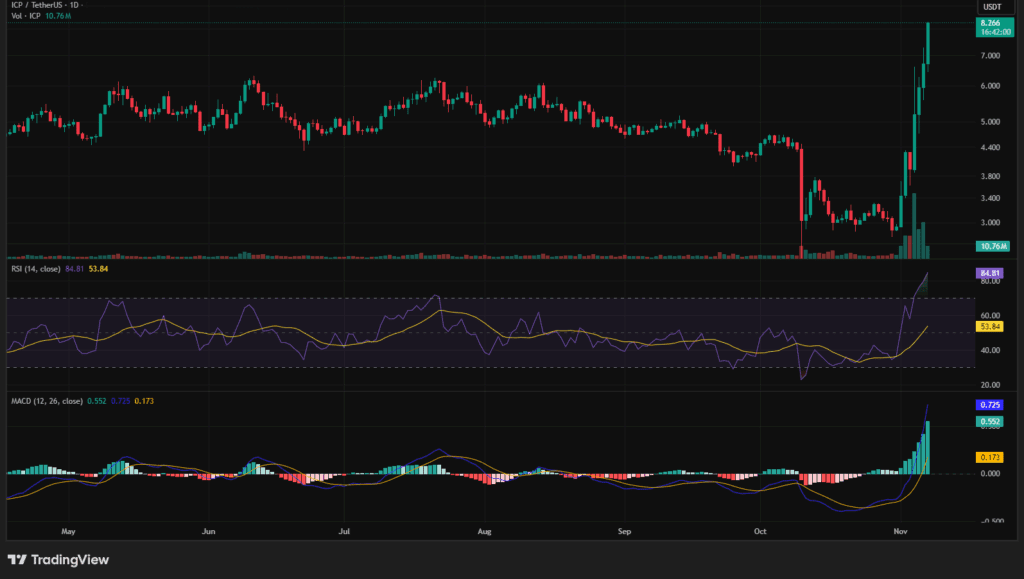
In a time when most cryptocurrencies struggled, Internet Computer (ICP) made a stunning comeback. The token’s price jumped nearly 200%, rising from around $2.90 to over $8, even as the broader market cooled off. This rally wasn’t luck, it reflected a mix of technical, on-chain, and narrative-driven catalysts that turned ICP from an overlooked project into one of crypto’s most discussed assets.
Breaking Resistance and Fueling FOMO
ICP’s price first exploded when it broke past its long-term resistance near $3.70. This technical breakout flipped sentiment overnight, inviting momentum traders and algorithmic buyers into the mix.
Indicators like RSI says overbought and a MACD bullish crossover confirmed strength, while trading volume surged over 200% in 24 hours. Open interest in futures touched multi-month highs around $148 million, showing that real capital was returning to the asset. In short, technicals triggered the first spark, but the story didn’t end there.
The Short Squeeze That Set It Off
A cluster of short liquidations around $3.55 acted like jet fuel. As ICP kept climbing, short sellers were forced to buy back their positions, accelerating the rally. Even the project’s founder hinted that leverage-driven price suppression might have existed earlier, scaring more bears out of their trades. This sudden unwinding of bearish leverage left bulls fully in charge.
AI Integration: ICP’s Caffeine Moment
What really changed the narrative was AI. In October, the Dfinity Foundation unveiled Caffeine (or Caffein), an AI layer that lets users build apps via natural-language prompts instead of code. It positioned ICP as one of the first “AI-native blockchains,” merging two of 2025’s hottest trends: AI and crypto.
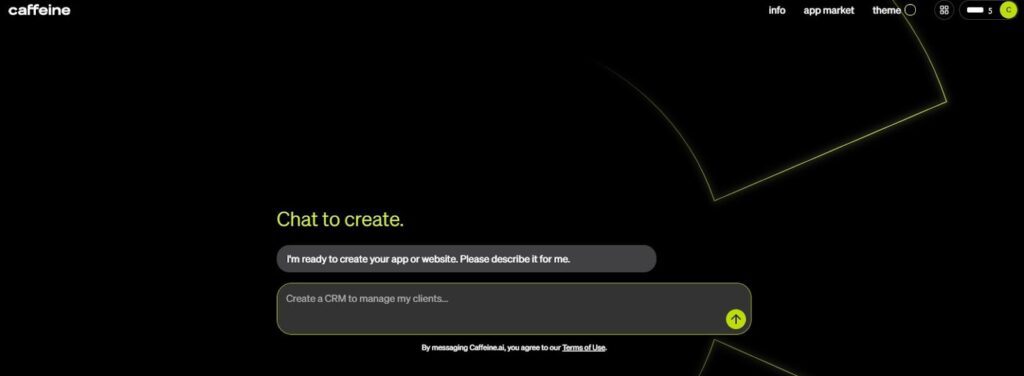
ICP’s roadmap now includes 40+ AI-related updates and upcoming “AI agents,” pushing the idea that entire AI applications could live on-chain. As the rest of the market debated what AI even meant for blockchain, ICP was already deploying it.
Chain Fusion and the Multi-Chain Revolution
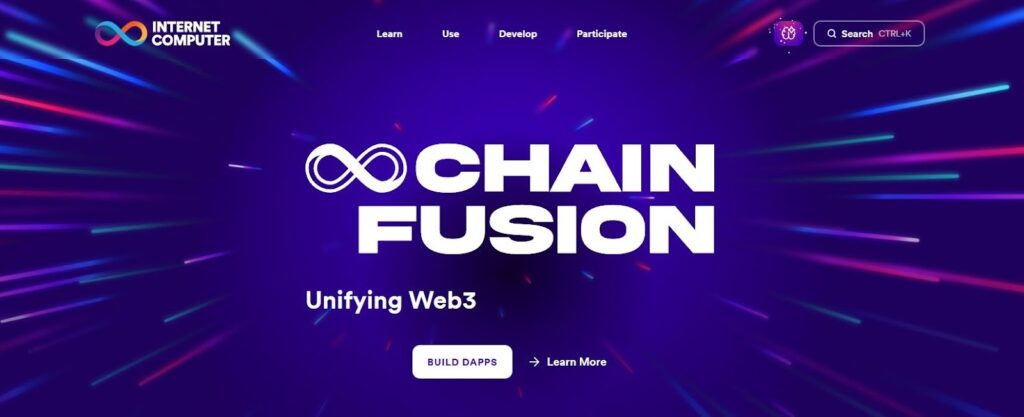
Another major pillar of ICP’s surge is its Chain Fusion technology, a system that lets ICP smart contracts directly interact with Bitcoin, Ethereum, and soon Solana without bridges.
This isn’t just a technical milestone, it’s a bridge-free, trustless approach to interoperability.
- ckBTC and ckETH allow holding and transferring BTC/ETH natively.
- Solana integration (via the “Helium” milestone) is next.
With these, ICP becomes a multi-chain DeFi hub, bringing liquidity and users who want decentralized, cross-chain cloud solutions.
Whale Accumulation and Tight Supply
Data shows whales have been accumulating aggressively. Wallets holding 10,000–100,000 ICP hit record highs, while nearly 50% of total supply is staked in long-term governance neurons.
At the same time, exchange reserves dropped by 31%, meaning fewer coins are available for sale. This created a “supply squeeze”, a perfect environment for price expansion once demand rose.
Real Usage: The Decentralized Cloud in Action
ICP isn’t a ghost chain. It has processed over 262 billion transactions, surpassing Solana and Hedera in total count. Apps like OpenChat, DSCVR, and ICDex run entirely on-chain, front end and back end, proving the system’s scalability.

A viral on-chain game, BOB, even caused the network’s compute usage to rise 20× in days. Few blockchains can handle that kind of workload without slowing down.
ICP also doubled its subnet storage capacity from 1 TiB to 2 TiB, expanding total on-chain data to roughly 94 TiB, a feat no other decentralized network matches today.
Centralized Outages Highlight ICP’s Strength
When AWS and Azure suffered major outages in October, parts of the internet went dark. ICP-based applications, however, kept running. This was a wake-up call for developers relying on centralized infrastructure.

ICP’s architecture, hosting full web apps on-chain, removes single points of failure. The event revived discussions about the need for a “decentralized cloud,” and ICP was suddenly at the center of it.
Institutional Partnerships and Product Focus
ICP’s ecosystem is no longer purely experimental. In late October, it partnered with PrimeVault, a digital-asset custody firm, to develop enterprise-grade storage and security tools.
Meanwhile, Dfinity’s “Mission 70” plan aims to cut token issuance by 70% by 2026, reducing inflation and making ICP more deflationary.

The organization also restructured into “DFINITY 2.0”, a shift from pure research toward product delivery, signaling maturity and accountability. These moves are helping institutional investors see ICP as a real contender, not just a tech demo.
Market Sentiment and Macro Tailwinds
As Bitcoin stabilized and traders rotated into altcoins, ICP stood out as undervalued but functional. Surveys showed over 86% of users bullish during its Q4 rally.
Analysts compared its current phase to Ethereum’s early 2017 period, calling it a “generational opportunity” that the market hasn’t fully priced in yet.
Macro optimism, like expectations of lower interest rates, also helped money flow into risk assets, and ICP, sitting at the crossroads of AI, cloud, and DeFi, fit that rotation perfectly.
The Bigger Picture
ICP’s surge isn’t a random pump. It’s a case study in how strong technology, real usage, and shifting narratives can revive a forgotten coin. It is now sitting in a rare position:
- A working decentralized cloud,
- A bridge-free multi-chain system,
- And an AI-integrated Web3 platform.
While volatility remains, ICP’s recent rally suggests it’s no longer just another altcoin, it’s a prototype for Web3’s next infrastructure wave.
This article is for informational purposes only. Always perform your own research before investing.
Read more on blog.millionero.com. Trade spot and perpetuals at millionero.com