



The Long-Awaited “UNIfication”
Uniswap Fee Switch: On November 10, 2025, Uniswap Labs and the Uniswap Foundation announced a major plan called “UNIfication.” For the first time, the decentralized exchange wants to turn on its fee switch, a built-in system that sends part of trading fees back to UNI token holders.
Here’s what it means in plain terms:
- Traders pay a 0.30% swap fee, as usual.
- Liquidity providers (LPs) still get 0.25%.
- The other 0.05% goes to the protocol as revenue to burn UNI tokens, removing them from circulation.
This connects Uniswap’s activity directly to UNI’s value, making trading volume reduce UNI’s total supply over time.
The plan also includes a one-time burn of 100 million UNI from the treasury, about 16% of all UNI, worth nearly $800 million. It represents what might have been burned if the fee switch had existed since Uniswap’s start.
In addition, fees from Uniswap’s new Layer-2 network, Unichain, and future systems like MEV discount auctions, will also go into UNI burns.
To keep things fair, Uniswap Labs will stop taking its own interface fees (worth about $179 million before) and move under one shared structure. The governance process will take about 22 days, including community discussion, Snapshot voting, and final on-chain approval.
Social Media Reactions
The proposal quickly spread across social media. Founder Hayden Adams called it “Uniswap’s next era,” saying, “That ends today!”, meaning Labs can finally take part in governance and help build value for token holders.
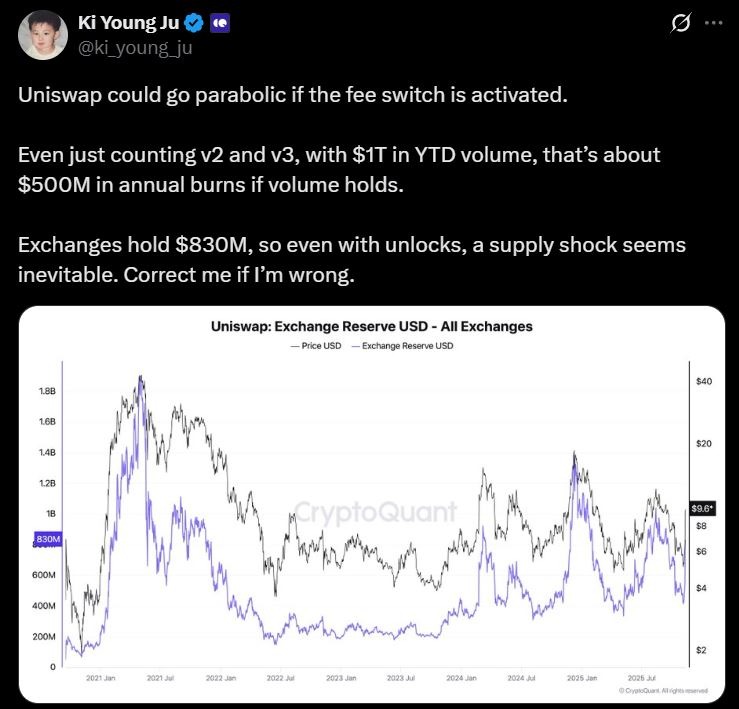
Analysts like Ki Young Ju (CryptoQuant) said the switch could lead to $500 million worth of UNI burned each year, which might cause a big drop in supply. Another researcher, “Bread,” said the burn could reach $38 million per month, faster than most other DeFi projects.
For many users, this move signals that DeFi is finally entering a real profit phase, where projects share income with token holders, similar to how companies do stock buybacks.
Still, not everyone agreed. Critics like Alexander from Dromos Labs said taking a cut from LPs’ fees could make them earn less (0.25% instead of 0.30%) and possibly move to other exchanges. Some analysts also said liquidity might fall at first. But supporters believe Uniswap’s MEV auctions and other new fee systems will balance things out over time.
Overall, the community’s tone was mostly positive. Many called this a turning point for decentralized finance, showing that a major project can grow while sharing earnings fairly with its users.
Market Impact: UNI Shoots Up
Markets reacted fast. Just hours after the news, UNI’s price jumped almost 40%, going from around $6 to $9.70, its highest in months.
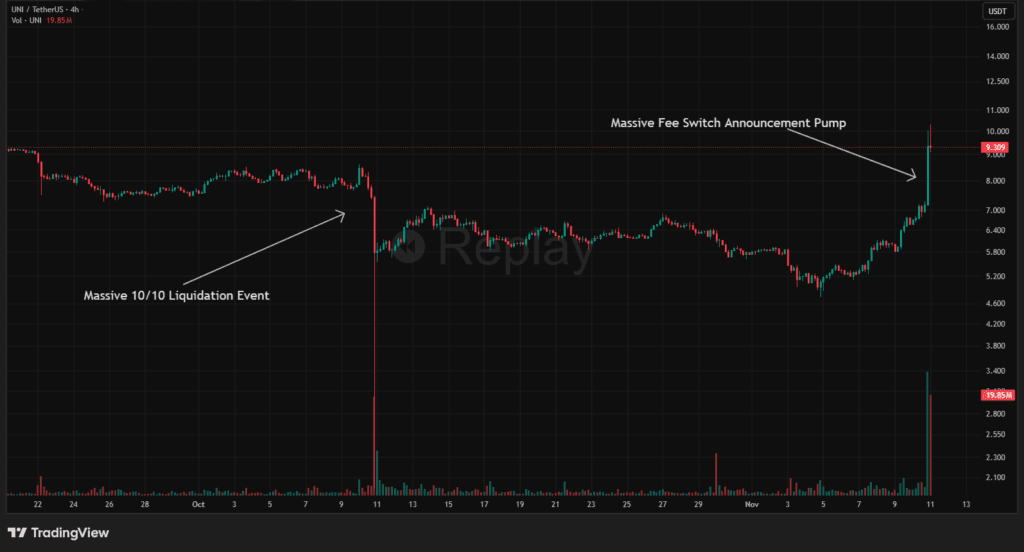
This move pushed Uniswap’s market value above $6 billion, ranking UNI among the top 35 crypto coins. Data also showed big holders, called whales, bought more UNI, increasing their total from 8.3 million to 9.6 million tokens. Meanwhile, exchange balances dropped, meaning people are holding UNI for the long term instead of selling.
Analysts said this reaction was rare for a governance vote, comparing it to a tech company starting buybacks or dividends. The “fee switch rally” lifted not only UNI but also other DeFi tokens. Even competitors like AERO rose about 9%, as traders guessed liquidity might shift.
This shows that investors see the proposal as more than hype, they view it as proof that Uniswap is ready to reward its users.
What Happens Next
The vote process is still ongoing, but if it passes, this could set a new standard across DeFi. Other protocols may start doing the same, sharing part of their fees through burns or rewards.
If approved, the Uniswap fee switch will give UNI real value, turning it from a simple governance token into something that earns from the exchange’s success.
If rejected, UNI could face short-term ups and downs. But either way, Uniswap has already sparked new excitement in the DeFi world, showing that years of talk about “protocol income” can finally become real.
This article is for informational purposes only. Always do your own research before investing. For more, visit blog.millionero.com and trade on Millionero.