



What Is Alchemist AI?
Alchemist AI is a no-code platform on Solana that turns plain language into working apps and games. Users type something like “make a Snake game” and the system generates the code, designs the interface, and deploys a playable version in a browser, all without the user writing a single line of code.
The project’s goal is simple: make software creation open to everyone, from hobbyists to entrepreneurs, by combining large language models (LLMs) with a fast, cheap blockchain base.
How the Technology Works
Under the hood, Alchemist AI uses a multi-agent AI pipeline:
- One AI agent reads the text prompt and figures out what the user wants.
- Other agents generate the UI, the game or app logic, and even graphics.
- The finished app is deployed to a web sandbox so users can test it right away.
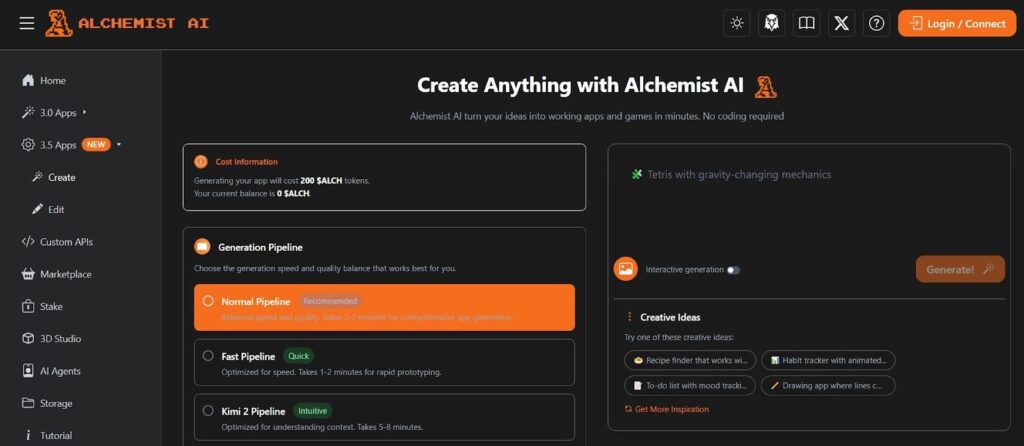
The team says the system can plug into advanced models like “GPT-5” and Grok as they become available, and can also integrate third-party APIs and image generation inside the apps. This keeps the platform flexible as AI technology improves.
Solana is used mainly for speed and low fees. It handles payments, app marketplace trades, and token-based features with cheap, fast transactions.
The Team and Origins
Alchemist AI started in 2024 in Hanoi, Vietnam, led by:
- Thien Phung Van – Founder & CFO, with a background in software entrepreneurship and finance (formerly CEO/CFO of Vistia).
- Trong Pham Van – Co-founder with trading and corporate leadership experience.
- Duc Loc “Louis” Nguyen – CTO, leading technical development.
The project launched as a bootstrapped startup without big venture capital. Most public info about the team comes from third-party databases rather than a public team page, which some investors see as a transparency risk.
ALCH Token: Supply, Utility, and Incentives
The native token ALCH is central to the platform.
Supply and distribution
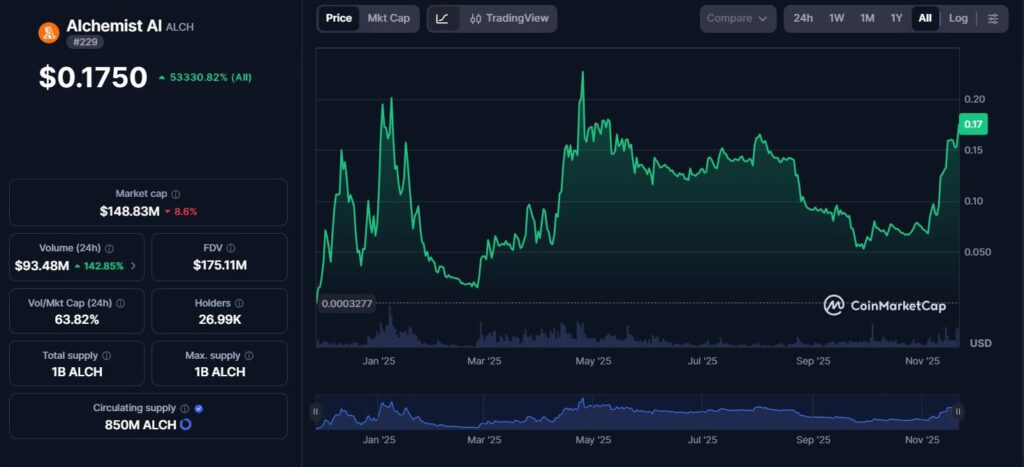
- Total supply: 1,000,000,000 ALCH.
- 85% went straight into the public liquidity pool at launch.
- 5% for marketing (3-month linear unlock).
- 7% for treasury and ecosystem (12-month unlock).
- 3% for the core team (1-month cliff, then 6-month vesting).
This design puts most tokens in the hands of the community early, with a small team allocation and short vesting.
Main utilities
- App generation: users pay a flat fee (e.g. 200 ALCH per app) to create new applications.
- Arcane Forge Marketplace: apps are bought, sold, and tipped in ALCH.
- Staking: holders can stake ALCH to unlock premium features, faster generation, and extra rewards.
- Governance: ALCH holders can vote on upgrades, token parameters, and treasury use.
- DeFi use: as an SPL token, ALCH can be traded or used as liquidity in Solana DeFi.
The token is non-inflationary, supply is capped at 1 billion, so rewards must come from allocated pools or platform fees, which encourages careful economic design. turn0file0L92-L124
Who Is Alchemist AI For?
The platform targets a wide range of users:
- Hobbyists and creators who want simple tools or games (“to-do app with mood tracking”, “catch falling stars game”).
- Indie developers and Web3 builders who want quick prototypes for dApps, game front-ends, or small utilities.
- Non-technical entrepreneurs and small businesses that need MVPs or internal tools without hiring dev teams.
- Marketplace users who prefer to buy ready-made apps instead of building from scratch.
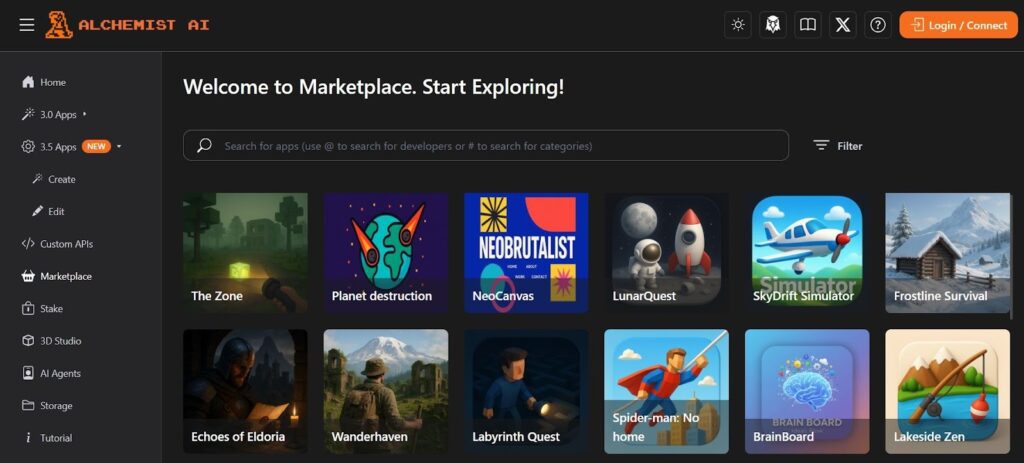
By turning natural language into running software and adding a tokenized marketplace, Alchemist aims to build a new creator economy for apps, similar in spirit to how YouTube enabled video creators.
Community, Ecosystem, and Market Performance
Alchemist AI has grown an active community of “Alchemists” who test early versions, give feedback, and list their apps on the Arcane Forge Marketplace, where users can rate and tip each other’s creations.
On social media, the project has tens of thousands of followers and often trends on Solana tracking platforms when volumes spike.
Market history has been very volatile:
- Launch: late November 2024.
- All-time high: around $0.2357 on January 2, 2025.
- All-time low: around $0.0143 on February 25, 2025 (over 90% down from the peak).
- Late 2025: trading again near $0.16–0.17 with a market cap around $140M and a rank near #200.
Regulation, Security, and Audits
Kraken’s UK disclosure states that ALCH is unlikely to be a security under UK law and treats it as a utility token used for access to tools and marketplace payments. Indonesian regulators have also allowed trading via Tokocrypto.
However:
- There is no public third-party smart contract audit yet, and CertiK lists the project as “Not Audited,” even though no hacks or token contract incidents have been reported so far.
- The team is not fully doxxed on the official site and has no public KYC badge, which some view as a trust issue.
CertiK’s security score has improved over time, reflecting a year of operation without major incidents, but the lack of audits and clear legal entity still counts as a risk factor.
Key Challenges and Risks
Analysts and community members point to several main challenges:
- Heavy competition from big tech and other AI/no-code platforms.
- Reliance on external AI models (like OpenAI or xAI) and potential changes to their APIs or terms.
- Extreme token volatility, amplified by high-leverage futures markets.
- Regulatory uncertainty around both AI and crypto, which could shift quickly.
- Limited transparency and no formal audits, which may keep some institutions away.
- Product maturity questions, the AI must keep improving so apps are useful, not just toys.
So far there have been no major scandals, hacks, or plagiarism claims, but the project still has to prove it can compete long term, scale its infrastructure, and maintain user trust.
Final Thoughts
Alchemist AI sits at a busy crossroads: AI, no-code tools, and crypto. It offers a clear and bold promise, turn ideas into apps with one prompt, and backs it with an active marketplace, a broad token utility, and a visible development pace.
At the same time, it carries the usual mid-cap crypto risks: sharp price swings, strong competition, partial anonymity, and no formal audits so far. For users, Alchemist AI is an interesting playground to experiment with AI-generated software. For investors, it is a high-risk, high-potential bet on a young project trying to make app building as easy as sending a message.
If you are following projects like Alchemist AI and the wider AI + crypto narrative, you need an exchange that is simple, fast, and fair on fees. Millionero offers an easy-to-use spot and futures platform, built for everyday traders who want clear order screens, 24/7 access, and strong security standards rather than noise and memes.
On Millionero, you can move between majors and high-conviction narrative plays, test ideas with small size, and manage risk with proper tools instead of guesswork. Our content, including reviews like this one, is for education only, not financial advice. Always do your own research, size your positions carefully, and treat every new token as a risk asset, no matter how exciting the story sounds.