



In Bitcoin, time used to feel simple. Every four years, the block reward halved, supply growth slowed, and, like clockwork, 12–18 months later a huge bull market would peak. Then came the crash, the “crypto winter,” and a fresh cycle began.
In late 2025, that story is under attack. Bitcoin is trading around $94,000, roughly 30% below its October peak near $126,000, just months after the April 2024 halving. At the same time, spot ETFs, corporate treasuries, and banks have turned Bitcoin into a global macro asset watched on Wall Street terminals next to the S&P 500.
So the question is no longer just “Where are we in the cycle?” but “Does the old cycle even exist anymore?”
How the Old Four-Year Cycle Worked
The classic thesis was simple:
- Every halving cuts new Bitcoin supply in half.
- Miners face higher pressure; weak ones exit, strong ones hold.
- With less new supply and steady or rising demand, price grinds up.
- Roughly 12–18 months later, a parabolic top forms, followed by a brutal drawdown of 70–85%.
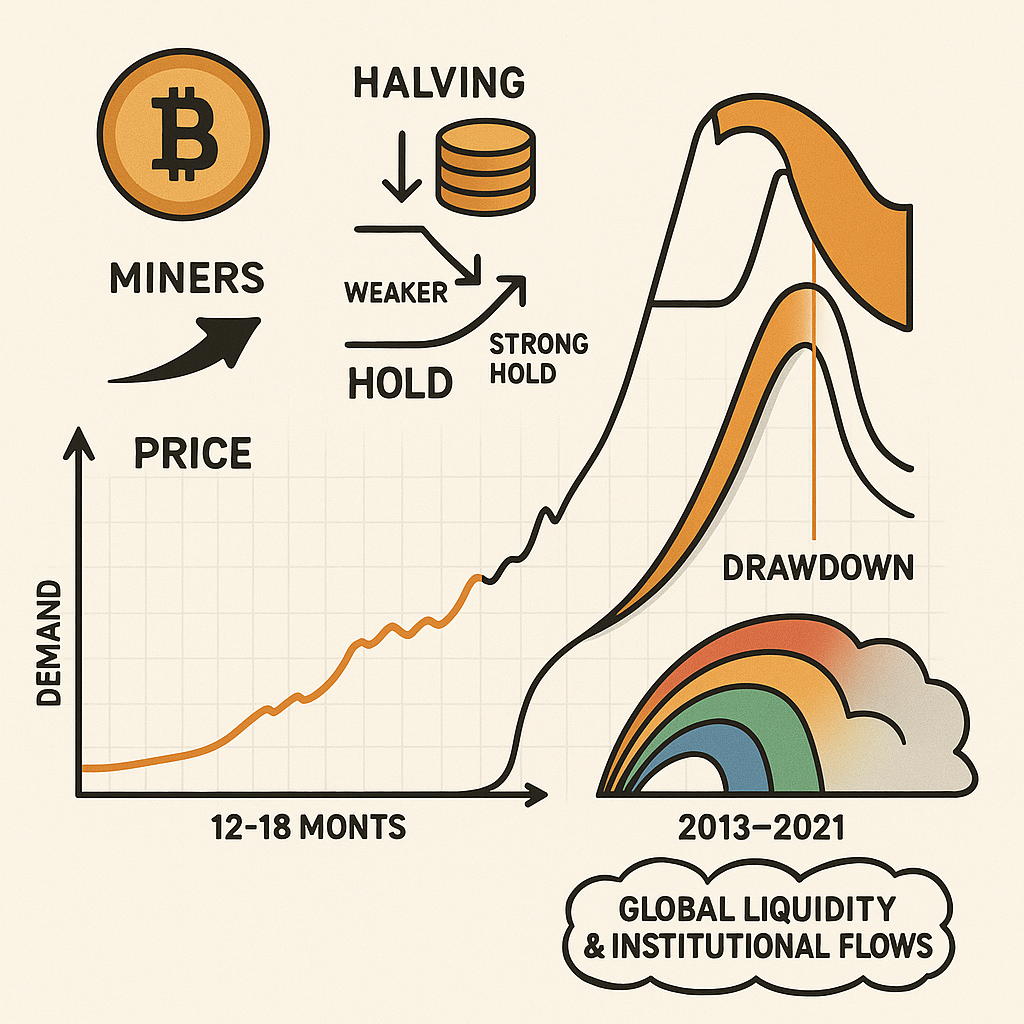
From 2013 to 2021, this pattern held well enough that traders built charts, “rainbow bands,” and fractals around it. The halving became Bitcoin’s internal clock, a built-in monetary cycle.
Today, many argue that clock has been drowned out by a louder beat: global liquidity and institutional flows.
The “Cycle Is Dead” Camp: Bitcoin as Liquidity Sponge
A growing group of executives, banks, and macro analysts say the four-year rhythm is broken and replaced by something bigger.
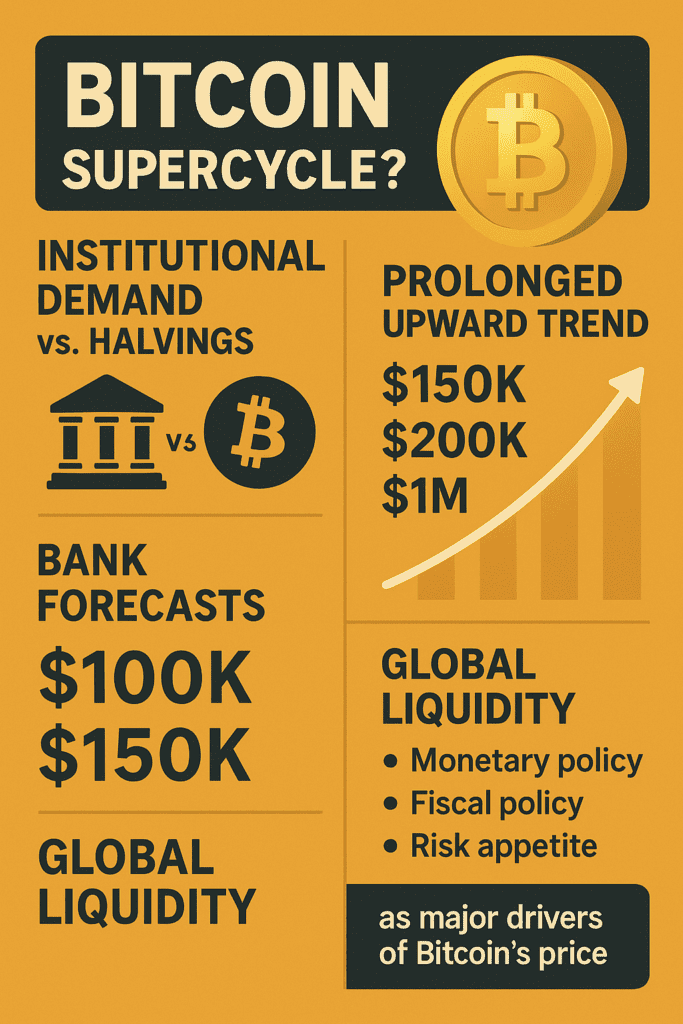
Institutional demand vs. halvings
Binance founder CZ has publicly argued that the old four-year cycle is over and that Bitcoin may be entering a supercycle, a long, ETF-driven uptrend where supply shocks matter less than constant institutional demand.
Research from Bernstein goes further. The firm states that Bitcoin has “broken the four-year cycle” and entered an “elongated bull market” powered by ETFs and institutions. It now sees about $150,000 in 2026 and a potential peak around $200,000 in 2027, with a long-term target near $1,000,000 by 2033.
Banks stretch the timeline, not the story
Standard Chartered, long one of the most bullish banks on Bitcoin, has recently cut its near-term forecasts but kept its long-term view. The bank now expects:
- ~$100,000 by end-2025 (down from $200,000)
- ~$150,000 by end-2026
- A path toward $500,000 by 2030, pushed back from 2028
Crucially, it argues that classic “crypto winters” may be over, with ETF flows and broad adoption softening the brutal boom-and-bust pattern.
Bitcoin as a global liquidity barometer
Macro analysts like Lyn Alden describe Bitcoin as a “global liquidity barometer”: it rises when global money supply (M2) expands and struggles when liquidity tightens. Her work shows Bitcoin moving in the same direction as global M2 roughly 80%+ of the time, more than many other risk assets.
Grayscale and other institutional researchers now emphasize:
- Central bank policy (rate cuts, QE/QT)
- Fiscal policy and deficits
- Risk appetite in traditional markets
as major drivers of Bitcoin’s price, independent of the halving schedule.
In this view, the halving is just a small tweak at the margin. The real story is whether the world is in easy money or tight money mode.
The “Cycle Survives” Camp: Same Pattern, Different Wrapper
On the other side, cycle-focused analysts argue that it’s too early to bury the halving.
They point to a few key points:
- From the 2022 lows to the 2025 highs, Bitcoin has already done a multi-fold move, similar to earlier cycles, just with smaller multiples and lower volatility.
- The current ~30% drawdown looks like a normal bull-market correction, not a full bear market, especially with ETFs still holding the vast majority of coins they bought.
- Miner economics are still tied to halvings. Revenue is cut in half every four years; that must influence supply behavior, even if it’s less dramatic in a trillion-dollar market.
This camp warns that every cycle has declared the old model dead, 2013, 2017, 2021, only for the halving pattern to reassert itself in hindsight. They see today’s debate as another version of “this time is different”, often the most dangerous phrase in markets.
Hybrid Views: Extended Cycles, Power Laws, and “Right Translation”
Between these extremes lies a more nuanced picture:
The four-year cycle isn’t dead, it’s being stretched and absorbed into larger macro cycles.
Several ideas support this “hybrid” view:
- Right-translated cycles: Instead of peaking about a year after halving, the top arrives later (2026 or 2027), as institutional capital slowly grinds price higher. This lines up with Bernstein’s 2027 peak view and banks’ longer timelines.
- Dampened volatility: With ETFs and large funds holding Bitcoin as a strategic asset, sharp 85% crashes may give way to shallower, multi-step drawdowns, still painful, but less apocalyptic.
Then there is the Power Law theory. Physicist Giovanni Santostasi argues that over long horizons Bitcoin price follows a logarithmic power law curve, like a growing city or organism, with the boom-and-bust noise oscillating around a surprisingly stable trend line.
In that framing:
- Halvings and liquidity cycles explain the swings.
- The power law explains the direction.
The four-year pattern is not a precise clock anymore; it is one layer of rhythm inside a larger, slower structure
What This Means for the Next Phase
As of December 2025, markets are again focused on the Federal Reserve, with traders pricing in rate cuts after a long tightening campaign and a messy period of missing economic data. Bitcoin’s rebound toward $94,000 has arrived alongside renewed optimism for easier policy.
For investors, a few practical shifts follow from this debate:
- Don’t worship the calendar. Halving dates still matter, but they are no longer a reliable countdown to a guaranteed top or bottom.
- Watch liquidity first. Fed decisions, global M2, fiscal deficits, and credit conditions now explain a large share of Bitcoin’s big moves.
- Respect both sides of the trade. ETFs, corporate treasuries, and nation-states create a powerful “buy the dip” force, but if liquidity truly dries up, those same structures can amplify outflows.
- Expect smaller manias and smaller winters. As Bitcoin matures into a $1–2 trillion asset, 10x blow-offs and 85% crashes become harder to achieve, but 40–60% drawdowns in a macro shock remain very possible.
Conclusion: The Clock Is Fading, the Rhythm Remains
The clean, almost mechanical four-year cycle that defined Bitcoin’s early life is fading as a primary driver, but it has not disappeared. It now sits inside a broader framework shaped by global liquidity, institutional flows, and long-term adoption.
Halvings still tighten supply. Liquidity still drives demand. Power-law dynamics still tug price back toward a rising long-term path.
In that sense, the real shift is not from “cycle” to “no cycle,” but from a simple, internal clock to a messy, global rhythm, one where Bitcoin moves less like a speculative toy and more like what it is slowly becoming: a major, macro-sensitive asset class in its own right.
This article is not financial advice. Always do your own research and make sure you understand the risks before you invest. You can dig deeper into Bitcoin, macro, and crypto strategy on blog.millionero.com.
When you feel ready, you can trade spot and futures on Millionero, but only with money you can afford to lose.