


Online, it’s getting harder to know who is real. Bots can farm airdrops, fake votes, and flood apps with junk. Humanity Protocol is trying to solve that exact problem: proving a user is a unique human without turning the internet into a giant public ID database.
At a high level, Humanity Protocol is a decentralized identity network. It aims to give each person a self-sovereign “Human ID” that can be used across crypto apps to prove “I’m a real person” (and later, prove certain attributes) while keeping private data private.
What Humanity Protocol is trying to build
Humanity Protocol is designed as an Ethereum-compatible zkEVM Layer-2. That means it wants cheap, fast transactions, but still anchored to Ethereum’s security model.
The identity part is not a “nice extra.” It sits at the center of the network’s design. The protocol’s custom idea here is Proof of Trust (PoT), where identity verification plays a direct role in making the system Sybil-resistant (resistant to one person pretending to be many).
How the verification works
1) Palm scans, but with privacy safeguards
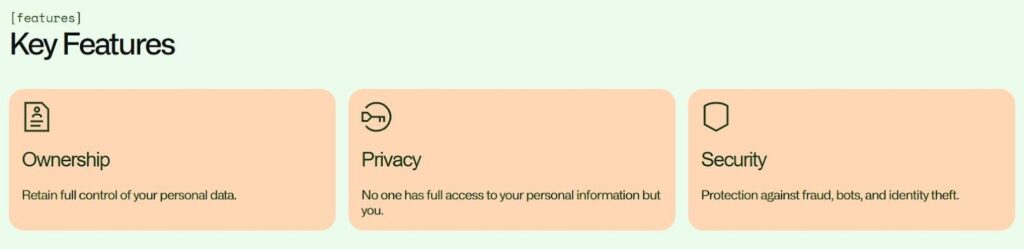
Users enroll by scanning their palm using a phone app (and later, possibly dedicated scanners). The system creates a hashed biometric template tied to a Human ID. The key detail: the raw palm image isn’t stored. It’s processed locally and turned into an irreversible hash. There’s also liveness detection to reduce spoofing.
2) Zero-knowledge proofs (ZKPs) do the “proof” part
After enrollment, specialized nodes generate a proof that the user is a unique human. The chain can verify that proof without seeing the biometric data. This also opens the door for selective claims like “I’m over 18” without revealing a name or birthdate.
3) Human IDs + credentials
A verified user gets a Human ID (a decentralized identifier) that can be linked to verifiable credentials (age, citizenship, attendance, qualifications, etc.). The design supports non-transferable credentials bound to Human IDs, so they can’t be sold or “passed around.” Personal data can be encrypted and stored off-chain, with only hashes/proofs on-chain, and the user controls access through consent.
4) Nodes and incentives
The network uses a two-tier setup: zkProofer nodes generate proofs, and Identity Validator nodes verify them and participate in consensus by staking $H.
The $H token: supply, split, and what it’s used for
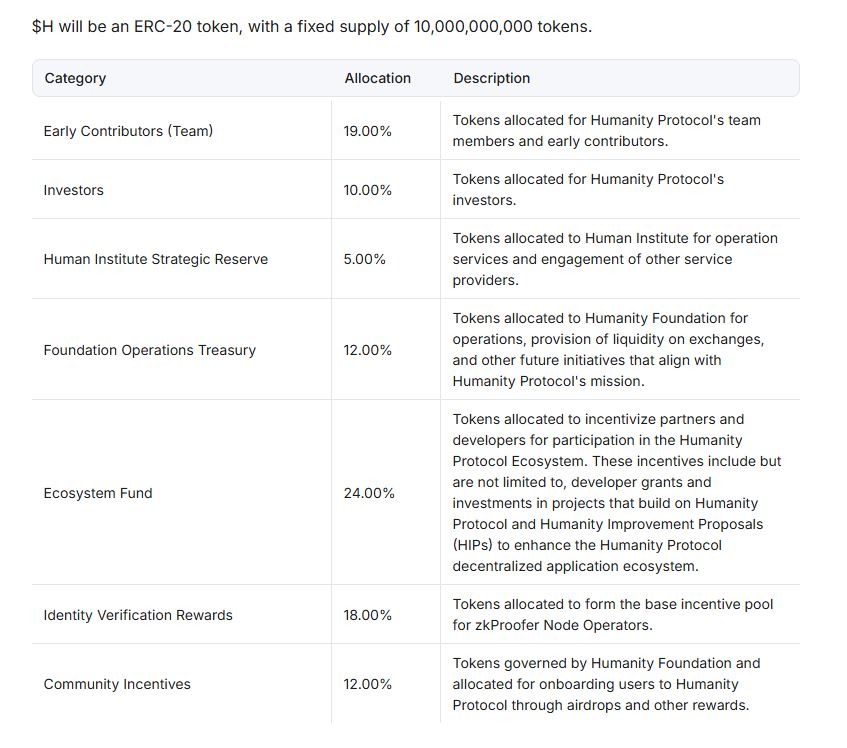
$H is the protocol’s native token (ERC-20). The supply is fixed at 10 billion H, and the design emphasizes no inflation, with incentives coming from predefined allocations instead.
Allocation (10B total)
Here’s the official split:
- Ecosystem Fund (24%)
- Identity Verification Rewards (18%)
- Team & Early Contributors (19%)
- Community Incentives (12%)
- Foundation Operations / Treasury (12%)
- Investors (10%)
- Human Institute Strategic Reserve (5%)
H Whitepaper
Utility (what $H actually does)
$H is positioned as the “working token” of the system:
- Verification fees (registering a Human ID, getting credentials)
- Staking and rewards for validators and proof generation
- Governance voting via a DAO-style mechanism
- User incentives like airdrops/referrals, including the initial Fairdrop
The “Fairdrop” idea: airdrops for humans, not bots
Humanity Protocol’s token launch leaned into its identity-first story. In late June 2025, it ran a “Fairdrop” designed to be claimable only by people who passed the Proof-of-Humanity check. The point was simple: wide distribution, less Sybil farming.

Market snapshot (what happened after launch)
- $H debuted around $0.02 in late June 2025 and quickly spiked.
- It hit an ATH around $0.39 (Oct 25, 2025).
- By late December 2025, it was around $0.15–$0.20, with market cap estimates in the $300–$380M range.
- Circulating supply is about 2.3B H (~23% of max), meaning a large part of supply is still locked and scheduled to unlock over time.
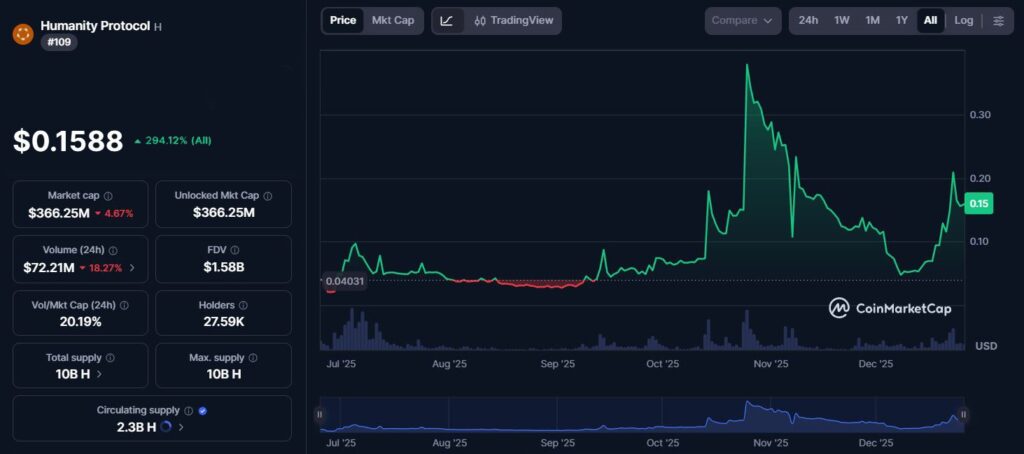
Liquidity-wise, H had tens of millions in daily volume at times.
Roadmap: from “verification works” to “verification is everywhere”
The rollout is described in phases:
- Early period: ID reservations and referrals, with 8,000,000+ users reserving Human IDs before main verification began.
- Phase 1 (mid-2025): mainnet + Fairdrop; early users verified via palm scan; initially more permissioned validation.
- Phase 2 (late 2025–2026): broader app availability, more onboarding, and a big focus on attestations / verifiable credentials plus more decentralization.
Team, funding, and partnerships (why the market cares)
The founder/CEO is listed as Terence Kwok, and there are notable involvements like Yat Siu (Animoca Brands) and Mario Nawfal as part of the broader leadership/advisory picture.
Funding-wise, Humanity raised $20M in January 2025, co-led by Pantera Capital and Jump Crypto, at a reported $1.1B valuation (FDV).
On the partnership side, two moves stand out:
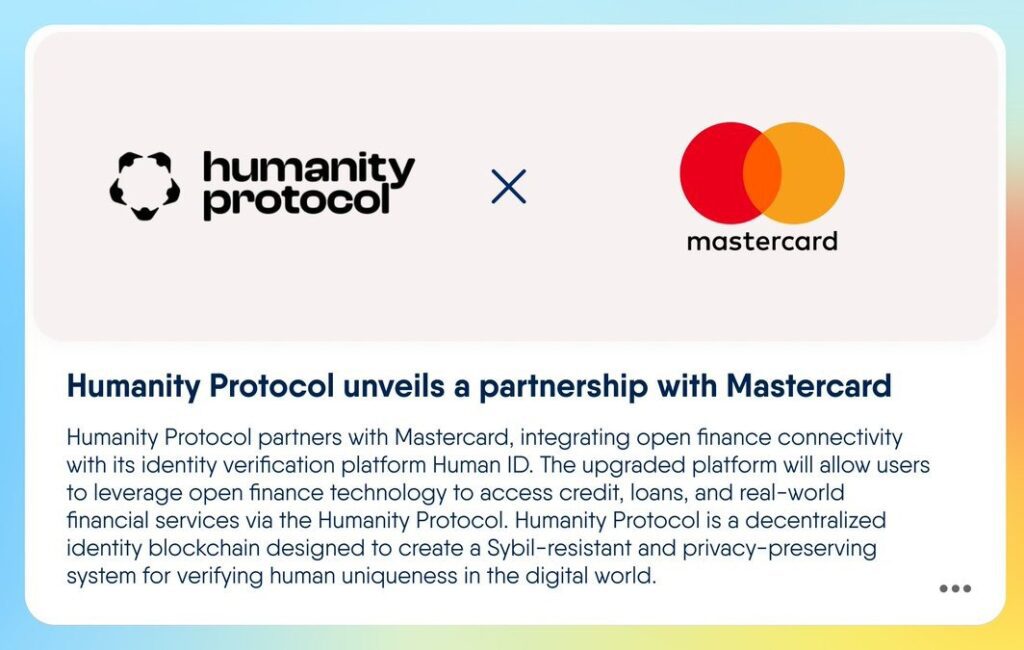
- Mastercard x Humanity is described as linking Human ID to traditional financial credentials in a privacy-preserving way (so a user can prove things about finances without dumping raw data).
- The project acquired Moongate (Web3 ticketing/loyalty), aiming to use Human IDs to reduce scalping and fake tickets, including “prove it’s you” at entry with a palm scan.
Narrative and competition: where $H “fits” in crypto
Humanity Protocol sits in the decentralized identity / proof-of-personhood narrative: tools that help apps tell humans from bots, without handing identity power to one central gatekeeper.
Its main comparables include projects that solve the same core problem in different ways: iris scans (Worldcoin), facial scans (Humanode), puzzle-based liveness checks (Idena), social-graph verification (BrightID), and credential-focused frameworks (Polygon ID).
What to watch from here
If you’re tracking Humanity Protocol as a story, a few things matter most:
- Adoption: do Human IDs become something people actually use day-to-day?
- Credibility: can they keep trust while handling biometrics, even as they scale?
- Supply unlocks: only ~23% is circulating in the review’s snapshot, so unlock schedules can matter for price behavior.
This article is for general information only and does not provide financial, investment, or trading advice. Crypto assets are highly volatile and you can lose money. Do Your Own Research (DYOR) before making any decision.
For more market explainers and guides, visit blog.millionero.com.
If you choose to trade, you can explore Spot and Futures on Millionero.