



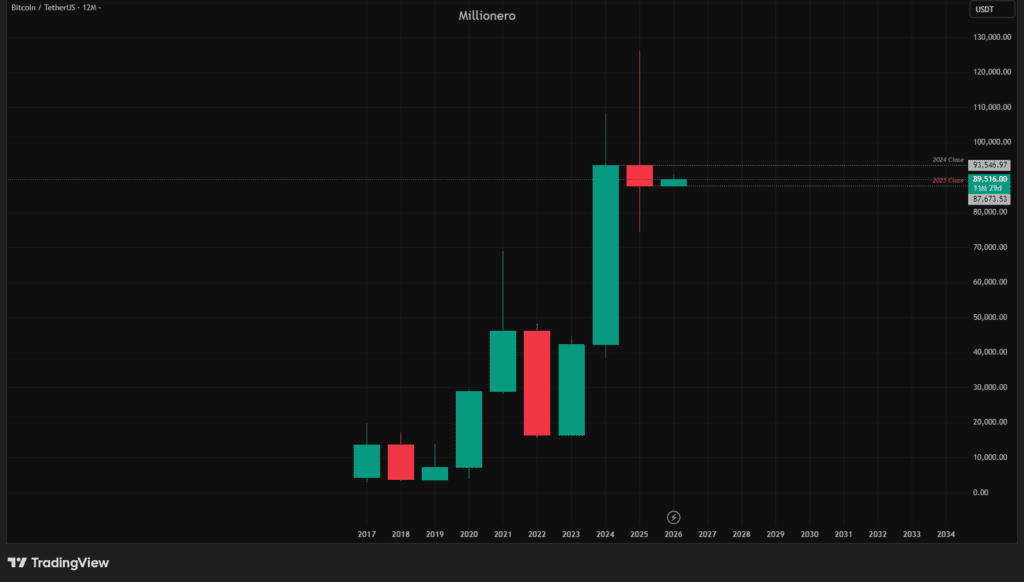
$BTC closed 2025 in the red, even as the story around it became bigger, more political, and more institutional. On the yearly candle, BTC/USD opened 2025 around $93,374 and closed the year near $87,612.7, a drop that captures the feeling many traders have right now: crypto is exhausted, while other assets keep moving higher.
This past week sat exactly on that fault line between fatigue and a possible new phase. On one side, you have heavy macro liquidity, new laws, and big institutions stepping deeper into digital assets. On the other, you have weak token sectors, painful drawdowns, and real questions about which projects actually matter.
Bitcoin: tired price, heavy positioning, and a new halving on the horizon
Even with all the excitement around Bitcoin in recent years, 2025 ended with BTC lower than it started. At the same time, stocks, gold, and other risk assets have been “flying,” which is the opposite of what many expected for Q4. The open near $93k and close below $88k show that the market spent a lot of time trying to re-price what Bitcoin really is in a world of higher rates, regulation, and competition from other assets.
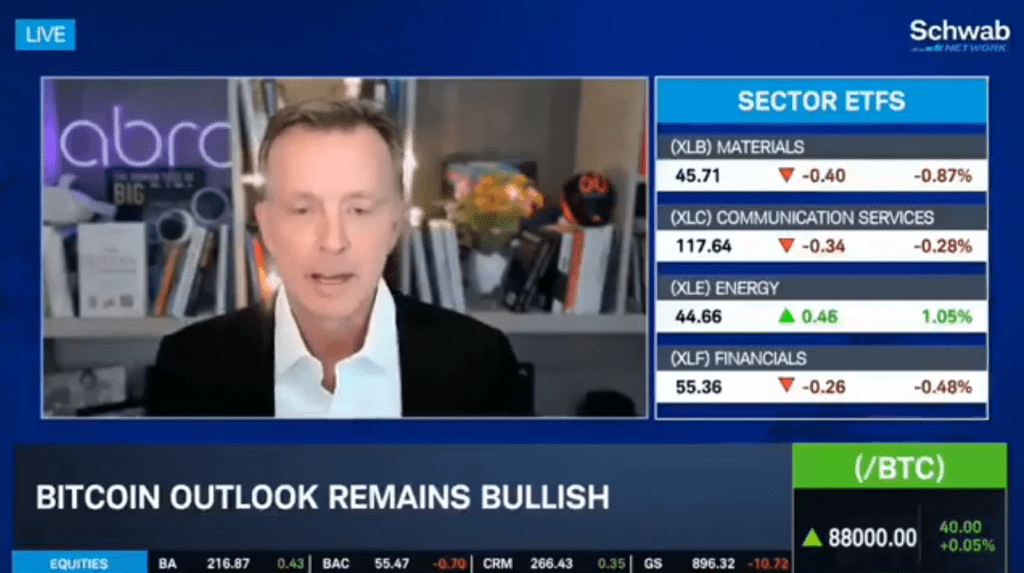
A big part of that story is regulatory overhang. Charles Schwab estimates that regulatory pressure may have cut Bitcoin’s upside by about 50% over the recent period. In their view, the picture can flip if three things line up: quantitative easing, a return of the Federal Reserve to buying bonds, and weaker demand for U.S. government debt. If those line up, the macro environment in 2026 could be much more friendly to Bitcoin’s price.
At the same time, on-chain and structural signals are still quietly bullish. There are only about 120,000 blocks left before the next Bitcoin halving, a key event that usually brings some kind of re-pricing and a shift in market behavior beforehand.

Traders know halving cycles, and they also know that this time the setup is not clean: Korean exchange Upbit will suspend all services on 1 January 2026, temporarily removing about $2 billion of daily liquidity. Historically, Korean traders have helped drive strong post-halving rallies, so a one-day shutdown at year-end could cause forced selling, a short-term liquidity vacuum, and higher volatility before the market finds a new balance.
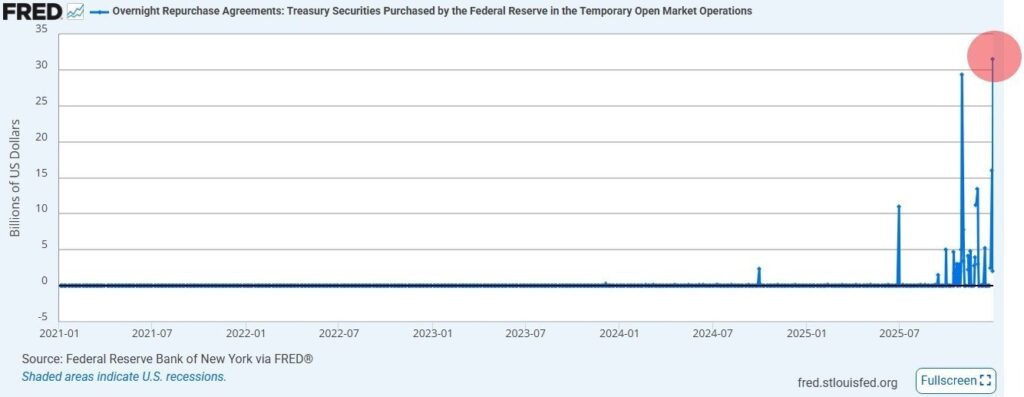
On top of that, the Federal Reserve is quietly changing direction. The Fed injected around $31 billion into the U.S. banking system through overnight repo operations, the largest liquidity injection since the COVID era and even bigger than the peak of the dot-com bubble.
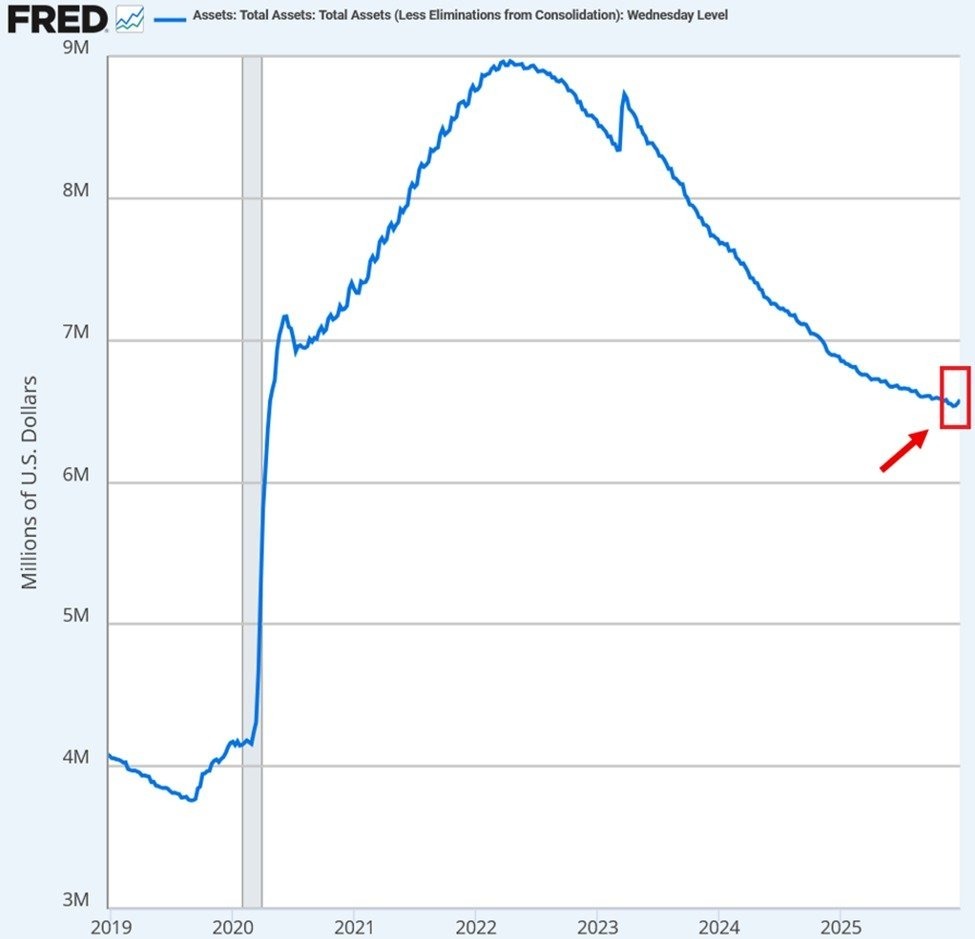
Later data showed the Fed’s balance sheet jumped by $24.4 billion in the week ending December 24, the biggest weekly increase since the March 2023 banking crisis. This is the third week in a row of growth, adding up to $45.5 billion and pushing total assets to about $6.58 trillion, the highest level since the end of October. Projections suggest the Fed may buy $35–55 billion in Treasury bills each month in 2026, or roughly $550 billion over the year, which would lift the balance sheet back above $7 trillion, near the levels of late 2024. In simple words: balance sheet expansion is back.
So we end 2025 with a strange picture: Bitcoin price is weak, the crypto market feels tired, but the macro setup for 2026 looks more supportive than it has in a while.
Corporate treasuries, stablecoins, and the slow institutional grab of Bitcoin
Even while price looks heavy, institutions and corporates are still accumulating.
- Metaplanet bought 4,279 BTC for about $448 million at an average price of $104,679 per coin. The company now holds 35,102 BTC, worth roughly $3.08 billion, with an average cost basis of $102,246. On paper, it is sitting on unrealized losses of more than $504 million, which raises a clear question: is this deep conviction about the next cycle, or a risky bet that only works if Bitcoin rallies again soon?
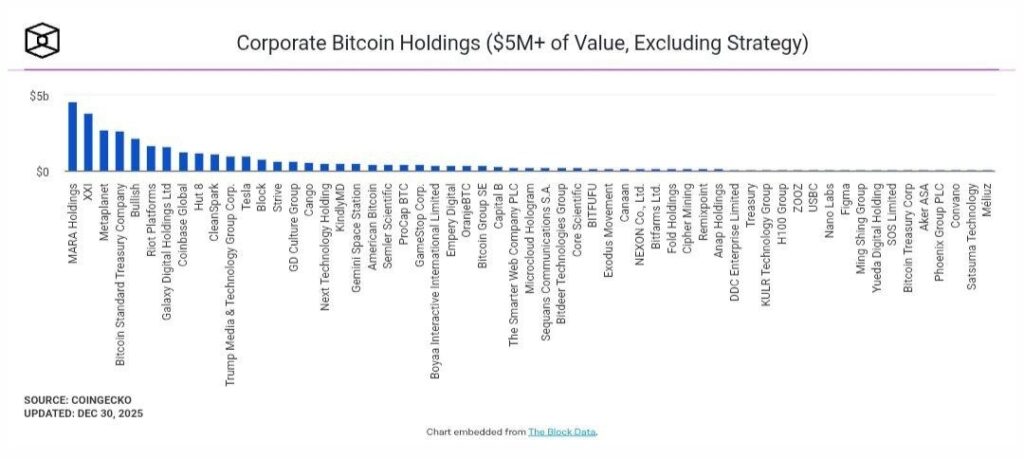
- Corporate Bitcoin treasuries are no longer about just one famous company. Beyond the well-known Strategy/MicroStrategy, we now see miners, exchanges, fintechs, and even firms far outside crypto adding BTC to their balance sheets. The important point is that concentration is spreading, not disappearing. Bitcoin is shifting from a speculative trade to a line item on corporate balance sheets, added in slow, planned steps rather than one big rush.
- Norges Bank, Norway’s central bank, increased its indirect Bitcoin exposure by raising its stake in Strategy to more than $1.18 billion. That means a sovereign institution is tightening its link to the largest corporate BTC holder in the market.
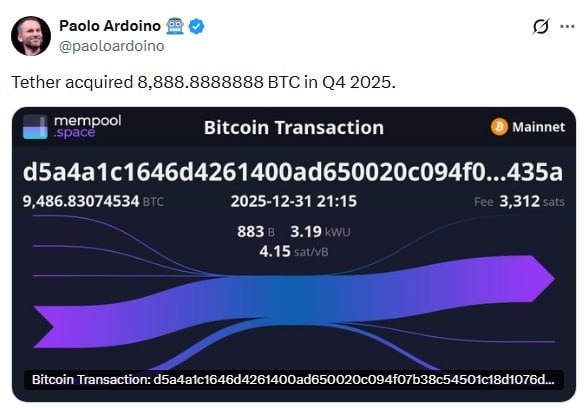
- Tether also kept buying. The company purchased 8,888.8888888 BTC during Q4 2025, according to CEO Paolo Ardoino. This adds to the story of stablecoin issuers holding large amounts of Bitcoin and U.S. Treasuries behind the scenes.
- Scott Bessent gave a key reminder: crypto, and especially dollar-backed stablecoins, do not necessarily weaken the U.S. dollar. In his view, dollar stablecoins actually support dollar dominance because they become huge buyers of U.S. Treasury bonds.
All of this suggests that while traders may feel burned out, the slow, institutional grab of Bitcoin is still underway.
Regulation, law, and the “inside the system” moment
The regulatory layer also moved this week in ways that could shape the next few years.
- The proposed CLARITY Act in the U.S. is being described as a potential “moment of truth” for crypto in the coming year. A portfolio manager at Bitwise, which manages around $15 billion in assets, explained that CLARITY aims to define who regulates what, what counts as a security, and what does not. The answer will decide whether big institutions come in with size or stay cautious on the sidelines.
- Bitwise also filed for 11 new crypto ETFs with different strategies. These funds would invest directly or indirectly in tokens such as Aave, Ethena (ENA), Hyperliquid (HYPE), and Bittensor (TAO). This is a sign that institutional products are moving beyond just Bitcoin and Ethereum into specific protocols and narratives.
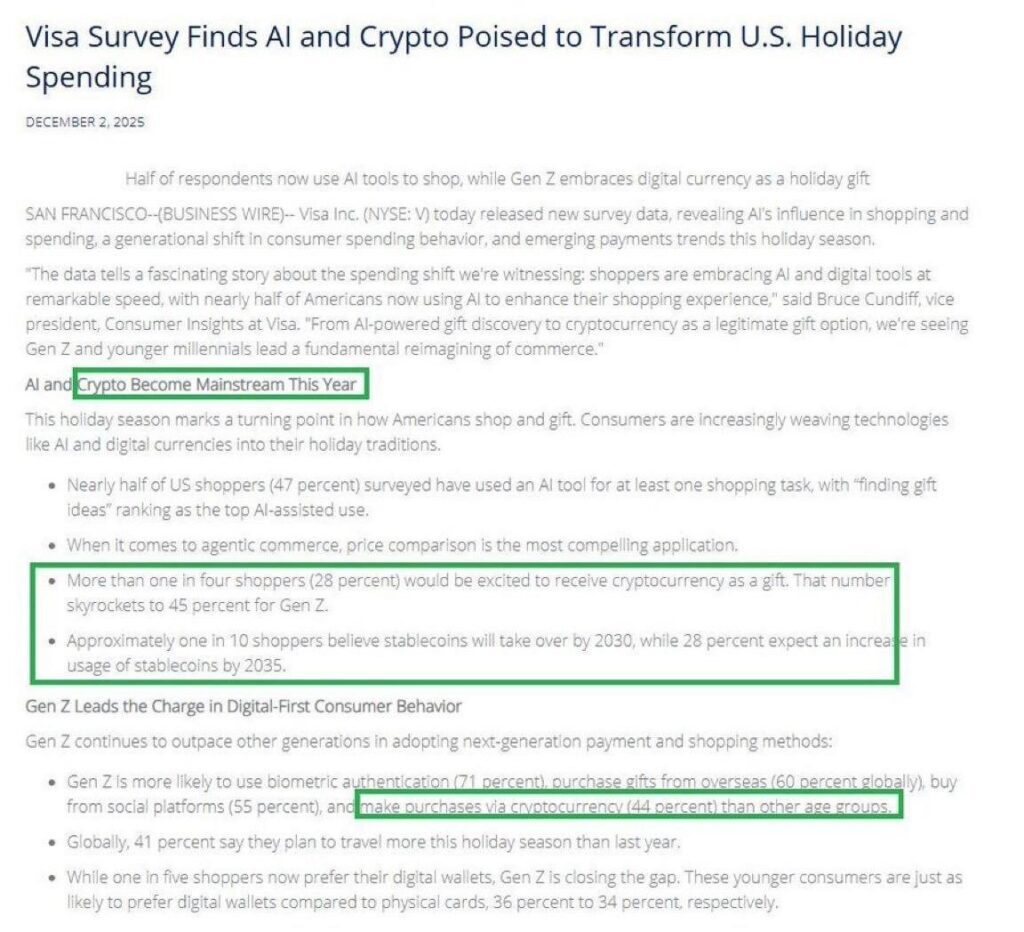
- Visa said that digital assets became one of its main focus areas in 2025, after expansion in crypto payments, stablecoins, and settlement over crypto rails. The message is clear: for a global payment giant, crypto is no longer just an experiment; it is part of the real financial plumbing.
- On the other side of the spectrum, JPMorgan froze bank accounts linked to two stablecoin companies over sanctions concerns. That is a reminder that even when money moves in tokens, it often still touches traditional banks, regulators, and compliance rules.
- Russia’s Sberbank, the largest bank in the country, launched a trial loan backed by crypto, using digital assets as collateral. This is another signal that crypto is not only used on exchanges; it is slowly getting pulled into regular banking products.
- Turkmenistan announced the legalization of crypto mining and trading, an important move for a tightly controlled gas-based economy. Even highly closed systems are now experimenting with digital assets, though it is not yet clear if this is the start of a bigger opening or just a limited, controlled step.
- In China, the People’s Bank of China said banks will be allowed to pay interest on balances of the digital yuan (e-CNY) under a new regulatory framework starting 1 January 2026. This changes the e-CNY from a simple digital version of cash into something closer to a digital deposit. That may speed up adoption of the currency and influence how other countries think about central bank digital currencies.

Taken together, this is the week where crypto clearly looks inside the system, not outside it. Laws, banks, and payment networks are all adjusting around it.
Ethereum, AI, and the demand for real utility
The focus is not only on Bitcoin. Ethereum and the broader tech story had their own developments.
Vitalik Buterin laid out his view for Ethereum in 2026. His core idea is simple but ambitious: Ethereum should become a “world computer” for a truly free internet. That means:
- Decentralized applications without fraud, censorship, or easy hacks.
- Apps that keep running even if the original developers disappear or services like Cloudflare go down.
- Privacy-first tools for finance, identity, governance, and more.
- Independence from specific companies or ideologies that may fade over time.

The open question is whether the ecosystem is truly ready to live with a sovereign internet and all the responsibility that comes with it, or if this vision remains mostly on paper.
At the same time, Tom Lee argued that asset tokenization could push ETH to the $7,000–9,000 range by early 2026. His logic is straightforward: tokenization means more institutional demand and more real usage on Ethereum, which can lead to long-term buying pressure.
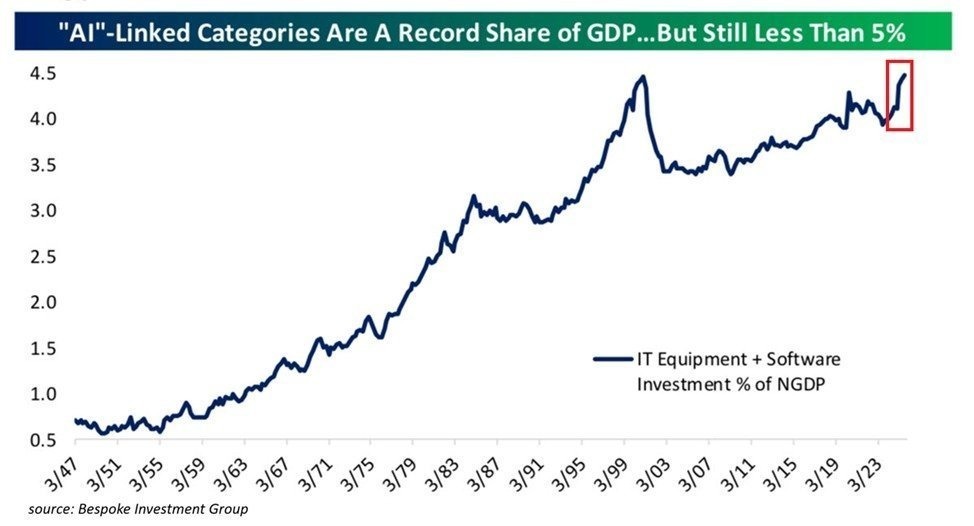
In the real economy, AI is already reshaping the numbers. Investment in IT equipment and software, driven mainly by artificial intelligence, has reached a record 4.5% of U.S. GDP. Since Q3 2023, spending has jumped by about $288 billion, a rise of 26%, reaching a total of about $1.39 trillion. AI is no longer just a tech buzzword; it is a real economic engine.
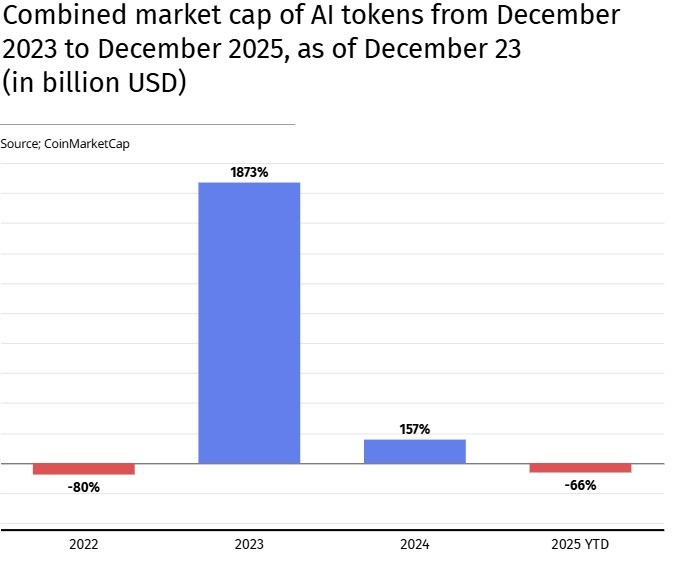
But AI tokens in crypto had a harsh year. Across 2025, AI-themed cryptocurrencies fell around 66%, wiping out more than $53 billion in market value and erasing much of the 2023–2024 gains. Some of the hardest-hit names were Render and The Graph, each down about 82%, and Virtuals Protocol, down 73% since the start of the year. The message is clear: being linked to an exciting narrative like AI is not enough if the token does not show strong, sustained usage.
That same idea appeared in Mike Novogratz’s comments on XRP and ADA. He warned that both coins risk losing momentum if they do not deliver real-world use cases. The market is slowly shifting away from purely story-based assets toward projects that show concrete adoption and value.

Sector scoreboard for 2025: winners and losers
Performance data from CoinGecko for 2025 shows how sharply the market has rotated:
- Real-world assets (RWA): about +185.76%
- Layer 1 chains: around +80.31%
- “Made in America” projects: roughly +30.62%
Below zero, the picture gets ugly:
- Memecoins: about −31.61%
- DeFi: around −34.79%
- Layer 2 networks: near −40.63%
- AI tokens: about −50.18%
- Decentralized exchanges: roughly −55.53%
- Solana ecosystem: around −64.17%
- Gaming tokens: near −75.16%
- Decentralized infrastructure: about −76.74%
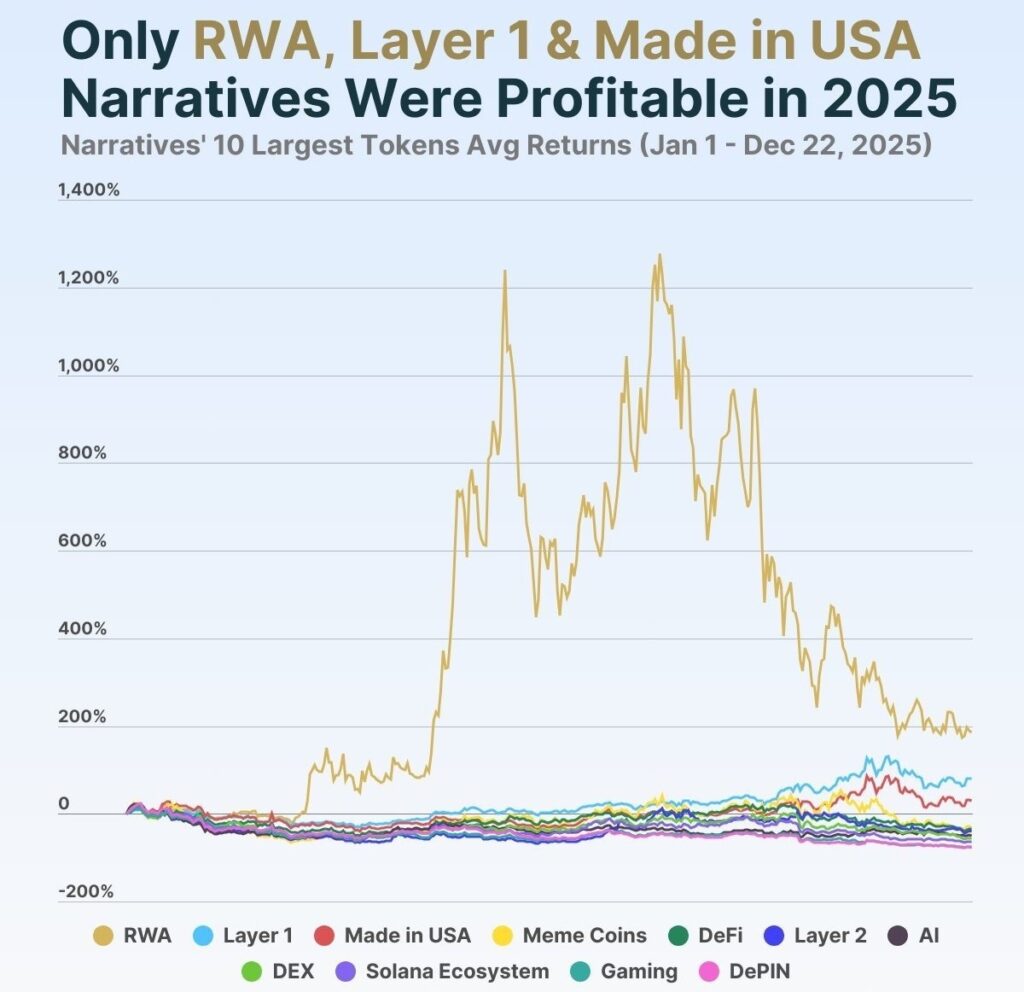
In simple terms, tokens with clear links to real assets and base-layer blockchains outperformed, while many narrative and high-beta sectors collapsed. The question now is whether a new sector will rise in 2026 or if the market will double down on these same winners.
New tokens, unlocks, and the micro stories that move traders
On the more tactical side, there were a few token-specific moves that traders watched closely.
Hyperliquid (HYPE) and its unlock path
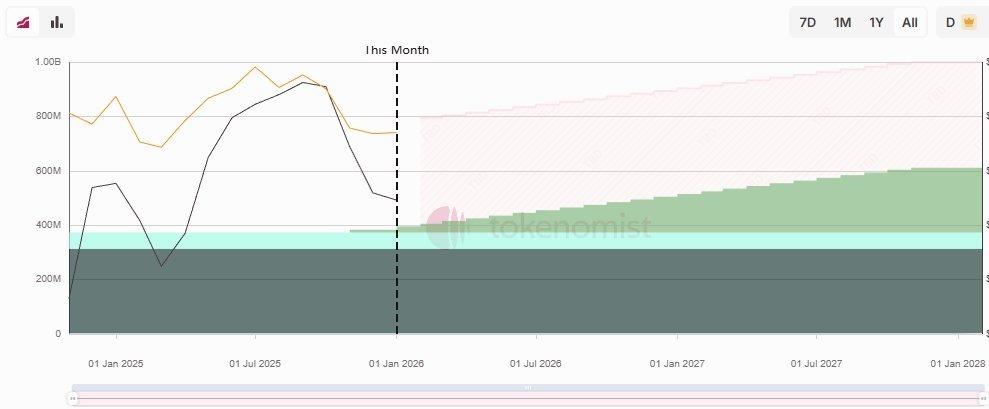
The HyperliquidX team announced on Discord that 1.2 million tokens from Hyperliquid Labs would be unlocked and distributed to team members on 6 January. From now on, any future distributions, if they happen, will also land on the 6th of each month.
For context, a previous public statement from HyperliquidX said that most token releases will happen between 2027 and 2028, with some extending beyond 2028. That implies monthly unlocks through December 2027, according to data shared by Tokenomist_ai. The team is clear about timing, but the market will watch how these monthly releases affect circulating supply and price over time.
Lighter (LIT) launches
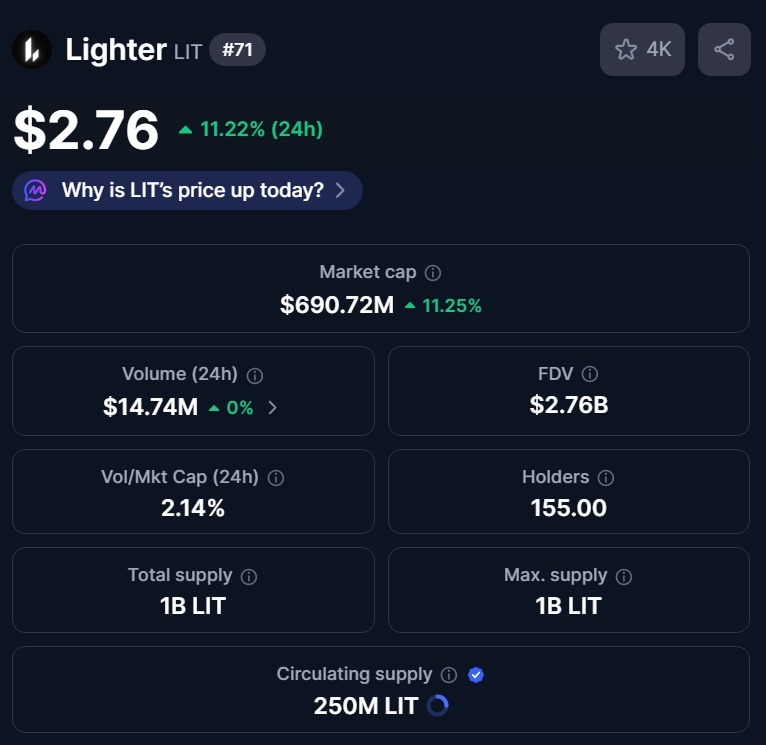
The perpetual DEX Lighter officially launched its token LIT and started trading. The distribution is skewed toward growth: 50% of supply is set aside for the ecosystem, while the rest goes to the team and investors. The real test in the coming months will be whether liquidity, open interest, and trader activity justify that ecosystem focus.
Chainlink reserve accumulation
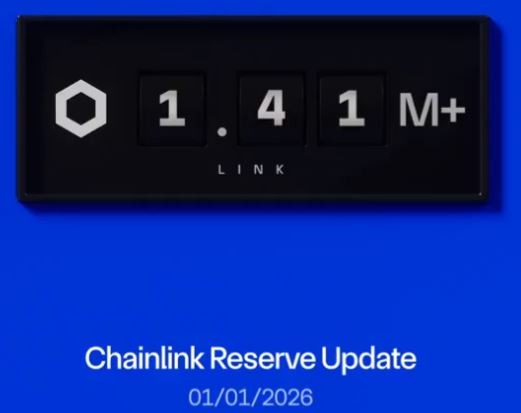
The Chainlink Reserve added 94,267.77 LINK, bringing its total holdings to about 1,416,379.61 LINK. This constant accumulation sends a simple signal: there is still a strong focus on building long-term strength and resilience around the Chainlink network.
The TRUMP memecoin lesson
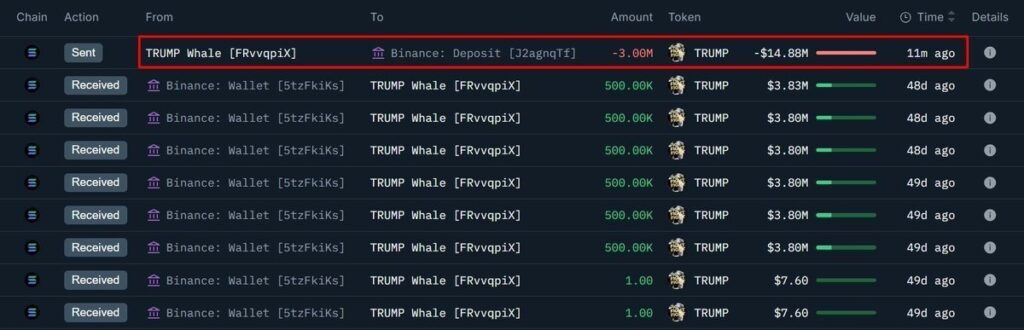
A whale holding the TRUMP meme coin sold 3 million tokens after holding for 50 days, realizing a loss of about $7.8 million. It is a familiar story: the volatility in meme coins is brutal, and traders who do not manage their risk can lose big, even in a short period.
Global debt, China’s stimulus, and the macro wall behind everything
Behind all of this sits a huge debt and liquidity backdrop.
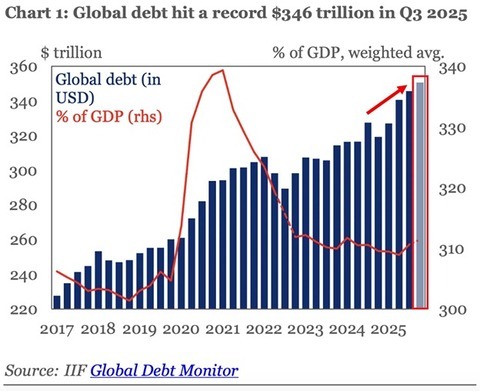
- Global debt has reached a new record of about $346 trillion. In the third quarter alone, it rose by about $8 trillion.
- In 2025, total debt increased by around $26.4 trillion, with the U.S. and China together responsible for about 33% of that rise.
- The global debt-to-GDP ratio is now near 310%, the highest since Q1 2024.
In parallel, China approved a $42 billion spending plan for the coming year. This shows Beijing is ready to use fiscal stimulus to support growth in a difficult environment. Markets are asking whether this is just one measure or part of a much larger package.

When you put this together with the Fed’s expanding balance sheet, it looks like we are moving into a world where liquidity is creeping back in, even while official narratives still talk about discipline.
Politics, war talks, and trade tensions
The political layer also connects back to markets.
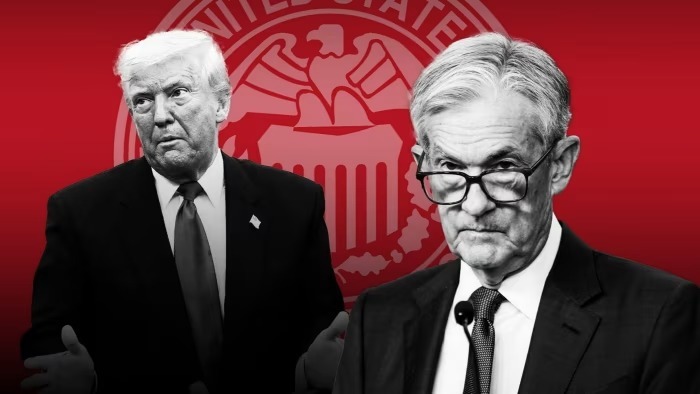
- Donald Trump said he will “probably” announce an alternative to Jerome Powell as Fed Chair in January, and added that he is still considering firing Powell. For markets, this raises questions about future monetary policy, central bank independence, and how aggressive future easing or tightening could be.
- In another comment, Trump said tariffs create “great wealth” for America, repeating his view that customs duties can both raise revenue and protect local industry. This revives the debate around trade policy, inflation, and the knock-on effects on global markets and supply chains.
- On the geopolitical side, Trump also said the U.S. is in the “final stages of talks” after a meeting with Ukraine President Zelenskyy on ending the Russia–Ukraine war, claiming, “We made a lot of progress… it’s very close.” Any real move toward a settlement would have large consequences for energy markets, defense spending, and risk sentiment.
All of these comments feed into the same big question: what kind of macro and political world will Bitcoin and crypto have to trade in during 2026?
Crypto vs. the rest of the market: is this just a pause?
Pulling the week together, one key theme stands out: “crypto fatigue” is real.
Bitcoin underperformed while equities, gold, and other risk assets rallied. This is not the Q4 many people expected. The market is asking whether this is just a temporary pause before a stronger phase, or a deeper re-pricing of how crypto fits into portfolios.
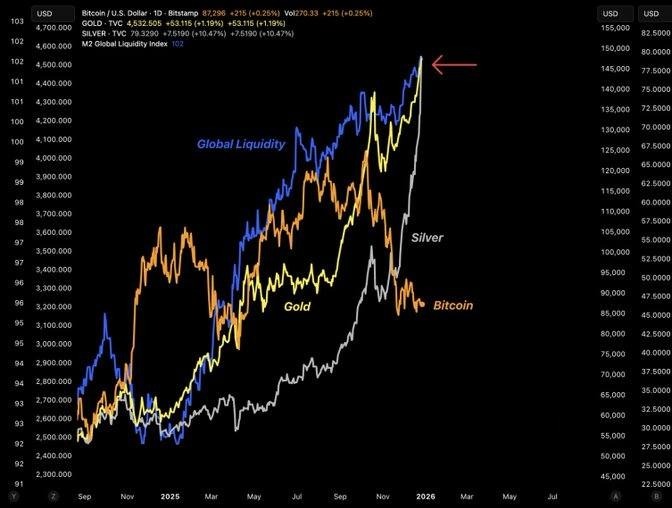
Yet, under the surface, the foundation keeps changing:
- Central banks, especially the Fed, are again expanding their balance sheets.
- Global debt is at record levels, which often pushes investors toward hard or alternative assets.
- Institutions and corporates are still adding Bitcoin and building ETF products.
- Payment giants like Visa and banks like Sberbank are integrating digital assets into their systems.
- Governments from Turkmenistan to China are experimenting with regulation, legalization, and digital currencies.
- In the crypto market itself, money is rotating from pure narratives into real-world assets, core layer-1s, and projects with clear usage.
At the same time, Ethereum’s community is talking about a sovereign internet, AI spending is hitting record shares of GDP, and the token world is slowly being forced to answer a simple question: what do you actually do in the real economy?
So the week ends with a split picture: prices that look tired, but a structure that is getting more serious, more regulated, and more integrated into the global system. Whether 2026 turns that structure into higher prices is still an open question, but the groundwork is clearly being laid.
This article is for information only and is not financial advice. Always do your own research on blog.millionero.com, and when you feel ready, you can trade spot and futures on Millionero at your own risk.n trade spot and futures on Millionero at your own risk.