


Bitcoin is back near the $90K area after failing (again) to cleanly push through the mid-$90K. Today’s print is around $89,958. That kind of pullback feels dramatic in headlines, but on a chart it often looks like something more boring: a market that tried to break higher, didn’t get enough follow-through, and then reset.
A lot of traders are reading this as a mix of profit-taking, position clean-up, and a fresh wave of macro nerves, especially because U.S. stocks have also been twitchy this week.
Why $90K Matters So Much Right Now
The simplest way to say it: $95K has been a ceiling, and $90K to $88K is probably the new floor. When price keeps bouncing between two levels, it usually means the market is waiting for a stronger reason to choose a direction.
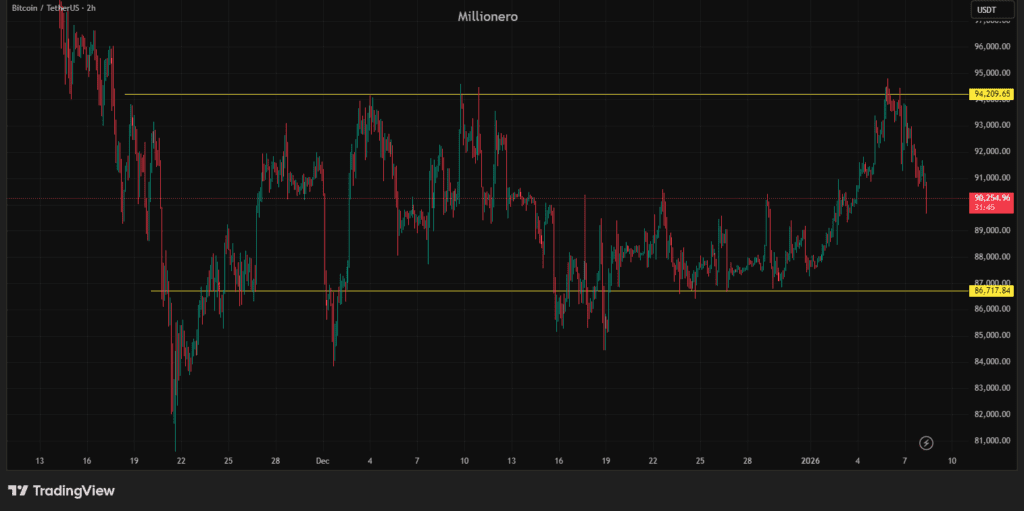
In this kind of range, bad news can push price down faster than expected, because leveraged positions get shaken out and liquidity can feel thin. But the flip side is also true: when the selling pressure runs out, price can snap back quickly, because the move was more about positioning than long-term belief.
Big Money is Still Hesitant
ETF flows did get weaker right after those strong early-January buys. The last two sessions were actually net outflows, not inflows:
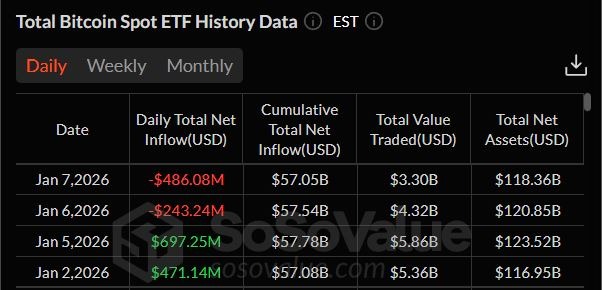
- Jan 6: -$243.24M
- Jan 7: -$486.08M
That’s about -$729.32M leaving in two days.
This does not automatically mean “institutions are gone.” In a jittery week, ETF money can swing for very normal reasons: rebalancing, profit-taking, or a simple “reduce risk for now” move while stocks and rates headlines are loud.
What still matters is that the ETF market is very active. Daily trading value stayed in the billions. So the pipeline is still there, but the tone changed: big money is not only buying dips, sometimes it also steps back when macro stress spikes.
MicroStrategy: Finally Stabilizing
MSTR got beaten up hard for months, but the last part is different: since around Dec 26, it’s been mostly sideways instead of dumping. It’s basically chopping in a tight zone.
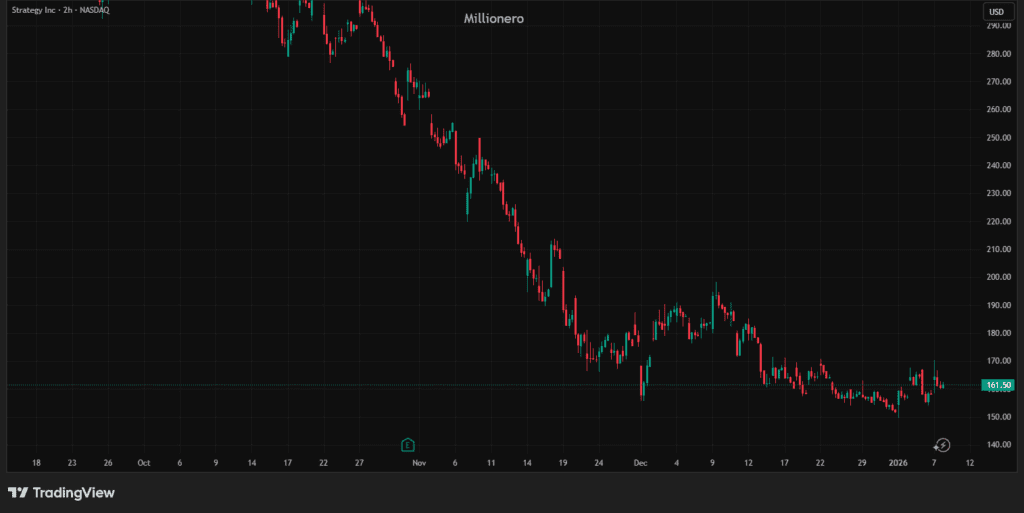
That “holding steady” matters because MSTR is still a high-beta BTC proxy. So when Bitcoin wobbles, MSTR usually wobbles harder. But right now, the signal is simple: the forced selling vibe cooled off, and the stock is acting like it’s trying to build a base, even if it’s still fragile and headline-sensitive.
Why Bank Stocks Took a Punch: Housing + “Debanking” Politics
If crypto looked shaky, parts of traditional finance looked worse, especially anything tied to housing speculation and big-finance political risk.
1) A push against institutional home buying
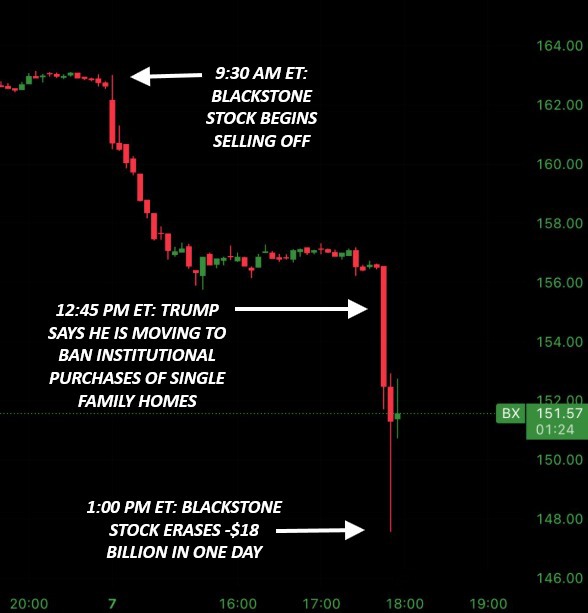
A new political push to curb or ban large institutional investors from buying single-family homes hit the sector fast. Big names exposed to housing investment themes sold off sharply, and the broader financial complex felt the drag.
2) “Debanking” enforcement pressure
Separately, the administration’s “fair access” / anti-debanking posture has been escalating, with regulators reviewing whether large banks used restrictive policies against lawful industries. The White House order itself explicitly targets the use of “reputation risk” as a reason to deny services
The OCC also released preliminary findings tied to this review process.
When markets see regulatory uncertainty, they usually sell first, because nobody knows where the fines, compliance costs, or headline risk will land.
“How Much Are Banks Losing?” The Clean Way to Think About It
In the last couple of sessions, the “loss” has mostly been market value, not a sudden hole in bank balance sheets.
A simple way to frame it:
- If a bank stock drops 1–3% in a day, that can represent billions in market cap, fast.
- Some finance and real-asset-linked names moved even more sharply on the housing headlines.
So the pain investors feel is real, but it’s mostly equity repricing based on uncertainty, not proof that banks are suddenly insolvent.
Will This Force Banks to Sell Bitcoin?
Probably not, because most large U.S. banks do not hold meaningful Bitcoin directly on their own balance sheets in the way a corporate treasury holder does. Their exposure is usually indirect (client services, custody, market-making, fund/ETF rails, partnerships).
If anything, the long-run effect of an anti-debanking stance could be the opposite: banks may end up more involved with crypto businesses, because refusing them becomes harder to justify. But near-term, risk teams tend to slow down expansion until the rules feel clearer.
Temporary FUD or Something That Sticks?
Right now, this looks more like temporary FUD with real consequences, not a permanent regime change.
- Bitcoin’s drop fits a familiar pattern: rejection at resistance, pullback to support, leverage gets cleaned out.
- Institutional access points (like spot ETFs) are still active, which can act like a dip-buying baseline.
- The bank story is more complicated: policy risk can linger, but markets also adjust once rules become specific and enforcement becomes predictable.
The real “tell” from here is simple: does BTC keep holding the $90K zone, or does it start living below it? If it holds, this episode may be remembered as a loud headline week inside a bigger uptrend. If it breaks down and stays weak, then the macro stress is doing more than just shaking out leverage.
This article is for information and educational purposes only and does not constitute financial advice, investment advice, or trading advice. Crypto markets are high-risk and highly volatile, and you can lose some or all of your funds. Always Do Your Own Research and make decisions based on your own risk tolerance.
For more market explainers and guides, visit blog.millionero.com.
If you choose to trade, you can access Spot and Futures/Perpetuals on Millionero.