



Over this weekend, markets and politics moved together again. Bitcoin had a sharp drop, prediction markets kept growing, and Washington mixed geopolitics, trade wars, and interest-rate drama into one story. At the same time, some U.S. officials kept sending “crypto-friendly” signals, especially about Bitcoin and stablecoins. All of this now leads into a heavy week of U.S. economic data and a key Fed decision.
Weekend Market Jolt: Bitcoin, Liquidations, and Side Rallies
The most direct shock for crypto traders came when Bitcoin fell below 88,000 dollars, with about 100 million dollars of leveraged long positions getting liquidated in just 30 minutes. This kind of move reminds everyone that high leverage can disappear in a single candle, especially when macro headlines turn ugly.
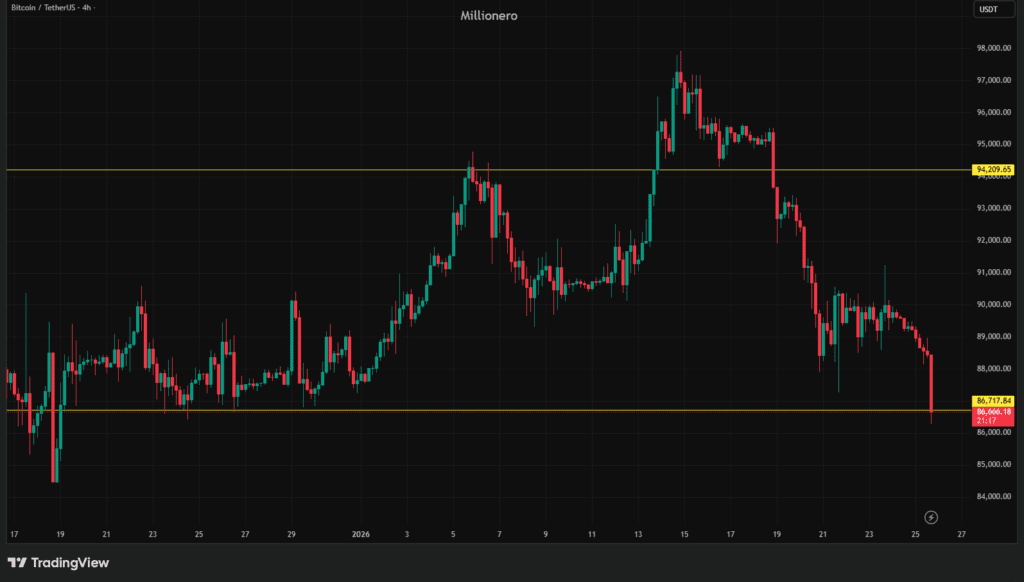
The drop did not happen in a vacuum. It came while traders were already nervous about a new U.S. government shutdown, now seen as likely, and about possible 100% tariffs on Canada. U.S. stock market futures were set to open in a few hours, so crypto reacted first, as usual, to the rising tension.
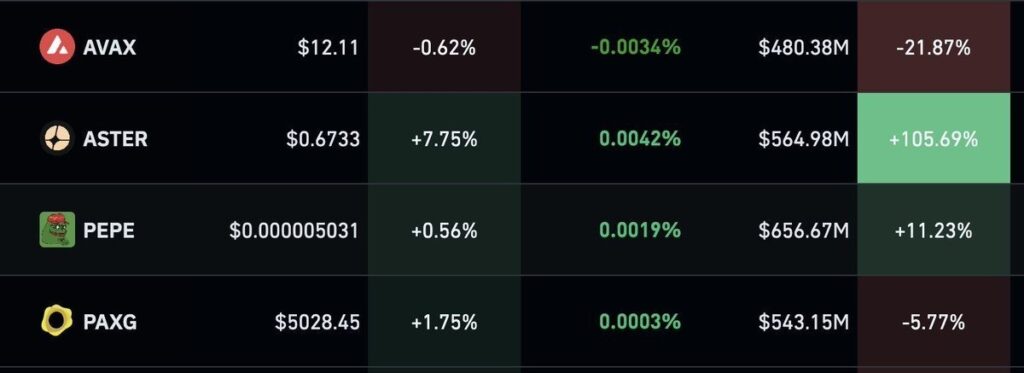
Interestingly, not all coins were quiet. ASTER saw a 105.59% jump in trading volume over the last 24 hours, even though the broader market was relatively stable. That kind of volume spike in a calm environment usually means one of two things: either concentrated speculation or some new narrative building around a smaller asset while majors are under pressure.
Prediction Markets Go Mainstream
Away from spot coins, prediction markets have quietly turned into a serious business. Over the past year, spot trading volume in prediction markets has gone from basically zero to 5 billion dollars.
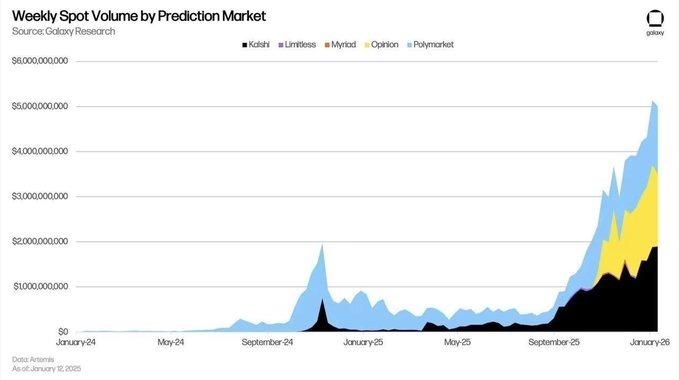
This is more than just casual betting. It shows:
- More people want to bet on real-world events like elections, shutdowns, and wars.
- These markets are starting to work as information and pricing tools, not just entertainment.
- Adoption is spreading beyond traditional crypto users into a wider audience.
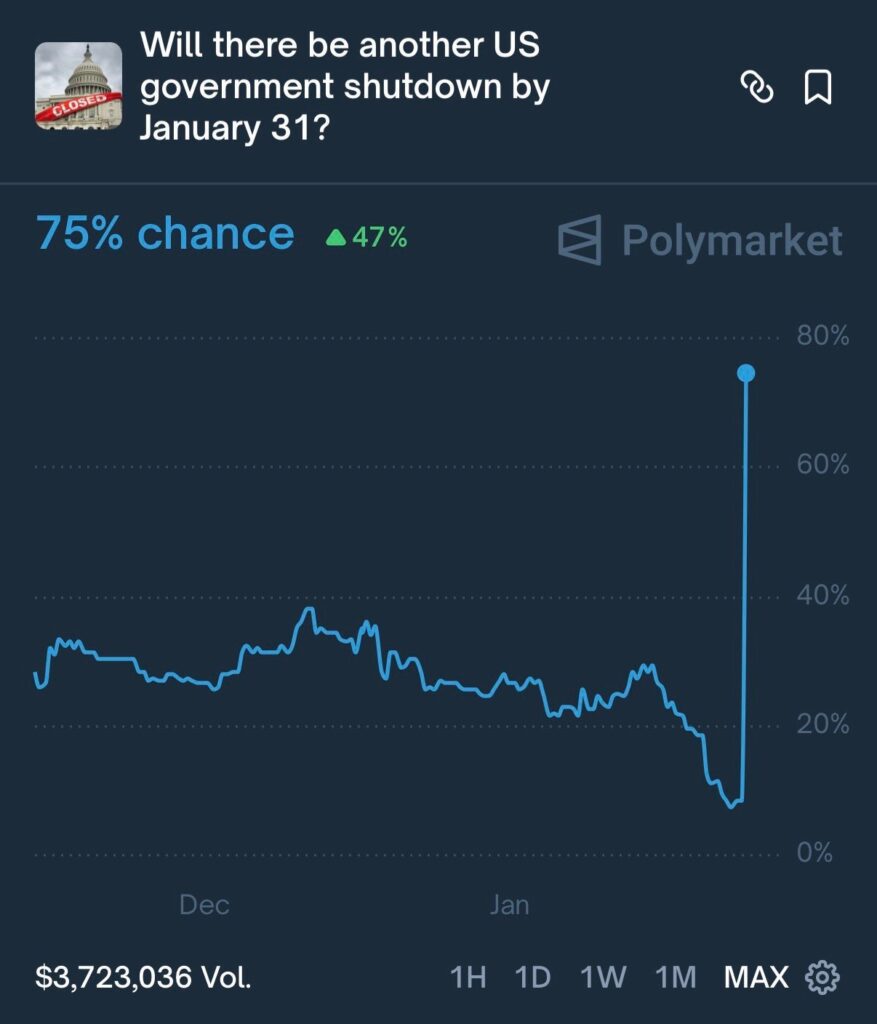
You can see this clearly in the way people now look at odds of a U.S. government shutdown. The probability of another shutdown by January 31 has jumped to 75%, based on on-chain prediction markets like Polymarket. Less than three months after the last showdown, the same risk is back, and traders watch these probabilities like a live economic indicator.
Geopolitics on Fire: Canada, China, Greenland, and Iran
The biggest political noise this weekend came from Donald Trump’s foreign and trade comments, which touched Canada, China, Greenland, and even Iran.
Trump said “China is successfully and completely taking over the once Great Country of Canada,” and argued that “Canada is systematically destroying itself. The China deal is a disaster.” This was presented as step three in a wider tariff playbook, hinting that more trade pressure is coming. At the same time, there is already a threat of 100% tariffs on Canada, which would be a huge shock to North American trade if implemented.
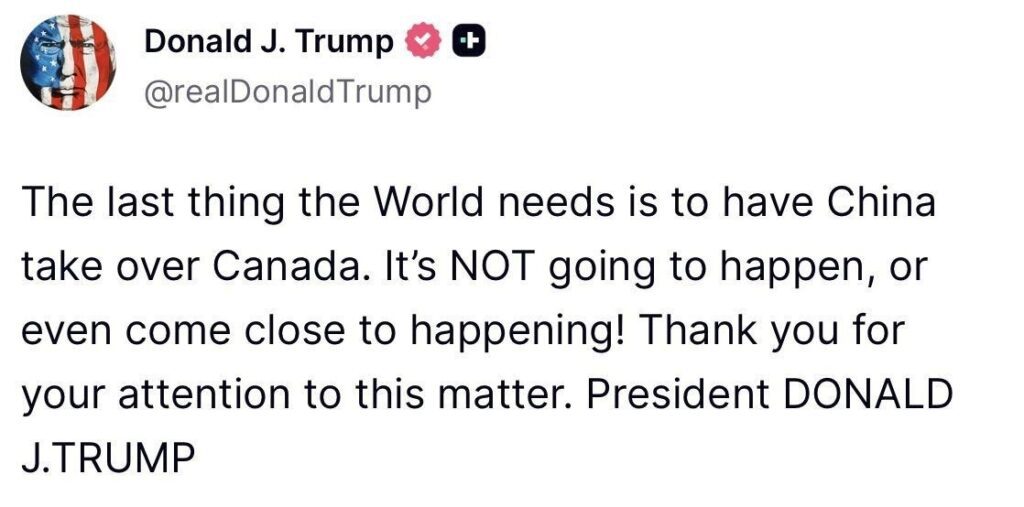
Trump also warned that “the last thing the world needs is China taking over Canada”, adding that this will not be allowed to happen. The language is very direct and shows how geopolitics and trade are now tightly linked in the U.S. narrative.
Greenland came back into the picture too. Trump said the United States will not pay for Greenland, but will still get full military access. He described it as a security agreement focused on Arctic defense and on balancing Russian and Chinese influence in the region.
Some numbers highlight why this matters:
- Greenland’s GDP is about 3.3 billion dollars.
- Its strategic and economic value is estimated between 50 billion and almost 1 trillion dollars.
So the message is simple: this is no longer just an economic debate. Greenland has become a long-term geopolitical bet, especially in the Arctic and in future shipping and resource routes.
At the same time, there was another sign of rising global tension: China accused its top general, Zhang Youxia, of leaking nuclear weapons secrets to the United States. The claim is that he passed on core technical data on China’s nuclear weapons. If true, this is not just an internal scandal; it could change how both sides think about military balance and trust.
Finally, U.S. military activity also entered the picture, with reports of a “destroyer fleet” moving toward Iran. Taken together, Canada, China, Greenland, Iran, tariffs, and nuclear leaks, the weekend was full of signals that global power competition is heating up again, and markets cannot fully ignore that.
Washington Reset: Shutdown Risk, Tariffs, and the Fed Chair Fight
Domestically, the U.S. political scene is boiling.
A new government shutdown is now expected by many observers, and prediction market odds for a shutdown by January 31 have climbed to 75%. Less than three months after the last standoff, Washington is again facing the risk of federal workers not being paid and agencies closing.
On top of that, there is:
- A threat of 100% tariffs on Canada, which would hit supply chains, car makers, and inflation.
- A criminal investigation by the U.S. Department of Justice into current Fed Chair Jerome Powell.
- Expectations that a senior BlackRock executive could become the next Fed Chair, which links Wall Street even more closely to U.S. monetary policy in people’s minds.
- Trump calling for 2,000-dollar stimulus checks and asking to cut interest rates down to 1%.
Together, these moves suggest that Washington is trying to reshape both the economy and its place in global politics at the same time. Fiscal policy (stimulus checks, shutdown risk) and trade policy (tariffs on Canada) are now pointed straight at the Federal Reserve’s rate path, increasing uncertainty for markets.
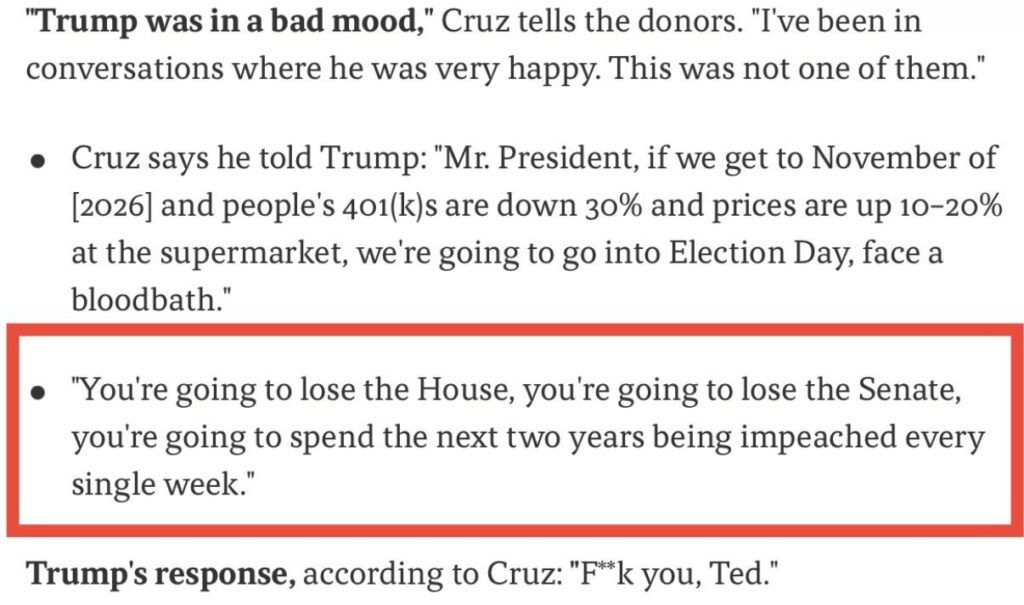
Even inside the Republican Party, there is tension over this direction. Secret recordings reportedly show Senator Ted Cruz warning Trump that aggressive tariff policies would cost them the House and the Senate and lead to two years of impeachment fights. Trump’s reply was short and clear: “F you, Ted.” That tells you how high the political temperature is around these decisions.
Crypto Policy Signals: Bitcoin, Stablecoins, and the “Capital of Crypto”
While macro and geopolitics looked chaotic, some U.S. officials sent clearer signals on crypto policy.
Rick Rieder, a leading candidate to become the next Fed Chair, said that Bitcoin could largely replace gold. In his view, Bitcoin is “much more efficient” and is “undoubtedly here to stay.” Market estimates give him about a 40% chance of getting the job. If someone with that view of Bitcoin ends up running the Fed, it would be a major psychological shift for both traditional finance and crypto investors.
In Congress, Representative French Hill said that the CLARITY Act is a necessary precondition for any serious stablecoin law. His argument is simple: the structure of the market has to be defined first. Without clear rules about who does what, where tokens trade, and how they settle, any stablecoin regulation would be weak. In other words, you cannot regulate stablecoins properly if you do not first decide what kind of market they live in.
From the regulatory side, CFTC Chair Mike Selig added another piece. He said there is “no better place in the world to build than the capital of crypto”, referring to the United States. This marks a clear change in tone from past years, when the U.S. often sounded like it wanted to push crypto innovation away. Now the message is closer to: we want to be the main hub again, but likely on American legal terms.
The Week Ahead: Fed Decision, Data, and the Rate-Cut Story
All of this leads into a very heavy week for U.S. data and policy, which will strongly shape expectations for future Fed rate cuts.
Key events lined up:
- Wednesday – Federal Reserve monetary policy decision.
- Wednesday – Press conference by Fed Chair Jerome Powell.
- Thursday – Initial jobless claims.
- Friday – U.S. Producer Price Index (PPI).
- Friday – Final deadline for a potential U.S. government shutdown.
- Plus, there will be live coverage of Powell’s press conference, which markets will watch word by word.
Fed rate path:
Here is how these events connect to the Fed rate path:
- The policy decision on Wednesday is where the Fed shows whether it will hold rates, signal slower cuts, or move closer to the 1% level that Trump is publicly calling for. Even if they do not change rates now, the tone of the statement and the press conference will guide expectations for the next few meetings.
- The Powell press conference is almost as important as the decision itself. Traders will listen for any mention of growth risks from a shutdown, inflation pressure from tariffs on Canada, and financial stability after the latest Bitcoin drop and global bond volatility. If Powell sounds worried, markets may price more cuts. If he sounds calm and focused on inflation, they may pull back some expectations.
- Initial jobless claims on Thursday show how the labor market is doing week by week. If claims rise, it suggests cooling employment, which supports the argument for faster or deeper cuts. If claims stay low, the Fed can argue that there is no urgent need to rush toward very low rates.
- PPI on Friday measures producer inflation, or the price pressures inside the supply chain. This is very sensitive to tariffs. If new tariffs or fears of tariffs push producer prices up, it becomes harder for the Fed to cut quickly, because they will worry about inflation coming back.
- Finally, the shutdown deadline on Friday adds extra pressure. A shutdown would hit growth and hurt confidence, pushing the economy in a direction that usually calls for more easing. But it would also show deep political dysfunction, which can make the Fed more cautious in how it communicates.
So the same week that includes Bitcoin liquidations, tariff threats, geopolitical tension, and political fights inside Washington will also decide how the Fed talks about the future of rates. And in the background, a potential future Fed Chair is saying Bitcoin could take gold’s place, regulators are talking about the U.S. as the capital of crypto, and lawmakers insist that market structure rules must come before stablecoin regulation.
That mix of macro risk, political drama, and slow but steady crypto integration is what sets the stage for the coming days.
Upcoming Major Token Unlocks
Sui (SUI)
Date: February 1, 2025
Unlock Value: 80.38M USDT
% of Circulating supply: 0.54%
Number of Tokens: 54.00M SUI
EigenCloud (EIGEN)
Date: February 1, 2025
Unlock Value: 12.35M USDT
% of Circulating supply: 2.06%
Number of Tokens: 36.82M EIGEN
KITE AI (KITE)
Date: February 1, 2025
Unlock Value: 11.54M USDT
% of Circulating supply: 1.00%
Number of Tokens: 100.00M KITE
Undeads Games (UDS)
Date: January 30, 2025
Unlock Value: 11.31M USDT
% of Circulating supply: 1.87%
Number of Tokens: 4.68M UDS
Optimism (OP)
Date: January 31, 2025
Unlock Value: 9.81M USDT
% of Circulating supply: 0.75%
Number of Tokens: 32.21M OP
Treehouse (TREE)
Date: January 29, 2025
Unlock Value: 9.78M USDT
% of Circulating supply: 9.07%
Number of Tokens: 90.66M TREE
Sign (SIGN)
Date: January 28, 2025
Unlock Value: 7.81M USDT
% of Circulating supply: 1.89%
Number of Tokens: 189.17M SIGN
This article from Millionero is not financial advice. Please do your own research. For more market explainers and weekly recaps, visit blog.millionero.com. When you feel ready, you can trade spot and perpetual markets on Millionero with proper risk control.