


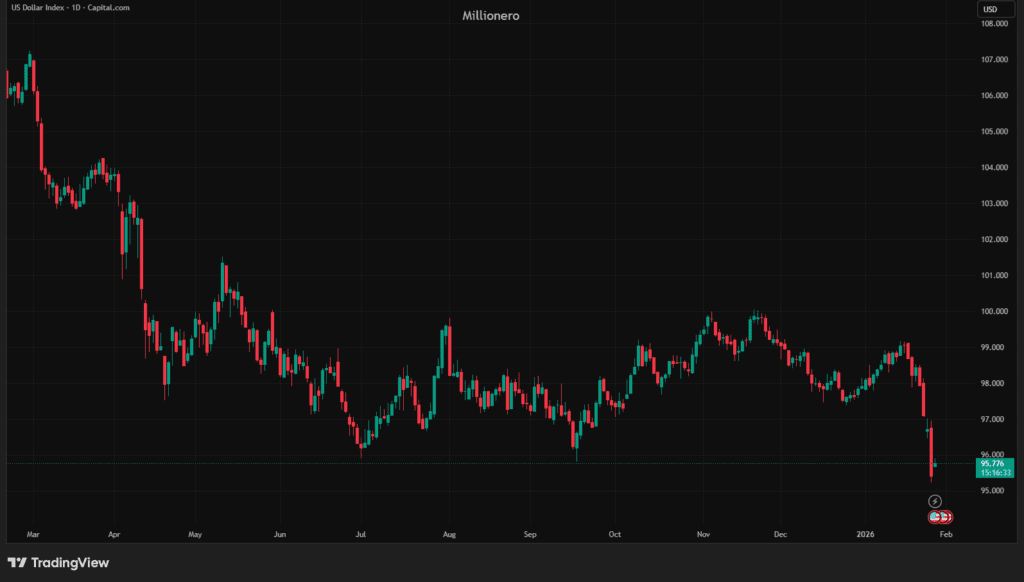
For weeks, the U.S. Dollar Index (DXY) has been sliding hard, dropping under the 96–97 area and reaching levels not seen in nearly four years. That sounds technical, but the meaning is simple: the dollar is losing strength, and that changes prices, flows, and emotions across almost every market.
And here’s the strange part: in the middle of all this, Bitcoin has not really “done the thing” people expect it to do.
Let’s break down what’s pushing the dollar down, what’s rising because of it, and why BTC looks unusually calm.
What DXY Really Measures (and Why 96 Matters)
DXY is a scoreboard for the dollar against a basket of major currencies. When it falls, it usually means:
- global money feels less pulled toward the U.S.
- holding dollars pays less (or feels less safe)
- commodities priced in dollars often look cheaper to the rest of the world
This recent move mattered because the dollar didn’t just drift lower, it broke a key zone (96-ish) that markets had respected for a long time. When big “support” levels break, traders often treat it like a new chapter, not just a normal dip.
Why the Dollar Is Falling Even With “Okay” U.S. Data
This drop is not about one headline. It’s a mix of policy expectations, debt nerves, and something harder to measure: trust.
1) The Fed Path: Markets Smell Rate Cuts
Even if the Fed is holding for now, markets are looking ahead and pricing in at least two rate cuts by late 2026. When future rates look lower, the dollar tends to lose some of its advantage.
There’s also a second layer: the fear that monetary policy could become more political, which makes investors uncomfortable.
2) Debt, Deficits, and the “Big Bill” Effect
The U.S. has been running large deficits for a long time, but markets don’t panic until they do. Lately, rising debt and rising debt-servicing costs have become more central in the story.
When investors worry that the fiscal path is heavy, they sometimes demand a higher “risk premium” to hold dollars, or they simply rotate elsewhere.
3) Politics and Policy Noise Adds a Risk Discount
Trade threats, tariff talk, and shutdown risk can hit confidence fast. The idea of a shutdown alone can make markets price in disorder, and disorder is poison for a currency’s “safe” image.
4) The Trust Factor: A Dollar Priced on Credibility
This is the deepest driver: investors are increasingly treating the dollar less like a pure interest-rate trade and more like a confidence trade.
When traders start buying expensive protection against further dollar downside, it’s a sign the mood has changed.
What Usually Wins When the Dollar Loses
When the dollar weakens, the world often feels a bit more liquid. And capital starts hunting for alternatives.
Precious Metals: The Loudest Winner
Gold has been acting like the market’s “main character,” ripping to fresh highs and trading above $5,000 in this stretch.
Silver has been even wilder, moving into the $110–117 area in the same period described, with a huge run over the prior year.
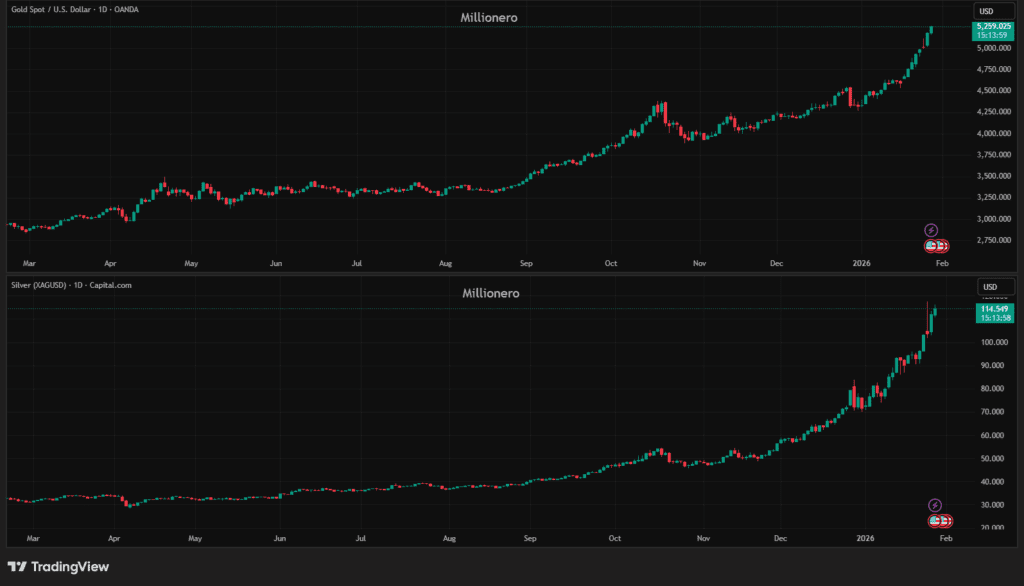
The message from metals is blunt: people want hard assets when they feel uneasy about paper promises.
Stocks: Quietly Benefiting
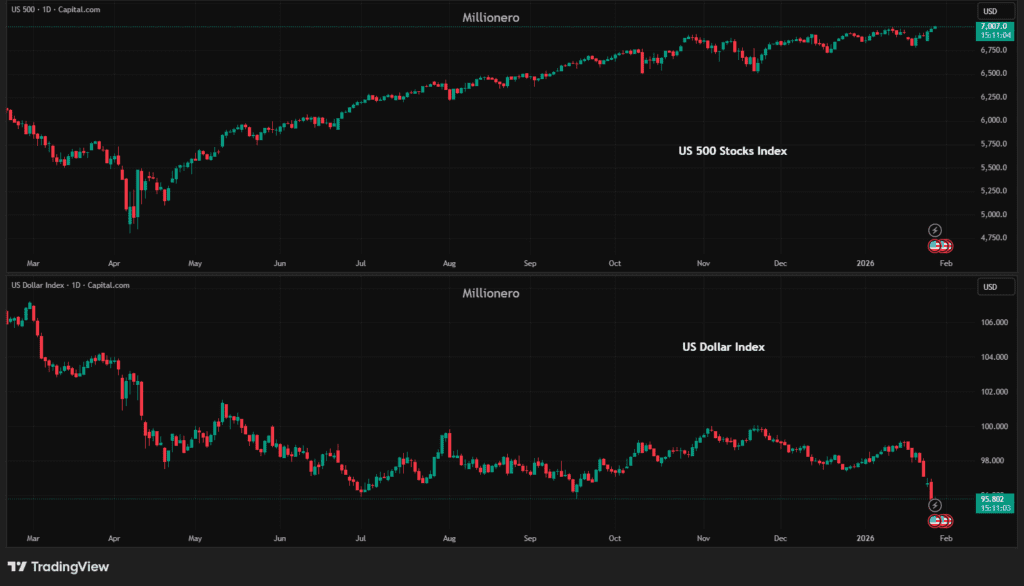
A softer dollar often helps big U.S. companies because foreign earnings look bigger when translated back into dollars.
So you can get this odd pairing: the dollar falls, and stocks still hold up, not because everything is healthy, but because the currency move itself supports risk assets for a while.
Emerging Markets: Breathing Room
When the dollar drops, it can ease pressure on countries and companies that borrow in dollars. That can attract flows into emerging markets, especially if global conditions feel less tight.
So Why Is Bitcoin Flat?
This is the part that surprises people. When the dollar drops, many expect Bitcoin to pump like a high-energy version of gold.
But in this phase, BTC has been stuck in a range, roughly $85,000 to $90,000, after an earlier spike near $98,000.
Here are the most realistic reasons.
1) Bitcoin May Have “Moved Early”
BTC had a big run through 2025, tested the psychological $100K zone, then went through a serious reset later.
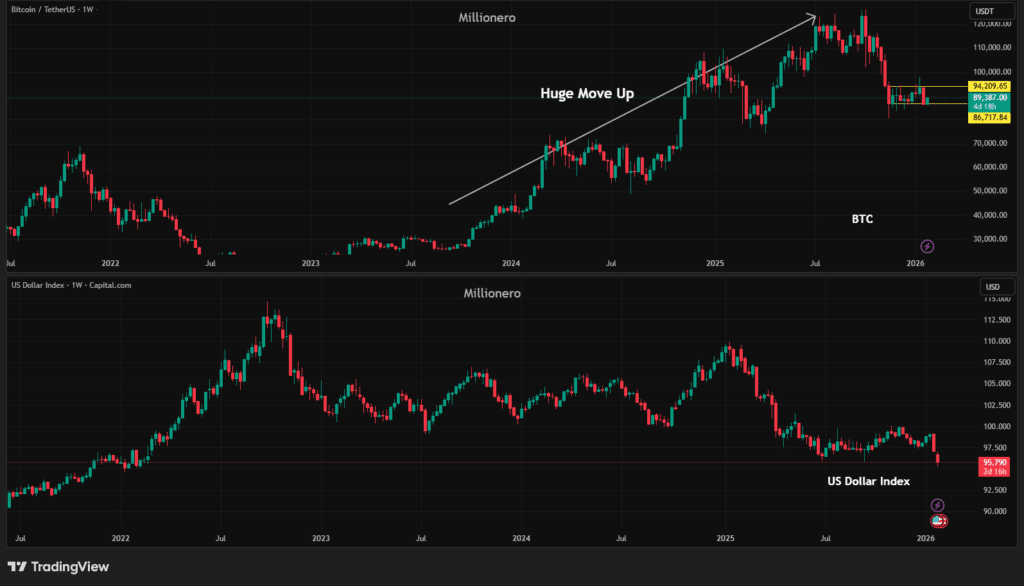
So instead of reacting immediately to the dollar now, Bitcoin may simply be consolidating old gains while other assets (like metals) catch up.
2) The Safe-Haven Crown Went to Gold, Not BTC
In this cycle, investors looking for shelter seem to be choosing metals first. The idea is simple: when fear rises, money often runs to the oldest safe haven before it trusts the newer one.
At the same time, strong equity narratives (like AI-linked stocks) can pull risk capital away from crypto.
3) “Digital Gold” Isn’t Automatic in Stress Moments
Bitcoin is called digital gold, but it doesn’t always behave like gold when headlines get tense. In past stress windows, BTC has traded like a risk asset, not a shelter, and that memory can keep buyers cautious.
4) This Dollar Weakness Feels Like a Confidence Shock, Not a Liquidity Flood
There’s a difference between “the dollar is falling because money is easy” and “the dollar is falling because people are uneasy about policy and credibility.”
In the first world, Bitcoin often flies.
In the second world, gold often leads, and Bitcoin may lag, then follow later.
What to Watch Next
If you want a simple checklist, it’s this:
- Does DXY stay below ~96, or snap back?
- Do metals keep absorbing the fear bid, or cool off?
- Does Bitcoin break out of the $85K–$90K box?
- Do rate-cut expectations stay firm into late 2026?
If the dollar weakness persists and the market mood turns more “risk-on” again, Bitcoin may not stay quiet forever. But right now, the market is voting with real money: gold is the hedge people trust first.
This article is for information only and is not financial advice. Markets can move fast, and you can lose money. Always DYOR and manage risk. If you want more simple crypto and macro explainers, you can DYOR on blog.millionero.com. When you’re ready, you can trade spot and perpetuals on Millionero.