



In the span of 24 hours, January 28–29, 2026, markets got a rare mix: a Federal Reserve that looks firmly in wait-and-see mode, a U.S. dollar that keeps sliding, gold that keeps printing records, and a report that Nvidia, Microsoft, and Amazon are in talks to invest up to $60B in OpenAI.
Put together, this is the kind of setup that can re-energize risk, and it’s exactly the kind of narrative shock that often spills into AI-themed crypto tokens, whether or not those tokens are truly connected to OpenAI.
The “agreement” question: Trump and Powell didn’t align, markets just heard the same shrug
When US President Trump says the dollar is “great,” and Chair Powell downplays gold’s message, it can sound like they’re reading from the same script. But functionally, they’re talking past each other.
- Trump’s comments have been framed as dismissive of dollar weakness, which some analysts argue can add pressure to a currency already under stress.
- Powell, by contrast, has repeatedly kept the Fed away from explicit FX commentary, focusing the institution’s legitimacy on domestic inflation and employment rather than currency targets. The official statement from the January meeting is consistent with that “policy-first” stance.
So, no, it’s not a meaningful “agreement.” It’s something more uncomfortable: the market is reacting to dollar + gold signals, while policymakers refuse to validate the signals as policy-relevant.
What the Fed actually told the market on Jan 28
The clean, verifiable message is in the official release:
- The Fed maintained the target range at 3.50%–3.75%.
- The statement describes growth as solid, job gains as low, unemployment stabilizing, and inflation “somewhat elevated,” with “uncertainty… elevated.”
- The vote was 10–2, with two dissenters preferring a 25 bps cut.
Professionally translated: the Fed is not trying to re-tighten, and the internal debate is already drifting toward when to ease, not whether to hike. That matters because markets price direction more than they price the current level.
The backdrop: dollar stress + gold strength is a trust indicator
A falling dollar isn’t automatically bullish or bearish for everything. But paired with gold ripping to new highs, it often signals something broader: investors are paying up for store-of-value and policy hedges.
Recent coverage has highlighted the dollar trading near multi-year lows while gold pushes to record territory (reports cite levels above $5,200/oz).
And European regulators are now openly talking about the risk of markets questioning the dollar’s role, language you don’t usually hear unless volatility is forcing the conversation.
For crypto investors, the key point is not “gold up means BTC up tomorrow.” It’s this: when macro hedging demand rises and the Fed stops sounding aggressive, speculative flows tend to look for the next high-beta theme.
The main catalyst: Big Tech circling up to $60B for OpenAI
This is the part you wanted emphasized, and it deserves it.
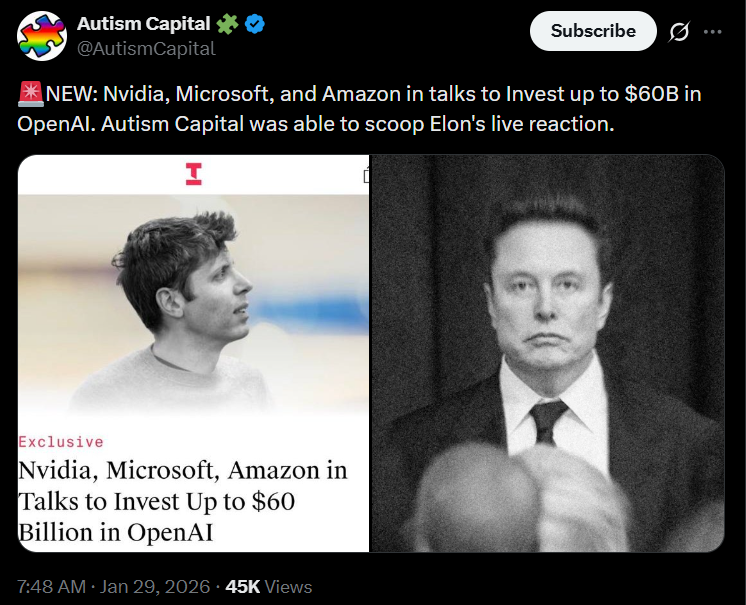
Reuters reports that Nvidia, Amazon, and Microsoft are in discussions to invest up to $60 billion in OpenAI, citing The Information. Nvidia is reportedly considering up to $30B, Amazon over $20B, and Microsoft less than $10B, with term sheets described as close to final.
Even if the final structure shifts, the signal is loud:
Frontier AI is being treated like strategic infrastructure.
This isn’t just “another tech funding round.” It’s capital at a scale that implies:
- sustained compute burn,
- intensified competition across the AI stack,
- and a longer runway for OpenAI to push model training, deployment, and productization harder than rivals.
Why this can ignite a push in AI tokens
Crypto doesn’t need OpenAI to have a token. It needs a story that makes traders say: “AI is the trade again.” A mega-round like this does exactly that, through three channels:
1) It validates the “compute is scarce” narrative
If OpenAI needs funding measured in tens of billions, the market concludes that the bottleneck is still chips + data centers + power, not clever marketing.
That’s where “AI tokens” get pulled in as tradable proxies: decentralized compute, inference marketplaces, data rails, agent networks, and identity/provenance. Some are serious attempts. Some are thin wrappers on the trend. A big catalyst lifts both, at least at first.
2) It gives risk markets a “respectable” momentum theme
In a world where the Fed is holding steady and internal votes even lean toward cuts, momentum often rotates from defensive trades into narratives that feel inevitable.
AI is one of the few themes that retail, institutions, and Big Tech can all talk about without sounding fringe. That shared attention is powerful.
3) Attention becomes liquidity in crypto
Crypto is uniquely reflexive. If enough capital decides “AI is the sector of the week,” you can get:
- synchronized pumps across unrelated AI tokens,
- exchange listing chatter,
- basket trades,
- and “AI + memecoin” hybrids catching flows.
This is exactly how sector waves form: not from perfect fundamentals, but from coordinated attention.
What could break the AI-token trade quickly
A professional take has to include the downside, because this is where people get chopped.
- Deal risk: “in talks” is not “closed.” Any change in terms, valuation expectations, or investor participation can cool the hype fast.
- Macro whiplash: if inflation surprises upward or policy rhetoric turns hawkish again, narrative trades lose oxygen. (The Fed explicitly emphasized uncertainty and data dependence.)
- Token reality gap: many AI tokens still struggle with product-market fit, real demand, and sustainable token value capture. A narrative spike can lift price, but it can’t replace adoption forever.
This article is for information only and is not financial advice. Do your own research. When you’re ready, you can explore more market education on our blog and trade spot/perpetuals on Millionero.