


In the same 24 hours, three headlines landed that look separate on the surface, but actually connect to the same theme: the fight over who controls “compute,” capital, and distribution in the next tech cycle. On one side, Nvidia is reportedly close to putting around $20 billion into OpenAI’s funding round, while both companies publicly downplay rumors of tension between Sam Altman and Jensen Huang.
At the same time, Intel is saying it wants back into serious GPUs, hiring a top architect to build chips aimed at the data-center market, the exact arena Nvidia has come to dominate.
And in crypto, Tether, one of the biggest private money machines in the industry, appears to be stepping back from an eye-watering fundraising plan after investors balked at a reported valuation push.
Put together, these aren’t random. They’re signals that the compute cycle is getting expensive, competitive, and politically sensitive, and that even the richest players are getting more careful about how they fund the next leap.
Why Nvidia putting ~$20B into OpenAI matters more than the “beef” rumors
The gossip angle (“are they fighting?”) is the least important part.
What matters is the structure of the deal: OpenAI is reportedly raising a gigantic round (figures around $100B total raise and ~$830B valuation have been floated), and Nvidia could become its single biggest check.
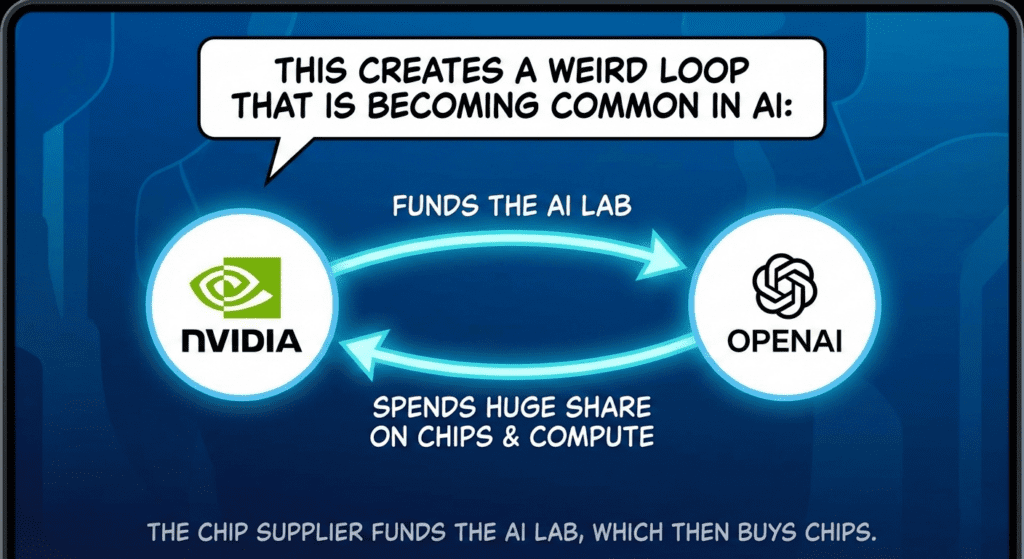
That doesn’t automatically mean something shady is happening. It does mean the market is trying to solve a brutal math problem: AI wants more compute than today’s normal financing can comfortably provide.
That’s why Nvidia’s CEO has been publicly emphasizing that reports of major conflict are “nonsense,” while still signaling that Nvidia wants in, just not necessarily at the “$100B from Nvidia alone” level people were speculating about.

So the real question becomes: why would Nvidia invest, instead of just selling GPUs?
Because the AI war is shifting from “sell chips to everyone” toward “help shape who wins the platform layer.” If OpenAI becomes a long-term center of gravity (models, APIs, enterprise contracts, developer ecosystem), then being financially and strategically close to it is not just revenue, it’s leverage.
Nvidia doesn’t only want to be the gas station. It also wants a stake in the highway.
Intel’s GPU move is a direct attack on Nvidia’s “default winner” status
Intel’s message is basically: we’re not watching the GPU era from the sidelines anymore.
According to reporting, Intel’s CEO Lip-Bu Tan said the company plans to develop GPUs and has hired a chief GPU architect (reported as Eric Demmers, formerly at Qualcomm) to push into the data-center GPU market.
This matters because the data-center GPU market is where:
- the largest AI budgets are spent
- the tightest supply constraints show up
- the stickiest customer relationships form (once a stack is built, switching is painful)
Intel is not starting from zero. It already sells data-center CPUs and has tried multiple graphics strategies over the years. But the key point is timing: Intel is choosing to fight now because the money is now.
Also notice the target list: Nvidia and AMD. That’s a signal that Intel believes the market is big enough that even “third place” could still be a massive business.
If Intel becomes credible here, the ripple effects are huge:
- Nvidia loses some pricing power at the margin
- big customers gain bargaining leverage
- the “AI compute bottleneck” story becomes less one-company-dependent
That last point matters for everyone, tech firms, startups, and even crypto markets that trade on “AI hype” narratives, because monopolies create extreme cycles, while competition can smooth them out.
Tether’s $20B fundraising retreat is about investor psychology, not weakness
Now jump to crypto.
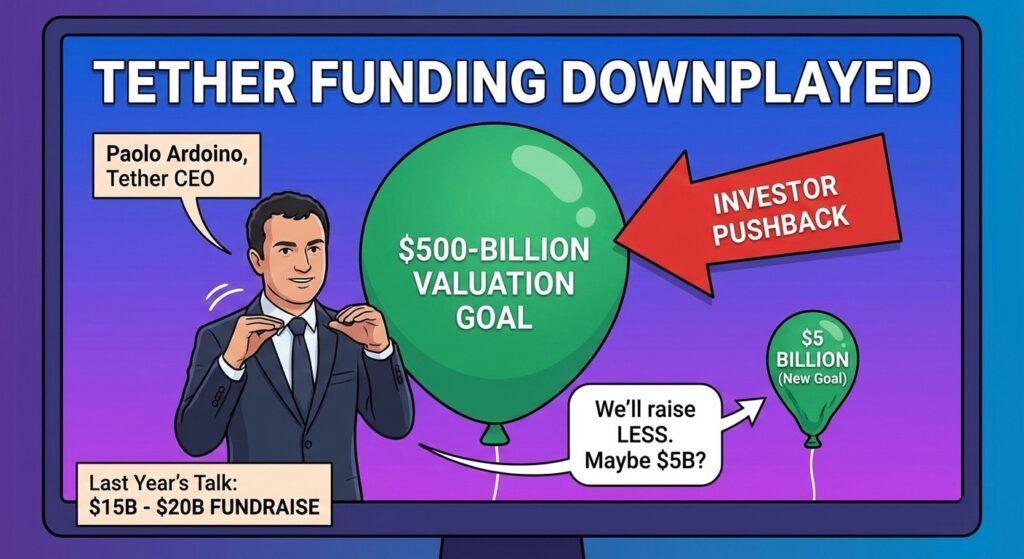
Reuters reports that Tether scaled back fundraising ambitions after pushback tied to a proposed valuation ceiling (reported around $500B), with talk shifting from $15B–$20B down to potentially as little as $5B.
The interesting part is not “Tether can’t raise.” It’s why the market pushed back even on Tether, a firm that sits at the center of crypto liquidity.
This tells you something about where we are in the cycle:
- Investors are more skeptical of giant private valuations
- People are asking harder questions about governance, jurisdiction, and risk
- Even if a company prints cash, buyers still care about price and terms
Tether’s CEO Paolo Ardoino reportedly framed parts of the huge valuation figure as more of a “maximum” than a firm target, and also pointed to internal reluctance to sell shares.
They may not need the money badly enough to accept investor demands. But the pushback still matters because it shows that the market is not automatically applauding “bigger number = better.”
Takeaway: compute is getting crowded, and capital is getting picky
These three stories line up into one simple picture:
- AI is sucking in capital at historic scale (OpenAI round, Nvidia check).
- Competition is catching up (Intel wants GPUs for data centers).
- Even crypto’s biggest liquidity engine is facing valuation discipline (Tether fundraising reset).
That combination usually happens when markets transition from “easy narrative phase” to “prove-it phase.”
A few things to watch next:
- Deal structure details: Is Nvidia’s money tied to compute supply, preferred access, or governance? That changes everything.
- Customer pull: Intel said it’s already talking to customers for GPUs, watch who publicly commits.
- Stablecoin politics and regulation: Tether’s scale makes it a regulatory focal point; funding choices can be shaped by that reality.
What this could mean for crypto markets
Crypto often trades like a mood ring for global liquidity and tech risk appetite. These headlines suggest two opposing forces can exist at the same time:
- Bullish force: AI investment ramps can boost “risk-on” sentiment and keep capital rotating into tech-adjacent narratives. (That’s the emotional channel markets trade.)
- Bearish / limiting force: funding and valuation discipline is returning, which can cap the most extreme “everything pumps forever” behavior.
So the vibe might be: still bullish for innovation, less tolerant of weak math.
That’s usually when markets start rewarding the boring things again: real revenue, real product, real distribution, real balance sheets.
This article is not financial advice. Please do your own research. You can explore more education on blog.millionero.com, and if you decide to trade, use proper risk management and trade with us on Millionero.