



The crypto markets had a busy weekend, with a mix of bold predictions, institutional developments, and on-chain events that reveal where smart money might be positioning itself. As we head into a Fed week packed with critical US economic data, understanding these weekend developments becomes essential for navigating what could be a volatile period ahead. Let’s break down what happened and what traders should be watching in the coming days.
Big Predictions and the Strategic Reserve Question
China’s Potential Bitcoin Accumulation
One of the weekend’s most striking claims came from billionaire investor Dan Morehead, who predicted that China might purchase 1 million Bitcoin, roughly 4.76% of Bitcoin’s total supply. To put this in perspective, this isn’t just a large investment. If this actually materializes, it would represent a sovereign decision that could fundamentally alter the supply-demand dynamics of the entire Bitcoin market.

The implications of such a move would extend far beyond simple price impact. It would signal a geopolitical shift in how nation-states view Bitcoin, potentially triggering a competitive race among countries to accumulate scarce digital assets. Whether Morehead’s prediction proves accurate or not, the mere fact that serious investors are discussing nation-state Bitcoin accumulation at this scale shows how dramatically the conversation around Bitcoin has evolved from its early days as a fringe asset.
Did the US Quietly Start Building Its Strategic Bitcoin Reserve?
Perhaps even more intriguing than speculation about China is the growing body of evidence suggesting the United States might have already begun building its Strategic Bitcoin Reserve. Several data points are aligning in a way that’s hard to ignore:
Michael Saylor has stated publicly that Trump is serious about establishing a strategic reserve. Jim Cramer mentioned hearing that purchases would begin at the $60,000 level, a price point Bitcoin just reached. Saylor was also spotted with the Trump family on Thursday night, adding another piece to the puzzle.
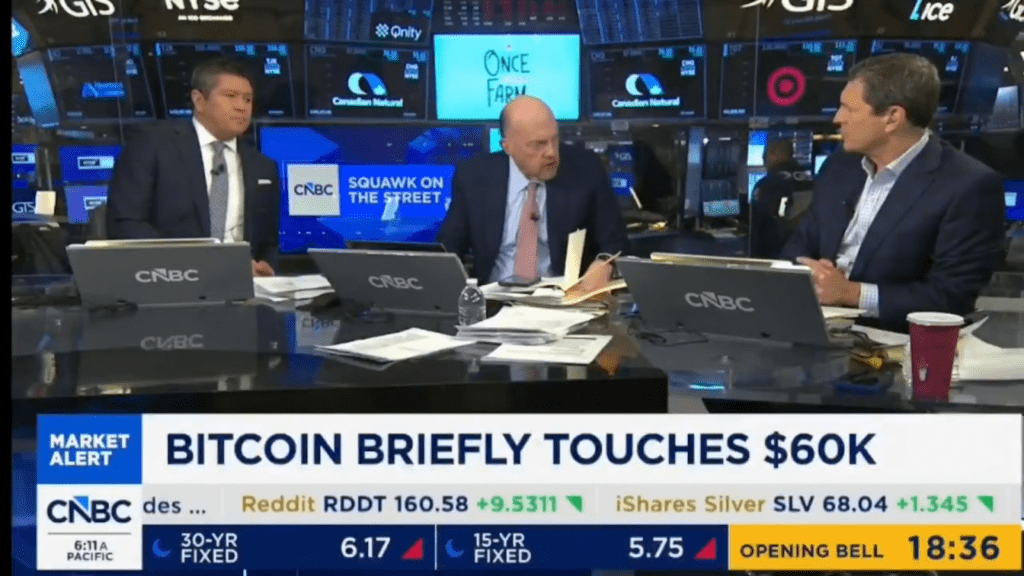
But the most compelling evidence comes from market data itself. The Coinbase spot price premium is surging, and the Coinbase premium index has been going nearly vertical. This premium typically indicates one thing: aggressive US spot demand. When Bitcoin trades at a higher price on Coinbase (the primary US exchange) compared to international exchanges, it suggests strong buying pressure specifically from American buyers.
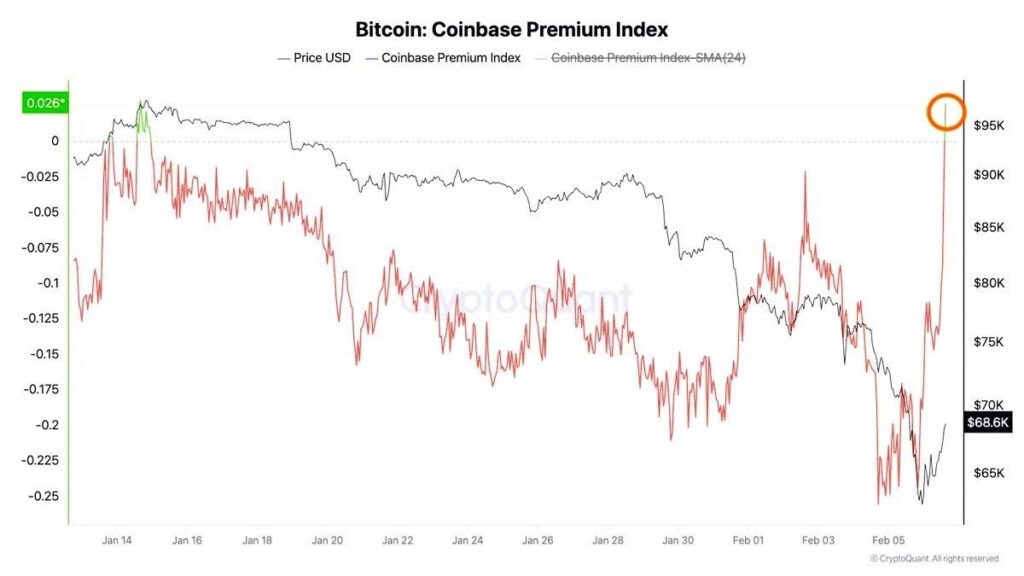
This could mean one of two things. Either institutions are front-running the upcoming crypto bill that would unlock over $3 trillion in institutional capital through stablecoin regulations, or the US government has actually started accumulating Bitcoin for its strategic reserve. Given that institutional buyers often have advance knowledge of regulatory changes and the timing coincides with Bitcoin hitting that $60,000 threshold Cramer mentioned, there’s a real possibility that coordinated accumulation is already underway.
Michael Saylor and MicroStrategy’s Next Move
Michael Saylor posted his now-famous “Saylor Tracker” chart over the weekend, accompanied by his characteristically brief comment: “Orange Dots Matter.” For those who follow Saylor’s pattern, this is significant. These chart posts have historically preceded official announcements of new Bitcoin purchases by MicroStrategy.
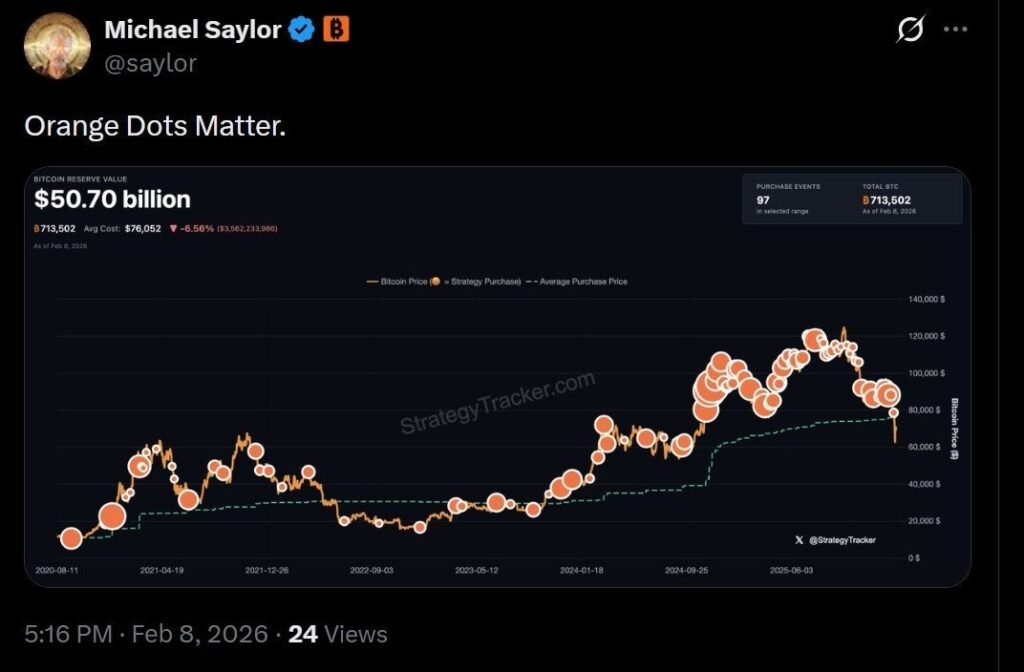
The timing is interesting given the current market conditions. With Bitcoin pulling back from its recent highs and trading around support levels, MicroStrategy may be preparing to add to their position at what they perceive as attractive prices. The company has consistently demonstrated a strategy of accumulating during market weakness, and this signal suggests another purchase announcement could be imminent.
Traditional Finance Makes Its Move
Charles Schwab Enters Direct Crypto Trading
In a development that underscores how rapidly traditional finance is embracing cryptocurrency, Charles Schwab, which manages over $11 trillion in assets, announced plans to launch spot trading for Bitcoin and Ethereum by mid-2026.

CEO Rick Wurster explained that direct trading will initially roll out on the thinkorswim platform before expanding to Schwab’s main website and mobile app. This represents a significant shift for the firm, which until now has only offered crypto exposure through ETFs and futures products. The move is being driven by two forces: regulatory changes that are making direct crypto custody more feasible for traditional financial institutions, and strong client demand that Schwab can no longer ignore.
This puts Schwab in direct competition with Coinbase and other crypto-native platforms. When a firm managing $11 trillion decides to build direct crypto trading infrastructure, it sends a powerful signal about where the industry is headed. It also means that millions of traditional investors who already have Schwab accounts will soon have seamless access to spot Bitcoin and Ethereum trading, potentially bringing a new wave of capital into the market.
Bitcoin’s Growing Real-World Footprint
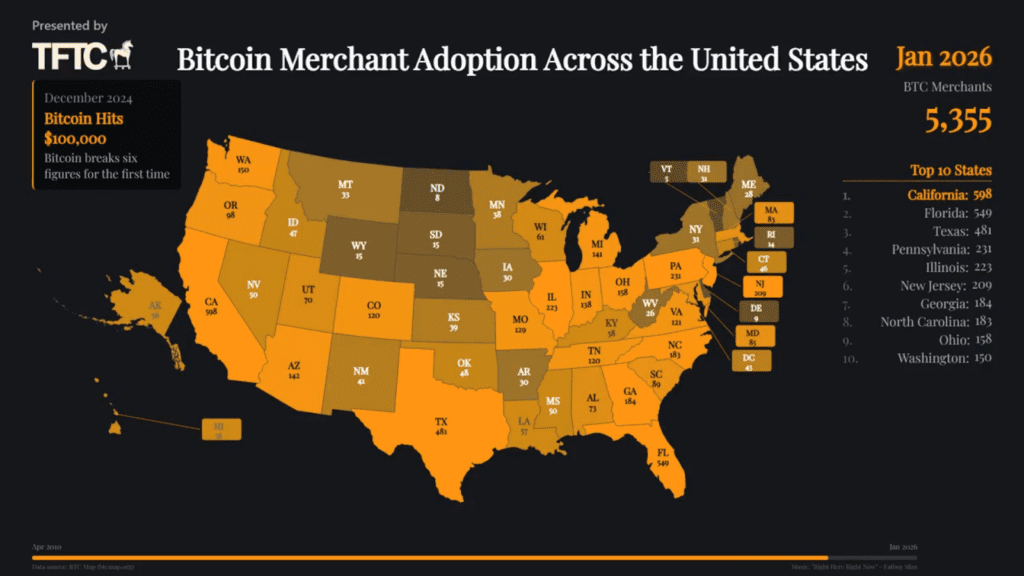
While price action dominates headlines, actual Bitcoin adoption continues to expand quietly in the background. There are now 5,355 stores across the United States that either accept Bitcoin directly or offer Bitcoin-related products and services. This isn’t speculative positioning or financial engineering, it’s actual usage on the ground in everyday commerce.
The network fundamentals continue to strengthen as well. Bitcoin’s hash rate remains near all-time highs, indicating that mining security has never been stronger. The network is running the highest number of nodes ever, showing robust decentralization, and maintaining 99.99% uptime. These technical metrics don’t make headlines the way price swings do, but they represent the foundation that gives Bitcoin its value proposition.
It’s worth remembering Bitcoin’s current position in the broader financial landscape. It ranks 13th globally among the largest assets. 60% of the largest US banks are actively developing Bitcoin-related products. 50% of major hedge funds and investment advisors now hold Bitcoin ETFs. Half of Bitcoin’s supply is held in self-custody, demonstrating long-term conviction rather than speculative trading. The asset is legal in most countries worldwide, and 23 nations now hold Bitcoin on their balance sheets.
Market Warnings and Structural Pressures
Goldman Sachs Sounds the Alarm
Not all weekend news was bullish. Goldman Sachs issued a warning that US equity markets might face additional downside pressure in the coming week. The bank highlighted that trend-following funds (CTAs) have triggered sell signals on the S&P 500, with potential selling pressure of $33 billion this week alone. If the market decline continues, that selling pressure could escalate to $80 billion over the next month.
What makes this particularly interesting is that Goldman notes even a sideways or slightly rising market could still trigger CTA selling. This is because these algorithmic funds are rebalancing their positions based on volatility and trend metrics, not just on price direction. In other words, the selling pressure is somewhat mechanical and may persist regardless of short-term price movements. This creates a challenging environment for risk assets across the board, including cryptocurrencies that often correlate with tech stocks and broader risk appetite.
Liquidations Show Protocol Resilience
The Aave protocol liquidated over $450 million in the past seven days as volatility swept through crypto markets. While that sounds alarming in isolation, context matters. This liquidation volume represents only about 0.9% of Aave’s total deposits, with the protocol’s total size exceeding $50 billion.
According to Stani Kulechov, Aave’s founder, these numbers actually demonstrate the protocol’s resilience during market stress. The liquidation mechanism worked as designed, closing out undercollateralized positions before they could threaten the protocol’s solvency. This is exactly how DeFi lending protocols are supposed to function during volatile periods, and Aave’s ability to handle nearly half a billion in liquidations while maintaining stability is a testament to its robust design.
On-Chain Activity and Notable Moves
World Liberty Finance Sells at Key Levels
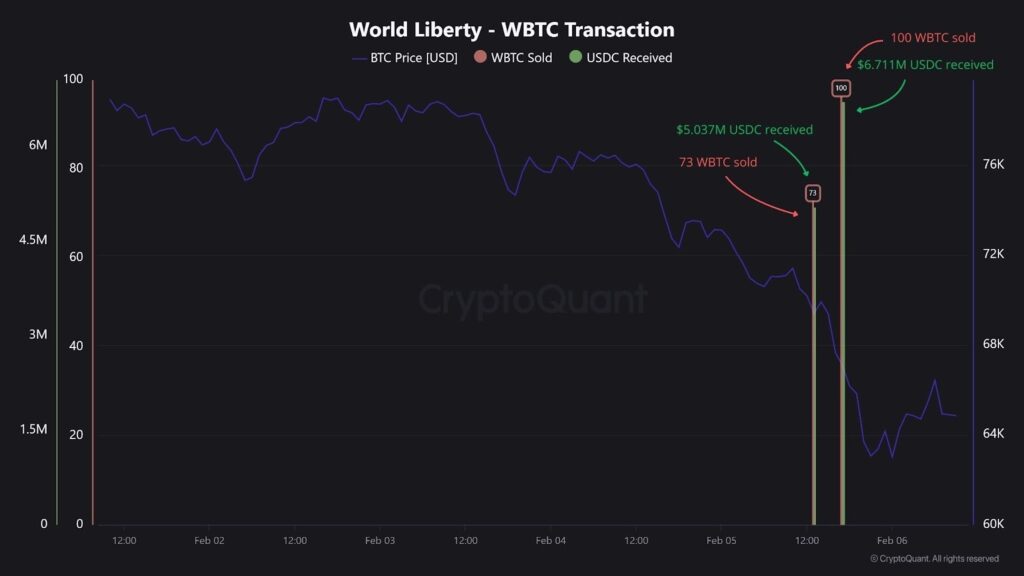
Wallets connected to World Liberty Finance, the DeFi project associated with Trump, executed strategic sales of wrapped Bitcoin (WBTC) around the $67,000 level. On-chain data from CryptoQuant reveals three separate transactions executed on February 5 during a period of heavy price volatility:
- 40 WBTC sold for 2.761 million USDC
- 33 WBTC sold for 2.276 million USDC
- 100 WBTC sold for 6.711 million USDC
In total, 173 WBTC was sold for approximately $11.75 million USDC. The timing is notable, these sales occurred during price swings and near local highs, suggesting either profit-taking or strategic rebalancing. Given the project’s connection to Trump and the broader political interest in crypto policy, these moves are being watched closely for any signals about insider positioning.
The Bithumb Airdrop Disaster
In one of the more dramatic operational failures of the weekend, an employee at Korean exchange Bithumb accidentally sent 2,000 Bitcoin to hundreds of users during what was supposed to be an airdrop of a different token. The immediate result was predictable chaos: Bitcoin began trading approximately 10% lower on Bithumb compared to the rest of the global market as recipients rushed to sell their unexpected windfall.
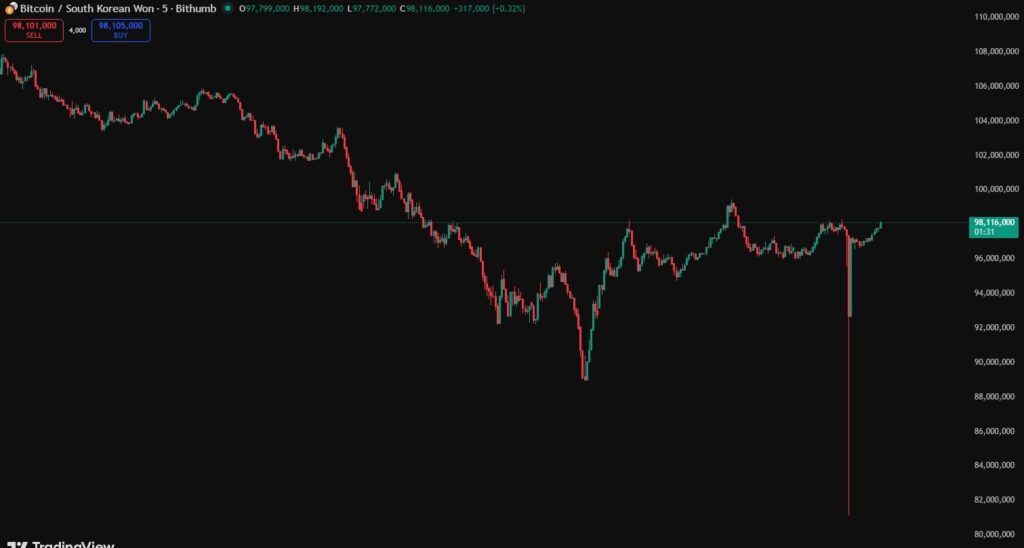
This incident highlights the real risks that still exist in crypto infrastructure, particularly around custody and operational procedures. A single employee error was enough to create immediate price dislocations on a major exchange. While Bithumb will likely recover most of the mistakenly sent Bitcoin through various means, the incident serves as a reminder that even established platforms can experience critical operational failures.
Mining Economics and Market Sentiment
The Cost of Production
The average cost to mine one Bitcoin has climbed to approximately $67,704, according to the latest disclosure from MARA Holdings for Q3 2025, as reported by CryptoQuant. This figure is significant because it represents a floor of sorts for Bitcoin’s price, when the asset trades near or below mining costs, it creates economic pressure on miners who may need to sell their holdings to cover operational expenses.
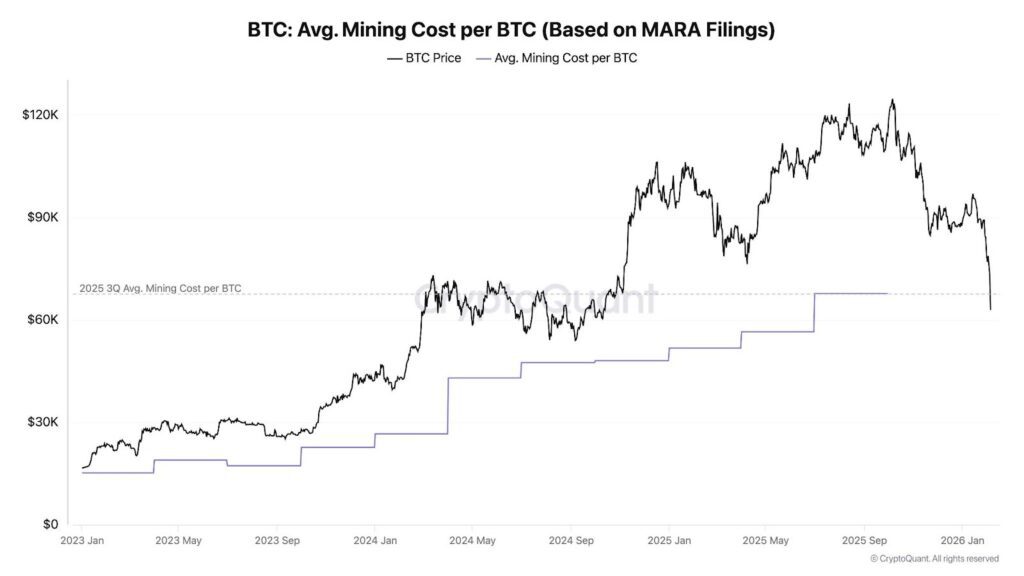
With Bitcoin recently trading in the $60,000 range, miners are operating with compressed margins. This typically leads to consolidation in the mining industry, with less efficient operations shutting down while more efficient miners acquire their equipment and capacity. Over time, this process tends to strengthen the network by concentrating hash power among the most sustainable operators, but in the short term, it can create selling pressure as struggling miners liquidate Bitcoin holdings.
Extreme Fear and Potential Bottoms
Mike Novogratz, CEO of Galaxy Digital, used the weekend to share his view that the crypto market is approaching a bottom. His reasoning is based on several classic contrarian indicators: pessimism has reached extreme levels, leverage has been wiped out of the system, and crypto Twitter has gone notably quiet, a stark contrast to the euphoria typically seen at market tops.
The recent price action supports this pessimistic sentiment. Bitcoin fell from $76,000 to below $60,000, driven largely by early investors taking profits after strong gains. Ethereum’s decline has been even more severe, dropping below $2,000 for the first time since early 2025. The Fear and Greed Index currently sits at 6, indicating extreme fear, a level historically associated with attractive buying opportunities for long-term investors.
Of course, calling bottoms is notoriously difficult, and markets can always go lower than seems rational. But Novogratz’s observations align with classic market psychology: maximum pessimism often coincides with minimum prices.
Protocol Developments
Sui Network announced it has joined Ethereum and Solana as a core protocol partner at Coinbase. This partnership involves Coinbase adopting the Sui token standard, which makes it significantly easier for institutions, developers, and everyday users to interact with the Sui ecosystem.
This development reflects growing institutional confidence in Sui as a Layer 1 blockchain. When Coinbase, the largest US crypto exchange, designates a protocol as a core partner, it signals that the platform expects significant user demand and believes in the protocol’s long-term viability. For Sui, this represents validation and a pathway to greater institutional adoption alongside more established ecosystems like Ethereum and Solana.
Geopolitical Developments
Trump’s Iran Tariff Order
US President Trump signed an executive order allowing the United States to impose additional tariffs of up to 25% on any country conducting trade with Iran. The order specifically targets nations that buy or import goods or services from Iran, representing a form of severe economic pressure in the ongoing tensions between Washington and Tehran.
Interestingly, this hardline economic stance comes even as direct talks between the US and Iran are reportedly taking place this week. The tariff threat could affect international trade relationships significantly, particularly if it strains connections with major economic partners who maintain trade ties with Iran. Countries like China, India, and various European nations could find themselves caught between their economic relationships with Iran and their desire to avoid punitive US tariffs.
For markets, this adds another layer of geopolitical uncertainty at a time when investors are already nervous about economic data and monetary policy. Tariff threats historically create volatility in global markets, and this particular order could complicate international trade flows in unpredictable ways.
The Week Ahead: Critical Economic Data
The coming week is absolutely packed with major US economic releases that will heavily influence Federal Reserve policy expectations and, by extension, risk asset prices including cryptocurrencies. Understanding what these data points mean and how they relate to Fed decisions is crucial for navigating the week ahead.
Tuesday: Retail Sales and Employment Costs
Retail Sales data provides insight into consumer spending strength, which represents about 70% of US economic activity. Strong retail sales would suggest the economy remains resilient despite higher interest rates, potentially supporting the Fed’s case for keeping rates elevated to ensure inflation is truly under control. Weak retail sales, conversely, might indicate the economy is finally feeling the impact of tight monetary policy, which could open the door for rate cuts.
The Employment Cost Index measures how much companies are paying for labor, including wages and benefits. This is a key inflation indicator for the Fed because wage growth can fuel sustained inflation as workers have more money to spend. Rising employment costs would concern the Fed and reduce the likelihood of near-term rate cuts, while moderating labor costs would be welcomed as a sign that inflation pressures are easing.
Wednesday: The Jobs Report
Wednesday brings the marquee release: Nonfarm Payrolls (NFP), the Unemployment Rate, and Average Hourly Earnings. This is the most comprehensive monthly snapshot of the US labor market, and it carries enormous weight in Fed policy deliberations.
Nonfarm Payrolls tells us how many jobs the economy added or lost. Strong job growth indicates economic strength but also suggests the Fed may not need to cut rates anytime soon. Weak job growth raises concerns about economic slowdown but might accelerate the timeline for rate cuts. The Fed faces a delicate balancing act: they want the labor market to cool enough to bring down inflation, but not so much that it triggers a recession.
The Unemployment Rate provides a different perspective on labor market health. A rising unemployment rate signals growing economic stress and typically pushes the Fed toward easier policy. A stable or falling rate suggests the labor market remains tight, which historically correlates with wage pressure and inflation.
Average Hourly Earnings directly measures wage growth. This is critical because sustained wage growth above 3-4% annually can fuel persistent inflation as higher wages translate to increased consumer spending power. If wages are growing rapidly, the Fed has reason to keep rates higher for longer. If wage growth is moderating, it supports the case for rate cuts.
Thursday: Jobless Claims and Housing
Initial Jobless Claims provide a weekly pulse on layoffs and labor market stress. Rising claims suggest companies are cutting workers, which could indicate economic weakness developing. Claims have been remarkably stable recently, so any significant increase would catch attention.
Existing Home Sales data shows housing market activity, which is particularly sensitive to interest rates since most buyers finance purchases with mortgages. Strong home sales despite elevated mortgage rates would suggest robust consumer demand. Weak sales would confirm that high rates are constraining a major sector of the economy.
Friday: The Inflation Picture
The week concludes with the Consumer Price Index (CPI), arguably the single most important inflation measure for markets and the Fed. CPI directly measures price changes across a basket of consumer goods and services, from food and energy to housing and healthcare.
If CPI comes in hotter than expected, showing inflation remains stubborn or is reaccelerating, it would significantly reduce the probability of Fed rate cuts in the near term. Markets would likely react negatively to this scenario, as it implies “higher for longer” interest rates that weigh on valuations for stocks and speculative assets like cryptocurrencies.
If CPI shows cooling inflation that’s continuing to trend toward the Fed’s 2% target, it would bolster expectations for rate cuts potentially beginning in the coming months. This would likely support risk assets across the board, as lower interest rates reduce the opportunity cost of holding non-yielding assets like Bitcoin and make it cheaper for companies and consumers to borrow.
How This Connects to Fed Policy
Understanding how these data points influence Fed decisions helps explain why markets react so strongly to them. The Federal Reserve has a dual mandate: maximum employment and stable prices (roughly 2% inflation). When the economy is too hot, with strong job growth and rising inflation, the Fed raises interest rates to cool things down. When the economy is too cool, with rising unemployment and falling inflation, the Fed cuts rates to stimulate activity.
Right now, the Fed is trying to achieve a “soft landing”: bringing inflation back to target without causing a recession. This requires threading a very narrow needle. Strong economic data (robust job growth, solid retail sales, persistent wage growth, sticky inflation) suggests the Fed’s work isn’t done and rates need to stay higher. Weak economic data suggests the Fed may have already tightened too much and risks pushing the economy into recession if they don’t cut rates soon.
For crypto markets, which have evolved to trade increasingly like risk assets, Fed policy expectations matter enormously. When rate cut expectations rise, crypto typically benefits from the prospect of easier financial conditions and renewed appetite for speculative investments. When rate cut expectations fall, crypto often suffers along with other risk assets.
This week’s data will likely determine whether markets continue pricing in rate cuts for 2026 or whether those expectations get pushed further into the future. The volatility could be substantial.
This Week’s Major Token Unlocks
Movement (MOVE)
Date: February 09, 2026
Unlock Value: 3.82M USDT
% of Circulating supply: 1.63%
Number of Tokens: 162.67M MOVE
ADI (ADI)
Date: February 09, 2026
Unlock Value: 16.82M USDT
% of Circulating supply: 0.70%
Number of Tokens: 6.99M ADI
Linea (LINEA)
Date: February 10, 2026
Unlock Value: 3.73M USDT
% of Circulating supply: 1.58%
Number of Tokens: 1.14B LINEA
Solayer (LAYER)
Date: February 11, 2026
Unlock Value: 8.34M USDT
% of Circulating supply: 9.89%
Number of Tokens: 97.94M LAYER
StarkNet (STRK)
Date: February 15, 2026
Unlock Value: 6.54M USDT
% of Circulating supply: 1.28%
Number of Tokens: 128.23M STRK
Throughout the Week (February 9-16, 2026):
CONX (CONX)
Date: February 09–16, 2026
Unlock Value: 15.72M USDT
% of Circulating supply: 1.56%
Number of Tokens: 1.32M CONX
Avalanche (AVAX)
Date: February 09–16, 2026
Unlock Value: 21.51M USDT
% of Circulating supply: 0.45%
Number of Tokens: 2.37M AVAX
Aptos (APT)
Date: February 09–16, 2026
Unlock Value: 13.32M USDT
% of Circulating supply: 0.76%
Number of Tokens: 12.46M APT
StarkNet (STRK)
Date: February 09–16, 2026
Unlock Value: 6.28M USDT
% of Circulating supply: 4.61%
Number of Tokens: 127.00M STRK
Extended Period (February 2-16, 2026):
RAIN (RAIN)
Date: February 02–16, 2026
Unlock Value: 86.65M USDT
% of Circulating supply: 2.59%
Number of Tokens: 9.45B RAIN
Solana (SOL)
Date: February 02–16, 2026
Unlock Value: 41.52M USDT
% of Circulating supply: 0.08%
Number of Tokens: 477.99K SOL
CC (CC)
Date: February 02–16, 2026
Unlock Value: 32.34M USDT
% of Circulating supply: 0.46%
Number of Tokens: 191.71M CC
TRUMP (TRUMP)
Date: February 02–16, 2026
Unlock Value: 21.26M USDT
% of Circulating supply: 1.30%
Number of Tokens: 6.33M TRUMP
RIVER (RIVER)
Date: February 02–16, 2026
Unlock Value: 15.77M USDT
% of Circulating supply: 3.17%
Number of Tokens: 1.25M RIVER
Worldcoin (WLD)
Date: February 02–16, 2026
Unlock Value: 14.48M USDT
% of Circulating supply: 0.80%
Number of Tokens: 37.23M WLD
Dogecoin (DOGE)
Date: February 02–16, 2026
Unlock Value: 9.16M USDT
% of Circulating supply: 0.06%
Number of Tokens: 94.80M DOGE
The largest unlocks by dollar value, RAIN at $86.65 million, Solana at $41.52 million, and CC at $32.34 million, bear watching as they could create meaningful selling pressure depending on how recipients handle their newly unlocked tokens. The Solayer unlock is also notable as it represents nearly 10% of that token’s circulating supply, which could have an outsized impact on price if significant portions are sold.
Putting It All Together
This weekend brought a fascinating mix of bullish institutional signals and bearish warnings that capture the current market’s complex crosscurrents. On one hand, predictions about China potentially buying Bitcoin, growing evidence of US strategic reserve accumulation, Charles Schwab entering direct crypto trading, and expanding real-world Bitcoin adoption all point to continued institutional embrace of digital assets as a legitimate asset class.
On the other hand, Goldman Sachs warnings about equity market selling pressure, extreme fear in crypto sentiment indicators, compressed miner margins, and large upcoming token unlocks all suggest the path forward may be volatile and challenging in the near term.
The data-heavy week ahead will likely provide directional clarity. How markets respond to jobs data, inflation numbers, and consumer spending figures will directly feed into Federal Reserve policy expectations, which remain the primary driver of risk asset valuations in the current environment. Traders should pay particular attention to Wednesday’s jobs report and Friday’s CPI data, as these releases have the potential to meaningfully shift rate cut expectations and trigger significant price movements across all risk assets.
For Bitcoin specifically, the fundamental picture remains intact despite price volatility. Network security is at all-time highs, adoption continues to expand, major financial institutions are building direct exposure, and there are credible signals that nation-states are accumulating. Whether we’re currently at a market bottom or heading lower in the short term, the structural pieces are in place for the next significant move higher when conditions align.
This article is not financial advice. Please do your own research. You can continue your research and stay updated on the latest crypto insights at blog.millionero.com. When you’re ready to trade, explore spot and perpetual futures trading on Millionero.