


The cryptocurrency markets are navigating a delicate moment as Bitcoin struggles to reclaim the $72k level while traditional risk assets surge, creating a divergence that could define the next major move for digital assets. At the same time, behind closed doors in Washington, banks and crypto firms are inching closer to a framework that could reshape how stablecoin yields work in America.
A Tale of Two Markets
This morning brought relief as both the US Dollar and long-end Treasury yields continued their pullback, typically positive for commodities and risk assets. The Dollar has now completely retraced gains from the Warsh nomination announcement, unwinding what briefly pressured risk assets across the board.
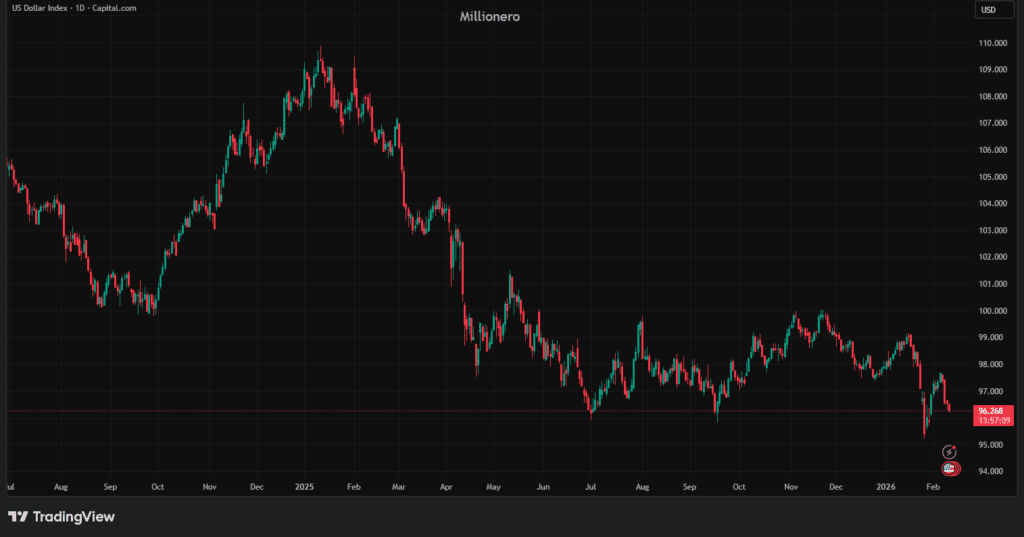
Dollar Chart
Yet Bitcoin appears reluctant to capitalize. After three rejections at $72,000, the cryptocurrency remains trapped in consolidation even as equities and software stocks have mounted an impressive recovery since the start of the week. The Nasdaq 100 has retraced most of its selloff and sits just 3.5% below all-time highs, while the IGV software index approaches resistance around the 90 level.
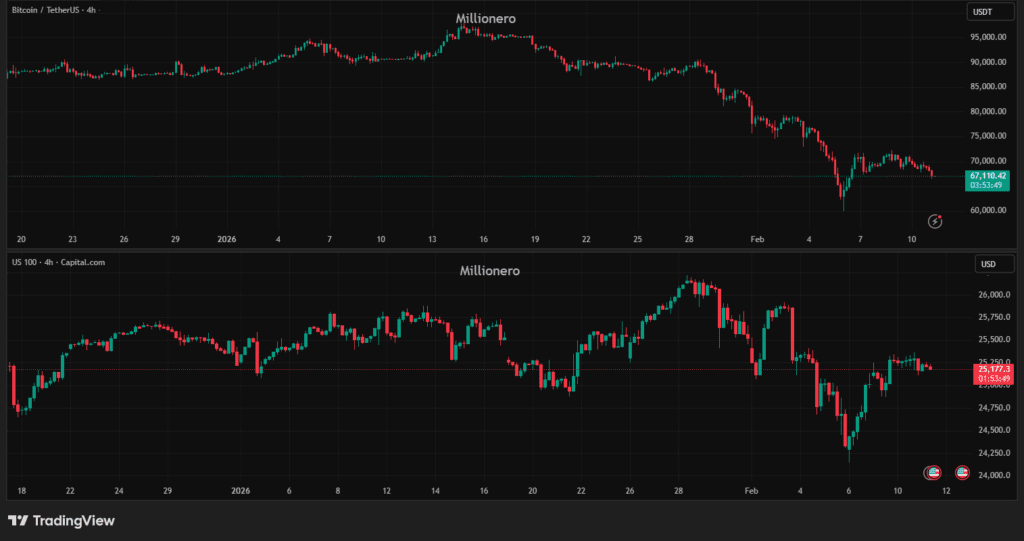
MicroStrategy’s Michael Saylor could provide the spark Bitcoin needs with significant purchases while the company’s premium to net asset value sits at an attractive 1.21 multiple. A window remains for Bitcoin to push higher while equity markets maintain momentum, but that window may be closing.
The Fragility Beneath the Surface
What makes this moment particularly consequential is the underlying fragility in risk appetite. Bitcoin is consolidating after a sharp drawdown, liquidity remains selective, and capital flows toward narratives that help participants manage volatility or command attention.
Three key structural shifts are commanding disproportionate mindshare:
- Market infrastructure evolution: US policy discussions around CLARITY-style frameworks and stablecoin rulemaking gather momentum, pushing capital toward compliance-adjacent infrastructure and credible venues. Jurisdictional divergence on crypto policy is creating opportunities for capital to flow toward projects with regulatory clarity.
- Counterparty risk concerns: Periodic concerns around centralized exchanges are driving renewed interest in self-custody solutions, DeFi credit markets, and privacy tools.
- Strategic institutional positioning: Institutional capital remains measured and strategic rather than euphoric, with long-term accumulation continuing alongside real-world asset tokenization maturation, even as retail traders rotate tactically into assets with clear catalysts.
Progress in the Stablecoin Yield Debate
The most significant development this week may be happening away from price charts entirely. A second White House meeting on stablecoin yields has revealed meaningful progress toward compromise between banks and crypto firms, even though no final agreement has been reached.
According to sources present at the meeting, both sides described the gathering as productive, with more substantive discussion of deal specifics than the initial session. The banking sector came prepared with a written set of prohibition principles that outlined their red lines on stablecoin rewards, but notably included language about potential exemptions that represents a shift from their previous unwillingness to discuss any exceptions whatsoever.
Stuart Alderoty
Chief Legal Officer at Ripple, captured the mood succinctly when he said “compromise is in the air.” The meeting focused heavily on defining permissible activities, essentially determining what kinds of account activity could allow crypto firms to offer rewards on stablecoins. The crypto industry wants these definitions to be broad and flexible, while banks are pushing for narrower, more restrictive parameters.
The attendee list itself tells a story about the seriousness of these negotiations. Led by Patrick Witt, Executive Director of the President’s Crypto Council, with Senate Banking Committee staff in attendance, the crypto side included senior legal and policy leaders from:
- Coinbase (Paul Grewal)
- Andreessen Horowitz (Miles Jennings)
- Ripple (Stuart Alderoty)
- Paxos (Josh Rosner)
- Blockchain Association (Summer Mersinger)
- Crypto Council for Innovation (Jonelle Kim)
Representing the banking sector were Goldman Sachs, JPMorgan, Bank of America, Wells Fargo, Citigroup, PNC Bank, and US Bank, along with major trade associations.
This second meeting was notably smaller and more focused than the first, allowing for deeper discussion of specific mechanisms and compromises. Further conversations between the parties are expected in the coming days, though it remains unclear whether another meeting of this scale will occur before month’s end. The White House has set a March 1st deadline for the parties to reach an agreement.
What This Means for Markets
The convergence of these technical and fundamental factors creates an interesting setup. If Bitcoin continues to show weakness at $72,000 while equities begin pulling back from their recent recovery, the path toward a retest of the low to mid $60,000 range becomes increasingly likely. That move would represent a healthy consolidation after the run-up earlier this year, but it would also test the resolve of newer holders who entered during the rally.
On the other hand, the progress toward regulatory clarity on stablecoins, even if incremental, represents the kind of structural development that supports long-term capital formation in the crypto ecosystem. Stablecoins have become critical infrastructure for the digital asset markets, and clear rules around yields and permissible activities would remove a significant source of regulatory uncertainty.
The challenge for traders and investors is navigating a market where short-term price action remains choppy and vulnerable to equity market sentiment, while longer-term fundamentals around regulatory clarity and institutional adoption continue to improve. This is precisely the environment where risk management becomes paramount, and where the ability to separate signal from noise determines success.
Key levels to watch:
- Bitcoin holding or breaking $72,000 resistance
- Nasdaq 100 behavior near all-time highs
- MicroStrategy accumulation activity at current mNAV levels
- Any announcements from Washington before the March 1st deadline
As we move deeper into February, watch for Bitcoin’s response if equity markets begin to roll over, and pay close attention to any announcements from Washington about stablecoin framework progress. The next major move in crypto markets may well be determined by which of these forces proves stronger: technical resistance and risk-off positioning, or structural progress toward mainstream financial integration.
Note
This article is for informational purposes only and does not constitute financial advice. Always do your own research before making any investment decisions. For more insights and analysis, visit blog.millionero.com. When you’re ready to trade, explore spot and perpetual futures on Millionero.