


In the span of just three days, LayerZero’s ZRO token went from a quiet crypto corner to one of the most talked-about assets in the market. The price surged roughly 40%, briefly touching $2.60, and trading volume exploded by more than 400%. So what actually happened, and why does February 20 matter so much?
Three Big Announcements in Three Days
The excitement didn’t come from a single piece of news. It came from a cluster of major announcements hitting back-to-back, each one bigger than the last.
First: Tether invests in LayerZero (February 10)
Tether, the company behind USDT, the world’s most widely used stablecoin, announced a strategic investment in LayerZero. This was a massive vote of confidence. Tether’s stablecoins already use LayerZero’s technology to move across different blockchains, and the partnership has already handled over $70 billion in transfers in less than a year. The deal also pointed toward something futuristic: AI agents running their own wallets and making payments automatically, without any human clicking “approve.” Tether’s CEO called this “agentic finance,” and LayerZero’s infrastructure is being built to power it.
Second: The Zero blockchain goes public (February 11)
LayerZero dropped its biggest announcement yet, “Zero,” a brand-new blockchain built from scratch. But this isn’t just another blockchain. Zero is designed to reach 2 million transactions per second, which would make it one of the fastest networks ever built. What made the market really pay attention, though, was who is backing it:
- Citadel Securities, one of the largest market makers on Wall Street
- Intercontinental Exchange (ICE), the company that owns the NYSE
- Google Cloud, exploring AI micropayments on the network
- ARK Invest, invested in both equity and tokens; Cathie Wood joined LayerZero’s advisory board
- BNY Mellon and the DTCC, the U.S. clearinghouse that settles trillions of dollars in securities every day
These are not crypto-native names, these are institutions that move the global financial system. The idea behind Zero is that it could eventually replace some of the centralized infrastructure that traditional finance runs on today. Whether or not that vision fully plays out, the announcement alone was enough to send ZRO flying.
Third: Cardano joins the network (February 12)
The Cardano blockchain announced it would integrate with LayerZero, giving its users access to over 150 blockchains and more than $80 billion in cross-chain assets. Cardano’s founder Charles Hoskinson called it the largest cross-chain expansion in Cardano’s history. For LayerZero, it meant yet another major blockchain joining a network that already connects 165 chains and has processed over $210 billion in total transfers.
Put all three together and you have a story that even people outside crypto could understand: a blockchain protocol landing partnerships with Tether, Citadel, Google, the NYSE, and the DTCC, all in the same week.
What Is ZRO Actually For?
To understand why these partnerships matter for the token price, it helps to know what ZRO actually does. Think of LayerZero as a postal service for blockchains, it carries messages and tokens from one blockchain to another. ZRO is the stamp you use to pay for that service. When someone sends tokens across chains using LayerZero, they pay fees in ZRO. Those fees are then burned (destroyed forever), which gradually reduces the total supply of ZRO over time.
The more activity on the network, the more ZRO gets used and burned. So when big players like Tether, Citadel, and the DTCC start using the network, it points toward more future demand for ZRO, and that’s exactly why the token price responded so strongly.
The February 20 Unlock: What It Is and Why It Matters
Here is where things get more complicated, and where investors need to pay close attention.
On February 20, 2026, LayerZero will release 25.71 million new ZRO tokens into the open market. This is what the crypto world calls a “cliff unlock.” To understand why it matters, think of it like this: when companies hire employees, they often don’t give them all their shares on day one. Instead, shares are locked up and released slowly over time, this is called vesting. LayerZero did the same thing when it launched ZRO. Early investors and core team members received tokens that were locked for one year before anything could be sold.
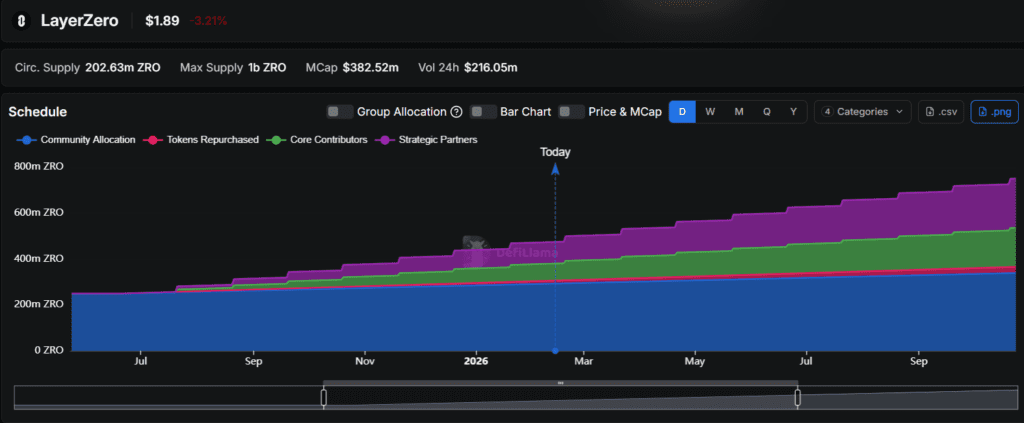
February 20 marks the end of that one-year lockup for core contributors and strategic partners. Once that date passes:
- 25.71 million ZRO unlocks immediately
- Approximately 23 million additional tokens will unlock every single month going forward, until at least April 2027
- Right now, only about 20–43% of ZRO’s total 1 billion supply is circulating; the rest is still locked
That’s a steady drip of new supply hitting the market month after month. More supply coming into the market can push prices down, especially if the people receiving those tokens decide to sell. This is the core tension right now: the bullish news from this week is pushing the price up, while the unlock schedule creates pressure in the other direction.
Will the Unlock Crush the Price?
Not necessarily. There are real forces working against a price collapse.
Whales are accumulating. On-chain data ahead of the February 20 unlock shows large wallets buying ZRO rather than waiting to sell. This mirrors what happened during the last major unlock in October 2025, when many analysts expected a sharp drop, but big holders absorbed the supply instead, and the price recovered.
Buybacks are already running. LayerZero acquired Stargate, a popular bridge, in August 2025. Under that deal, all of Stargate’s bridge revenue goes toward buying back and burning ZRO. In the first few months after the acquisition, about $1.2 million worth of ZRO was already bought back. The team has set a target of $100 million in annual revenue for 2026, which, if hit, would create significant buying pressure that could counterbalance the unlock schedule.
A fee switch could make ZRO deflationary. The community has the option to vote for a mechanism that would burn ZRO collected from messaging fees. If activated, this could gradually shrink ZRO’s total supply over time, the opposite of what unlocks do.
The Bottom Line
LayerZero just had one of the most news-packed weeks in its history. The Zero blockchain, the Tether investment, and the Cardano integration are all genuinely significant developments that point toward a future where LayerZero sits at the center of both crypto and traditional finance. That story drove a 40% price surge.
But February 20 is a real test. The unlock will add millions of new tokens to the market, marking the start of a steady monthly release that runs through 2027. Whether ZRO holds its gains or gives them back will depend on one thing above all else: whether real usage of the network grows fast enough to absorb the new supply. Whale behavior and buyback revenue will help, but sustained adoption is the only long-term answer.
This article is not financial advice. Always do your own research before making any investment decisions, you can start at blog.millionero.com for more crypto insights. When you’re ready to act, trade ZRO spot and perpetuals on Millionero.