


Something has shifted in global markets over the past few days. The conversation about a possible military conflict between the U.S. and Iran has gone from background noise to something traders are actually pricing into their positions. This piece breaks down what’s happening, why it matters, and what you should be watching if you trade crypto or any other risk asset.
What’s Actually Happening on the Ground
The clearest sign that something is brewing is where the U.S. is sending its military hardware. The USS Gerald R. Ford, one of the most powerful aircraft carriers in the world, has been ordered to move toward the Middle East, where it will join the USS Abraham Lincoln strike group that’s already in the region. That’s two full carrier strike groups in the same theater at the same time. You don’t send that kind of firepower as a casual gesture. USNI News, which tracks U.S. naval movements reliably and without much drama, has confirmed this repositioning.
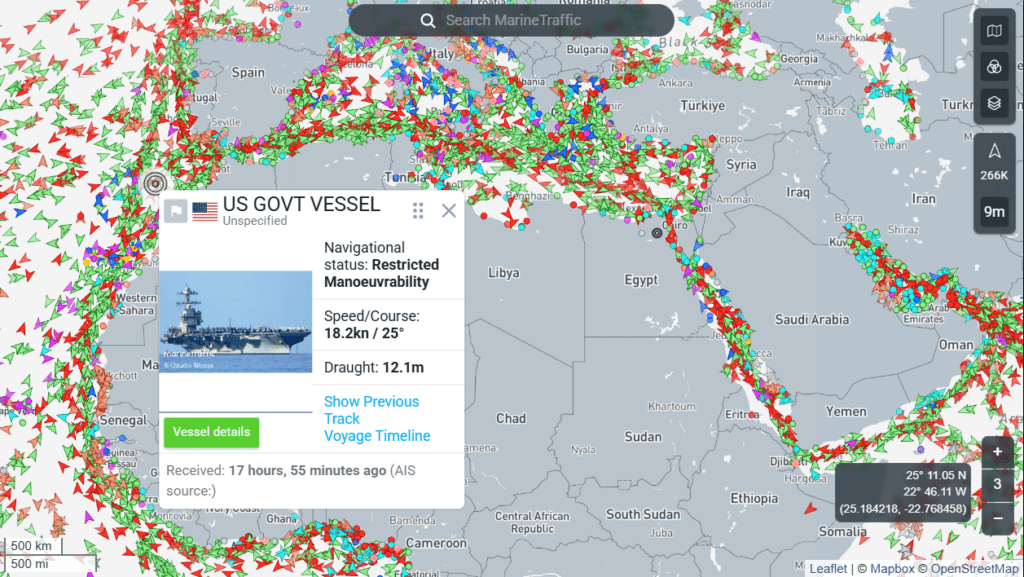
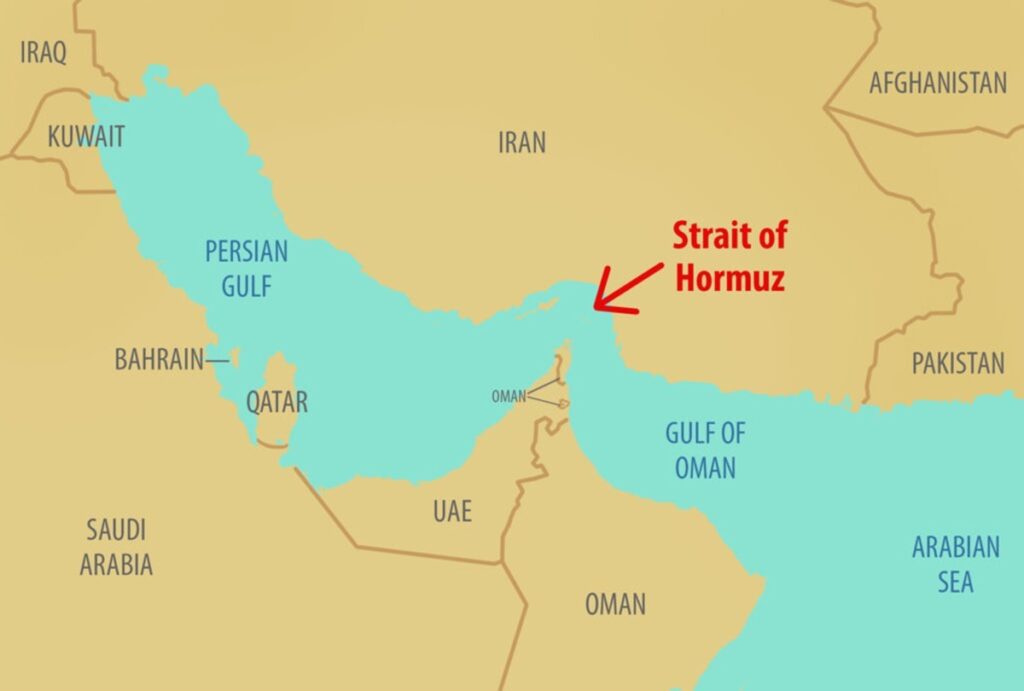
At the same time, Iran and Russia recently conducted joint naval drills, and Iran has been running military exercises around the Strait of Hormuz, the narrow waterway through which roughly 20% of the world’s oil supply passes every day. None of this is secret. All of it is being watched.
On the diplomatic side, talks between the U.S. and Iran are happening, but they’re not going smoothly. Iranian officials have made it publicly clear that their ballistic missile program is a “red line”, something they will not negotiate away. When countries draw explicit red lines and make them public, it removes the flexibility needed for deals to get done. That’s a bad sign for anyone hoping that negotiations solve this without incident.
How Markets Are Reacting
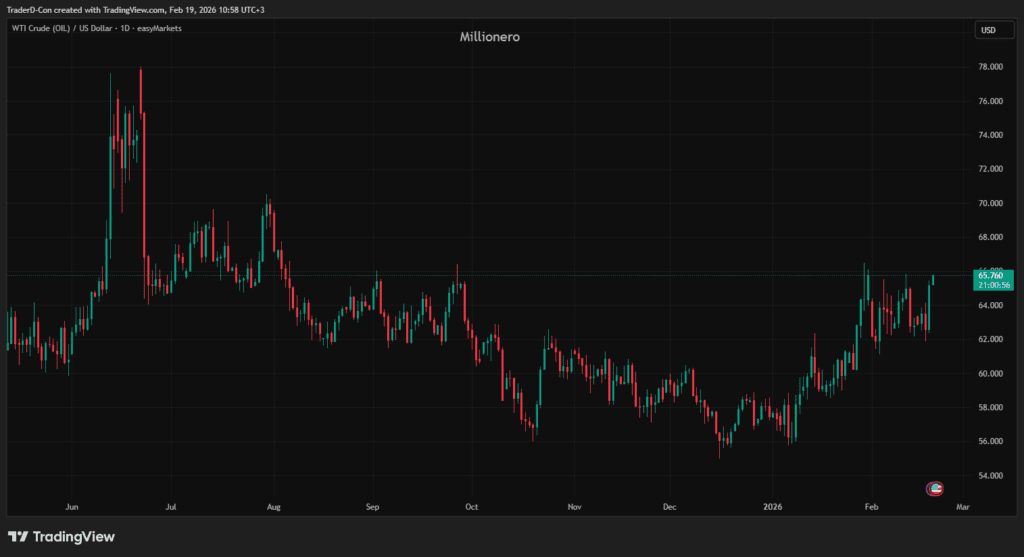
Oil is the most direct signal. Brent crude has a measurable “risk premium” built into it right now, meaning part of the current price is traders paying extra as insurance against the possibility that Iranian supply gets disrupted or the Strait of Hormuz gets threatened. Importantly, the market is not yet pricing a full disruption as the expected outcome. It’s more like buying flood insurance before a storm that might or might not hit. If the storm passes, the premium disappears. If it doesn’t, the premium was cheap.
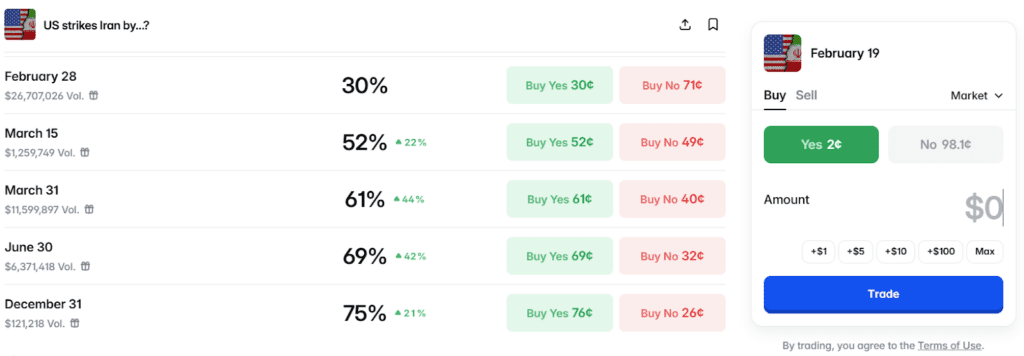
Prediction markets like Polymarket have been running active contracts on questions like “Does Israel strike Iran before February 28?” and similar longer-dated versions running out to June. These markets have seen real volume, and the probabilities are high enough that they’re worth paying attention to. One important caveat: the Wall Street Journal recently reported that some Israeli soldiers were accused of using nonpublic information to bet on strike timing in these same markets. That doesn’t mean the markets are wrong, but it does mean the numbers can move in ways that aren’t purely driven by public information.
How to Read the OSINT Signals Without Getting Tricked
A lot of the real-time tracking in situations like this comes from open-source intelligence (OSINT), publicly available data on ship movements, flight patterns, and diplomatic signals. Tools like MarineTraffic and AirNav Radar let anyone watch where military and commercial vessels are moving in near real time.
The key principle for reading this kind of data honestly is simple: one signal means almost nothing. Ships move around all the time. Military flights happen constantly. A single “interesting” data point is usually just normal activity that looks spooky in context. What actually means something is when multiple independent signals point in the same direction at the same time. When diplomatic language hardens and forces reposition and markets start pricing higher premiums simultaneously, that’s a real shift in the risk environment, not just social media noise.
What This Means If You Trade Crypto
Crypto tends to behave in a specific pattern when geopolitical risk spikes. The first move is usually down, because fear makes people reduce exposure to anything that feels speculative or risky. Bitcoin and altcoins get sold alongside equities. That’s the “risk-off” phase.
If it turns out there’s no major escalation, or a strike happens but stays limited in scope, you often see a sharp recovery, the “relief rally.” If escalation is serious, the story gets more complicated: historically, Bitcoin has been bought as an alternative store of value in regions experiencing currency crises or financial sanctions, so a longer-term conflict can actually be bullish for crypto from a completely different angle. The problem is that the short-term volatility is extremely difficult to trade around, especially when headlines can gap markets open by 5–10% in either direction.
The most important practical things to understand right now come down to three points. Leverage is your enemy in this environment, because even a position you’re correct on can get stopped out by a sudden gap before it recovers. Weekend risk is higher than normal because liquidity is thin and a single headline can move markets with nobody around to absorb the shock. And the thing that matters least for your trading is trying to guess whether something happens on Saturday versus Tuesday, the real tradable insight is simply that the range of outcomes is wider than usual, so your position sizing should reflect that.
The Bottom Line
Nobody is saying a regional war is the most likely outcome. The base case in markets is still that some kind of deal or de-escalation happens. But the probability of something going wrong has risen meaningfully in the past couple of weeks, and the combination of carrier groups moving, red lines being drawn publicly, and oil adding a risk premium tells you that serious people are taking the possibility seriously.
This article is not financial advice. Markets are unpredictable, geopolitical situations evolve fast, and no article can substitute for your own judgment and research. Always do your own research before making any trading decision, and if you want more market insights, analysis, and educational content, head over to blog.millionero.com where we break down what’s moving markets in plain language, regularly.
When you’ve done your homework and you’re ready to act, you can trade both spot and perpetuals on Millionero, built for traders who want a clean, fast, and reliable experience. Trade smart. Stay informed. Manage your risk.