



A lot of people on CT are saying the daily Bitcoin selling stopped the moment Jane Street hit the headlines. Here’s why it’s not that simple.
First, Who Is Jane Street?
Before we get into the lawsuit, it’s worth understanding who we’re actually talking about, because Jane Street is not some shadowy crypto hedge fund. It is one of the most powerful quantitative trading firms on the planet.
Founded in 2000 and headquartered in New York, Jane Street is a market maker and proprietary trading firm that operates across equities, bonds, options, currencies, and ETFs in virtually every major market globally. The firm is notoriously secretive, it doesn’t advertise, rarely gives interviews, and publishes almost nothing publicly, but its scale is staggering. By some estimates, Jane Street trades well over $17 trillion in notional volume per year, making it one of the single largest liquidity providers in the world. For context, the firm is believed to be responsible for a significant slice of all U.S. ETF trading volume on any given day.
Jane Street is not a casino. It is a deeply sophisticated, mathematically rigorous operation that attracts some of the sharpest minds in finance. That context matters enormously when you hear Crypto Twitter say things like “Jane Street ran a visible daily sell pattern and then shut it off the second they got sued.” That framing should raise your eyebrows immediately, and we’ll come back to why.
The Lawsuit: What Is Actually Alleged
The headline is real. The lawsuit is being filed by Todd Snyder, the court-appointed administrator overseeing Terraform’s wind-down, and it names Jane Street, co-founder Robert Granieri, and two employees, Bryce Pratt and Michael Huang, as defendants.
The core allegation is that Jane Street used material non-public information (MNPI) to profit around the Terra/LUNA collapse in May 2022. The complaint paints a specific sequence of events:
- On May 7, 2022 at 5:44 PM ET, Terraform quietly withdrew 150 million UST from Curve’s 3pool, a major stablecoin liquidity pool, without publicly announcing it.
- Less than ten minutes later, a wallet that analysts have linked to Jane Street allegedly executed the largest single swap in that pool’s history: 85 million UST, dumped directly into the moment when liquidity was at its thinnest.
The complaint alleges those trades accelerated the collapse by adding selling pressure at the worst possible moment, while allowing Jane Street to exit or profit before the broader market understood what was happening.

Alleged Information
The alleged information pipeline ran through Bryce Pratt, a Jane Street employee who had previously interned at Terraform. According to the complaint, Pratt reconnected with his former Terraform colleagues in early 2022, establishing a private group chat referred to in the filing as “Bryce’s Secret”, used to funnel Terraform-related information back to Jane Street. The lawsuit further alleges that on May 9, while UST was already depegging, Pratt set up a group message between Do Kwon and Jane Street personnel discussing interest in purchasing Bitcoin or LUNA. Kwon allegedly pointed to Bill DiSomma of Jump Trading as the person Jane Street should coordinate with, which is exactly why this lawsuit reignites the “Jane Street ↔ Terraform ↔ Jump” triangle that crypto observers have speculated about for years.
For its part, Jane Street denies wrongdoing and has called the suit a money grab. And critically, the public version of the complaint contains significant redactions, it does not present direct, smoking-gun proof of collusion in the version available to the public. Allegations are not verdicts.
This is also not isolated. The same administrator filed a $4 billion lawsuit against Jump Trading in December 2025, alleging market manipulation and self-dealing that helped accelerate the Terra crash. The broader story here is Terraform’s estate trying to recover money for creditors by going after every major counterparty it can identify.
Why CT Immediately Jumped to “BTC Is Finally Free”
Here is the narrative leap Crypto Twitter made, assembled in three steps:
1. Jane Street got sued (real). 2. The 10AM daily Bitcoin selling stopped (possibly real, timing unclear). 3. Therefore, Jane Street was the seller, and the lawsuit scared them off (speculation dressed as conclusion).
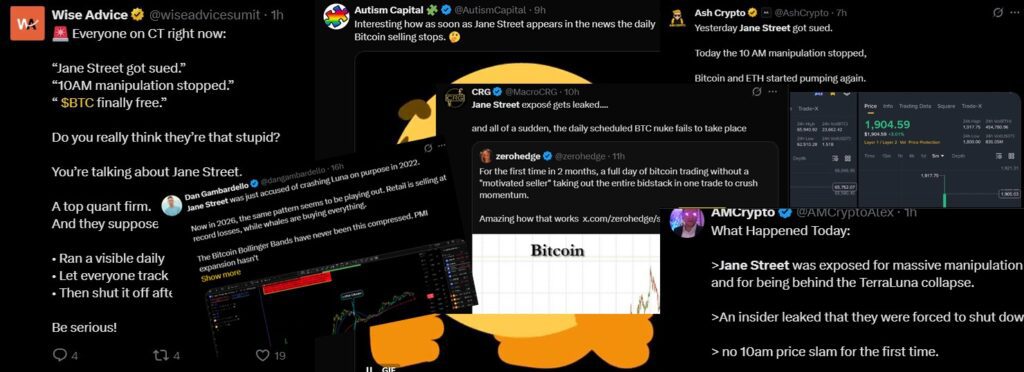
It sounds clean. Markets are never that clean.
The “10AM seller” has been a persistent meme on CT for months, the idea that Bitcoin sees coordinated selling pressure at a predictable time each day, suggesting a large, disciplined actor leaning on price. That observation may be based on something real. But jumping from “there is a recurring pattern” to “Jane Street is running it” to “the lawsuit shut it down” is three enormous inferential leaps stacked on top of each other.
The Boring, But Correct, Explanation for Repeating Intraday Patterns
If you genuinely believe there is a daily selling pattern in Bitcoin around a specific hour, the intellectually honest first step is to ask: what structural market forces operate on predictable schedules?
The answer is: quite a lot. 10AM New York time is one of the most active moments in global markets because it coincides with the normalization of liquidity after the 9:30 equity open, and it is when many major U.S. economic data releases land. Crypto trades 24/7, but real institutional size still tends to express itself during U.S. and European risk windows. That alone can imprint a time-of-day rhythm without anyone coordinating anything.
Beyond that, consider spot Bitcoin ETF flows. When ETFs are in a period of net outflows, which has characterized stretches of early 2026, the redemption and hedging process creates persistent spot pressure. You often don’t see it as one dramatic candle. Instead, you see rallies getting capped, bids getting absorbed, and a feeling like someone is always there to sell into strength. If outflows pause for even a single day, the pressure lifts and it can feel like “the seller stopped,” even if absolutely nothing changed in terms of who is in the market.
Dealer hedging around options positioning, systematic rebalancing by CTA funds, and even miner selling through scheduled TWAP/VWAP execution programs can all produce patterns that look conspiratorial on a chart. None of them require a villain.
The Part CT Gets Right, and the Part It Gets Wrong
CT is correct that there is something real and serious behind the Terra lawsuit.
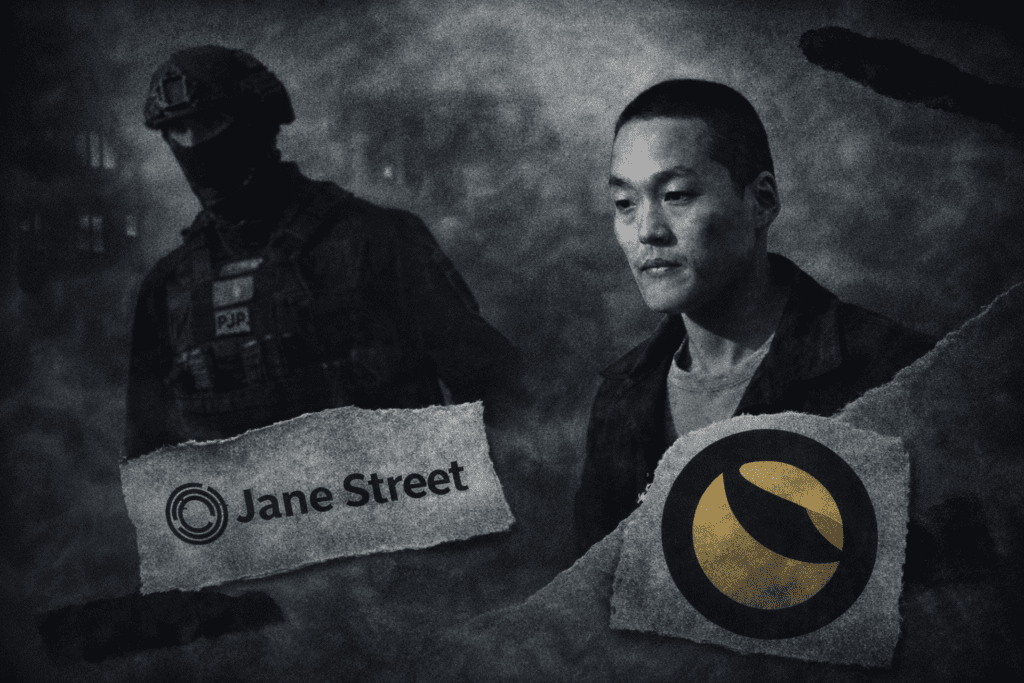
The specific details, the timing of the Curve pool withdrawal, the ten-minute window, the named group chat, the named individuals, give the complaint a level of granularity that demands serious attention. The administrator clearly has access to on-chain data and internal communications. Whether it proves what it claims to prove is a question for a court, not a Twitter thread.
CT is wrong to extend that lawsuit into a unified theory of Bitcoin’s price suppression. Even the most sophisticated institutional participant would have a very hard time creating a “daily visible sell pattern” on a globally traded, 24/7 asset like Bitcoin without being arbitraged away by the dozens of other large firms watching the same clock.
One of the tweets in the screenshots actually makes a sharp point worth quoting here: “Do you really think they’re that stupid? You’re talking about Jane Street. A top quant firm. And they supposedly ran a visible daily pattern, let everyone track it, then shut it off after headlines? Be serious.”
That skepticism is healthy. Hold onto it.
What to Actually Watch
If you want to know whether the selling pressure on Bitcoin has genuinely eased, and why, the right data points are not lawsuit headlines. They are:
- Spot ETF net flows, have they turned positive?
- Exchange inflows, are coins moving to sell venues at a lower rate?
- Perpetual funding rates, have they normalized away from persistent negative or suppressed territory?
- Open interest, has it contracted in a way that suggests de-leveraging rather than fresh shorts?
Those are the structural signals. Everything else is narrative.
The Jane Street lawsuit matters, both for understanding what may have happened in May 2022 and for following how Terraform’s administrator pursues the broader recovery of creditor funds. It is genuinely important. What it is not is a remote control for Bitcoin’s daily price behavior. Resist the urge to connect every headline to the chart in a straight line. That is how CT has always worked.
It doesn’t mean it’s right.
One Final Thing
This article is not financial advice. Nothing here should be taken as a recommendation to buy, sell, or trade any asset. Markets are complex, lawsuits are unproven allegations until decided by a court, and narratives move faster than facts. Always do your own research (DYOR) before making any financial decision.
If you want to go deeper on macro, crypto markets, and on-chain analysis, you can also DYOR on blog.millionero.com, and when you’re ready to put your research to work, you can trade both spot and perpetuals on Millionero.
Stay sharp. Stay skeptical. Trade informed.