


Decentralized finance moves fast, but lending is still the piece that quietly powers everything else. If you can borrow, you can trade, hedge, build, and manage risk. If you can lend, you can earn yield on idle capital. That’s why Morpho matters: it is not trying to be “just another lending app.” It is trying to be the lending infrastructure that many apps can share.
Over the past two years, Morpho has shifted from a smart optimizer on top of older protocols into something broader: a universal lending network that helps lenders and borrowers find better rates and deeper liquidity across markets. And lately, it’s also pushing toward distribution where real users are, most notably through a Telegram-focused expansion that aims to make DeFi lending feel as easy as using a chat app.
The simple idea Morpho started with
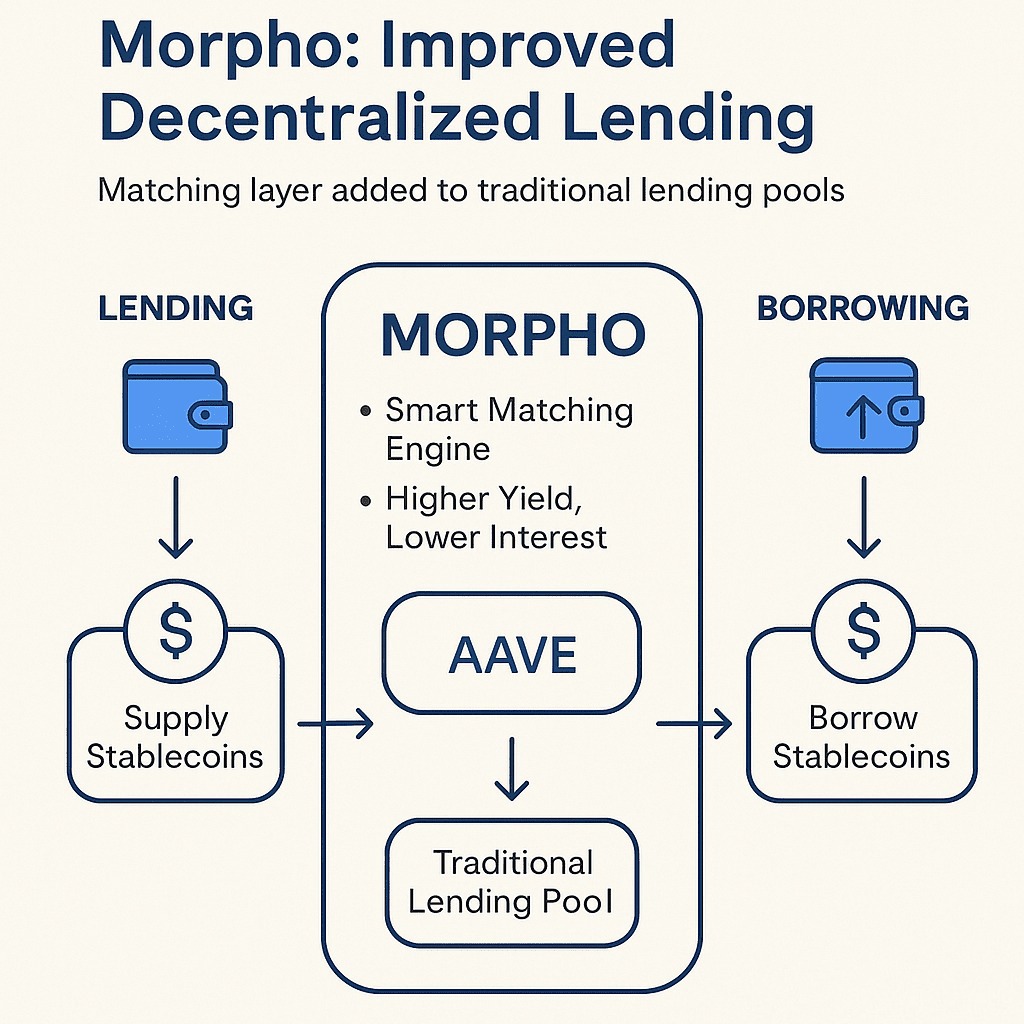
Early DeFi lending (think large pooled markets) works like a big shared bank vault:
- Lenders deposit into a pool and earn an interest rate.
- Borrowers take loans from that pool by posting collateral.
- Rates move based on supply and demand inside that pool.
That model is solid, but it has a common weakness: capital can sit idle or be priced inefficiently. Lenders sometimes get lower yield than they should. Borrowers sometimes pay more than they need to.
Morpho’s early breakthrough was straightforward in theory: match lenders and borrowers more directly when possible (peer-to-peer), while still using major pools as a backup when matching isn’t available. In plain words: try to give both sides a better deal, without breaking liquidity.
This is one reason many analysts describe Morpho as “infrastructure,” not a single product. It improves the base mechanics.
From optimizer to “universal lending network”
Morpho’s evolution matters more than its origin story.
Today, the big narrative is that Morpho is becoming a neutral base layer where many different lending products can live. Instead of one set of rules for everyone, Morpho leans into modularity, you can build markets with different risk choices, different collateral types, and different interest rate designs.
A simple way to picture it:
- Old lending: one giant mall with a few big stores.
- Morpho-style lending: a city of smaller, specialized stores, still connected, but more flexible.
That flexibility is what pulls in builders, risk managers, and institutions who want control and clarity.
Morpho Blue: the core building block
The heart of Morpho’s modern design is often described as a lightweight lending “primitive.” The practical meaning is: it’s a simple base that others can build on, without needing permission.
In Morpho’s modular setup, a market can be defined by a few key ingredients:
- Collateral asset (what borrowers post)
- Loan asset (what borrowers receive)
- Oracle choice (how prices are read)
- Interest rate model
- Loan-to-value rules (how much you can borrow)
Once a market is deployed, it is designed to be predictable and hard to “change behind your back.” That’s a big deal in DeFi, where trust often depends on how little room there is for surprise.
Vaults: where “hands-off” lending starts to feel real
Not everyone wants to micromanage risk settings or pick markets. That’s where vaults come in.
Vaults are basically strategy wrappers that route funds into lending markets based on a chosen approach. In many cases, these strategies are curated by well-known risk teams and DeFi specialists.
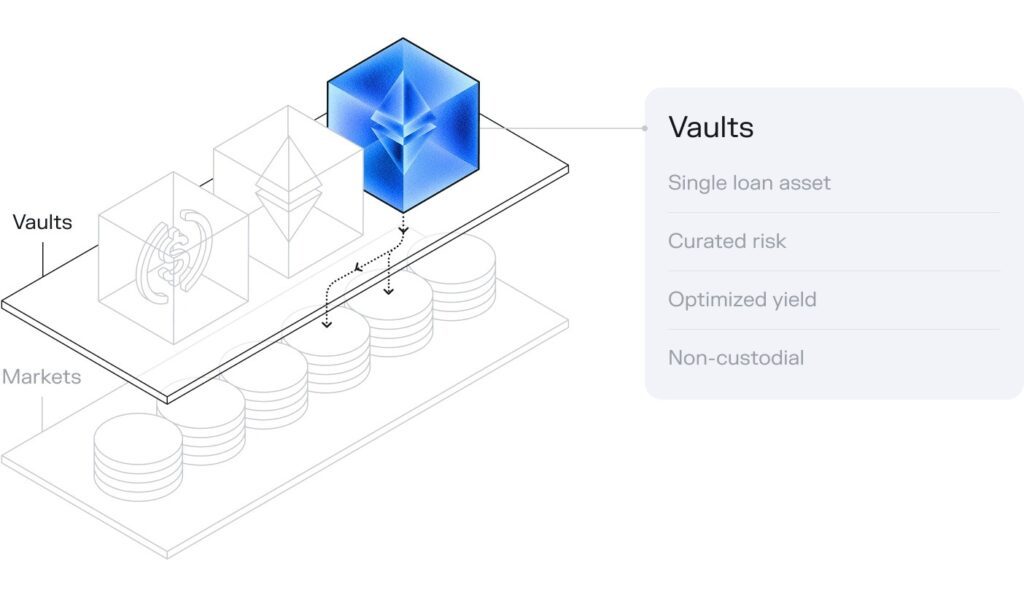
What vaults try to do:
- automate choices,
- aim for stable yield,
- keep risk rules consistent,
- make the experience less technical.
This is also where Morpho starts to look less like a “protocol only for power users” and more like something that regular users can touch through apps and wallets.
Security and the risks that still exist
Morpho’s design focuses heavily on transparency and auditability, but DeFi lending always carries baseline risks. It’s worth saying clearly:
Even strong infrastructure has failure modes. The most common categories are:
- Smart contract risk: bugs, edge cases, unexpected behavior
- Oracle risk: price feeds failing or being manipulated
- Market risk: fast volatility causing liquidations
- Governance risk: human decisions that can help or harm the system
In mature DeFi, the conversation is not “is it risk-free?” It’s how risks are isolated, measured, and priced. Morpho’s modular approach is partly a response to that: isolate markets so one problem does not automatically infect everything.
The $MORPHO token: what it is, and what it isn’t
Morpho’s token, $MORPHO, is mainly a governance tool. That means it gives holders a voice in how the ecosystem evolves, things like upgrades, parameters, treasury decisions, and long-term direction.
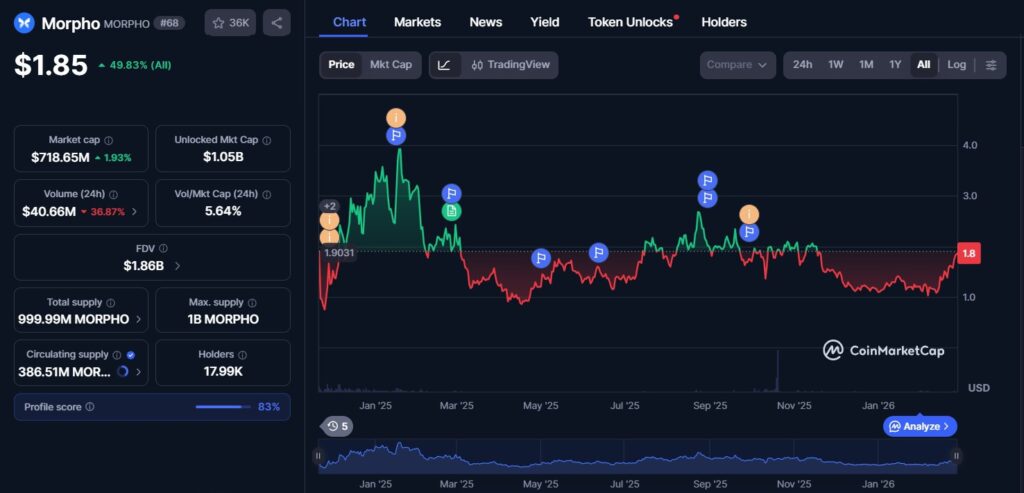
People often misunderstand governance tokens, so here’s the clean version:
- It is not a “share” in the legal sense.
- It is influence over decisions that shape a protocol.
- Over time, that influence can matter more as more value flows through the system.
Some analysts also focus on whether protocol fees may support mechanisms like buybacks or other value flows in the future. Those discussions exist across DeFi, but the key point is simpler: governance is the token’s core job.
Token supply and distribution, in plain language
Morpho’s token design is typically described as fixed maximum supply with allocations for governance/community growth, strategic partners, contributors, and the core team, usually with vesting to reduce sudden supply shocks.
The big picture logic is:
- A large share supports the DAO/community toolbox (rewards, grants, ecosystem growth).
- Partners and investors provide runway and network effects.
- Team allocations vest over time to align incentives.
The details can get technical fast, but the main thing users watch is always the same: how fast new supply enters the market, and whether growth and revenue keep up with that pace.
The Telegram angle: why distribution matters now
This is the part many people underestimate.
DeFi does not win only because it is “better finance.” It wins when it becomes easy finance, when you can access it where you already spend your time.
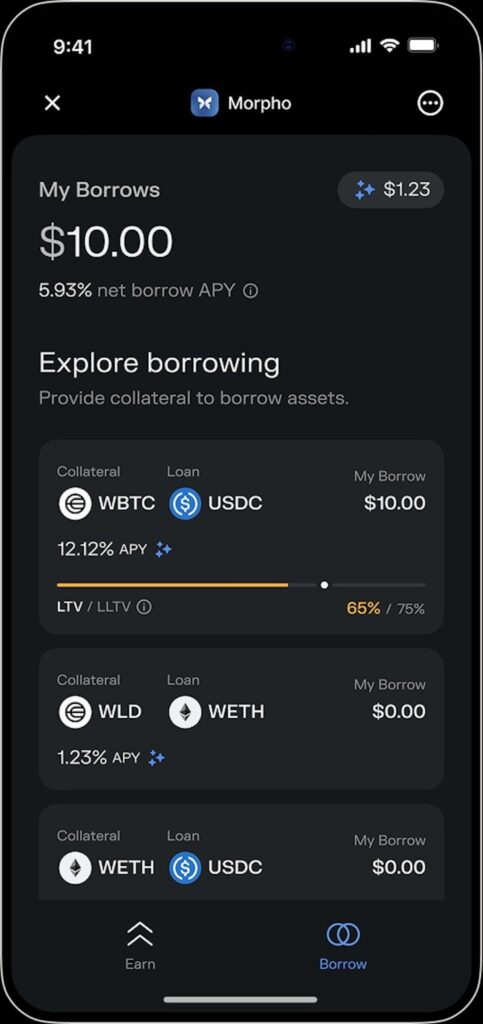
Morpho’s recent Telegram-related push fits into a wider trend: bringing DeFi into consumer interfaces. Telegram has:
- huge global reach,
- crypto-native communities,
- and a habit of turning features into “mini apps” people actually use.
If Morpho-based lending becomes something users can touch through Telegram experiences, without needing to learn a dozen DeFi steps, that’s a real distribution upgrade. In other words, it’s not just “a partnership headline.” It’s a bet on new user funnels.
And in DeFi, new funnels matter because liquidity follows convenience.
Why Morpho is showing up everywhere
Morpho’s ecosystem growth looks less like a single marketing push and more like a structural fit:
- Exchanges and wallets want lending features without rebuilding the whole stack.
- Risk managers and strategists want configurable markets and vault design.
- Institutions prefer clearer parameters and more “TradFi-like” options, including moves toward fixed-rate structures.
This is why Morpho is often described as a bridge layer: it can sit between users and the complexity underneath, while still keeping the system open and composable.
The bottom line
Morpho’s story is not “one more DeFi protocol.” It’s closer to: DeFi lending is turning into shared infrastructure, and Morpho is trying to be one of the main standards.
Its modular markets, vault ecosystem, and institutional-friendly direction point to the same outcome: more lending volume moving through Morpho’s rails. And the Telegram distribution angle adds something DeFi always needs, a path from niche power users to normal users.
As always, none of this removes risk. But it does explain why so many builders and analysts keep circling back to the same view: if on-chain finance grows up, lending infrastructure will be at the center, and Morpho wants to be that center.
This article is not financial advice.
Conduct thorough research before making investment decisions. For additional market analysis and educational content, visit blog.millionero.com. Trade responsibly on Millionero for spot and perpetual futures markets.