


When Korea Crashed, Crypto Felt It Too
A geopolitical shock halfway around the world sent one of Asia’s hottest stock markets into a freefall, and the ripples reached every screen watching Bitcoin.
Two Days That Shook Seoul
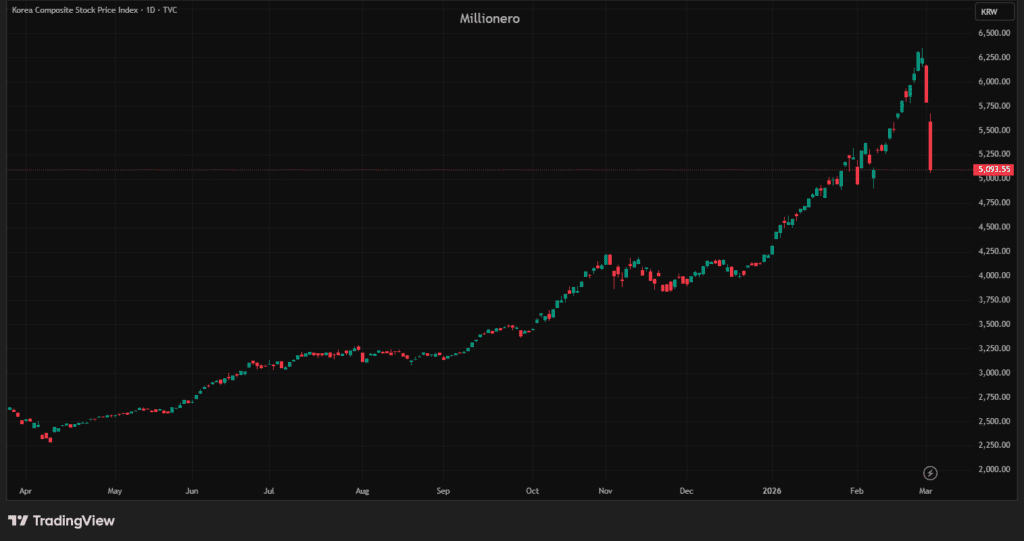
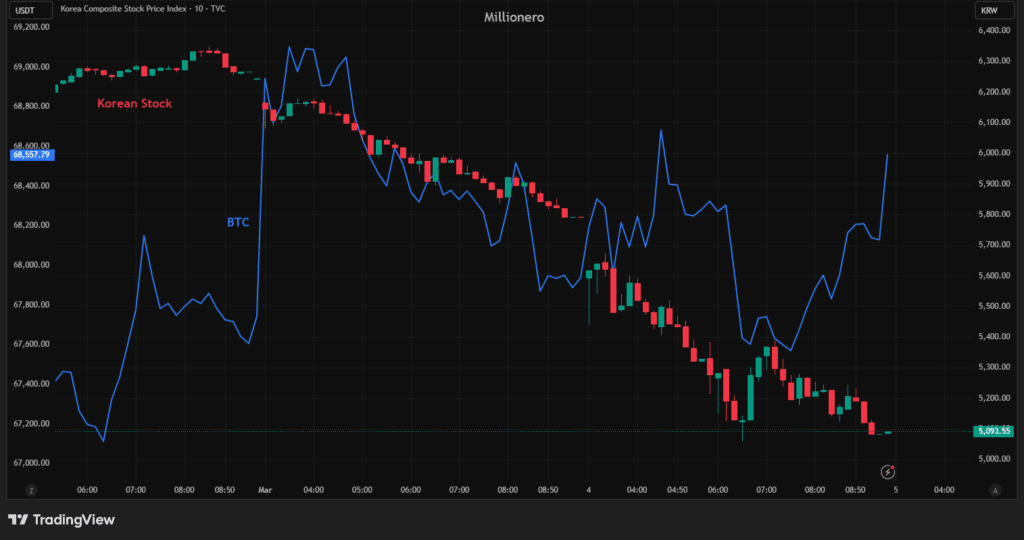
It started quietly enough. Then, on March 3, 2026, South Korea’s benchmark stock index, the KOSPI, dropped 7.24% in a single session. The next morning, it fell another 10% intraday, putting it on pace for its worst single-day loss since the 2008 financial crisis.
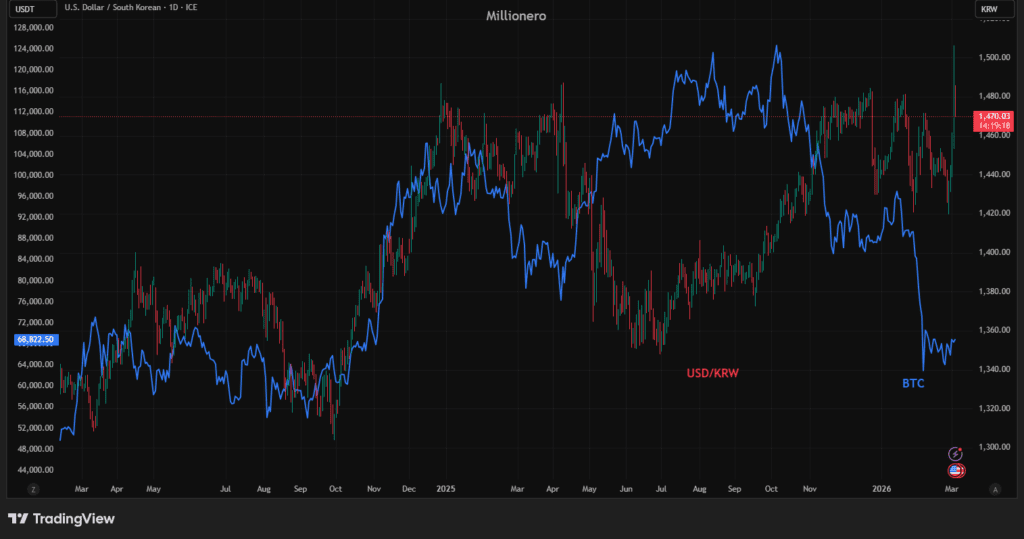
Korea Exchange circuit breakers fired for the first time since August 2024. Trading curbs kicked in for a second straight day. And the South Korean won, the country’s currency, briefly broke through the 1,500-per-dollar level, its weakest point since March 2009.
For a market that had just crossed 6,000 on the KOSPI for the first time ever, just days earlier on February 25, the reversal was stunning.
What Actually Caused It
This wasn’t a homegrown crisis. No major Korean company missed earnings. No bank collapsed. The trigger came from far outside Seoul.
The catalyst was an escalation in the Middle East conflict, which sent oil prices surging and rattled global investors. For most countries, that’s painful. For South Korea, it hits especially hard, roughly 70% of the nation’s oil comes from the Middle East. When markets start pricing in supply disruptions or higher-risk shipping lanes through the region, Korea feels it faster than almost anyone.
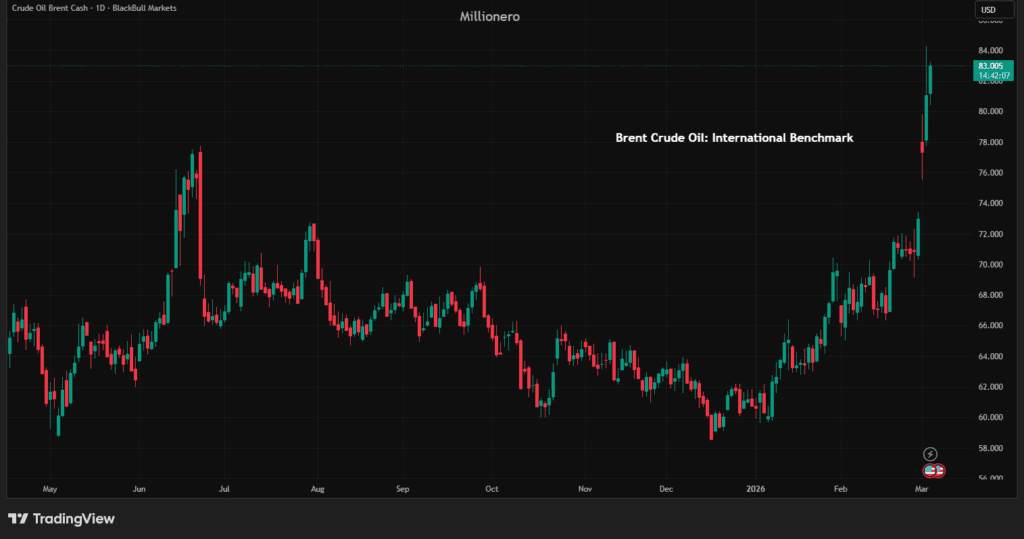
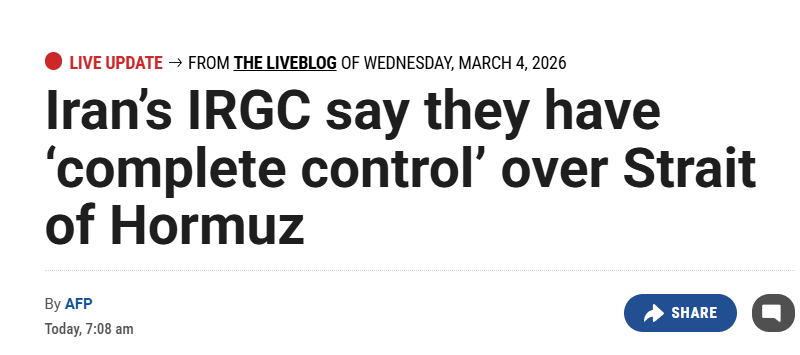
Making things worse, Iran threatened to shut down the Strait of Hormuz, a narrow waterway through which about one-fifth of all globally traded oil passes. That single threat injected a “stagflation” fear into markets: the idea that oil prices could push inflation higher while simultaneously slowing economic growth, a combination that delays central bank rate cuts and hits stock valuations hard.
There was also a second factor, one that analysts were quick to flag: the crash wasn’t just about oil, it was also about how far the market had run. The KOSPI had more than doubled over roughly a year, driven by artificial intelligence and semiconductor enthusiasm. It had become what Reuters described as a globally “crowded” trade. When a crowded trade breaks, it tends to break fast, as investors all rush for the exit at once.
Crypto’s Reaction: Messy, But Telling
Crypto didn’t just sit still while all of this happened. But its reaction wasn’t a simple one-to-one mirror of Korean stocks either.
On March 2, the day before the KOSPI’s big drop, Bitcoin was actually up about 5.6%, trading around $69,364, even as oil markets and currencies were already moving on war fears. Crypto was still in “risk-on” mode.
By March 3, as the broader selloff deepened, Bloomberg reported Bitcoin fell more than 4.5%, pulling back to roughly $66,171 before recovering some of those losses. By March 4, it was nudging up again, about 0.8% higher in early Asia trading, even as global markets stayed choppy.
The final price snapshot during the shock window put Bitcoin around $67,641, trading in a range of roughly $66,326 to $68,946.
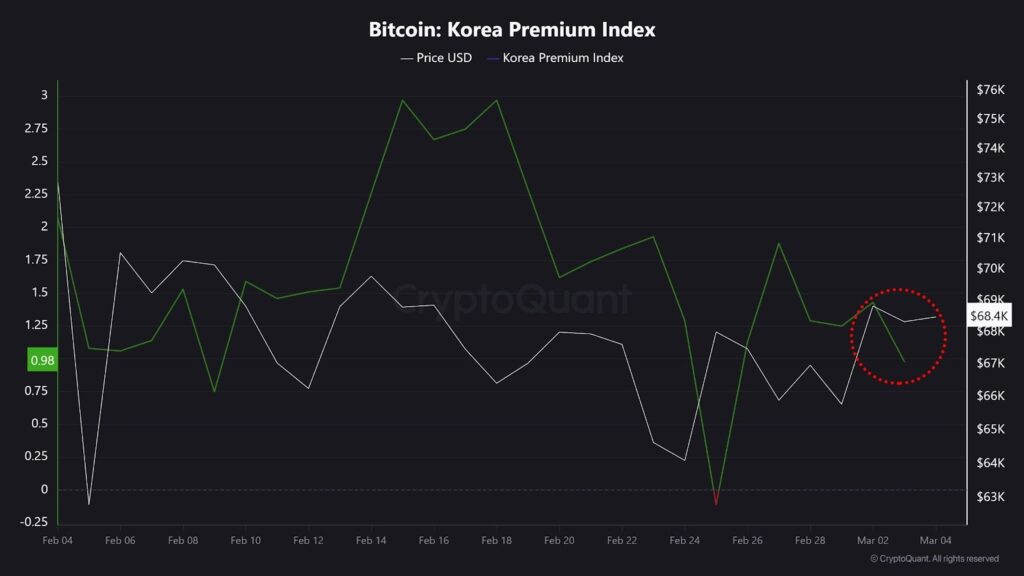
What’s interesting is the local data coming out of Korean crypto exchanges. The so-called “kimchi premium”, the gap between what Koreans pay for Bitcoin versus what people pay on international exchanges, flipped during this window. On March 2 it sat at about +0.50%, a slight premium. By March 3, it had slipped to roughly -0.35%, meaning Koreans were briefly selling below global prices. That’s a subtle but real signal: local selling pressure, or urgency to exit, was briefly outpacing global demand.
How Connected Is Korea’s Crypto Market, Really?
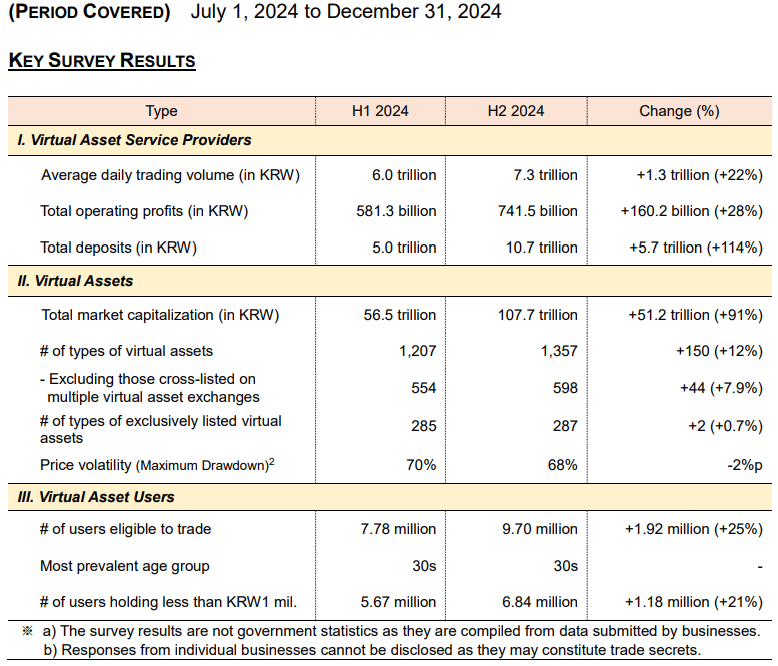
South Korea isn’t a small player in crypto. As of the end of 2024, Korea’s virtual asset market cap sat at roughly ₩107.7 trillion (around $78 billion USD). Nearly 9.7 million users were active on domestic exchanges. Average daily trading volume ran around ₩7.3 trillion.
That’s a serious market. But the connection between Korean crypto and the traditional financial system is complicated.
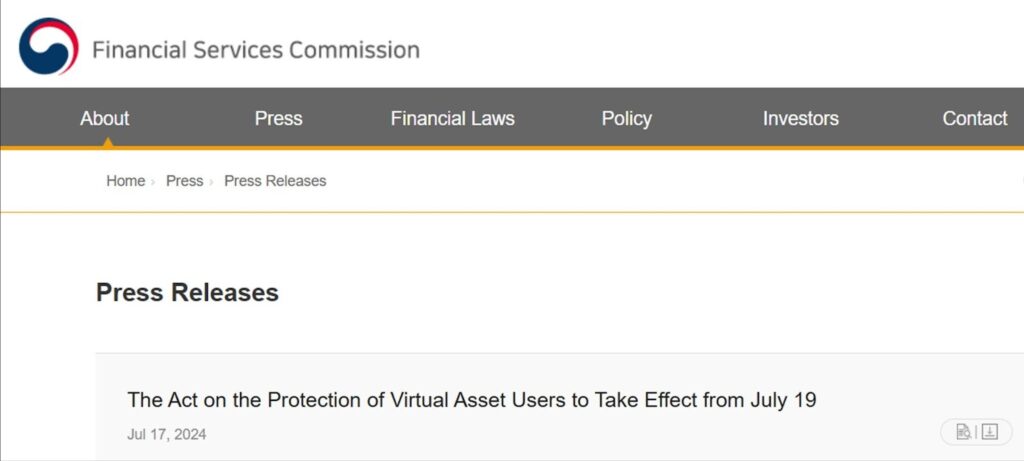
On one hand, Korea has strict rules: customer deposits must be held at banks, user assets must be kept separate from exchange assets, and suspicious transactions are actively monitored under the Virtual Asset User Protection Act, which took effect in July 2024. These rules reduce the risk of a crypto exchange failure dragging a bank down with it.
On the other hand, those same rules create friction. Moving money in and out of crypto takes more steps. Arbitrage between Korean and international prices isn’t instantaneous. That’s a big reason the kimchi premium exists at all, and why Korea can partially decouple from global crypto prices during moments of stress.
Academic research on KorBit, one of Korea’s major exchanges, confirms this. Price correlations between Korean and global Bitcoin markets are typically above 0.8, meaning they track each other closely. But during high-volatility periods, especially when the won is moving sharply, those correlations loosen. The local market can develop its own short-term personality.
Why a Korean Stock Crash Ripples Into Bitcoin
There are a few different ways the Korean equity shock transmits into crypto, and it helps to separate them.
The global macro channel is the most powerful. The KOSPI crash wasn’t really a “Korean” event, it was a Korean expression of a global shock. When that kind of fear spreads, crypto tends to trade like a high-beta risk asset, moving more than stocks in either direction. An IMF working paper on crypto-financial spillovers finds that return correlations between crypto and traditional markets increase specifically during turbulent periods, driven by negative news or external shocks. That’s exactly what happened here.
The currency channel matters specifically for Korean traders. When the won weakens sharply, the KRW price of globally USD-priced Bitcoin rises automatically, even if the dollar price hasn’t moved. That changes the calculus for local participants and shifts local premiums. Research on Korean crypto markets confirms that won depreciation is a meaningful driver of premium fluctuations.
The deleveraging channel is worth watching closely. Think back to August 2024, when the unwinding of the yen carry trade caused Bitcoin to drop around 15% alongside major equity indices. A Bank for International Settlements analysis of that episode found that Bitcoin and Ether fell as much as 20%, interpreting it as retail traders facing margin calls and being forced to close crypto positions even though crypto had nothing to do with the original trigger. The same mechanics can apply here, if traders are using leveraged positions across asset classes and one area cracks, they sell what they can.
What to Watch Next
The March 2026 Korea crash is best understood as a global oil shock filtered through a country that is unusually exposed to energy prices, with an overleveraged market that had run very far, very fast.
For anyone watching crypto through this lens, a few signals matter most going forward: the direction of USD/KRW (a weakening won tends to widen the kimchi premium and shift local behavior), the persistence of oil price disruption (the longer this drags, the more it pressures Asia-Pacific markets and global risk appetite), the sign and size of the kimchi premium (positive means local demand; negative means local selling), and any signs of forced deleveraging across equity and crypto markets at the same time.
South Korea’s financial regulator, the FSC, has been explicit about one thing: even with strong investor protections in place, virtual assets carry high volatility and risk, and no law can fully insulate users from that. In a world where a single Middle East escalation can erase months of stock gains in two days, that reminder lands with a little more weight.
This article is not financial advice. Always do your own research before making any investment decisions, you can start at blog.millionero.com. When you’re ready, trade spot and perpetuals on Millionero.