



Bitcoin has moved back above $70,000, and this rebound is starting to look like more than a random relief bounce. The market was hit hard when war headlines sent oil higher and pushed traders out of risk assets, but sentiment improved once crude cooled and signs of de-escalation began to appear. Bloomberg reported that Bitcoin rose alongside global markets after President Trump signaled that the U.S. war with Iran could be nearing its end.
What makes this move interesting is not just the price itself. It is the fact that Bitcoin recovered while traders were still dealing with war risk, inflation concerns, and uncertainty around interest rates. That tells us the market is no longer trading pure panic. It is starting to focus again on flows, positioning, and whether institutions are stepping back in.
The First Shock: War, Oil, and a Risk-Asset Selloff
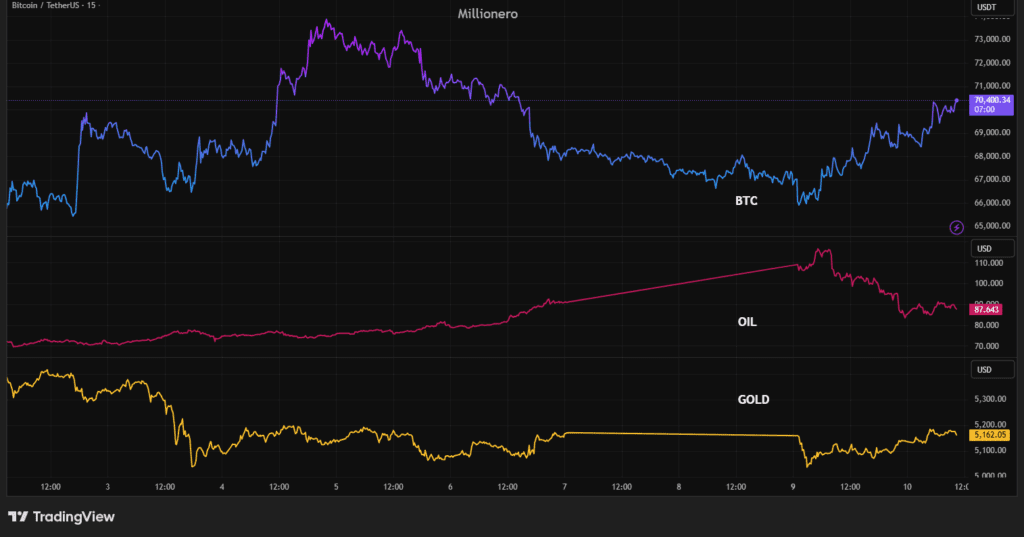
When the conflict escalated, oil became the center of the macro story. Rising tension around the Strait of Hormuz helped push oil above $110, adding to fears that inflation could stay sticky even as growth slowed. In that kind of environment, Bitcoin behaved like a liquid risk asset and sold off with the rest of the market.
But the next phase looked very different. Bitcoin later outperformed both gold and oil during the early days of the conflict, rising from about $65,492 to $73,419 while gold fell 3% and oil gained less than BTC over the same period. That does not suddenly make Bitcoin a classic safe haven, but it does show that the market absorbed the initial shock faster than many expected.
Institutional Demand Is Back in Focus
BlackRock’s IBIT Is Doing Heavy Lifting
One of the clearest supports behind this rebound has been spot Bitcoin ETF demand, especially from BlackRock’s IBIT. On March 4, IBIT absorbed $306.6 million in a single session, about 66% of that day’s ETF inflows. The same report said BlackRock had accumulated a net 21,814 BTC since February 24, worth roughly $1.55 billion at current prices.
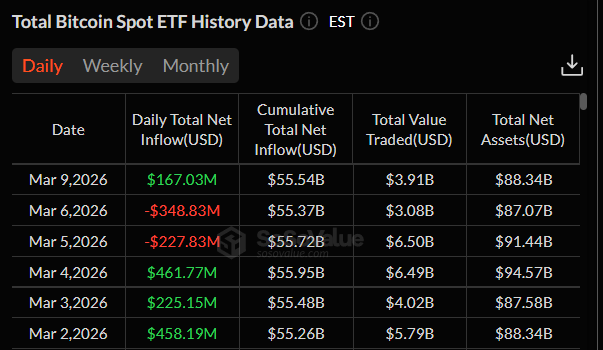
That matters because when Bitcoin is trading in a nervous macro environment, flows often matter more than narratives. If ETFs keep buying, dips can turn into accumulation zones. If those flows fade, rallies can stall fast.
Why the ETF Story Still Matters
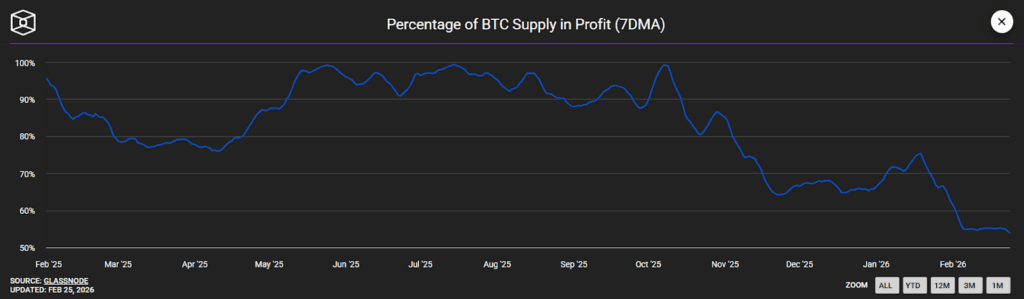
Realized profits have dropped sharply since early February and that only about 57% of Bitcoin supply is in profit. That is important because it suggests this recovery is still fragile. A market can bounce hard and still remain vulnerable if too many holders are only barely back in profit and ready to sell into strength.
What Analysts Are Seeing Now
Nansen: Resilience Is Real
Aurelie Barthere, principal research analyst at Nansen, told Sherwood News that Bitcoin’s price action has been “notable,” because earlier geopolitical shocks usually caused deeper drawdowns of around 5% to 10%. This time, the move has been much more controlled. Her read was that crypto traders may simply be exhausted and disengaged, which can sometimes become a contrarian bullish signal.
BRN and Bitfinex: Stronger, But Not Fully Free
Timothy Misir, head of research at BRN, sees the 14-day ETF flow trend turning positive, which suggests institutional selling pressure is fading. But he also warned that the next phase still depends heavily on ETF flows and derivatives positioning.
At the same time, Bitfinex analysts stated that Bitcoin is still likely to remain mostly range-bound between $63,000 and $72,000 unless macro conditions improve more clearly. They pointed to $70,000 to $72,000 as an important near-term supply zone and $78,000 as a major on-chain resistance area.
Benjamin Cowen: March Strength Can Still Be a Trap
Benjamin Cowen has taken a more cautious view. Cowen said Bitcoin often falls in January and February, rallies in March, and then weakens again in April and May. His warning is that this kind of March strength can turn into a lower high, not the start of a clean breakout. He highlighted $74,000 to $75,000 as an important resistance zone, while the broader bear-market resistance band sits near $85,000.
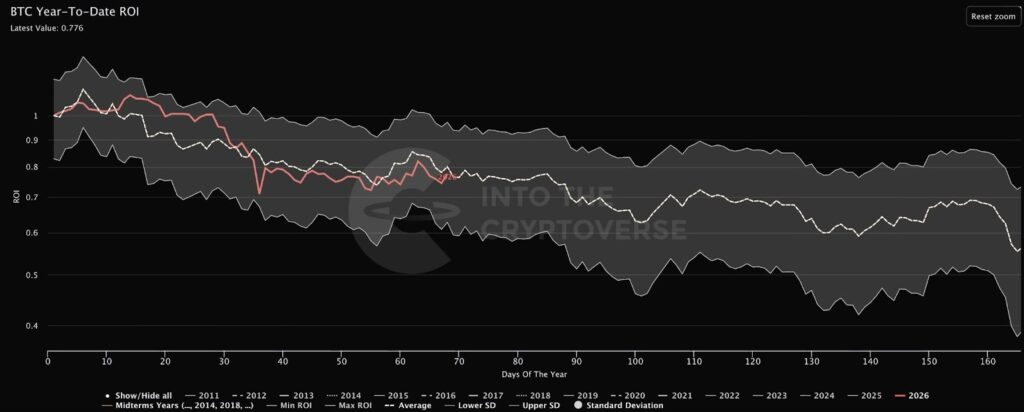
That does not kill the bullish case, but it does mean the market still has something to prove above $70K.
What Polymarket Is Pricing In
The War Market Is Still Cautious
Prediction markets are showing that traders do not believe the geopolitical story is fully over. On Polymarket’s U.S.-Iran ceasefire market, the odds of an official ceasefire are only 9% by March 15, 34% by March 31, and 53% by April 30. The probability rises to 71% by June 30, and the market has already seen more than $16.9 million in volume.
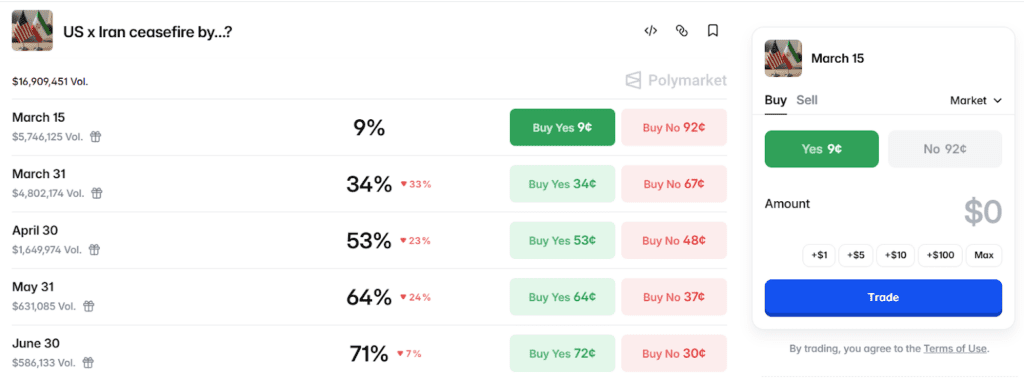
That tells us something important: Bitcoin is rallying even though the crowd still expects the conflict to remain unresolved in the near term.
The Millionero Take
Bitcoin’s move back above $70,000 looks real, but it also looks fragile.
On one side, the bulls have a strong case. War panic has cooled, oil is no longer screaming higher, ETF flows are improving, and BlackRock’s IBIT has been absorbing a meaningful amount of BTC. Analysts from Nansen and BRN see resilience and signs that institutional pressure is improving.
On the other side, the market still has clear limits. Bitfinex sees a range, Cowen sees major resistance ahead, and prediction markets are still not betting on a smooth or immediate breakout.
This article is for informational purposes only and is not financial advice. Always do your own research before making any investment decision. You can also explore more market insights on blog.millionero.com, and when you are ready, you can trade spot and perpetuals on Millionero.