


What Enso Network Is Actually Building
Enso Network is trying to solve a very real problem in crypto: using many blockchains and many protocols is still messy, fragmented, and far too technical. Instead of making developers build separate integrations for every chain, bridge, and DeFi app, Enso wants to act like a shared execution layer that bundles those actions together.
In simple terms, Enso is building infrastructure that helps apps, wallets, and even AI agents interact with onchain protocols more easily. Rather than forcing every team to manually connect to dozens of smart contracts, Enso offers a system that can turn an intended outcome into executable onchain actions.
That makes Enso more of a crypto infrastructure play than a consumer-facing token story. The network’s value depends less on hype alone and more on whether developers, protocols, and ecosystems keep using it as a backend rail.
Where ENSO Fits Into the Network
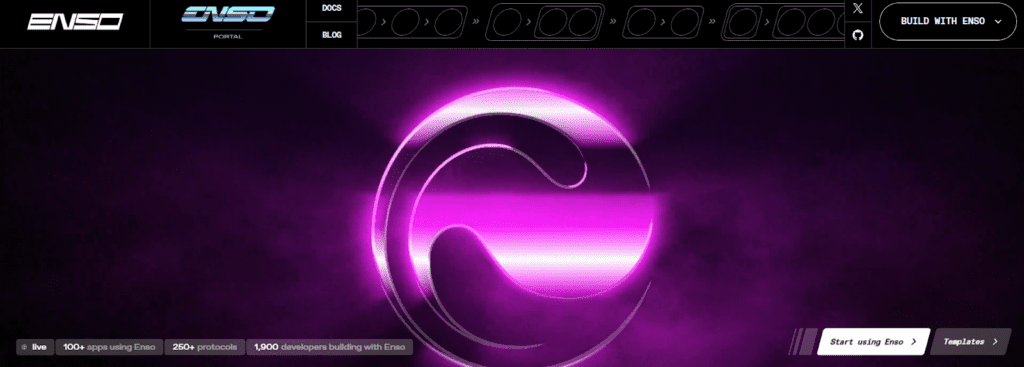
The ENSO token is meant to sit at the center of that network. It is not just a speculative asset attached to a brand name. According to the project’s design, ENSO has three main jobs: governance, validation, and delegation.
That means holders can use ENSO to take part in governance, validators can stake it to help secure and verify network activity, and delegators can back validators in exchange for a share of network economics. This gives ENSO more utility than a token that only exists for voting, although real demand still depends on whether the network sees meaningful activity over time.
This is important because many infrastructure tokens look useful on paper, but their long-term value only holds up if the underlying system attracts real builders and usage.
Funding History and Backers
Enso’s funding story has a few layers. An earlier version of the project, previously known as Enso Finance, raised $5 million in 2021. Later, in June 2024, the project announced another $4.2 million funding round led by IDEO CoLab Ventures and Hypersphere, alongside a long list of angel backers from across crypto infrastructure and DeFi.
Then came the public-facing token sale phase. Enso ran a community sale on CoinList in June 2025, offering 4 million ENSO tokens at $1.25 each, implying a fully diluted valuation of $125 million at that stage.
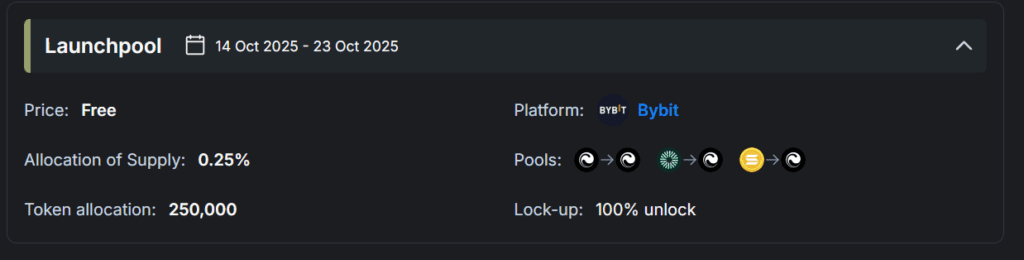
That funding path matters because it shows Enso is not a brand-new token with no backing. At the same time, it also means there is already a meaningful investor base behind the project, and that always matters when people start thinking about unlock pressure later.
Partnerships and Ecosystem Positioning
One of the stronger parts of the Enso story is its integration narrative. The project has tied itself to a number of recognizable names across crypto infrastructure and DeFi. Public materials around the network and the token sale have linked Enso with names such as Berachain, Stargate, LayerZero, Uniswap, CowSwap, Infinex, zkSync, and Sonic.
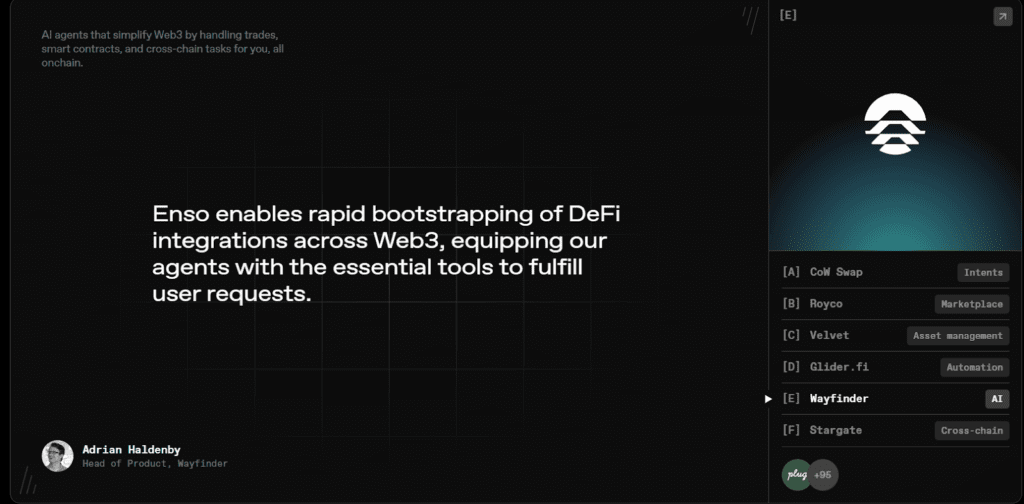
That does not automatically mean deep, revenue-heavy partnerships in every case. In crypto, the word “partnership” can mean many things, from a technical integration to a lightweight ecosystem collaboration. Still, the repeated appearance of Enso in multi-chain and launch-related workflows suggests it has managed to place itself in useful parts of the stack.
That is the kind of positioning infrastructure projects need. They do not always win through retail mindshare first. They often win by becoming part of the plumbing.
ENSO Tokenomics Explained
Enso’s tokenomics are one of the most important parts of the story, especially for investors trying to judge valuation and future supply pressure.
The project’s genesis supply is 100 million ENSO. Its long-term maximum supply is set at about 127.34 million, with the difference coming from an inflation schedule that starts higher and declines over time until it eventually stops.
The genesis allocation is split across ecosystem growth, foundation reserves, community round, advisors, investors, and team. The biggest buckets are investors at 31.305% and team at 25%, while the ecosystem allocation stands at 21.59% and the foundation at 16.605%. The community round received 4%, and advisors received 1.5%.
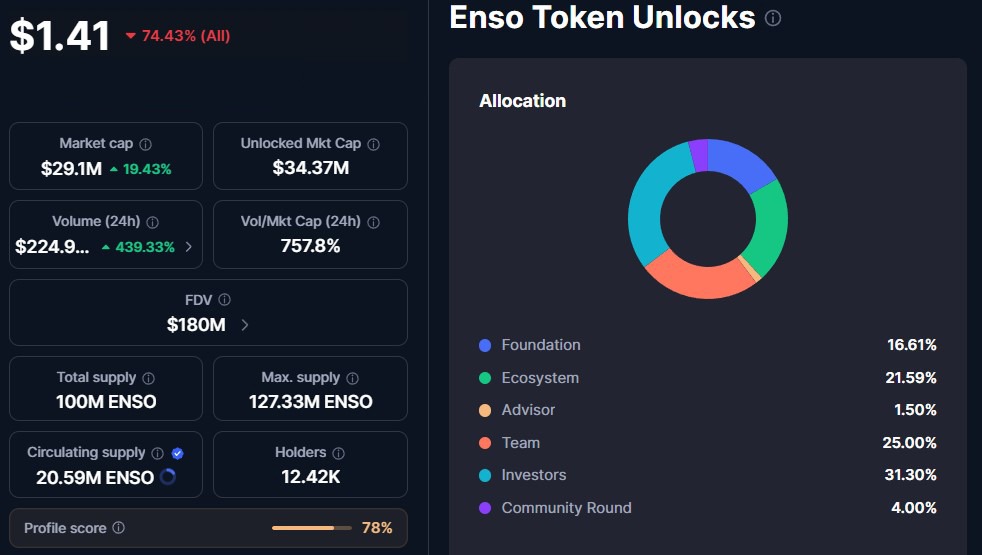
This distribution immediately tells you something important: a large part of the token base sits outside public community ownership. That is not unusual in crypto, but it does mean supply overhang is a real topic here.
Unlocks and Sell Pressure
This is where ENSO becomes much more interesting from a market perspective.
The CoinList community round was structured with full unlock at TGE, which means those tokens were already liquid. But the bigger story is the investor, team, and advisor allocation. Those buckets face a one-year cliff, followed by linear release over 24 months.
Together, those three categories account for 57.805 million ENSO. Once the cliff ends, that is a very large amount of supply that can begin entering circulation over time.
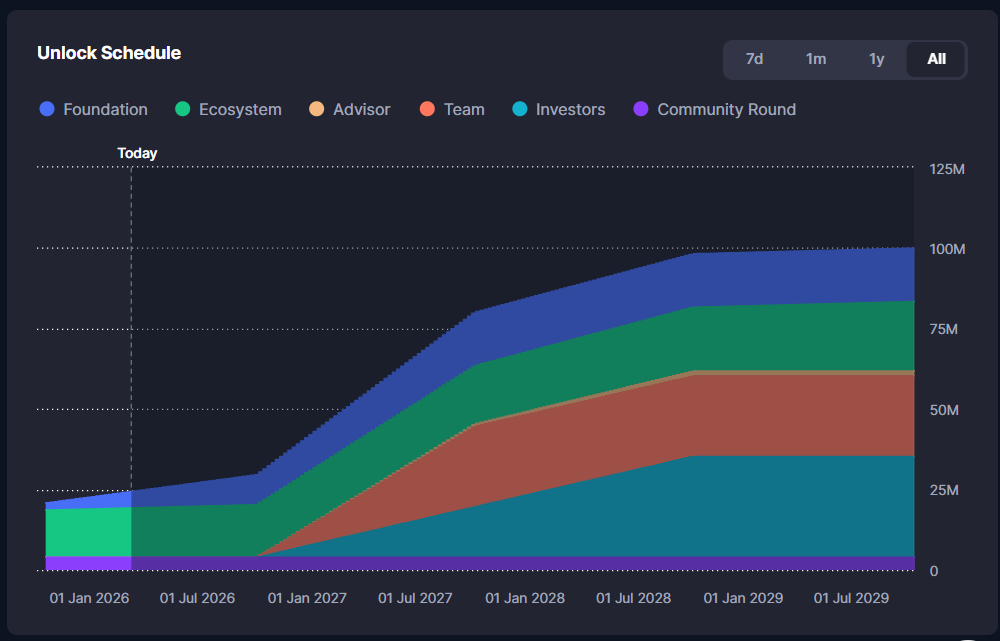
That does not mean all of it will be dumped. Some may be staked, some may stay inactive, and some may be held longer by insiders who believe in the project. But from a market structure point of view, this is still a major factor. When a token has a relatively modest circulating supply and a much larger locked base behind it, future unlocks can shape price behavior for months.
So even if Enso has solid infrastructure value, traders still need to watch the unlock calendar closely.
Market Performance and Valuation Context
ENSO has already seen strong volatility. After listing, the token traded well above its sale price at one stage, but like many altcoins, it later retraced sharply. Market data has shown a relatively small circulating supply compared with its fully diluted valuation, and that gap matters.
A token can look cheap on market cap while still being expensive on FDV. That is exactly why ENSO needs to be looked at through both lenses. If the circulating valuation appears manageable but a large share of supply is still locked, future releases can change the picture fast.
This does not make ENSO weak. It just means the token has to be judged as both a network asset and an emissions story.
Risks and Opportunities
Enso’s upside is clear. If more wallets, apps, and ecosystems use it as an execution layer, the project could become valuable infrastructure in a market that is still desperate for cleaner multi-chain interaction. The token also has more built-in purpose than many governance-only assets.
But the risks are just as real. Unlocks are large, transparency around some distribution details is not always perfectly clear, and infrastructure projects often face a long road between technical relevance and sustained token demand. There is also the classic crypto risk that good technology does not always translate into strong token performance.
That makes ENSO a project worth watching, but not one to approach blindly. The network story is serious. The token story is promising. The unlock story is the part nobody should ignore.
This article is not financial advice. Please do your own research. You can also explore more on blog.millionero.com, and when ready, trade spot and perpetuals on Millionero.