



Every day, the internet produces market opinions that vanish almost as quickly as they appear. A Twitter thread points to oil risk. A podcast guest makes a bold macro call. A video suggests a political event could move a market. Someone asks, what’s the trade here? An AI tool gives an answer, the moment passes, and the idea is gone.
paste.trade is built around that gap.
The platform takes posts, clips, articles, screenshots, and plain-text ideas, then tries to convert them into something more concrete: a public trade card with an instrument, an entry point, and live performance tracking. In simple terms, it is trying to turn online market commentary into a visible position.
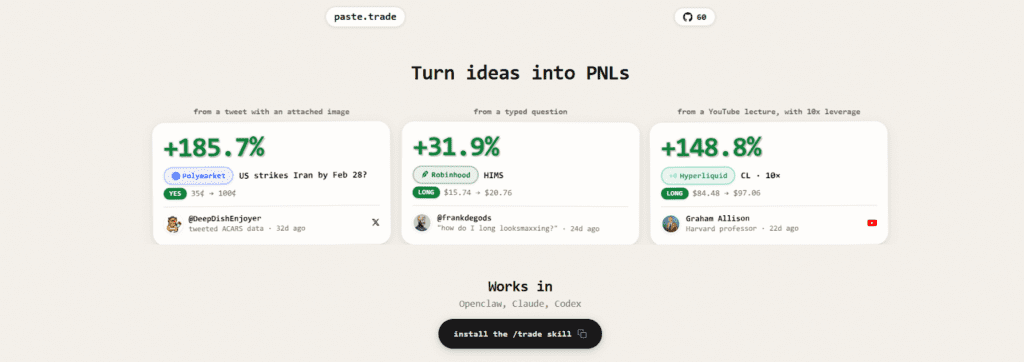
That idea is a big part of why the project has started to draw attention in 2026. Not because it promises perfect trades, but because it tries to make market takes easier to test.
Turning market opinions into something measurable
A large number of AI finance tools can already summarize a thread, explain a chart, or pull out the main point from an article. paste.trade is doing something slightly different. Instead of stopping at interpretation, it tries to push the idea one step further.
That matters because a market opinion feels very different once it has a timestamp, a route to execution, and public P&L attached to it. At that point, the idea is no longer just commentary. It becomes a claim that can be judged by the market.
This is the core of the project. It is less about AI-generated insight and more about turning loose market talk into a format that can be tracked over time.
From a post, video, or screenshot to a trade card
How the workflow is structured
paste.trade accepts a wide range of inputs, including tweets, YouTube videos, articles, podcasts, PDFs, screenshots, and typed prompts. A user can ask the tool to find the trade in a source, and the system then tries to extract one or more tradeable theses from it.
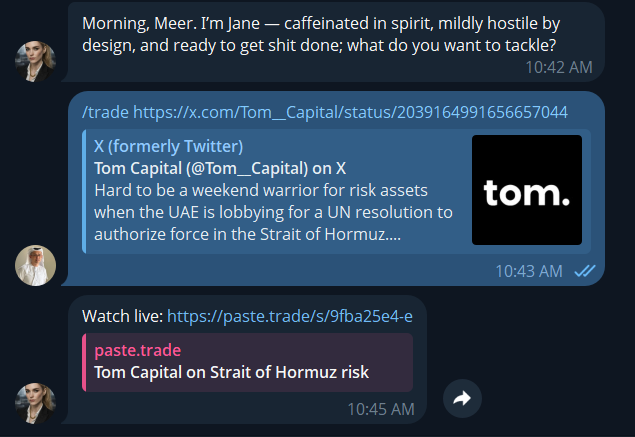
Our Editor talking to his personal Openclaw bot through Telegram
From there, the platform compares possible instruments, chooses a route, and publishes the final trade card. Depending on the idea, that can mean a stock trade, a leveraged macro position, or a prediction market bet.
How users actually run paste.trade
paste.trade is not a simple click-and-use website. It works through the terminal, and users usually need access to Claude Code, OpenAI Codex, or another AI setup connected through an API.
After installing it inside that AI environment, the user gives a command like /trade with a link, screenshot, document, or short prompt. The system then reads the source, extracts the thesis, finds a fitting instrument, and turns it into a public trade card.
So while it can handle tweets, videos, articles, PDFs, screenshots, and typed ideas, it is built more for people who already use AI in a technical workflow.
Why it tracks two different prices
One of the more useful details in the product is the split between author price and paste price.
The author price is the market price when the original source was published. The paste price is the price when the trade card was actually created and posted. That difference helps show whether the idea was caught early, late, or after the move had already started.
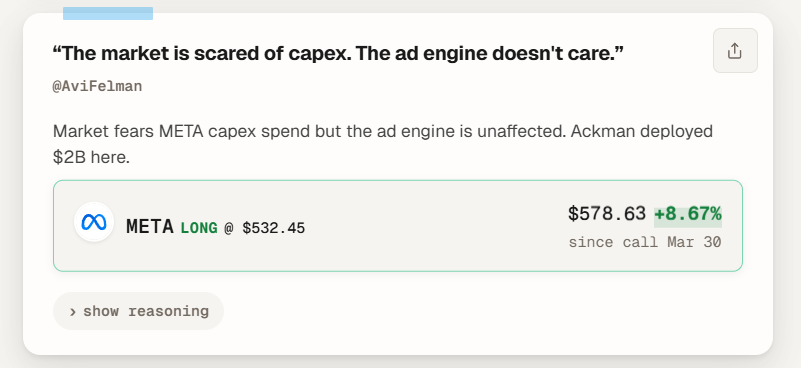
This does not make the trade better by itself. But it does add context. In fast-moving markets, the distance between the original idea and the formal trade can matter a lot, and paste.trade makes that delay visible instead of hiding it.
The project behind the platform
paste.trade is linked to Rohun Vora, better known online as Frank DeGods, who is the main developer behind the GitHub repository and the product’s public launch in March 2026.
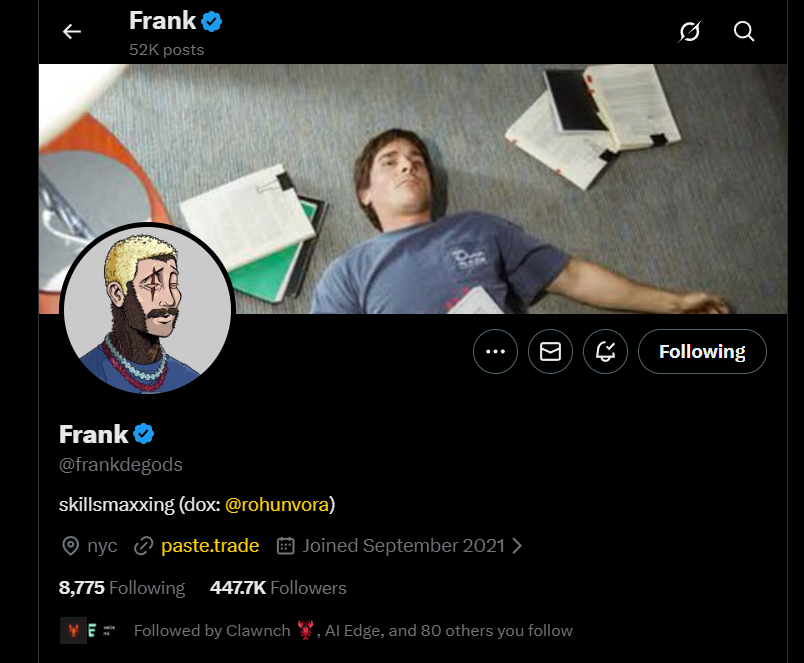
That background partly explains why the project has spread quickly through crypto-native circles. Vora is already a known figure online, and paste.trade fits into a broader shift toward tools, automation, and public experimentation. Because the project is open source, users can inspect how it works rather than rely entirely on polished product messaging.
That does not remove risk, but it does make the platform easier to examine.
The kinds of trades showing up early
Oil, geopolitics, and event-driven bets
The early examples on the platform help explain what kind of content works well with this format.
Some of the more noticeable trades have come from topics tied to current events. One example used a Graham Allison lecture on supply disruption and turned it into a leveraged crude oil position. Another used a tweet referencing military flight data and pointed toward a Polymarket contract tied to a possible US strike on Iran. There was also a consumer-theme trade built around looksmaxxing that was routed to HIMS.
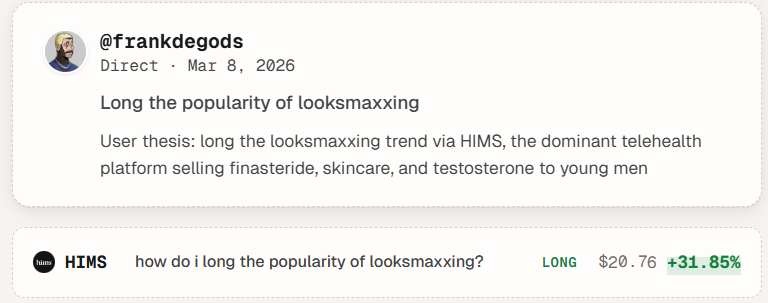
These examples suggest that paste.trade currently works best when the source contains a clear directional thesis. Geopolitical tension, oil, policy-sensitive narratives, and event-driven setups appear especially suited to that model because they already invite a direct market expression.
Users are also testing older tweets, sports markets, and past content to see how a thesis would have performed if it had been formalized at the time. That gives the platform a second use beyond live idea generation: it can also function as a way to revisit public calls and see how they would have translated into positions.
A public trading record, not a promise of profits
The most important thing to keep clear is that paste.trade is not proving that AI can reliably produce winning trades. That would be a much bigger claim, and the project does not have the long history needed to support it.
What it appears to show is something narrower. It can take a source, derive a thesis, assign an instrument, and keep the result visible. That is different from saying the trade will be right.
Every output still depends on the quality of the original source, the logic used to express it, and the market conditions around it. A clean thesis can still lose money. A well-timed idea can still be expressed through the wrong instrument. And a public trade card, by itself, does not solve the deeper problem of whether the reasoning is actually strong.
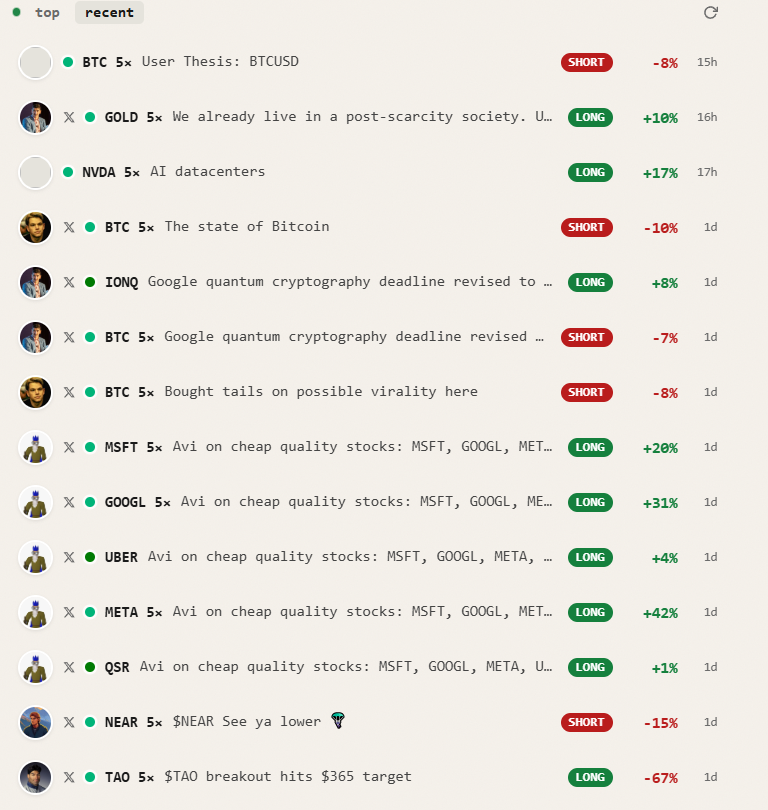
Still, the value of the platform is not hard to see. In a market filled with screenshots, opinions, hot takes, and AI summaries, paste.trade is trying to preserve the part that usually disappears: the actual trade expression and what happened after.
What the platform still has to prove
paste.trade is still very new, and that matters.
There is not yet much long-term data. The system also seems more naturally suited to directional trades than to more complex market structures. And while the open-source aspect makes the project easier to inspect, it does not automatically answer every question about consistency, edge, or long-run usefulness.
So the early interest around the platform should be understood for what it is: interest in a concept that is easy to grasp and easy to test, not proof that a new trading model has already arrived.
Final take
paste.trade is not interesting because it makes markets easier. It is interesting because it makes market opinions harder to leave vague.
It takes a tweet, a video, a screenshot, or a hunch and tries to force it into a trade that can be watched in public. That shift, from online commentary to visible exposure, is what gives the platform its shape.
Whether that turns into a lasting tool or stays a niche experiment will depend on how well it holds up over time. But for now, paste.trade is offering something that much of online market discussion lacks: a record of the call, the trade, and the result.
This article is for informational purposes only and does not constitute financial advice. Always do your own research before making any investment decisions.
For more market explainers, crypto insights, and weekly updates, visit blog.millionero.com.
Ready to act on the market? Trade spot and perpetuals on Millionero.