


Crypto users have heard the same question for years: is this token a security, a commodity, or something else?
That question has followed the US crypto market like a shadow. It has shaped exchange listings, token launches, lawsuits, investor warnings, and the way developers build. You may have entered crypto through a simple app and a price chart, but behind that clean screen sits a legal problem that has never felt simple.
Which rules apply here?
The Digital Asset Market Clarity Act, better known as the CLARITY Act, tries to give that question a clearer answer. On May 14, 2026, the bill moved forward after the Senate Banking Committee advanced it by a 15-9 vote. That vote did not make the bill law, but it gave the proposal real momentum and moved it closer to a full Senate fight.
Why This Bill Matters
For us crypto people, regulation feels far away from the actual crypto experience. People usually think about coins, charts, wallets, apps, and profit first. Regulation appears later, often during moments of stress: a token gets delisted, an exchange changes a service, a project faces legal action, or a platform suddenly limits access.
The CLARITY Act deals with the structure beneath those moments.
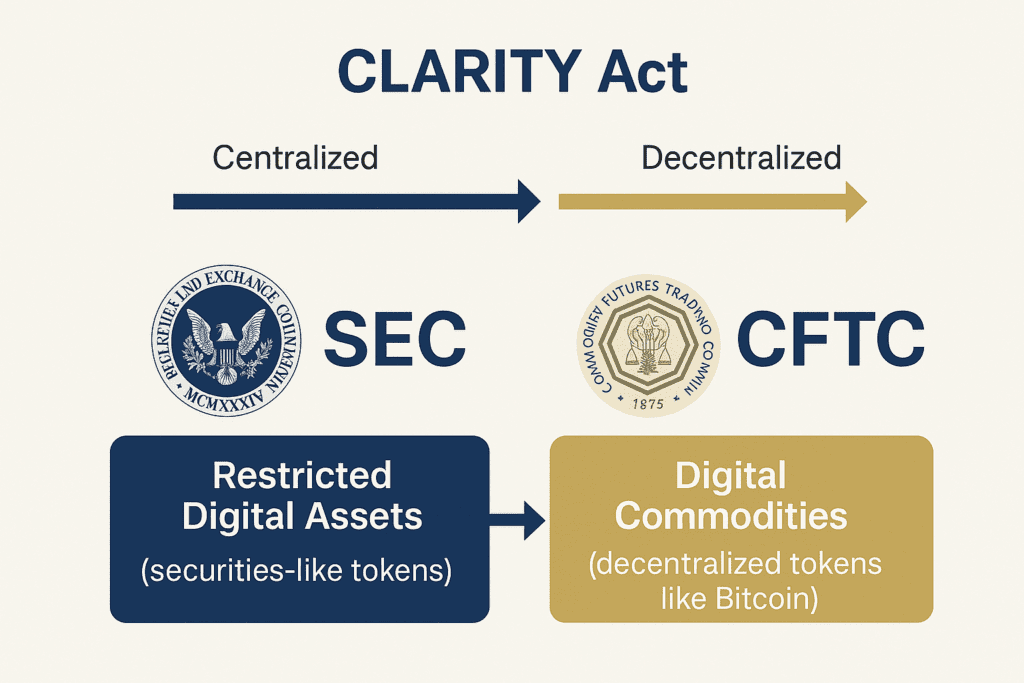
Its main goal is to define different types of digital assets and decide which US regulator should oversee them. That means drawing clearer lines between the Securities and Exchange Commission and the Commodity Futures Trading Commission.
The SEC usually deals with securities, such as stocks and investment contracts. The CFTC usually deals with commodities and derivatives markets. Crypto often sits between these worlds. A token may work as a network tool, a speculative asset, a governance instrument, or a fundraising product. Sometimes it may carry more than one role at once.
That mix has created years of confusion.
The Main Idea Behind the CLARITY Act
The bill attempts to place digital assets into better-defined legal boxes.
That could help companies understand how to launch products. It could help exchanges understand how to list assets. It could help users understand what protections exist. It could also reduce the current habit of answering major crypto questions through lawsuits after the damage has already begun.
What Happened on May 14
The May 14 vote was a real step forward. The Senate Banking Committee debated the bill, considered amendments, and advanced it to the full Senate.
All Republicans on the committee voted yes. Two Democrats, Ruben Gallego and Angela Alsobrooks, also supported the bill at this stage. Their votes gave the bill a bipartisan shape, although both signaled that their final support on the Senate floor is still not guaranteed.
That detail gives the moment its tension. The bill has momentum, yet the road ahead still demands negotiation. A committee vote opens the gate. A full Senate vote requires a wider coalition, more compromises, and enough support to survive procedural pressure.
The biggest unresolved issues include stablecoin rewards, anti-money laundering rules, DeFi coverage, banking-sector concerns, and ethics-related objections.
What the Bill Would Actually Do
The CLARITY Act is a market-structure bill. It focuses on how digital-asset markets should be organized, supervised, and regulated.
One major part gives the CFTC a clearer role over parts of the crypto spot market, especially where digital commodities are involved. Another part creates a tailored SEC disclosure and fundraising framework for certain digital assets, giving some projects crypto-specific rules instead of forcing every case into older securities-law models.
The bill also brings major digital-asset intermediaries under Bank Secrecy Act obligations. That means certain brokers, dealers, and exchanges would need anti-money laundering programs, customer identification processes, and due diligence systems.
For the market, this could create firmer expectations. For users, it could create clearer protections. For regulators, it could provide stronger tools to act against fraud, illicit finance, and abuse.
Self-Custody, Developers, and NFTs
The bill also touches one of crypto’s deepest values: direct ownership.

It protects lawful self-custody, which means users would have clearer protection for holding assets in their own wallets. It also protects many software developers and non-custodial network participants from being treated as money transmitters simply because they publish code or help operate blockchain infrastructure.
That matters because crypto was built around direct participation. Users can hold assets, interact with networks, and use software without always passing through a central gatekeeper.
The bill also creates a safer legal path for many NFTs, unless they involve an investment contract. That separates ordinary digital collectibles from products that behave like investment offerings.
The Criticism Still Matters
The CLARITY Act has serious critics. Some lawmakers argue that it leaves gaps around illicit finance, DeFi activity, sanctions evasion, mixers, and offshore stablecoin channels. Banking groups have also raised concerns that stablecoin rewards could act like interest and pull deposits away from traditional banks.
These objections may shape the next version of the bill. Clear rules still need strong safeguards. A useful crypto framework has to support innovation while protecting users and the wider financial system.
What Happens Next
The bill still needs Senate floor time. It may need 60 votes to overcome a filibuster. It also has to align with other Senate work and be reconciled with the House-passed version before it can reach the president.
So the May 14 vote was a milestone, not the finish line.
The takeaway is clear. The CLARITY Act is one of the most important attempts to turn years of crypto confusion into a federal rulebook. It could influence exchanges, token launches, DeFi tools, stablecoins, wallets, and investor protections.
Crypto moves quickly. Law moves slowly. The CLARITY Act is where those two speeds are finally meeting.
Crypto regulation can change quickly, and every trader should stay informed before making decisions. Always do your own research, manage risk carefully, and never trade with money you cannot afford to lose. For more beginner-friendly crypto education, visit the Millionero Blog. When you are ready to explore the market, you can trade on Millionero Exchange.