



For years, perpetual futures powered the crypto market. They were also off-limits to most Americans on regulated venues. That changed in mid-2026. The Commodity Futures Trading Commission opened a legal path for perpetual futures in the United States. It is one of the most important regulatory moves since the spot Bitcoin ETF approvals.
The shift matters far beyond US borders. Perpetuals are the engine of global crypto trading. When the largest derivatives market starts to embrace them, every trader should pay attention.
What the CFTC actually approved
On May 29, 2026, the CFTC approved Kalshi’s Bitcoin perpetual contract. It was the first perpetual futures contract cleared on a US designated contract market. The contract settles in cash. It tracks a live Bitcoin price index. It trades around the clock. A funding rate keeps it close to spot.
The agency did not stop at a single product. It released a policy statement on how it will treat future perpetual listings. It issued staff guidance on certain offshore perpetuals. It published an advisory on continuous markets. Together these actions built a framework, not a one-off approval.
Then came the conversion rule. On June 12, 2026, the CFTC issued a no-action letter. It lets exchanges remove expiration dates from existing perpetual-style contracts. Exchanges must give traders advance notice, clear risk disclosures, and a chance to exit. The relief is time-limited. It expires on June 30, 2026.
What a perpetual future actually is
A perpetual future is a derivative with no expiry date. You can hold the position as long as you keep enough margin. Standard futures expire on a set date. Perpetuals do not. That single difference changes how traders use them.
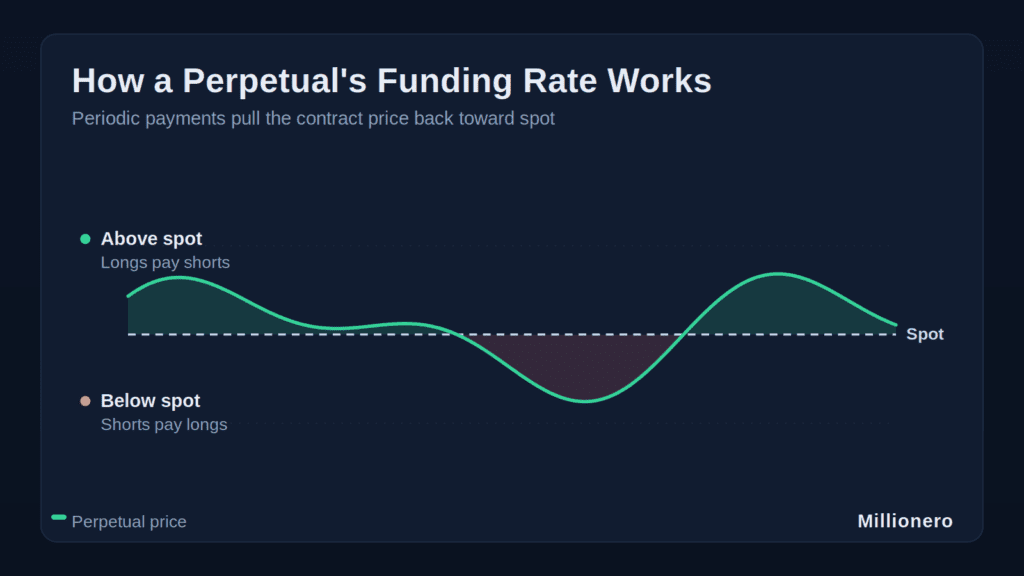
A funding rate keeps the contract aligned with the spot price. Longs and shorts exchange small periodic payments. When the contract trades above spot, longs pay shorts. When it trades below spot, shorts pay longs. This pulls the price back toward the underlying market.
Why traders prefer them
Perpetuals remove the need to roll contracts. There is no expiry calendar to manage. Liquidity pools into one contract instead of many. The basis to spot stays tight because of funding. These features made perps the dominant crypto derivative worldwide.
Why the US sat on the sidelines
Most perpetual volume has lived offshore for years. The CFTC says a clear domestic framework never existed. Chair Michael Selig argues that gap pushed trading abroad. He estimates offshore perpetual volume near 60 trillion dollars a year. That activity sat beyond US oversight and consumer protection.
Selig also pushed back on common objections. Some critics said a futures contract needs a fixed expiry date. He noted that US law does not define the term that way. Other critics pointed to extreme leverage as high as 250 times. He replied that such leverage is an offshore habit, not a built-in feature of the contract. He also framed the funding rate as a constraint that keeps the contract tied to spot.
What changes for traders now
US venues are moving fast. Kalshi launched its perpetual contract on approval day. It cleared over one billion dollars in volume during its first week. Kraken went live on June 14, 2026, through its Bitnomial exchange. Its lineup covers nine crypto assets. Coinbase secured a path to offer offshore perpetuals to US users. It plans its own US product later in 2026.
For US traders, a regulated domestic option now exists. The cost and tax profile differs from offshore venues. Institutions gain legal access to perpetual exposure for the first time. Hedge funds and family offices can finally participate within the rules. That flow could reshape how Bitcoin derivatives trade over the next year.
The risks regulators still flag
Not everyone welcomes the change. Consumer advocates call perpetuals risky for retail traders. They point to leverage that can trigger fast liquidations. They warn that nonstop markets expose traders to constant volatility. They argue that the absence of an expiry date can encourage overtrading.
The approval also faces industry friction. Reports indicate the CME plans to challenge the move in court. The CFTC has stressed that each asset needs its own review. Bitcoin cleared first. Other tokens are not automatically approved. The path forward will be slow and case by case.
What it signals for the market
This is a structural change, not a passing headline. The US is folding crypto’s busiest product into its own rule set. Liquidity that once fled offshore now has a domestic home. The funding rate and the no-expiry model are going mainstream. Traders everywhere should understand how these contracts work.
Perpetuals reward discipline and punish careless leverage. The mechanics are simple, yet the risk is very real. Learn the funding rate. Respect your margin. Size every position with care. The product is becoming more accessible, so the responsibility shifts to the trader.
Trade on Millionero.