



The stablecoin war escalated sharply this week. On June 30, a consortium of more than 140 companies unveiled a new dollar token called Open USD. One day later, on July 1, Europe’s toughest stablecoin rules reached their hard deadline. Two separate forces are now reshaping the same market. One attacks the economics. The other attacks who is even allowed to compete. For traders, the base layer of the market is shifting under their feet.
The $300 billion business everyone wants a piece of
Stablecoins have grown into critical financial plumbing. The market now tops $300 billion, according to CoinDesk. Citi has projected it could reach $4 trillion by 2030. That scale explains the sudden rush of new entrants.
The current business model is simple and lucrative. An issuer takes in dollars. It buys US Treasuries and other safe assets. It keeps the interest and hands users a token worth one dollar. Tether and Circle have dominated this model for years. Tether’s USDT sits near $145 billion in circulation, while Circle’s USDC sits around $73 billion, per CoinDesk. Both companies earn most of their revenue from reserve interest they do not share.
Open USD flips the economics
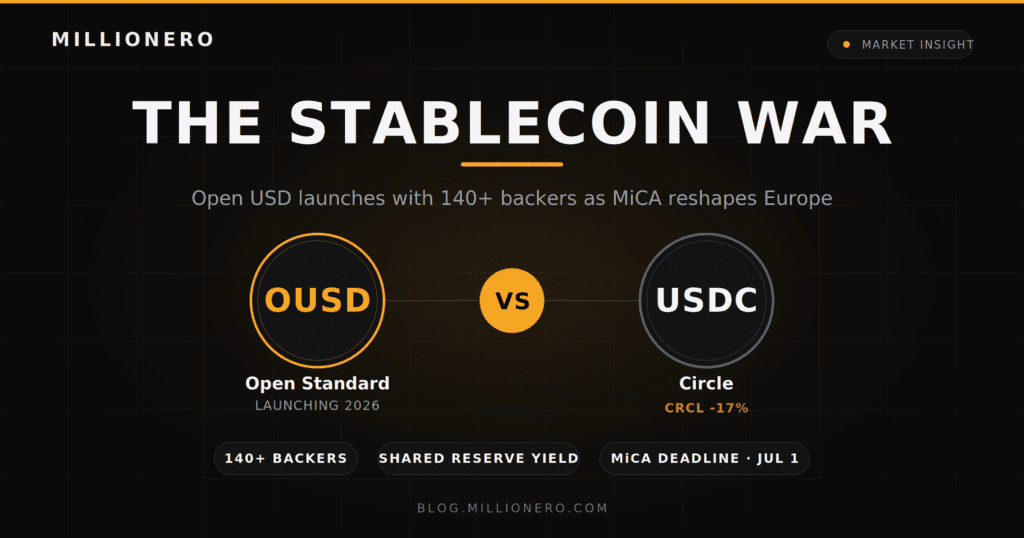
On June 30, an independent operator called Open Standard unveiled Open USD, ticker OUSD. The backer list is unusually broad. It includes Stripe, Coinbase, Visa, Mastercard, BlackRock, BNY, Google, Shopify, Ripple and Solana. In total, more than 140 firms have signed on, according to CoinDesk and The Block. Zach Abrams leads the project as interim chief executive. He previously co-founded Bridge, the stablecoin infrastructure firm that Stripe acquired for about $1.1 billion.
The design breaks the old model in three ways. Businesses can mint and redeem OUSD for free, with no volume caps. Reserve earnings flow to the partners who drive adoption, not to a single issuer, minus a small management fee. Governance sits with a board of partner companies rather than one corporate parent. Stripe has already said OUSD will become the default stablecoin for businesses on its platform, according to The Block. The token is expected to launch later in 2026, starting on Solana.
Why Circle’s stock cratered
Circle was the clearest casualty. Its shares fell more than 17% on June 30 to a four-month low. They closed below $63, according to CoinDesk and Blockhead. The drop makes sense. Circle’s entire business depends on keeping the interest on USDC reserves. OUSD proposes to share that interest instead.
The Coinbase detail stings most. Circle paid Coinbase more than $900 million in 2024 to distribute USDC, according to Blockhead. Coinbase still earns a share of that reserve revenue. Yet Coinbase signed on to the rival OUSD anyway. That raises an obvious question about future negotiations. Circle chief executive Jeremy Allaire played down the threat. He said the company welcomes continued innovation and competition, in a post on X. Tether chief executive Paolo Ardoino was blunter, writing that a second player had entered the game.
MiCA splits the market in Europe
The second front is regulatory, and it hit its deadline on July 1. Europe’s Markets in Crypto-Assets rules, known as MiCA, reached full enforcement for stablecoins that day. The effect is stark. Tether never applied for the electronic money token authorization that MiCA requires. As a result, licensed European exchanges have pulled USDT from their order books, according to Phemex and multiple exchange notices.
Circle took the opposite path. It secured an electronic money institution license in France, according to reporting on the deadline. That keeps USDC and its euro token EURC compliant on regulated European venues. The split is clean. Compliance, not market share, now decides which stablecoin a regulated venue can list.
The liquidity impact is already visible. Data from Kaiko showed USDT volumes on European venues fell more than 70% between late 2024 and mid 2025. Over the same period, USDC volumes nearly doubled, according to figures cited by Eco. Holding USDT remains legal in self-custody and on decentralized exchanges. The restriction applies to regulated service providers, not to the asset itself.
Distribution is the new moat
Put both fronts of the stablecoin war side by side, and a pattern appears. Value in this business is moving away from the issuer. It is moving toward whoever controls distribution and settlement. MiCA rewards the firm with the right license. Open USD rewards the firms that route the volume. Both shift power to the rails, not the token factory.
Arca chief investment officer Jeff Dorman made this point directly. He argued the real value now sits with those who distribute and settle stablecoins, according to Blockhead. That means exchanges, wallets, payment processors and blockchains. Open Standard has assembled exactly that kind of network. On paper, the incentive design is powerful.
The skeptics have a fair case too. Dragonfly partner Rob Hadick called the partner list a genuine threat to Circle. Yet he warned that large consortiums break easily, because incentives rarely stay aligned, according to Blockhead. Clear Street’s Owen Lau called the 17% selloff an overreaction. He pointed to Paxos and its partner-owned Global Dollar Network. That token uses a similar revenue model. Yet it has grown to only about $3 billion in supply, according to Blockhead. A list of 140 logos is not the same as 140 companies routing real volume.
What the stablecoin war means for traders
Nothing about your trading changes overnight. Open USD is not live yet, and its adoption is unproven. Still, three shifts are worth tracking.
First, a stablecoin now carries a regulatory status of its own. Where you can use a token, and on which venue, may depend on that status. This is new. It matters most if you trade across both European and offshore platforms.
Second, watch liquidity fragmentation. As European desks move to USDC while offshore desks keep USDT, base pairs can diverge. Thinner order books can widen spreads and increase slippage on large orders, as market participants noted to ForkLog.
Third, keep an eye on which stablecoins your venue actually supports. The settlement layer under your trades is becoming a competitive battleground. If a partner-owned token like Open USD gains real traction, base-pair choices and incentives could shift again. For now, the smart move is simple. Understand what backs the stablecoin you hold, and know where it is accepted.
Disclaimer: This article is for informational and educational purposes only. It does not constitute financial, investment, or trading advice. Crypto assets are volatile and carry significant risk. Always do your own research and consider your risk tolerance before trading. Read more on Millionero Blog.
Trade on Millionero exchange.