


Some companies today are turning themselves into something strange: half business, half crypto wallet. Instead of just selling products or services, they put billions of dollars’ worth of coins like Bitcoin, Ethereum, or even Dogecoin on their balance sheet and then run their company around that stash. These firms are sometimes called crypto treasury companies. They live and die by the price of the coins they hold. Let’s break down how they work, why they do it, and what risks they face when markets turn ugly.
What is a crypto treasury company?
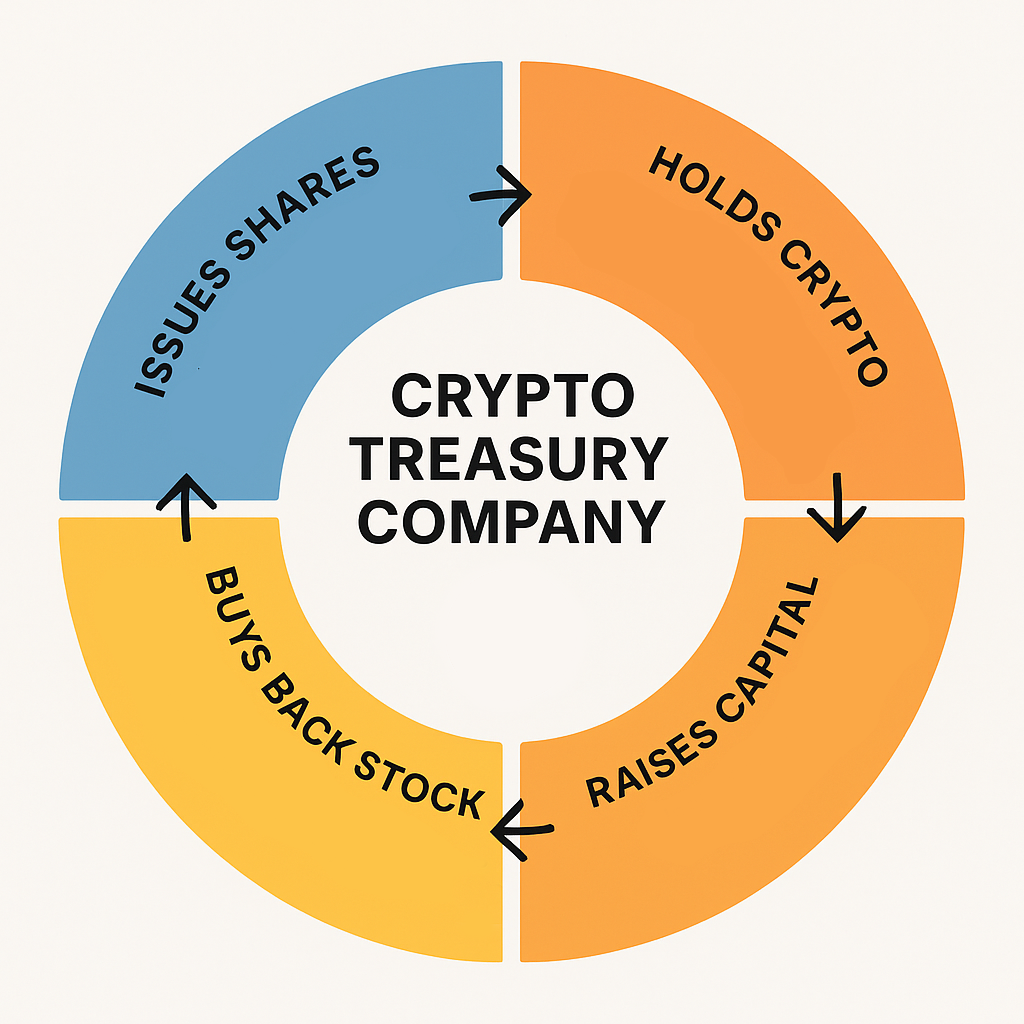
It’s a public company (listed on the stock market) that buys and holds a big pile of crypto. Its main “business model” is basically:
- Collect crypto (like BTC, ETH, DOGE).
- Use Wall Street tools (selling shares, buying back shares, issuing debt) to manage that stash.
The classic example is MicroStrategy, which over time has turned itself into the “Bitcoin company.” As of 2025 it holds more than 600,000 BTC. It sells shares and bonds to raise money, then buys more bitcoin.
Now others are copying that playbook:
- SharpLink Gaming is the Ethereum treasury company. It has billions in ETH and just started a $1.5B buyback program, beginning with $15M worth of stock repurchases.
- Forward Industries says it will become a Solana treasury company.
- CleanCore is collecting Dogecoin, it already holds hundreds of millions of DOGE.
Why would any company do this?
- Stock price boost: If a company’s stock trades for more than the value of the coins it holds (called “premium”), it can issue new shares, use that money to buy more crypto, and make each share worth even more.
- Investor hype: Being “the Bitcoin company” or “the Dogecoin company” is a great marketing hook. It makes investors and media pay attention.
- New accounting rules help: In the past, companies had to write down the value of crypto when prices dropped but couldn’t record gains as easily. In 2023, new US accounting rules made it simpler: companies can now show crypto’s true market value on their financial statements. That makes this model less messy for CFOs.
ETH vs. BTC vs. DOGE treasuries
- Ethereum (ETH): ETH companies can also stake their coins to earn yield (like earning interest). That income can help them run the company or fund stock buybacks without selling their ETH. This gives ETH treasuries a bit of an edge.
- Bitcoin (BTC): BTC treasuries are the pure “digital gold” bet. No yield, but the story is simple: hold BTC and don’t sell. MicroStrategy is the template.
- Dogecoin (DOGE): DOGE treasuries are the riskiest. DOGE doesn’t generate yield, and its price is driven mostly by memes and hype. But some firms are betting that community + brand = long-term value.
- Solana (SOL): SOL treasuries are newer. They’re a bet on a fast-growing blockchain ecosystem. They carry more growth upside but also more execution risk.
How buybacks and share sales work
Here’s the trick these companies play with their stock:
- If the stock trades above the value of the coins it holds: The company sells new shares, uses the money to buy more crypto, and makes each share backed by more crypto than before. Good deal for existing investors.
- If the stock trades below the value of its coins: Issuing new shares would dilute everyone, so the company may do the opposite, buy back its own stock to reduce the discount. That’s exactly what SharpLink is doing now with ETH.
If the buyback works, investors feel more confident and the stock price rises closer to the value of the crypto it holds. If it fails, the company just spends cash (or sells crypto) without fixing the problem.
Can this model last?
It can work when:
- The company’s stock trades at or above the value of its crypto.
- The coin it holds has strong demand and deep liquidity (BTC, ETH).
- ETH treasuries earn steady staking rewards to cover buybacks or expenses.
- The company shows clear and transparent financial reporting.
It breaks when:
- The stock stays at a discount to its crypto value for a long time.
- The company takes on too much debt and can’t service it in a downturn.
- The coin it holds is super volatile and has no yield (DOGE risk).
What happens in a bear market?
This is where the strategy really gets tested.
- Raising money becomes impossible. If the stock trades well below the value of the coins, issuing new shares only makes things worse.
- Buybacks may drain cash. Companies start buying their own stock to close the gap, but that costs money, and sometimes means selling crypto to fund it.
- Debt pressure rises. If they borrowed money during the bull run, those interest payments don’t go away in a bear market.
- Earnings look messy. Because crypto prices swing so much, company earnings bounce up and down too. Investors may lose patience.
What should investors watch?
If you’re looking at one of these stocks, here are the key signals:
- Price vs NAV (Net Asset Value). Is the stock trading above the value of its crypto or below? Above = growth flywheel, below = stress.
- Debt levels. Leverage helps in a bull run, kills in a bear.
- Staking policy (for ETH). Are they only using the staking yield, or are they dipping into principal?
- Type of coin. BTC and ETH have deep liquidity. DOGE and SOL are spicier but riskier.
- Disclosure. Are they clear about how much crypto they hold and what each share is worth?
Where is this going?
If ETH treasuries like SharpLink show success, expect more “single-coin companies” to appear: the Solana company, the DOGE company, maybe even the meme coin company. These firms become public stock wrappers for crypto, part marketing, part balance sheet game.
But remember: they are not magic. They rise and fall with the cycles of the coins they hold. In good times, they can outperform the coins themselves. In bad times, they can underperform badly.
Final Word
Crypto treasury companies are basically Wall Street wrappers for crypto assets. They can make coin exposure more exciting by adding stock market tools like buybacks and share sales. But they also add more moving parts, and more ways to fail in a downturn.
If you like the coin, it’s usually easier just to buy the coin on Millionero. If you want the extra spice, then watch price vs NAV, debt, and how they manage buybacks very closely.
This article is for educational purposes only and does not constitute financial advice. Please do your own research (DYOR) before investing. Blog.millionero.com can also provide you with a ton of useful information. Millionero provides a secure platform for trading spot and perpetual markets with confidence.