


The past few weeks have shown something very important about Ethereum: even the biggest, most confident buyers can get cold feet when the market turns ugly.
On the surface, the news is simple: a $1 billion Ethereum DAT plan has been shelved, a major ETH treasury company is sitting on heavy paper losses, ETFs are still seeing net outflows, and yet some big voices on Wall Street are calling this a “once-in-a-lifetime buying opportunity.”
Let’s unpack all of this.
The $1 Billion DAT That Just Hit Pause
A group of powerful Asian investors, led by Li Lin’s Avenir Group and joined by Distributed Capital, Wanxiang Capital, and Meitu, had put together a plan to buy about $1 billion of ETH.

The structure was:
- Use a Nasdaq-listed shell company
- Turn it into a DAT (Digital Asset Treasury) focused on Ethereum
- Fund it with:
- About $200 million from Avenir
- Around $500 million from other Asian institutions
- The rest from additional investors
- About $200 million from Avenir
This would have been one of the largest Ethereum treasury vehicles in the world.
Instead, the plan has been put on hold, and roughly $200 million already raised has been returned to investors. Industry sources link this pause to:
- The sharp market drop after the so-called “1011 Incident”
- The falling stock prices of several listed DAT-style companies
- A desire to “protect investors” and “wait for better conditions”
In plain terms:
Big players still like Ethereum, but they are not willing to launch a giant, high-profile ETH vehicle while their own share prices are bleeding.
What Was the “1011 Incident”?
The “1011 Incident” is the nickname for the huge crypto crash on October 11, 2025.
On that day:
- More than $19 billion worth of positions were liquidated in a single day
- Bitcoin dropped roughly $15,000 from its recent levels
- The event exposed hidden leverage and weak spots in the market structure
It wasn’t quite a once-in-a-generation “black swan,” but it was still a major shock.
For DAT-style companies, whose whole brand is “we hold crypto on our balance sheet,” such a crash hits both:
- The price of the crypto they hold
- The stock price investors are willing to pay for their shares
So, launching a giant new Ethereum DAT into that environment suddenly looked risky.
BitMine: The Giant Ethereum Holder Everyone Watches
In this story, BitMine sits at the center.
- BitMine is currently seen as the largest Ethereum treasury company in the world, and it has been continuously accumulating. It now holds about 3,559,879 ETH, which is roughly 2.949% of the total ETH supply.
- That makes it a key benchmark for how “institutional Ethereum” is doing.
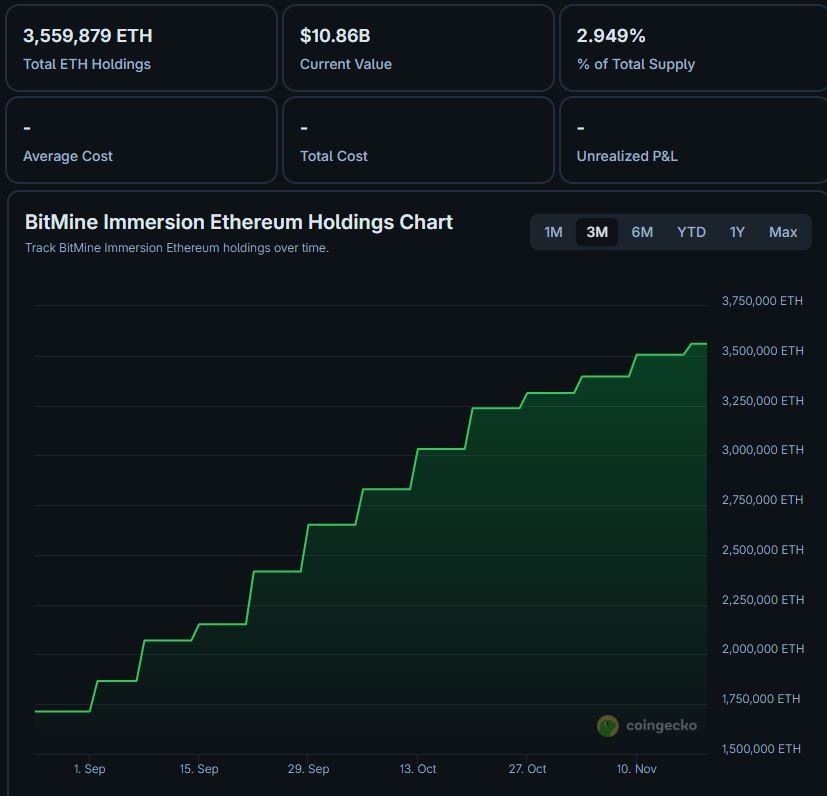
The company has announced that it will release its Q4 and full-year 2025 results (for the period ending August 31, 2025) before the U.S. market opens on November 21.
Those results matter for several reasons:
- Investors want to see how much ETH BitMine holds now
- They want to know if the company is still in aggressive accumulation mode or slowing down
- They want clues on how management sees Ethereum after the 1011 crash
If BitMine sounds bullish and continues to add ETH, it sends a signal that some big players still think long-term Ethereum is cheap here. If it sounds defensive, the mood could flip the other way.
SharpLink: Heavy ETH Bags and a Quiet OTC Move
Then we have SharpLink, another major Ethereum treasury company.
Onchain data shows that SharpLink moved 5,442 ETH (about $17 million) from its main address to Galaxy Digital’s OTC wallet a few hours ago. However, official treasury data (for example, CoinGecko’s tracking) does not show a reduction in its holdings. In fact, SharpLink’s reported ETH balance rose from 838,728 ETH to 859,853 ETH on October 21, confirming that it has continued to accumulate, not de-risk.
SharpLink now:
- Holds around 859,853 ETH
- Has an average buying price of about $3,609 per ETH
- With ETH trading near the $3,000 level, is still sitting on a large unrealized loss on its position
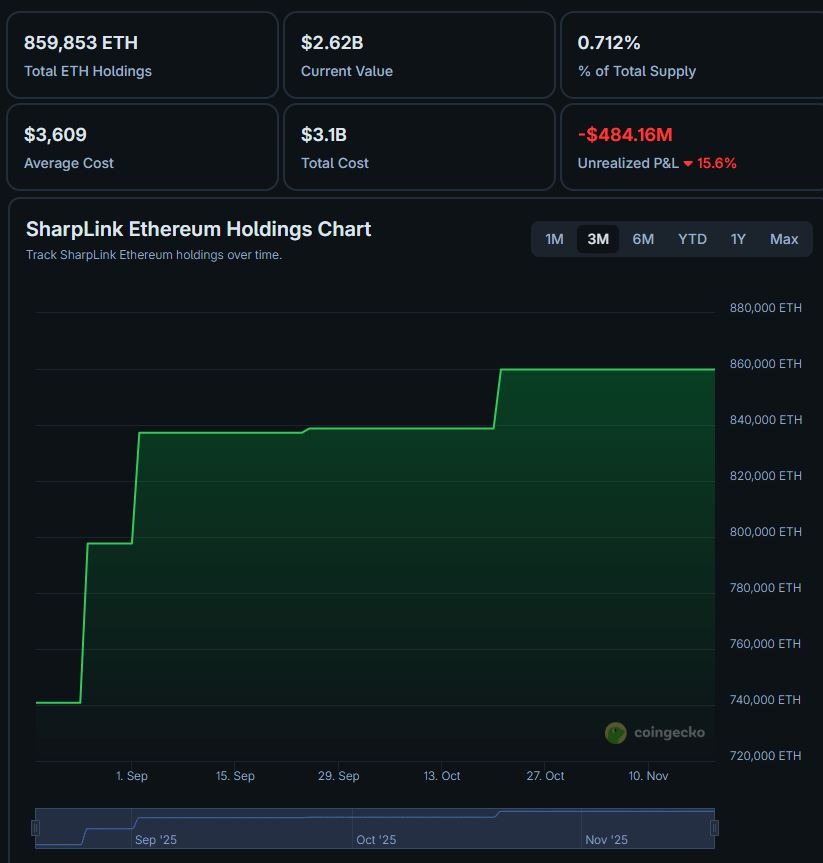
That is a huge number. It shows how brutal this down-move has been for listed ETH treasuries:
- Their tokens are down
- Their stocks are down
- Their shareholders are nervous
A single OTC transfer does not mean “they are panic-selling everything,” but it does show pressure. Treasury-style companies do not like showing massive paper losses quarter after quarter.
A New Whale Wallet
While one treasury is under stress, another sign points in the opposite direction.
Onchain monitoring has spotted a new wallet that just received 21,045 ETH from Kraken, worth around $64.3 million. The address is new, and there is speculation that it may belong to BitMine, though this is not confirmed.
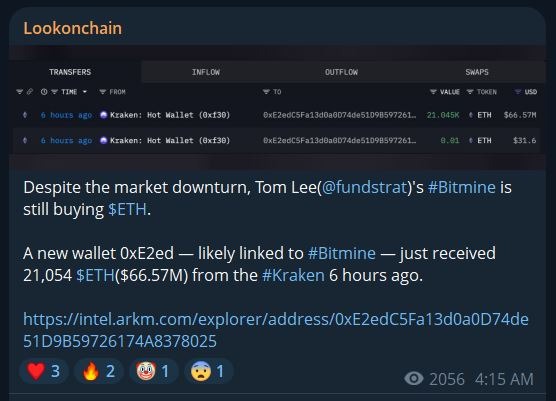
If it is BitMine or another institutional buyer, this suggests that someone is still willing to buy tens of millions of dollars worth of ETH into weakness, even while the big DAT plan is paused and treasuries like SharpLink show heavy losses.
This tension is exactly what defines market bottoms:
- some players are forced or scared into trimming,
- others quietly soak up supply.
Are We Near a Bottom? The Tom Lee & Matt Hougan View
Tom Lee, the chairman of BitMine, has said he thinks the market will be “close to bottoming out” this week.
Matt Hougan, CIO of Bitwise, agrees and even calls the current environment a “once-in-a-lifetime long-term buying opportunity.”
Hougan’s argument, in simple words:
- People are too worried about:
- AI stock valuations
- The macro environment
- Tariff and trade tensions
- AI stock valuations
- These worries have pushed prices down more than the actual long-term damage justifies
- For long-term investors, this correction may be giving better entry prices, not worse ones
This is the classic clash between short-term fear and long-term conviction.
Ethereum Spot ETFs: Six Days of Net Outflows
The ETF data tells another side of the story.
According to SoSoValue, Ethereum spot ETFs saw a net outflow of about $74.22 million yesterday (Nov 18, U.S. time), marking six straight days of net outflows.
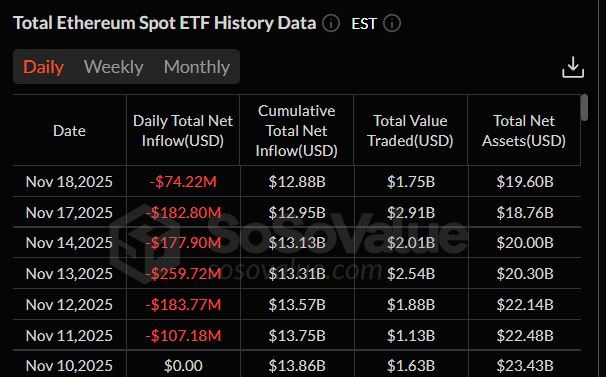
But the picture inside the ETF group is more nuanced:
- Grayscale, Bitwise, VanEck, and Franklin Templeton all recorded net inflows into their Ethereum spot products yesterday.
- The only ETF with a net outflow was BlackRock’s Ethereum fund, but its selling was large enough to pull the entire group into a combined net outflow of $74.22 million on the day.
So what does that mean?
- At the headline level, money is still leaving Ethereum ETFs overall.
- Under the surface, there is rotation: some investors are shifting into non-BlackRock products they see as cheaper, better structured, or a better long-term fit.
- As long as total flows stay negative, ETFs still add a layer of steady sell pressure on ETH, which helps explain why price has struggled to hold higher levels even while some issuers are quietly seeing fresh demand.
What All This Means for a Normal Investor
Put together, these signals tell a complex but readable story:
- A high-profile $1B ETH DAT is paused, not canceled
- The pause is mainly about timing and optics after a huge crash, not a total loss of faith in Ethereum
- BitMine remains a massive ETH holder, with earnings this week that could either calm or shake markets
- SharpLink is an example of how painful this drawdown has been for treasuries, sitting on hundreds of millions in paper losses and starting to move chunks of ETH via OTC
- A new wallet is quietly absorbing more than $60 million in ETH from Kraken
- ETF flows are negative overall, but some products like Grayscale’s mini trust still attract fresh capital
Are we at the exact bottom?
No one knows. Not Tom Lee, not Matt Hougan, not BitMine’s board, and certainly not retail traders scrolling through charts at 3 a.m.
But we can say this, in simple terms:
- Risk is real: DAT stocks are down, treasuries are underwater, and leverage has been punished.
- Time horizon matters: the people still buying, treasury companies, long-only funds, quiet whales, are usually thinking in years, not days.
- For regular investors, the lesson is not “ape into ETH now,” but:
- Understand who is selling and who is buying
- Respect how brutal drawdowns can be, even for “smart money”
- Only take risks that fit your own timeline, income, and stress level
- Understand who is selling and who is buying
Markets will keep moving. DATs may come back when the dust settles. Ethereum’s story as an institutional asset is clearly not over, but it is going through a harsh reality check.
This article is not financial advice. Always do your own research and manage your risk.
For simple breakdowns of institutional flows and ETFs, visit blog.millionero.com.
When you’re ready, you can trade spot and perps on Millionero with low fees and a clean interface.