


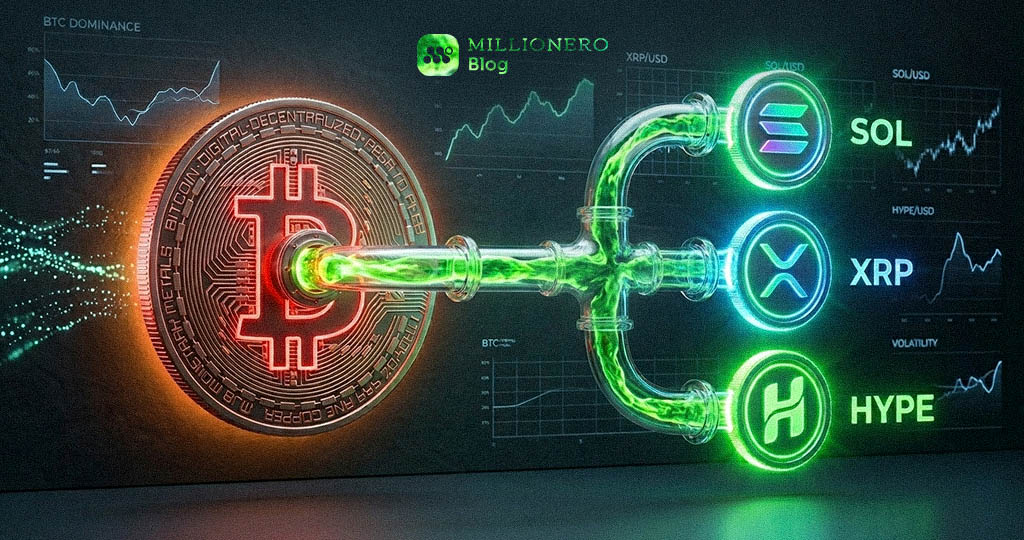
The headlines say crypto is bleeding. The ETF data tells a more useful story.
Yes, prices are down and fear is high. But underneath the sell-off, institutional money is not running for the exit. It is moving from one part of the market to another. For traders, that distinction matters far more than the red on the screen.
This is the difference between an exit and a rotation. One means capital is leaving the asset class. The other means it is repositioning inside it. Right now, the flows point clearly toward the second.
The divergence in the data
Look at what institutions did on June 9. They pulled money out of Bitcoin and Ethereum spot ETFs. At the same time, they added capital to XRP and Solana funds.
Bitcoin spot ETFs posted roughly $77 million in net outflows that day. XRP ETFs, by contrast, took in about $7.44 million. That pushed cumulative XRP ETF inflows since launch to $1.43 billion, with net assets near $982 million. Solana funds also drew fresh capital on the same session.
This is not a one day blip. Bitcoin ETFs have now logged 13 straight days of outflows. They have shed about $4.37 billion since mid May. Total assets fell to $82.83 billion from $104.29 billion over that stretch.
So the majors are losing institutional support while select altcoins gain it. That is rotation, not capitulation.
Why HYPE is the standout
One asset breaks the pattern entirely. Hyperliquid linked HYPE ETFs have drawn steady inflows even as every other major crypto ETF category sits in net redemption.
That matters because of what Hyperliquid is. It is the dominant name in decentralized derivatives trading. The protocol returns a large share of its revenue to holders through buybacks. In a fearful market, that creates a valuation floor that sentiment alone cannot easily break.
Capital tends to behave this way when fear runs high. It does not leave evenly. It concentrates. Money flows out of speculative names first, then mid caps, then large caps. The last assets standing are the ones with structural demand or a specific catalyst. HYPE has both.
A fresh institutional signal
The infrastructure keeps building even in a down market. On June 10, CME Group and Nasdaq launched cash settled crypto index futures.
The product tracks a market cap weighted index of eight major cryptocurrencies. Solana sits inside that index alongside Bitcoin and Ethereum. Regulated futures like these expand the ways institutions can gain and hedge exposure.
Solana already carries strong institutional credentials. Spot Solana ETFs have surpassed $1 billion in total assets, led by issuers including Bitwise and Fidelity. Morgan Stanley has also filed for its own Solana product. These are long term allocation moves, not short term speculation.
What ETF flows actually tell traders
This is the real value of watching flows. They act as a demand gauge that price alone cannot give you.
Citi recently told clients that spot Bitcoin ETF flows explain roughly 45% of weekly Bitcoin price moves. In other words, flows are one of the cleanest reads on institutional conviction available today. When they turn, price often follows.
So treat ETF flow data as a leading signal, not a lagging one. Sustained outflows from a category warn of weakening demand. Sustained inflows into another category show where conviction is building. The rotation you see now hints at where the next leg of strength may form once fear fades.
The skill here is reading the two streams together. Falling prices plus rising inflows can signal accumulation. Falling prices plus accelerating outflows signal distribution. The flows separate the two stories that price merges into one number.
The catch: rotation is real but fragile
Now the honest counterweight. This rotation is genuine, but it rests on a thin base.
Altcoin ETFs hold far smaller asset bases than Bitcoin products. That means outflows hit them proportionally harder when sentiment reverses. A $7 million outflow from a $982 million XRP fund stings far more than a $77 million outflow from a Bitcoin product many times its size.
So the same flows that look bullish today can flip fast. A few sessions of redemptions could erase the rotation narrative quickly. Treat the trend as a signal to watch, not a guarantee to trade blindly.
The takeaway is balance. The rotation is real and worth tracking. Its small scale means it can break before it confirms.
Bottom line
The crypto sell-off is loud, but the flow data is more instructive. Institutions are not abandoning the asset class. They are shifting weight from the majors into select altcoins and into HYPE.
Watch the streams, not just the prices. Persistent outflows from Bitcoin ETFs and persistent inflows into altcoin and HYPE products would confirm a durable rotation. A sharp reversal in those small altcoin funds would warn that the move was tactical, not structural.
Either way, the lesson holds. In a fearful market, the smart question is not whether money is leaving. It is where the money that stays decides to go.
Trade on Millionero exchange.
This content is for informational and educational purposes only. It is not financial advice. Cryptocurrency prices are highly volatile. Always do your own research and manage your risk before trading. Read more at Millionero Blog.