



For most of Bitcoin’s life, the story was simple: people bought BTC because they believed in a new kind of money, and they held it because they didn’t trust the old system. Now, a different story is getting louder. Bitcoin is being treated less like a “trade” and more like a treasury asset, something companies want to stack on the balance sheet, fund with cash flow, and defend like a strategic reserve.
In the last few days, a cluster of headlines and posts all pointed at the same idea: the next phase of Bitcoin may be driven by institutions and corporate structures, not only by retail hype.
Let’s tie the threads together: Grant Cardone’s “real estate + Bitcoin” IPO plan, the rising political fight around the Fed chair, Haseeb Qureshi’s “Big Tech window is closing” view, and the on-chain signs that sellers may be getting tired.
The “Saylor model” is mutating: cash-flow businesses want a Bitcoin treasury
A widely shared claim this week was that real estate billionaire Grant Cardone wants to take a hybrid real-estate + Bitcoin company public in 2026, using property cash flow to continually buy BTC, explicitly comparing it to Strategy/MicroStrategy’s approach, but backed by rent. Targets floating around included 3,000 BTC by end of 2026, with mentions of 1,000+ BTC already held.
What matters isn’t the exact number. It’s the mechanism.
Real estate throws off relatively predictable income (rent). It also creates a big accounting feature people forget: depreciation. In plain language, depreciation can reduce taxable income on paper, even when cash is still coming in. That can leave more usable cash flow inside the business. Cardone’s pitch, as described, is basically:
- Rent comes in every month
- the structure is built to keep more of that cash available
- that cash becomes a steady BTC-buying program

This is how Bitcoin stops being “something you buy when you feel brave” and becomes “something your company buys because the model says so.”
And it fits a bigger trend: Bitcoin treasury companies are no longer a one-off curiosity. Reuters has reported on more of these treasury-style vehicles going public (or preparing to), showing the playbook is spreading beyond one famous name.
The Fed chair drama is a liquidity narrative markets trade
Another thread in the conversation is the idea that Powell could be pushed out early, replaced by a more “pro-crypto” or more dovish pick, and that aggressive cuts could pump risk assets, until inflation forces tightening again.
The important part: this debate is no longer only a crypto meme. Mainstream outlets have reported that Trump has publicly talked about wanting to fire Powell, and that he has discussed announcing a successor in January, with names like Kevin Hassett appearing in the mix.

Even if Powell isn’t removed early, the market is already trading the possibility that Fed independence gets pressured and that the future Fed may be more politically aligned. That matters because Bitcoin is extremely sensitive to:
- the expected path of rates
- the expected path of liquidity
- the credibility of inflation control
So the “Powell firing” chatter is really shorthand for a bigger question: Do we get easier money, or do we get a policy mistake that ends in forced tightening later?
That’s why this topic keeps coming back. It’s not gossip. It’s the market trying to price the shape of the next cycle
Under the hood: on-chain data hints the “forced selling” phase is cooling
Price can look dead on the surface and still be changing underneath.
One of the strongest non-price signals discussed lately is that long-term holders may have slowed down distribution and flipped into mild re-accumulation, around 10,700 BTC on a 30-day measure moving back into positive territory, after months of selling pressure.
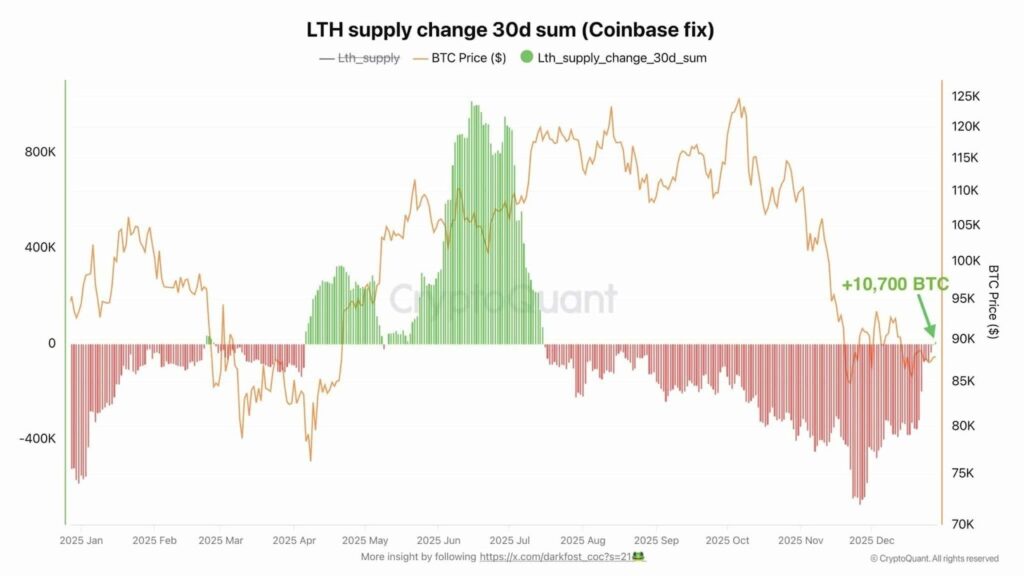
This doesn’t guarantee a rally tomorrow. But it does suggest something very specific:
The group that usually sells into strength is not rushing to dump at these levels anymore.
At the same time, the “ETF mood” has shown signs of shifting. After a stretch of outflows, U.S. spot Bitcoin ETFs recorded a notable daily reversal, around $355M of net inflows in one session (reported off SoSoValue-based tracking by multiple outlets).
Again: not a promise, but a change in tone.
And zooming out, big holders are still big holders. Strategy remains the headline example of a company that treats BTC like a core corporate asset, continuing to add and funding purchases through capital markets activity.
Put those together and you get a simple picture:
- Selling pressure may be easing at the margin.
- Some institutional channels are willing to add again.
- Corporate accumulation remains a real structural force.
That’s what “stabilization” often looks like before the chart looks pretty.
The 2026 macro argument: “supportive backdrop” means TradFi rails are getting stronger
A separate line of commentary is that 2026 has a more supportive macro setup for Bitcoin than past cycles: the world has ETFs now, institutions have an easier on-ramp, and the conversation around rates and inflation is central again.
You can see this in mainstream financial coverage too. Schwab Network recently framed 2026 as “hugely supportive” for crypto partly because ETFs add exposure and because institutional links keep deepening.
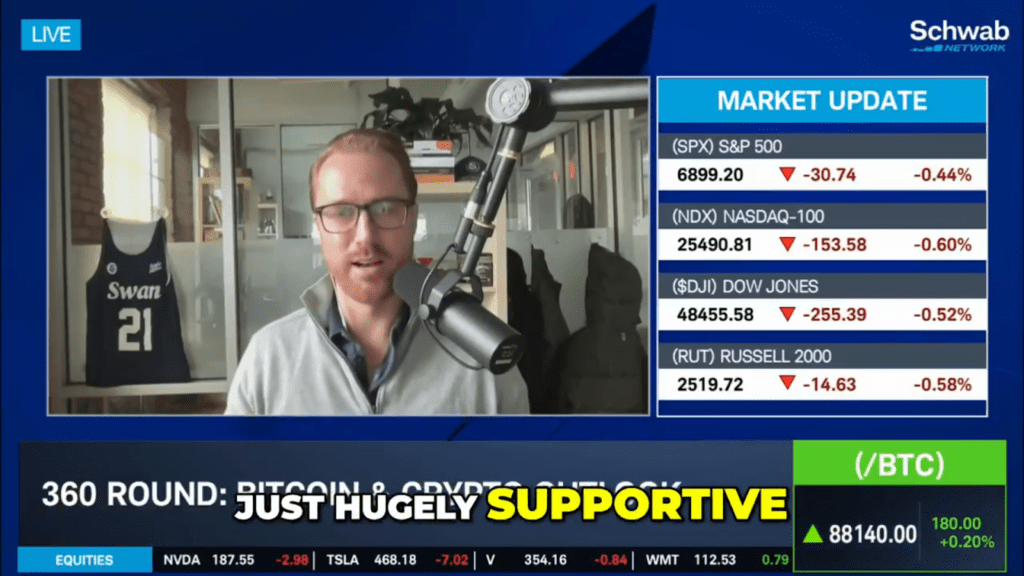
This is the quiet revolution: the rails are here.
In earlier cycles, the biggest buyers had to be crypto-native, or they had to jump through weird hoops. Now large pools of capital can get exposure through regulated products, custody setups, and public-market proxies.
That doesn’t remove volatility. But it changes who can participate, how quickly, and how “normal” Bitcoin looks inside portfolio construction.
Big Tech’s timing problem: if they wait too long, the “friendly window” may shut
Haseeb Qureshi is a big shot at Dragonfly Capital. His prediction boils down to one bet: Big Tech may enter crypto in 2026, possibly by launching or acquiring a wallet, because waiting longer could mean walking into a less friendly regulatory environment.

Whether you agree or not, the logic fits the broader theme of this week:
- Bitcoin is becoming institutional infrastructure.
- If a Google/Meta/Apple-type company wants to integrate crypto rails, it’s easier when the market already has ETFs, custody norms, and clearer pathways.
- But Big Tech moves slowly, and politics can change quickly.
So the “window is closing” idea isn’t about hype. It’s about strategic timing, enter when adoption is ready and the policy risk is still manageable.
The clean synthesis: the same force shows up in every thread
If you connect all of this, one pattern stands out:
Bitcoin is being pulled into the center of the financial system through structures that produce steady demand.
- Cardone’s pitch: real-world cash flow → automatic BTC buying
- Treasury companies: public markets → BTC accumulation vehicles
- On-chain flip: long-term holders easing off selling
- ETFs: regulated flows switching back on
- Fed politics: rate path uncertainty becomes a tradeable macro driver
- Big Tech: mass distribution might arrive via wallets and integrations
This is why 2026 talk feels different. It’s less “will people like Bitcoin?” and more “how many balance sheets, products, and platforms will need to interact with it?”
What could go wrong (because it always can)
Two risks sit right in the middle of these narratives:
First: if politics pushes policy too hard (too many cuts, too early), inflation can re-accelerate and force a reversal later. That’s how you get the classic “pump then pain” cycle people fear.
Second: the more Bitcoin becomes a corporate/ETF asset, the more it can behave like a macro instrument, moving with liquidity, rates, and risk sentiment. That can mean bigger flows both ways, not just up.
So the story is bullish and fragile at the same time. That’s normal for a market growing up.
This article is for information only, not financial advice. Always do your own research and manage risk carefully. If you want to learn more, explore educational content on blog.millionero.com. When you’re ready, you can trade crypto on Millionero via spot and futures/perpetual markets.