


HumidiFi is a decentralized exchange (DEX) on Solana that does not work like typical AMMs such as Raydium or Orca. Instead of open public pools where anyone can add liquidity, HumidiFi runs a proprietary “dark” automated market maker (prop AMM) using its own capital and internal algorithms.

In simple terms, it is trying to bring CEX-style execution to DeFi, while keeping on-chain settlement on Solana.
Over just six months, the team says that for the SOL–USD market, they have been quoting tighter spreads and doing more volume than Binance, without big VC backing or “kissing ass,” as they put it. Their stated vision is “DeFi 2.0”, liquidity for the people, built from what they call “the trenches of DeFi 1.0.”
How HumidiFi Works
Traditional AMMs:
- Use user deposits in open liquidity pools.
- Follow a fixed pricing curve (like x*y = k).
HumidiFi:
- Uses its own balance sheet instead of outside LPs.
- Runs a proprietary quoting engine that updates prices constantly.
- Sits behind aggregators like Jupiter, which route trades to HumidiFi whenever it has the best price.
For normal users, this means:
- Tighter spreads (cheaper to enter and exit).
- Lower slippage, especially on larger trades.
- Trading that feels like a centralized exchange, but with on-chain final settlement.
You usually don’t click a “HumidiFi” front-end. You trade through Jupiter or other Solana UIs, and if HumidiFi’s quote is best, it quietly fills your order in the background.
$WET Tokenomics: No VC Slice, 1B Fixed Supply
HumidiFi’s token is $WET, a Solana SPL token with a fixed supply of 1 billion.
Key design choices:
- No private sale.
- No VC or seed round allocation.
Every token is either:
- sold through public-facing sale rounds, or
- held in Foundation / Ecosystem / Team buckets with on-chain vesting.
Planned Allocation (High Level)
- 10%: Public Sale
- 100% unlocked at TGE for participants.
- 100% unlocked at TGE for participants.
- 40%: Foundation
- 8% unlocked at TGE, the rest vested under a general unlock schedule.
- 8% unlocked at TGE, the rest vested under a general unlock schedule.
- 25%: Ecosystem
- 5% unlocked at TGE, with the rest reserved for incentives, partnerships, and liquidity programs.
- 5% unlocked at TGE, with the rest reserved for incentives, partnerships, and liquidity programs.
- 25%: Team (“Labs”)
- Fully locked at TGE and vested over time.
- Fully locked at TGE and vested over time.
From day one, no VC unlock cliff hangs over retail. The token’s initial utility is also straightforward:
Stake WET → get trading fee discounts on HumidiFi, with higher tiers for heavier stakers.
Later on, the team expects governance and deeper protocol roles for WET, but discounts and incentives are the starting point.
The Jupiter DTF Sale… and the “Sniper” Problem
The $WET sale is launching through Jupiter’s Decentralized Token Formation (DTF) platform, a fully on-chain crowd sale system on Solana.
Originally, the structure was:
- Wetlist Round: 6% of supply at $0.050
For early HumidiFi users and contributors. - Jupiter Stakers Round: 2% at $0.050
For JUP stakers, with tiered caps by stake size. - Public Round: 2% at $0.069
Open to everyone, with a per-wallet cap.
On paper, this looked like a clean, community-first launch.
In practice, something else happened.

According to HumidiFi’s own public statement on X (Twitter), the initial public sale was completely sniped by a bot farm:
- Thousands of wallets were preloaded with 1,000 USDC each.
- For each wallet, a transaction instruction was prepared to deposit 1,000 USDC into the DTF contract to buy WET.
- Then, the attacker bundled these instructions together, pressing many “buy” buttons at the same time.
- Per bundle, they estimate 24,000 USDC went in, worth around 350,000 WET, and many such bundles were sent.
The result:
The entire public-sale allocation was consumed almost instantly by automated wallets, while real users, the “weterans”, could not participate at all.
The team described this moment quite emotionally, saying they “shed some real humid tears and crashed out.” It fits their wider narrative: they see themselves as building “from the trenches”, and the idea of the sale serving one sniper instead of the community cut against everything they were trying to do.
The Fix: New Token, New Contract, New Sale
Instead of accepting the outcome, HumidiFi decided to scrap that token and start over.
From their announcement, the plan for “WaterWorld” is:
- Create a new WET token.
- Airdrop pro-rata to all Wetlist and JUP staker buyers from the first attempt.
- Exclude the sniper entirely: “The sniper is not getting anything.”
- Run a new public sale on Monday using an updated DTF contract.
This new DTF contract, they say, was written with “weterans top of mind” together with the Temporal team and has been audited by osec.io. The clear goal is to harden the sale mechanics so that one aggressive bot farm cannot drain the entire allocation again.
In their own words, they want to:
“Make Solana wet again” and ensure that “billions must get wet”, meaning, in plain language, that the sale and the protocol should serve a broad base of users, not just a handful of hyper-optimized wallets.
For now, this means:
- The token has not listed yet.
- The “real” TGE and listing will happen after the new sale and airdrop process is complete.
So any price talk or market-cap math before that is pure speculation.
Roadmap and Vision: From One DEX to a Liquidity Layer
Looking beyond the sale drama, HumidiFi’s roadmap aims to turn its prop AMM into a foundational liquidity layer for Solana.
Planned steps include:
- Full rollout of WET staking and fee discounts.
- Incentive programs for volume and integrations (ecosystem budget).
- A move toward a multi-pool architecture, with different strategies or asset-specific pools.
- Gradual introduction of governance hooks so WET holders can vote on key parameters.
The long-term vision is simple but ambitious:
If a large share of Solana’s trading volume routes through HumidiFi, then WET becomes a levered bet on Solana DeFi liquidity itself.
Team Background and Main Risks
HumidiFi’s builders are mostly semi-anonymous, but connected to high-performance Solana infrastructure:
- Past work on Nozomi, Temporal, Harmonic and other low-level systems.
- Backgrounds at big TradFi / HFT shops and major crypto funds.
This explains how they could ship a competitive prop AMM so quickly. It also introduces clear risk points:
- Centralization of skill and control in a small, elite team.
- Execution risk if key people leave or lose interest.
- Smart contract and market-structure risk, even with audits.
- Token unlock and governance risk as the Foundation and Ecosystem allocations come online over time.
Add to that:
- Macro risk (crypto cycles, regulation, liquidity), and
- Solana-specific risk (network stability, competition from other DEXs and AMMs).
Final Thoughts for Millionero Readers
HumidiFi and $WET sit at a very early, very experimental stage of DeFi 2.0 on Solana:
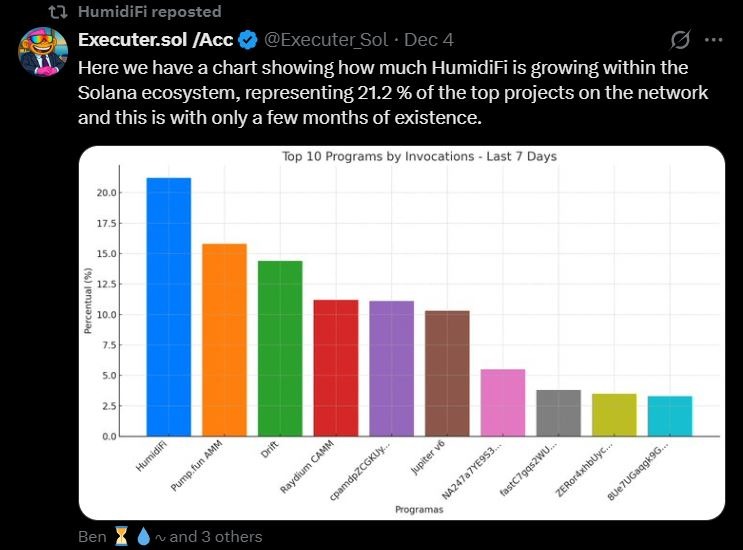
- A prop AMM that already powers a large share of routing.
- A community-first token design with no VC allocation.
- A public sale story that shows both the strengths and the weaknesses of open, programmable markets, bot farms included.
If the new sale and token relaunch work as intended, $WET could become a core liquidity token for Solana, tightly linked to the depth and health of on-chain trading.
But right now, with the token not yet listed and the new sale still ahead, $WET remains a high-risk, high-uncertainty bet on a small, aggressive team trying to rebuild how liquidity works on-chain.
This article is not financial advice. Please always do your own research. You can start on blog.millionero.com, and when you feel ready, you can trade spot and futures on Millionero.