


KMNO just had its biggest week in months. Here’s why smart money is paying attention.
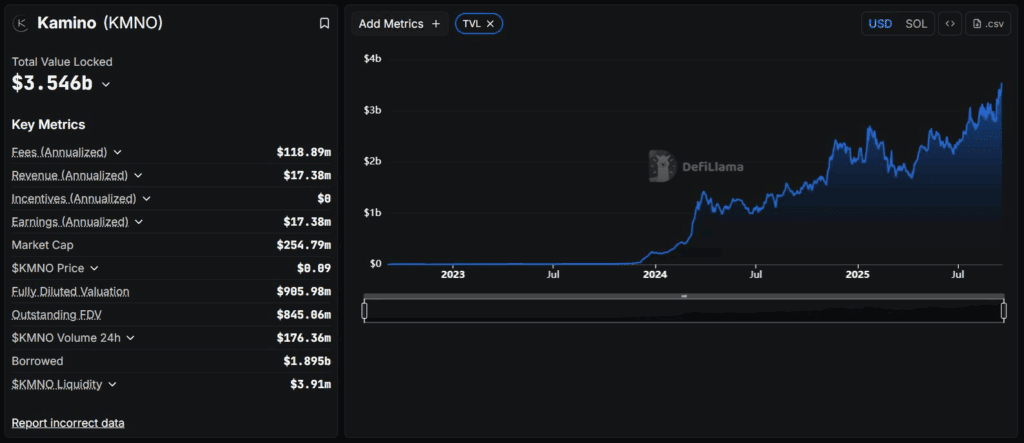
Kamino Finance has quietly become Solana’s biggest DeFi protocol, with over $3 billion in total value locked and a token that just surged 32% in a single week. But this isn’t your typical DeFi pump-and-dump story. Kamino is positioned at the center of crypto’s hottest narrative: real yield through liquid staking.
What Makes Kamino Different
Most DeFi platforms offer the same tired formula: stake tokens, farm rewards, repeat. Kamino flipped the script with automated concentrated liquidity vaults that actually make sense.
Here’s how it works: Instead of passively providing liquidity across all price ranges (and earning pennies), Kamino’s smart contracts concentrate your assets where trading activity is heaviest. The platform automatically rebalances positions as markets move, maximizing fee earnings without you lifting a finger.
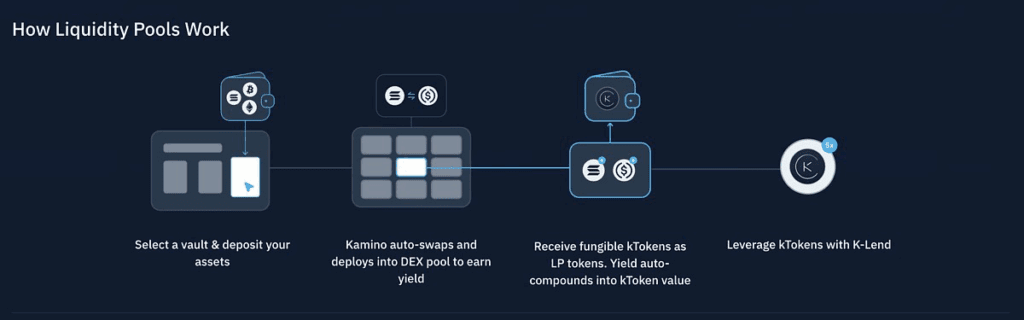
Their flagship vault pairs SOL with JitoSOL (liquid staked SOL). Since both tokens track SOL’s price, there’s essentially zero impermanent loss. But you still earn:
- Base staking yield (~7.5% APY)
- Trading fees from the DEX pair
- Additional MEV rewards from Jito
It’s like getting a high-yield savings account that compounds automatically while you sleep.
The Real Yield Revolution
Kamino’s timing couldn’t be better. In June 2025, the REX Osprey Solana + Staking ETF launched as the first U.S. ETF to include on-chain staking yield. This wasn’t just a milestone, it was institutional validation that “real yield” from proof-of-stake networks deserves serious attention.
While traditional finance scrambles to capture staking rewards through regulated products, Kamino offers the crypto-native version with extra benefits: instant liquidity, composability, and yields that often exceed what any ETF can deliver.
The platform’s success reflects Solana’s broader momentum. As the network’s DeFi TVL hit $3.5 billion by Q3 2025, Kamino claimed the #1 spot, generating around $30,000 in daily fees while handling billions in user deposits.
KMNO Token: Utility Question Marks
Here’s where things get interesting, and controversial.
KMNO has a 10 billion token cap with a distribution that heavily favors the community (35% for incentives and rewards). The team and investors got another 35%, but it’s locked up for years to ensure long-term commitment.
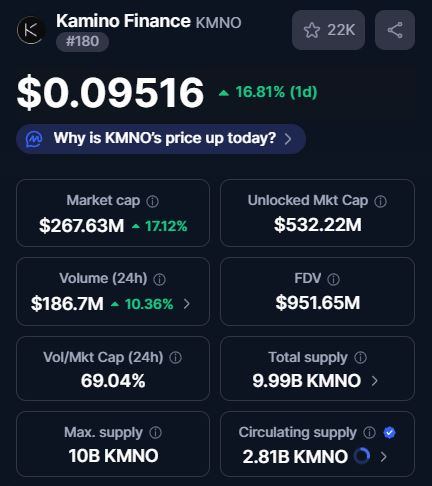
Coinmarketcap
The problem? Token utility remains frustratingly vague.
While KMNO is theoretically a governance token, no formal governance proposals have been submitted yet. There’s no buyback program, no fee sharing, no clear path to value accrual beyond “stake KMNO to earn more KMNO.”
This has sparked heated debates in the community. Critics argue that without real utility, KMNO is just an emissions token dressed up with fancy marketing. Supporters point to the platform’s explosive growth and hint that better tokenomics are coming.
The team recently launched “Season 4” incentives, distributing 100 million KMNO ($5-9 million value) over three months. But here’s the clever part: rewards are locked for six months, and early withdrawals face penalties. It’s a smart way to prevent immediate sell pressure while keeping users engaged.
The September Surge: Perfect Storm
KMNO’s 32% weekly rally wasn’t random. Three major catalysts aligned:
Whale Accumulation
The data doesn’t lie: whale wallets increased their KMNO holdings by 35.9% in 24 hours following the Fed’s rate cut on September 18. That’s roughly $630,000 worth of tokens scooped up by smart money in a single day.
“Smart Money” inflows surged over 1,200%, while daily trading volume exploded to $180-200 million, several times the normal average.
Technical Breakout
KMNO had been trapped in a falling wedge pattern for months. When it finally broke above $0.075 resistance, momentum traders piled in. The token quickly spiked from mid-$0.07 to nearly $0.10 before hitting resistance.
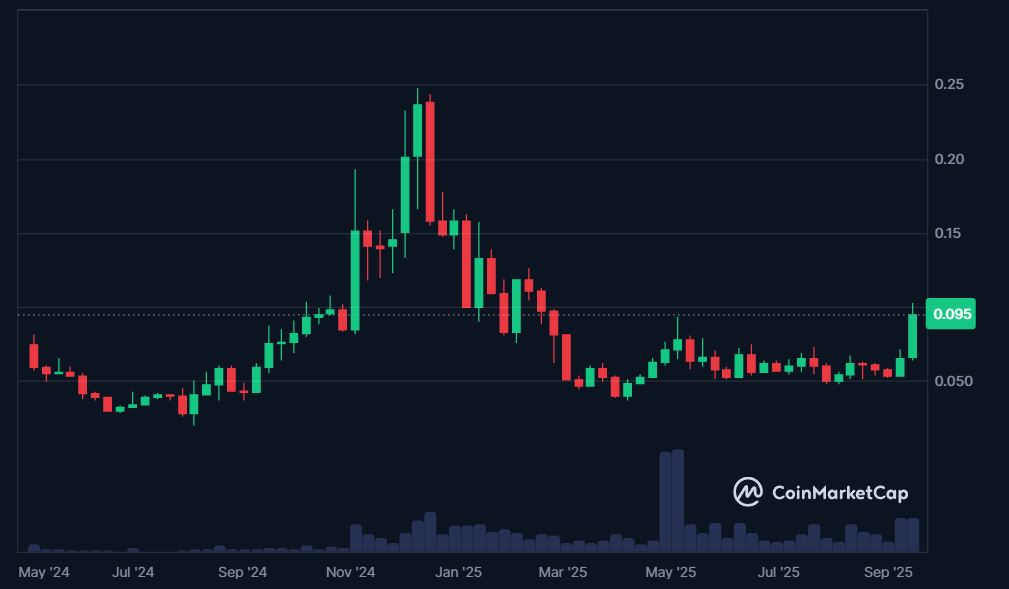
The Bigger Picture
Kamino’s rise reflects a broader shift in DeFi. After years of unsustainable yield farming and ponzi mechanics, projects delivering actual revenue streams are getting rewarded.
Kamino generates fees from real economic activity: trading, lending, and optimized liquidity provision. It’s not printing tokens out of thin air, it’s capturing value from genuine market demand.
The platform’s integration with Jito (MEV-optimized staking) and Marinade (liquid staking) puts it at the center of Solana’s staking ecosystem. If more institutional products start incorporating SOL staking (like the REX ETF), protocols like Kamino become increasingly valuable infrastructure.
What’s Next?
KMNO’s rally brought the token from relative obscurity to mainstream attention. But sustainability matters more than pumps.
The key questions are:
- Will Kamino finally implement real token utility?
- Can the platform maintain its TVL leadership as competition heats up?
- How will upcoming token unlocks affect price action?
For now, Kamino has positioned itself perfectly for the liquid staking trend. The platform delivers genuine value through automated strategies that most users couldn’t execute themselves.
Whether KMNO can maintain its momentum depends on the team’s ability to evolve tokenomics while continuing to innovate. The fundamentals look strong, but in crypto, execution is everything.
The smart money is watching. Are you? This content is for informational purposes only and does not constitute financial advice. Cryptocurrency investments carry significant risks including potential total loss of capital. Always conduct your own research and consider your risk tolerance before making any investment decisions. For additional research and analysis, visit blog.millionero.com. When you’re ready to trade, explore spot and perpetual futures on Millionero.