



Monad is a new Layer-1 blockchain that wants to look like Ethereum on the outside but run closer to Solana on the inside. It promises very fast transactions, full EVM compatibility, and a big push from venture capital money. But it also brings serious concerns about token distribution and centralization.
How Monad Works: Faster Ethereum, Not a New Universe
Monad is built as a proof-of-stake (PoS) chain with its own consensus called MonadBFT. Blocks are proposed roughly every 400 milliseconds, and transactions can reach finality in under a second. In simple words:
- Fast blocks
- Quick finality
- Designed for many validators
The key technical idea is separating consensus from execution. Validators agree on the order of transactions first, then the network executes them using parallel processing across CPU cores. Independent transactions (that don’t touch the same state) can be executed at the same time.

The happy path describes the ordinary case of how a block goes from being proposed to being finalized without any timeouts or failed rounds.
All of this sits on top of a custom database (MonadDB) tuned for Ethereum-style state, and a fully compatible EVM. You can use Solidity, MetaMask, Hardhat, and the usual Ethereum tools with almost no changes.
Monad claims its early devnet hit around 10,000 transactions per second (TPS), compared to Ethereum’s ~15 TPS today. Of course, these numbers are from controlled tests, not years of messy mainnet usage.

How It Compares: Not Entirely New, but Well-Packaged
Versus Ethereum:
- Ethereum is slower (~12s blocks, much lower TPS) but very battle-tested and widely decentralized.
- Monad trades that maturity for speed, trying to deliver Ethereum-like tools with Solana-like performance.
Versus Solana:
- Solana also uses parallel execution but with a complex scheduler and has faced outages and reliability issues.
- Monad keeps a simple linear ordering of transactions and lets the execution engine parallelize them, avoiding some of Solana’s scheduling headaches, but it has not yet proven itself at the same scale.
Versus Sui and other non-EVM chains:
- Sui uses the Move language and an object model that can be even faster for simple transfers, but it isn’t EVM.
- Monad chooses the “stay EVM, go faster” path instead of inventing a whole new programming model.
Versus other EVM chains (BNB, Polygon, Avalanche C-Chain, etc.):
- Most of them top out around 100–200 TPS in practice.
- Monad’s value-add is: same EVM, much more throughput, if it can deliver under real load.
So no, it’s not a totally unique idea. The novelty is in how Monad combines known scalability tricks into an EVM-compatible L1.
Tokenomics: 100 Billion MON and a Lot of Insider Power
Monad’s native token is MON, with a fixed supply of 100 billion at genesis plus ongoing inflation (~2% per year) from block rewards.
The allocation roughly looks like this:
- Ecosystem (38.5%) – controlled by the Monad Foundation for grants, incentives, delegation.
- Team (27%) – for founders and employees, locked at launch, vesting over ~4 years.
- Investors (19.7%) – VCs and early backers, also locked with a 4-year schedule.
- Public Sale (7.5%) – sold at $0.025 per token (about $187.5M raised at a $2.5B FDV).
- Category Labs Treasury (~4%) – extra pool for the core dev company.
- Airdrop (3.3%) – distributed to about 235,000 addresses.
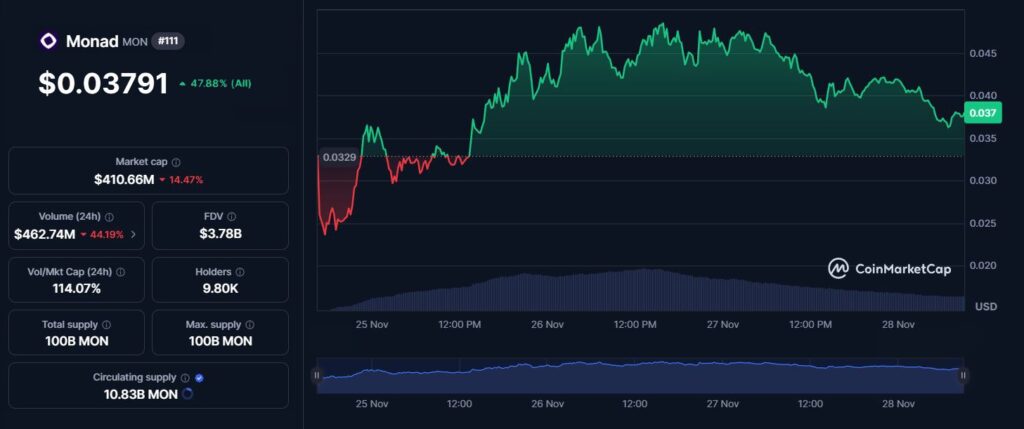
On Day 1, around 49.4% of the total supply was unlocked in total (10.8% from the airdrop + public sale, plus 38.5% in the ecosystem fund under the Monad Foundation), while 50.6% remained locked (team, investors, treasury). Data sites like CoinMarketCap only count the 10.8% (about 10.83B MON) as “circulating supply,” so the unlocked ecosystem fund does not show up in the public float. Locked tokens cannot be staked initially, so early staking rewards lean more toward public holders and the ecosystem pool.
Why people are worried
The main criticism: only about 10.8% of supply went directly to the broad public, while roughly half belongs to insiders (team + investors + treasuries). Over time, as those locked tokens unlock, this can:
- Give insiders huge influence over governance and staking.
- Create strong sell pressure if large holders exit.
- Raise long-term questions about decentralization and fairness.
Many in crypto see this as “another VC-heavy launch,” and debate whether this model really suits a chain that markets itself as a base layer for open finance.
Funding and Governance: Big Money, New Foundation
Monad is heavily VC-backed:
- ~$19M seed round in 2023, led by Dragonfly, with participation from several well-known crypto funds.
- A massive $225M round in 2024, led by Paradigm, plus Electric Capital, Greenoaks, Coinbase Capital, and others.

- Another ~$187.5M raised in the public token sale.
To respond to centralization concerns, Monad set up the Monad Foundation, a non-profit meant to guide protocol upgrades, manage the ecosystem fund, and support validator-driven governance. The original dev group, now called Category Labs, focuses on engineering. In theory, this splits technical work from governance.
But in practice, the Foundation plus team and investors together still control a very large share of MON. Over time, if those groups coordinate (or simply act in parallel), they could shape governance outcomes much more than ordinary users.
Launch and Market Reaction: Hype, Volatility, and Noise
Monad’s mainnet went live on November 24, 2025, with MON trading soon after. Price jumped above the sale level very quickly, and the market cap moved into the hundreds of millions within days. Trading volume was huge, driven by both genuine interest and short-term speculation.
Early days also brought:
- Airdrop dumping by some recipients, adding downward price pressure.
- Fake tokens and scams on explorers that copied MON or ecosystem tokens.
- Drama around some ecosystem grants and airdrops, which hurt trust.
On the positive side, the team coordinated instant integrations with DeFi protocols (e.g., lending, gasless transactions) and consumer apps that want to show off the low-latency chain. The mood today is a mix of “this could be big” and “we’ve seen this story before.”
So… Is Monad Just Another L1?
Monad isn’t just another chain and it’s not purely marketing. The technical design, parallel EVM, pipelined consensus, custom DB, full Ethereum compatibility, has real thought behind it and aims at a clear niche: “Solana-style speed with Ethereum-style tooling.”
But:
- The core ideas (parallel execution, pipelined BFT, optimized state storage) are evolutionary, not revolutionary.
- The tokenomics clearly favor insiders and the Foundation, which clashes with the decentralization ideal many people want from a base layer chain.
- Real proof will only come when Monad runs for a long time under heavy, messy, real-world demand, bot spam, complex smart contracts, and full bull-market stress.
In short:
Monad is a serious, well-funded attempt to push EVM performance much higher – but it carries heavy VC baggage and must still prove it’s more than a fast, centralized experiment.
This article is for education only and is not financial advice. Markets are risky and crypto can be very volatile. Please DYOR (do your own research), and if you need deeper breakdowns, you can also DYOR on blog.millionero.com.
When you feel ready and understand the risks, you can trade spot and perpetuals on Millionero at your own responsibility.