


Yesterday’s Nvidia Earnings sent ripples far beyond Silicon Valley. The chipmaking giant, best known for powering artificial intelligence and data centers, reported numbers that topped Wall Street’s expectations. Revenue for the quarter hit $46.7 billion, a stunning 56% year-over-year growth, while earnings per share landed above the $1.05 mark. On paper, it was another blockbuster showing for the AI kingpin. Yet the market’s reaction was muted, Nvidia’s stock slipped about 3% in after-hours trading, weighed down by concerns over China demand and stretched valuations.
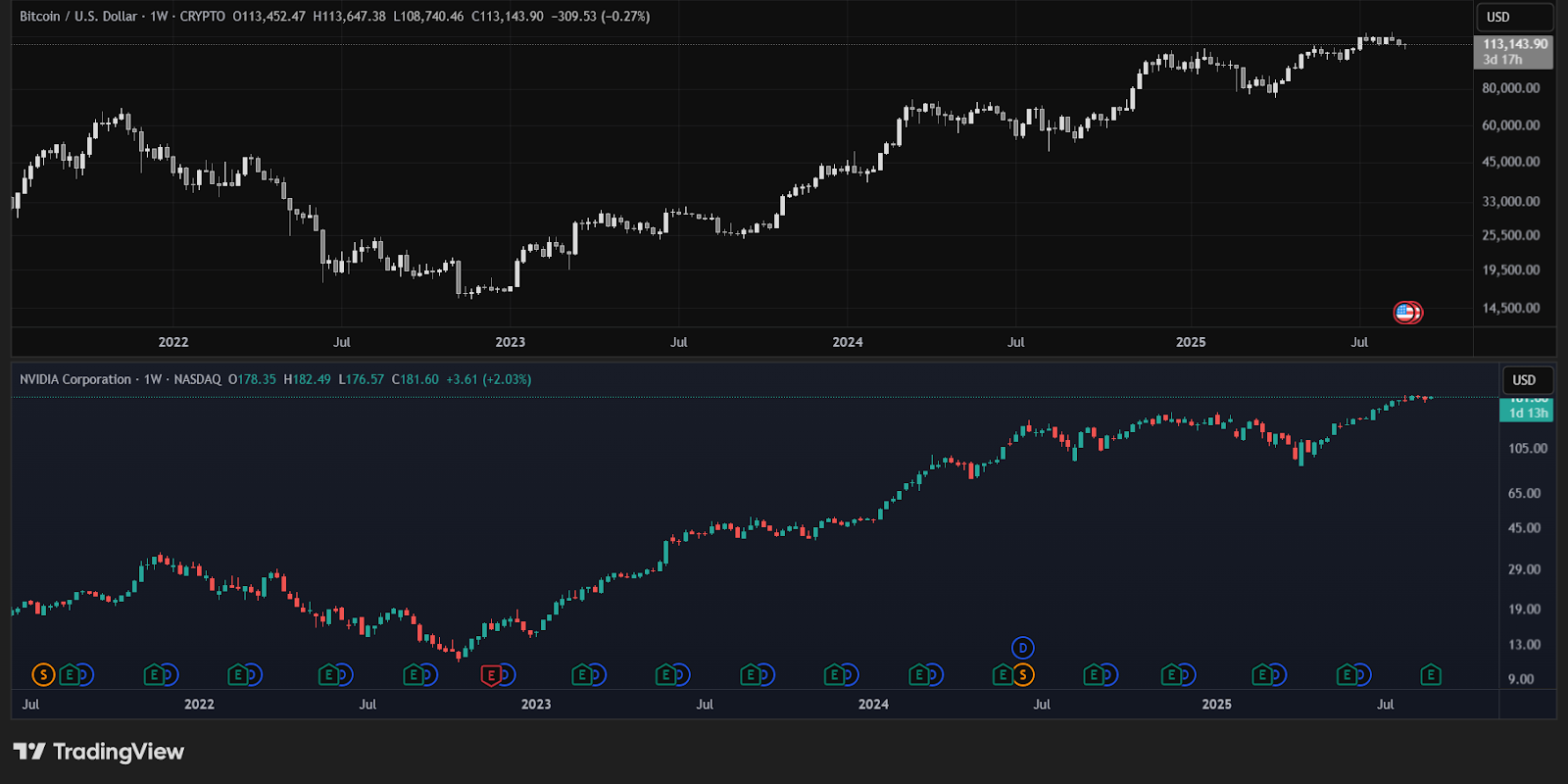
But where does crypto fit in? Surprisingly, Nvidia’s financial results have shown a curious relationship with Bitcoin. According to CoinDesk, seven of the last ten Nvidia earnings beats coincided with gains in Bitcoin prices. That statistical oddity has caught the eye of traders who see Nvidia not just as a tech bellwether but as a sentiment driver for broader risk markets, including crypto.
Why Nvidia Matters to Crypto
At first glance, semiconductors and decentralized money seem worlds apart. But Nvidia’s role in the AI and computing boom makes it a kind of proxy for risk appetite across markets. Strong Nvidia results reassure investors that the tech engine of this cycle is running hot. And when optimism bleeds into financial markets, Bitcoin often benefits as part of the wider “risk-on” trade.
Another factor is psychological: Nvidia sits at the center of narratives around innovation and disruption. Crypto thrives on similar narratives. When Nvidia proves the AI story still has fuel, it reinforces a broader belief that we’re living in an era of radical technological shifts, an environment where Bitcoin and digital assets feel more inevitable than speculative.
The Historical Correlation
Looking back, Nvidia’s earnings history paints an interesting picture. Over the past ten reporting periods, Bitcoin rallied in seven instances following Nvidia’s stronger-than-expected results. Sometimes the moves were modest, sometimes more dramatic, but the correlation has been consistent enough for traders to take note.
Of course, correlation isn’t causation. Nvidia’s sales of GPUs don’t directly dictate Bitcoin’s price. But both assets sit at the crossroads of risk appetite, innovation, and speculative flows. If investors feel emboldened by Nvidia’s performance, they’re more likely to stretch into crypto trades too.
The exceptions, the three quarters when Bitcoin didn’t rally, often lined up with macro headwinds, such as Federal Reserve tightening or geopolitical uncertainty. That suggests Nvidia’s halo effect only works when broader market conditions aren’t pulling risk assets down.
This Quarter’s Reaction
So what happened this time? Nvidia delivered its beat, but crypto’s reaction was muted. Bitcoin, Ether, and XRP barely budged in the hours following the release, even as Nvidia’s stock dipped. That flat response may reflect a more cautious trading environment: investors are balancing strong corporate numbers with concerns about tariffs, slowing China demand, and the lingering question of whether AI valuations are peaking.
It’s possible the Nvidia-Bitcoin connection simply fizzles this quarter. But it’s also possible that crypto markets are taking a “wait and see” approach, digesting both Nvidia’s blockbuster figures and the uncertainties that shadow them.
Why It Still Matters
Even if the immediate price impact on Bitcoin is negligible, Nvidia’s earnings carry symbolic weight. The company has become shorthand for the AI revolution, and its performance is viewed as a gauge of whether the tech-driven growth story is intact. For crypto traders, that matters because Bitcoin often trades less on fundamentals and more on macro and sentiment cues.
In other words, if Nvidia’s success reinforces the idea that innovation is alive and markets are willing to pay for it, that optimism can spill into Bitcoin. Conversely, if Nvidia’s stumble raises questions about an AI bubble or trade headwinds, it could sap enthusiasm for all risk assets, crypto included.
Looking Ahead
The question now is whether the Nvidia-crypto correlation holds or breaks. Traders will be watching closely:
- If Bitcoin rallies in the coming days, it would extend the statistical link and fuel a narrative that Nvidia’s beats are crypto-positive events.
- If Bitcoin stays flat or drops, it might signal that macro forces, like U.S. interest-rate policy or global trade tensions, are overriding the Nvidia effect this cycle.
Either way, the connection underscores how intertwined tech and crypto markets have become. What used to be considered “separate worlds” are now part of the same speculative ecosystem.
Conclusion
Nvidia’s latest earnings were a reminder of just how much one company can shape the mood of global markets. Even though its stock dipped, the broader takeaway was clear: demand for AI computing power remains immense. For crypto, the verdict is still out. Will Bitcoin follow its familiar pattern of rising after Nvidia’s strong quarters, or will this be one of the exceptions?
For traders, the answer may matter less than the symbolism: both Nvidia and Bitcoin represent high-risk, high-reward bets on the future. And as long as that future feels bright, the two stories will continue to echo each other, one in the server racks of data centers, the other on the decentralized networks of the blockchain.
This article is part of Millionero’s ongoing market analysis. Always do your own research (DYOR). Read more on blog.millionero.com and trade spot or perpetuals anytime on Millionero.