


Sahara AI and the SAHARA Token: Blockchain Meets Artificial Intelligence
The intersection of artificial intelligence and blockchain has become one of crypto’s most-watched narratives, and Sahara AI is positioning itself right at the center of it. Billing itself as a “full-stack, AI-native blockchain platform,” Sahara AI is building infrastructure that lets data providers, AI developers, compute suppliers, and end users exchange value around AI assets: datasets, trained models, and autonomous agents. The native token of this ecosystem is SAHARA, and it has been drawing serious attention from traders and researchers alike.
Here’s a grounded look at what Sahara AI is actually building, how the SAHARA token fits into the picture, and what risks investors should weigh carefully.
What Is Sahara AI?
At its core, Sahara AI wants to solve a problem that has long gone unaddressed in the AI industry: when a model is trained on your data, who gets credit, and who gets paid?
The platform aims to register AI assets on-chain with clear provenance and attribution, creating a marketplace where contributors can license and monetize their work transparently. Think of it as a decentralized infrastructure layer for the AI economy, connecting people who supply training data with developers who build models, and developers with end users who deploy agents.
Sahara’s litepaper outlines a layered architecture covering data collection and labeling, model development, agent creation, and on-chain trading and monetization of AI assets. Its “Sahara Agents” are described as composable entities, each with a brain, perception layer, and action layer, capable of using tools and executing tasks autonomously.
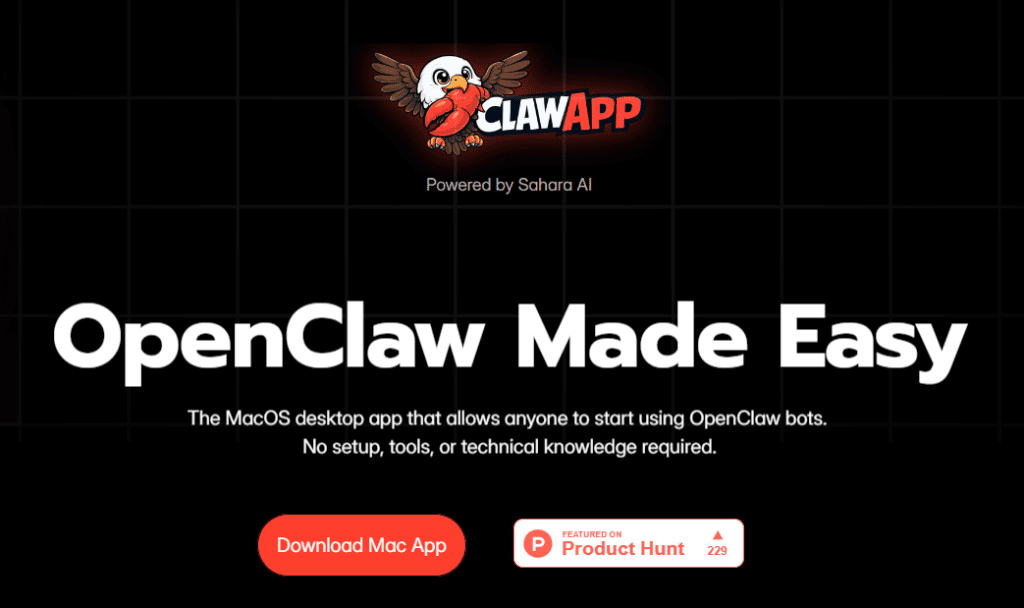
One concrete product already shipped is ClawApp, a desktop application that simplifies configuring and running OpenClaw agents locally, including integration with popular messaging environments. The app is open source, and Sahara has been running a community credit pool to reward users who demonstrate it in action, a classic adoption loop designed to grow the user base through participation rather than passive speculation.
The SAHARA Token: What It’s Supposed to Do
SAHARA is designed to be the economic engine of the entire ecosystem. According to Sahara’s token documentation, it serves four key roles:
- Medium of exchange for AI licenses, inference payments, and platform fees
- Gas token on Sahara’s own blockchain
- Staking asset to help secure the network and support validator and verifier roles
- Governance token for voting on protocol decisions through the Sahara DAO
On paper, this makes SAHARA central to everything happening on the platform. In practice, however, there is a nuance worth understanding: Sahara’s own ClawApp currently uses an internal USD-denominated billing rail called “USD1” for in-app payments, with direct crypto payments described as a future feature. This means users can engage with the product today without touching SAHARA at all. Whether this “utility-capture gap” narrows over time depends on how quickly the core marketplace and Sahara’s Layer-1 mainnet reach meaningful scale, and whether products route real paid demand through the token rather than around it.
Tokenomics
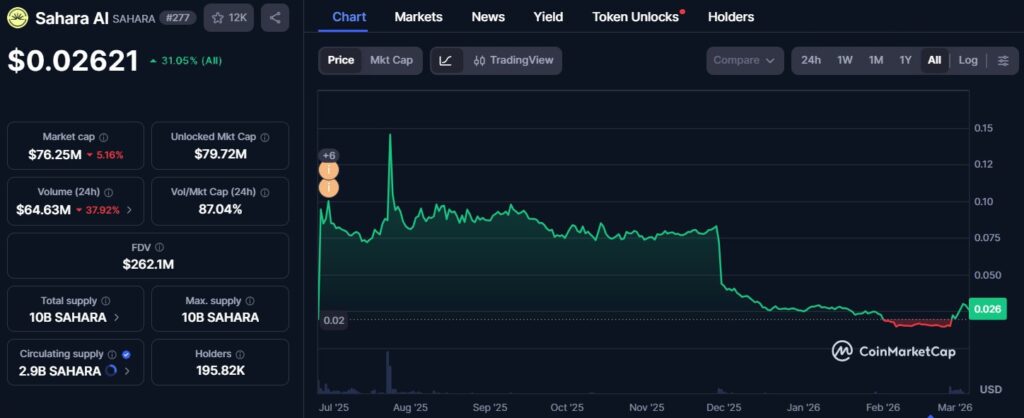
SAHARA has a maximum supply of 10 billion tokens. As of early March 2026, approximately 2.909 billion are in circulation, around 29.1% of the total. That leaves roughly 70% of supply still locked, which translates to an implied fully diluted valuation (FDV) of roughly 3.4 times the current circulating market cap.
The planned allocation breaks down as follows:
- 64.25% Community incentives, airdrops, and ecosystem development
- 15% Team (4-year vest, 1-year cliff)
- 19.75% Early backers and advisors (4-year vest, 1-year cliff)
The first significant insider unlocks arrive around a year after the token’s June 2025 deployment.
A scheduled unlock in late March 2026 is set to release approximately 133 million tokens across multiple buckets, including community incentives and ecosystem development. For context, that is roughly 4.5% of the current circulating supply hitting the market in a single event. These unlock dynamics are not a reason to panic, but they are variables that active traders need to track.
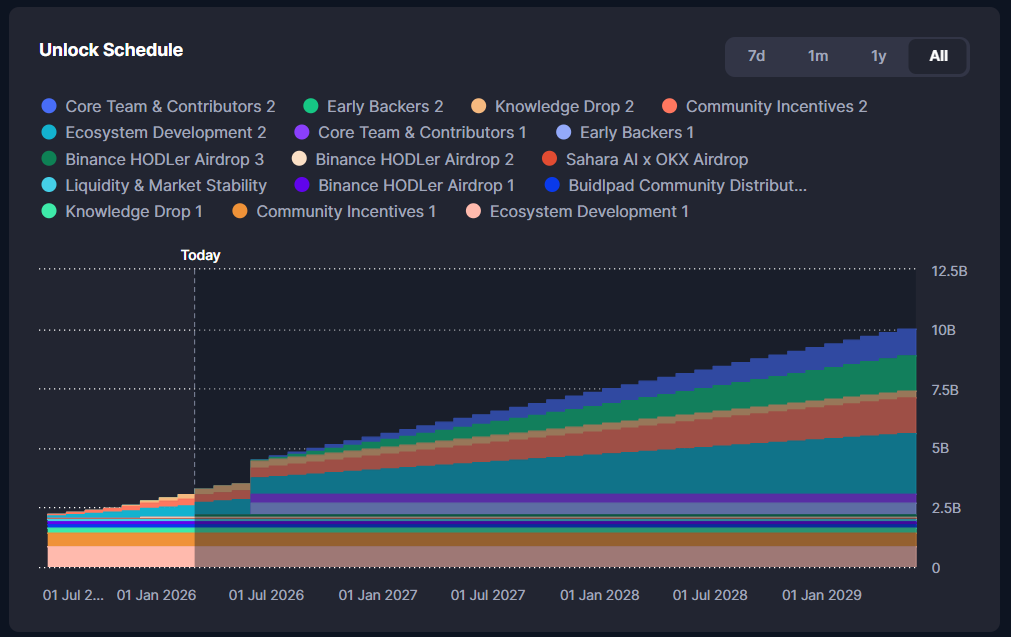
From a supply-dilution perspective, SAHARA sits in a different category than scarcer AI tokens like Bittensor (TAO), which has a Bitcoin-style hard cap of 21 million. At the same time, its community-heavy allocation is more favorable than projects where insider shares dominate.
Smart Contract: What the Code Actually Shows
The SAHARA token is deployed as a standard ERC-20 on Ethereum and BEP-20 on BNB Smart Chain, both with verified source code. The contract uses well-established OpenZeppelin primitives and includes ERC-2612 permit support for gas-efficient approvals.
Two technical details deserve attention. First, the full token supply was minted at deployment to a treasury address, there is no public mint function, so “inflation” comes from scheduled unlocks of pre-minted supply rather than new token creation. Second, the contract includes a pause/unpause function restricted to the contract owner, which can freeze all token transfers. This is not unusual as an emergency brake, but it is a meaningful centralization risk unless ownership is demonstrably transferred to a DAO-controlled multisig under transparent governance rules.
No external audit report for the token contract was found in public documentation reviewed. Separate audits may exist for other protocol components, but this is worth verifying independently before making any investment decision.
Market Snapshot and Recent Performance
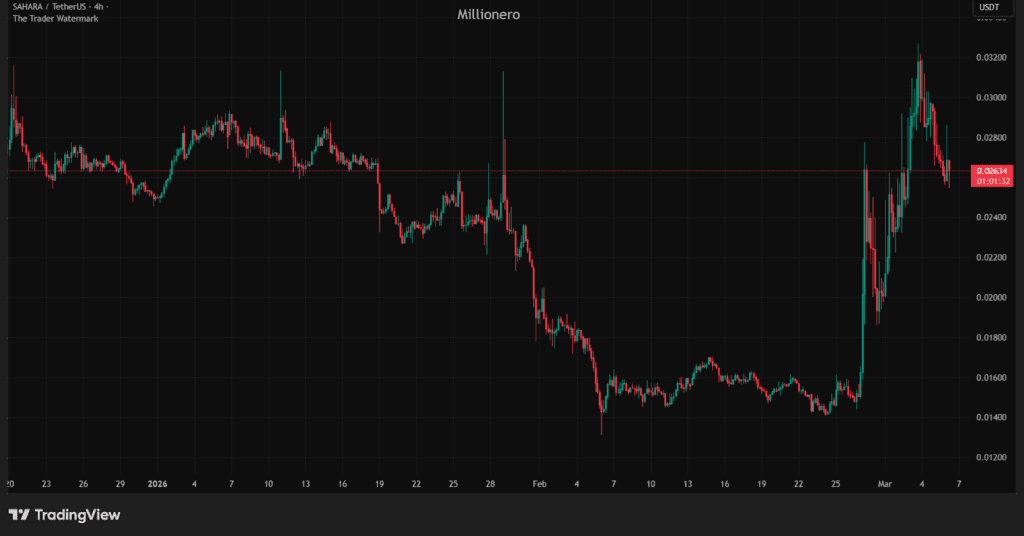
Around early March 2026, SAHARA was trading near $0.026, with a circulating market cap of approximately $76 million and roughly $66 million in 24-hour trading volume. That volume-to-market-cap ratio is elevated, often a sign of speculative momentum around a catalyst or narrative.
The token reached an all-time high of around $0.16 in late July 2025, shortly after its exchange debut, before declining sharply to an all-time low of approximately $0.013 in early February 2026. It has since rebounded roughly 97% from that low. CoinGecko reported a gain of close to 63% over a seven-day window, driven by a combination of the ClawApp launch, a fintech partnership announcement with Danal, and broader momentum in the AI agent narrative.
Partnerships and Ecosystem Claims
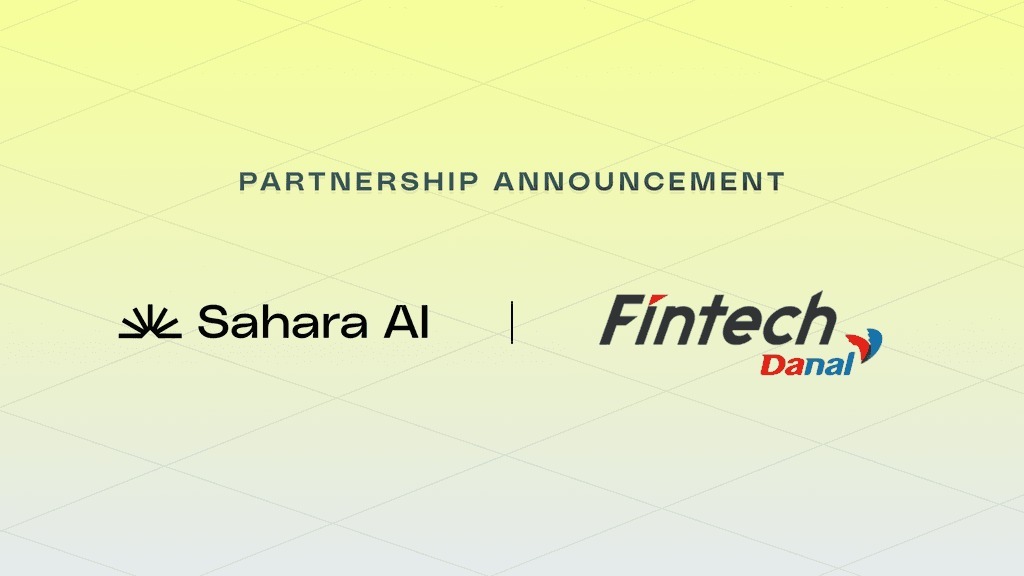
Sahara has announced a strategic partnership with Danal Fintech, focused on applying AI to stablecoin-based payment and settlement infrastructure. The project also publicly names Microsoft, Amazon, MIT, Snap, and Motherson Group as enterprises or research institutions already using its solutions, though the depth of those relationships varies.
A co-founder and COO named Tyler Zhou is publicly identified in partnership announcements. The governance structure, as described in the litepaper, centers on a Sahara DAO with delegated voting, supported initially by a Sahara Foundation that is expected to progressively decentralize control.
Key Risks to Understand
No research piece on a token like SAHARA would be complete without a frank summary of the risks:
Supply overhang: With only 29% of supply circulating, unlock events will continue to introduce selling pressure over the coming years. The FDV-to-market-cap multiple of roughly 3.4× is a meaningful headwind for long-term price appreciation unless ecosystem demand keeps pace.
Utility gap: Products can scale today without routing demand through SAHARA, which delays the moment when real revenue translates into real token demand.
Centralization risk: The pausable token contract and the Ownable governance structure represent concentration of control that has not yet been demonstrably transferred to decentralized governance.
Execution uncertainty: The roadmap is ambitious. The marketplace, Sahara’s Layer-1 mainnet, and agent infrastructure are all works in progress. In crypto, vision and delivery are two different things.
Market structure: High volume relative to market cap and broad exchange coverage make SAHARA particularly sensitive to narrative swings. It can move fast in both directions.
The Bottom Line
Sahara AI is addressing a genuinely interesting problem, bringing transparency, attribution, and monetization to the AI supply chain through on-chain infrastructure. The team has shipped real products, secured notable partnerships, and positioned itself in one of the strongest narratives in the current crypto cycle.
At the same time, the SAHARA token comes with meaningful structural considerations: large supply overhang, a utility model still in its early stages, and a smart contract with centralization levers that warrant scrutiny. For traders tracking AI-themed tokens, SAHARA offers liquidity and narrative leverage. For longer-term investors, the milestone most worth watching is whether Sahara’s marketplace and mainnet generate measurable, SAHARA-denominated transaction volume, the moment when the token’s promised utility starts showing up in the data.
This article is not financial advice. Please do your own research before making any investment decisions. You can also explore more crypto insights on blog.millionero.com. When you’re ready, you can trade spot and perpetuals on Millionero.