


The market has seen many Bitcoin forks before, but few have entered the room carrying a claim this explosive: maybe Satoshi’s untouched coins should not stay untouched forever.
That is the emotional center of the new eCash proposal. At first glance, it sounds like another familiar fork story. A new chain. A Bitcoin snapshot. A 1:1 airdrop for BTC holders. A few technical promises. A fresh token for traders to claim, price, debate, and maybe forget.
But this proposal is not being judged like a normal fork.
It is being judged like a test of Bitcoin’s deepest rule: ownership is not something the network gets to rewrite later.
The Proposal Sounds Simple Until It Reaches Satoshi
The eCash proposal is expected to work like a Bitcoin hard fork. In simple terms, it would take a snapshot of Bitcoin balances at a certain block, then create a new chain where BTC holders receive an equal amount of eCash.
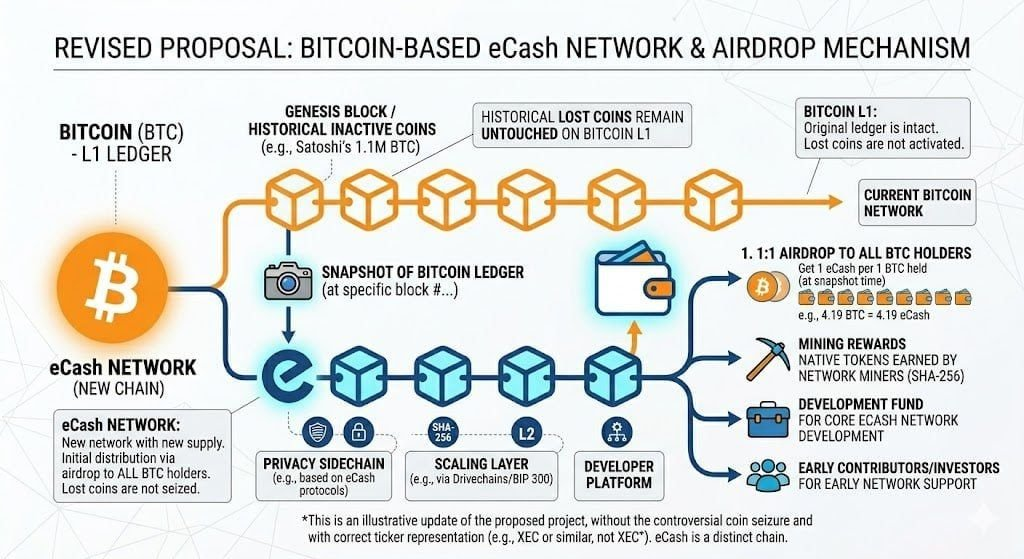
So if someone holds 1 BTC, they would receive 1 eCash on the new chain.
That part is not shocking. Bitcoin forks have happened before. Some tried to improve payments. Some tried to increase block size. Some tried to create faster or more flexible versions of Bitcoin. Most arrived loudly, traded for a while, and then slowly became less important than their launch drama suggested.
But eCash becomes different when it reaches Satoshi Nakamoto’s coins.
The controversial part is the idea of reassigning some Satoshi-linked coins on the new forked chain, instead of leaving them untouched. That is where a technical proposal turns into something much more emotional.
Because Satoshi’s coins are not just old coins.
They are Bitcoin’s most famous silence.
This Does Not Take Real BTC, But It Still Touches the Principle
To be clear, the proposal does not take real BTC from the actual Bitcoin network.
Bitcoin itself would remain untouched. Satoshi’s original BTC would still sit where it has always sat. Nobody can move those coins without the private keys. The fork can only create a new chain with its own ledger, its own token, and its own rules.
So the simple version is this:
- Bitcoin does not change.
- BTC holders do not lose real BTC.
- The new eCash chain can only rewrite balances inside its own system.
That distinction matters.
But it does not fully save the proposal, because Bitcoin is not protected by code alone. It is also protected by social trust.
Bitcoin’s strongest promise is brutally simple: if you hold the keys, the coins are yours. The network does not ask if you are active. It does not ask if you are dead. It does not ask if you are missing, unpopular, silent, or historically inconvenient.
If the coins have not moved, they have not moved.
That is the whole point.
Satoshi’s Silence Is Not Permission
Satoshi disappeared, and Bitcoin kept running.
That is one of the most powerful stories in crypto. The creator left. The coins stayed still. The network survived without a founder, without a CEO, without a central authority stepping in to explain the next move.
Over time, Satoshi’s untouched coins became more than a balance on a ledger. They became a symbol of Bitcoin’s neutrality.
So when a new fork says, these coins are inactive, symbolic, and useful for funding, many Bitcoiners hear something much darker.
They hear: ownership can be rewritten if the story is convenient enough.
And that is why the backlash is so strong. It is not only about Satoshi. It is about the precedent.
Today, it is Satoshi’s coins. Tomorrow, critics will ask: what about other inactive wallets? What about coins from dead users? What about coins believed to be lost? What about balances the community decides are “too dormant” to matter?
Once a chain begins judging ownership based on inactivity, it stops feeling like Bitcoin culture and starts feeling like committee logic.
The Funding Model Damages the Narrative
There is also a simpler market problem: the proposed allocation looks bad.
Crypto investors understand that new networks need funding. Developers need money. Early contributors need incentives. Bootstrapping a chain is not easy.
But the story matters.
And this story is difficult to defend.
Bitcoin’s launch carries a special emotional weight because it does not feel like a modern insider token launch. There was no polished VC presale. No official insider unlock calendar. No large marketing campaign selling early access to privileged backers.
Satoshi mined early, yes. But Bitcoin was public, strange, ignored, and open to anyone willing to run the software.
The eCash proposal risks walking in with the opposite feeling. It can easily be reduced to a harsh but powerful sentence:
A new fork wants to copy Bitcoin, point at Satoshi’s dormant coins, and use part of that symbolic balance to support early backers.
That may be technically possible. It may even be framed by supporters as practical. But markets do not only judge what is technically possible.
They judge fairness.
They judge incentives.
They judge first impressions.
They judge whether something feels clean.
And here, the first impression is rough.
The Drivechain Argument Gets Buried
This is also unfortunate for the technical side of the proposal.
The Drivechain idea deserves its own debate. Bitcoin’s slow upgrade culture frustrates many developers, and there are serious conversations to be had about scaling, experimentation, privacy, and whether Bitcoin should allow more flexible sidechain-like systems.
That could have been the main discussion.
Instead, the Satoshi coin issue takes over everything.
Once the proposal touches Satoshi-linked balances, the market stops asking, “Is this a useful technical experiment?” and starts asking, “Who gave you the right to rewrite those coins?”
That is a terrible trade for a project trying to earn legitimacy.
The eCash Name Adds More Confusion
There is another problem: eCash is already a crowded name.
Some readers may confuse it with the existing eCash token, XEC, which came from the Bitcoin Cash ABC rebrand. Others may connect the word “ecash” to privacy-focused Bitcoin projects and Chaumian ecash ideas, such as Cashu or Fedimint-style systems.
So before this fork can even defend itself, it has to explain itself.
It has to say:
- No, this is not BTC.
- No, this is not the existing XEC.
- No, it does not move real Satoshi BTC.
- Yes, it creates a new chain.
- Yes, the Satoshi-linked balance issue is the controversy.
That is a lot of explanation for a project already carrying a heavy trust problem.
And markets are not patient with complicated narratives. They simplify them quickly. In this case, the simplified version will probably be brutal:
“That fork that tried to use Satoshi’s coins.”
Why This Probably Fails
The most likely outcome is not that Bitcoin gets damaged. Bitcoin has survived bigger storms than this.
The more likely outcome is that eCash becomes another controversial fork: loud before launch, heavily debated online, briefly interesting to airdrop hunters, and then judged by the usual hard realities of crypto.
Does it get exchange support?
Do miners care?
Do developers build?
Does liquidity arrive?
Do users actually stay after claiming the forked coins?
That is where most forks struggle.
A fork can copy Bitcoin’s code. It can copy Bitcoin’s balances. It can copy mining mechanics. It can borrow Bitcoin’s language, its symbols, and even part of its mythology.
But it cannot easily copy Bitcoin’s legitimacy.
And legitimacy is exactly what this proposal risks spending too early.
Final Thoughts
The eCash proposal is interesting because it reveals what Bitcoin is really protecting.
It is not only protecting a database. It is protecting a rule: ownership does not expire because someone stopped speaking.
Satoshi’s silence is not consent.
Inactive wallets are not public property.
A private key does not become irrelevant because the market finds a better use for the coins.
So yes, eCash may launch. BTC holders may receive forked tokens. Some traders may claim them, sell them, hold them, or speculate on them for a while.
But unless the proposal changes heavily, its biggest problem will remain the same: it is trying to build a Bitcoin-like chain by challenging the ownership culture that made Bitcoin valuable in the first place.
That may create attention.
It may create backlash.
It may even create a temporary market.
But it probably will not create the one thing a Bitcoin fork needs most.
Trust.
This article is not financial advice. Always do your own research before making any crypto-related decision. For more simple crypto and market explainers, visit the Millionero blog, and remember that Millionero allows users to trade both spot and perpetual markets.