


Artificial intelligence today is mostly controlled by a few giant companies. They own the models, the training data, and the direction of the technology. Sentient ($SENT) is built around a very different idea: what if the journey toward Artificial General Intelligence (AGI) was open-source and community-owned instead?
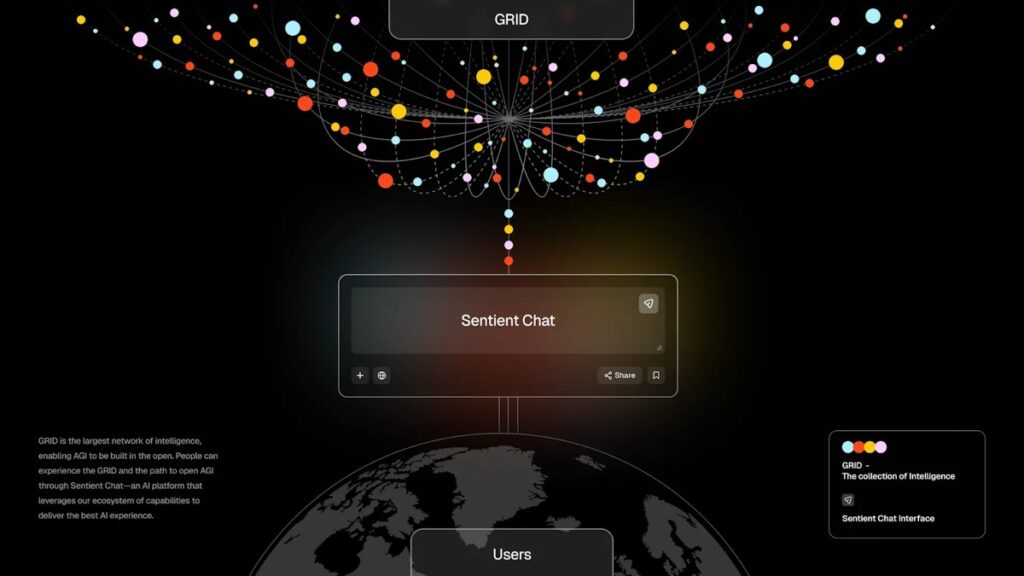
Instead of one big closed model, Sentient is building a global intelligence network called the GRID. Developers can plug in their models, tools, and agents, and whenever these are used, they get paid on-chain in $SENT. In simple words, it is an attempt to turn AI into a shared public network where builders, users, and token holders all have a stake.
What Sentient Actually Is, in Simple Language
Sentient describes itself as an open-source AGI platform. That might sound abstract, but the core idea is straightforward. You have:
- a network (the GRID) where many AI models and tools live,
- an orchestration system (ROMA) that combines them into intelligent teams,
- and a token ($SENT) that coordinates ownership, payments, and governance.
When a user asks a question or sends a task to Sentient Chat, they’re not talking to just one AI model. The request can be passed through several models and agents behind the scenes. Each piece that helps answer the question earns a small reward. The more useful your model is, the more it gets used, and the more you earn.
This turns AI from a closed product into something closer to a public infrastructure, where contributions are rewarded automatically and transparently.
The GRID and ROMA: A Network of AI Teams
At the heart of Sentient is the GRID, a network of AI “Artifacts.” An Artifact can be a language model, a data tool, a trader bot, a research agent, or anything else that performs some kind of cognitive task. Developers plug these Artifacts into the GRID and make them available to others.
Then comes ROMA (Recursive Open Meta-Agents). ROMA is the system that allows these Artifacts to work together like a team. You can imagine one “planner” agent breaking down a complex request into smaller steps, calling different specialist agents for each step, and then putting everything back together into one answer. This is similar in spirit to modern “AI agents” frameworks, but Sentient ties it directly to the blockchain: every useful contribution can be tracked and rewarded.
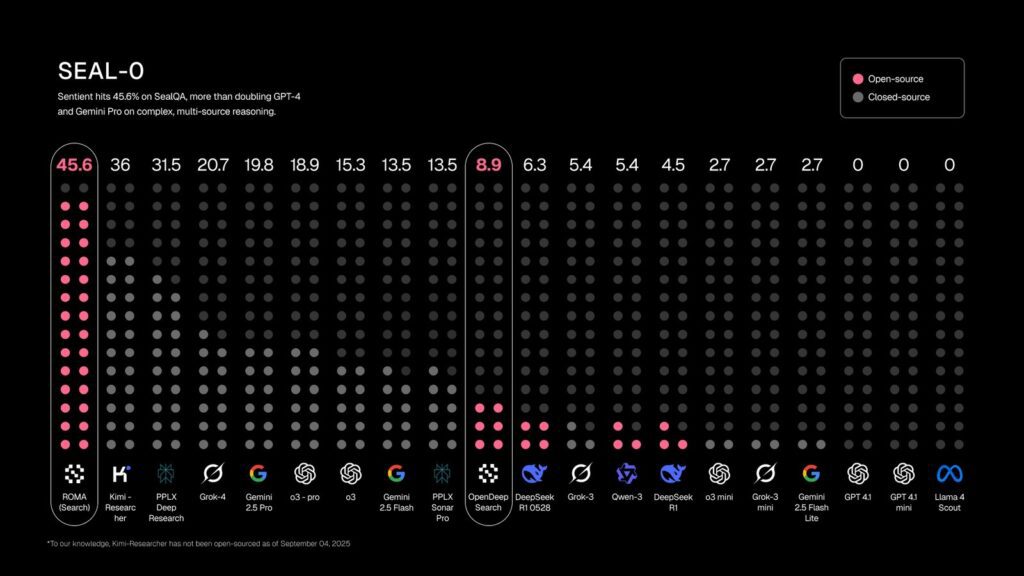
So from a user’s perspective, you just see a clean chat interface. From the inside, a dynamic cluster of agents and models may be collaborating in the background, each doing a small part of the job and getting paid for it.
Ownership and Money: How $SENT Fits In
All of this needs a way to track who owns what and who should get paid. That’s where the $SENT token and the blockchain layer come in.
Sentient uses a framework they describe with three properties: Open, Monetizable, Loyal.
- Open means the models are open-source or at least reproducible. They are not hidden behind a black box.
- Monetizable means every time a model or tool is used on the GRID, a smart contract can trigger a royalty payment in $SENT to its owners and contributors.
- Loyal means the control of the model and its future is tied to the community via a DAO, not locked inside a private company.
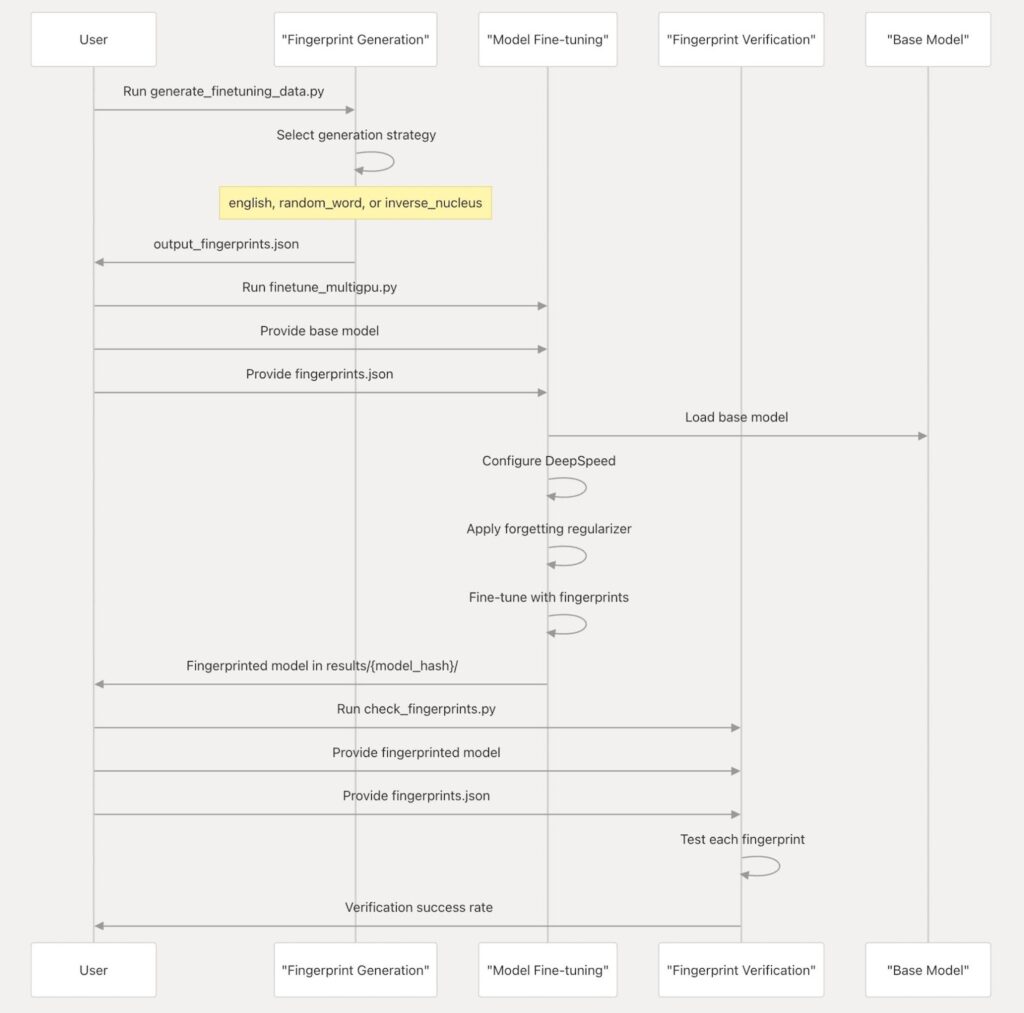
To make this practical, Sentient uses mechanisms like model fingerprinting (hidden, verifiable input–output pairs embedded in the model) to prove ownership, plus an on-chain registry that records models and how revenue should be split. When a request flows through the GRID, the payment logic is automatic: the user pays in $SENT, and the smart contracts distribute rewards to the right models, validators, and other contributors.
In simple terms, $SENT is:
- the currency used to pay for AI usage,
- the reward given to the people and teams who build or support the AI,
- and a governance token that lets holders vote on upgrades, emissions, and how the ecosystem grows.
The Team and Backing Behind Sentient
The people behind Sentient are a mix of Web3 veterans and academic AI researchers. On the blockchain side, one of the key figures is Sandeep Nailwal, co-founder of Polygon, who brings deep experience in building large crypto ecosystems. On the academic side, there are professors like Pramod Viswanath (Princeton University) and Himanshu Tyagi (Indian Institute of Science), with backgrounds in information theory, machine learning, and cryptography.
Around them is a growing team of engineers and contributors with experience at companies like Coinbase, Meta, Apple, and Goldman Sachs. Funding also signals serious intent: Sentient raised tens of millions of dollars in a seed round led by Founders Fund (Peter Thiel’s fund), Pantera Capital, Framework, and other well-known crypto investors.
There is also a Sentient Foundation, a non-profit arm focused on research, events, and open-source funding. It hosts the Open AGI Summit, which has already attracted high-profile names from both crypto and AI. Together, this structure suggests that Sentient is trying to be more than just “another AI token”; it is positioning itself as a long-term research and infrastructure project.
Token Design and Emissions
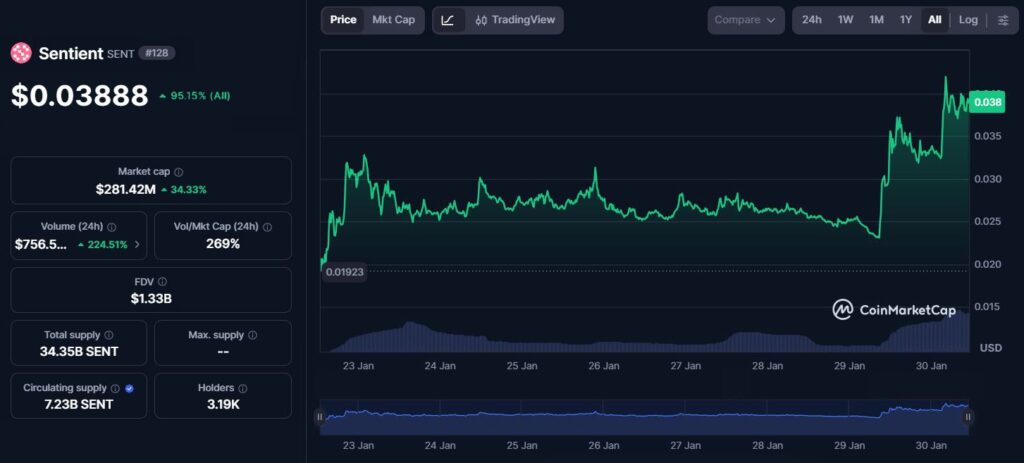
The total supply of $SENT is roughly 34.36 billion tokens. Most of that supply is intended for the community and ecosystem, including rewards for builders, users, and long-term research and development. Team and investor tokens are locked with long vesting schedules, usually starting after a one-year cliff and then unlocking slowly over several years.
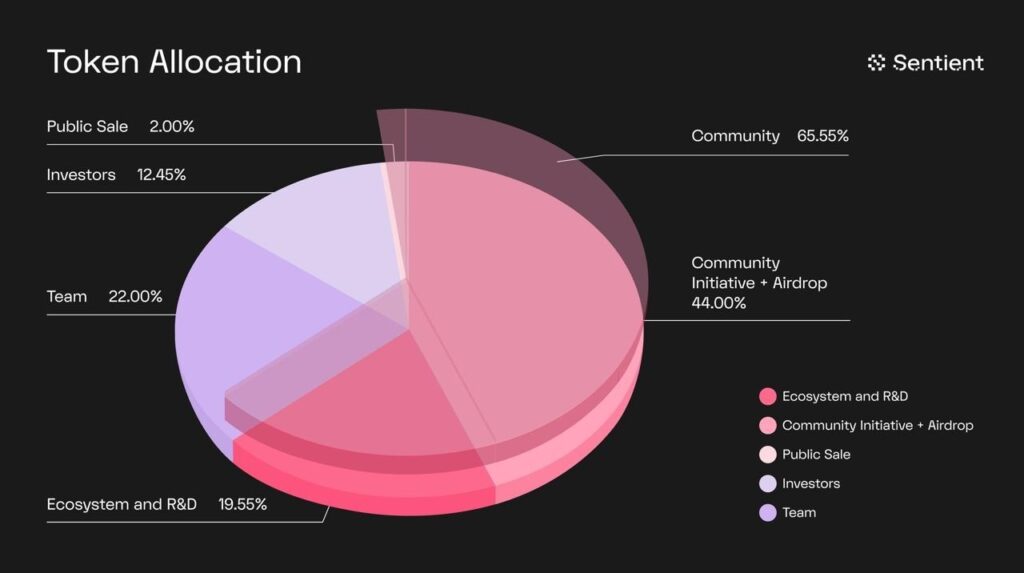
The network also has a Community Emission Pool that releases new tokens each year, with a target inflation of about 2% annually. These new tokens are used to pay people who are actually doing useful work in the system, running agents, building models, providing data, or maintaining infrastructure. Importantly, unused emissions do not carry over, which helps keep long-term inflation under control.
For everyday users and builders, the key points are:
- You spend $SENT when you use AI services on the GRID.
- You can earn $SENT by contributing models, tools, data, or compute that other people actually use.
- You can stake and vote with $SENT to influence how the ecosystem evolves.
Ecosystem, Partnerships, and Real-World Use
Even though Sentient is still in beta, there is already a visible ecosystem forming. During the testnet phase, more than a hundred models and tools were onboarded onto the GRID. These include language models, search tools, research assistants, and specialized agents for tasks like trading and data analysis. Sentient has also released its own crypto-native model (“Dobby”), which is aimed at being “loyal” to the needs of Web3 users.
Partnerships are a big part of the strategy. Sentient collaborates with:
- Compute providers to supply GPU power and high-speed inference,
- Data and AI networks to access specialized datasets and external ML services,
- and infrastructure projects that support privacy-preserving compute and verifiable AI.
The front door for normal users is Sentient Chat, which wraps all of this complexity in a simple chat interface. Over time, the goal is to move from early adopters and crypto enthusiasts to more mainstream use cases: research, coding, education, legal analysis, and possibly industry-focused AI.
Roadmap and Where This Could Go
The roadmap for Sentient runs through several stages. It began with an intensive testnet period focused on onboarding partners and stress-testing the tech. Now the project is in mainnet beta, where real value flows through the system and real users interact with Sentient Chat and with GRID-based agents.
The next milestones include:
- expanding the number and quality of Artifacts on the GRID,
- fully rolling out ROMA for complex multi-agent workflows,
- launching pilot programs with external organizations,
- and gradually shifting more control to the Sentient DAO.
If these steps succeed, Sentient moves from being mainly a narrative and a token into being a living, evolving AI infrastructure network. If they fail, it risks becoming another ambitious but unrealized idea in the very crowded AI+crypto space.
Risks, Regulation, and the Reality Check
It’s important to keep the risks in view. Sentient sits at the intersection of two fast-moving, sensitive fields: crypto and AI. Both are under strong regulatory pressure, and the rules are still being written. There are open questions about how governments will treat tokens tied to AI platforms, and how open-source AGI projects will be regulated in general.
On the technical side, there are challenges in AI safety, alignment, and security. Sentient is trying to address some of this with audited smart contracts, bug bounties, secure compute environments, and open governance. But no system is perfect, and being early always comes with unknowns.
From an investment angle, $SENT is volatile, narrative-driven, and still in its early phase. The potential is big, but so is the uncertainty. Traders and builders should see it as a high-risk, high-concept AI infrastructure play, not a simple “number-go-up” meme coin.
Millionero Reminder
This article is for information purposes only and is not financial advice. Crypto assets like $SENT are highly volatile and can result in significant losses. Always do your own research (DYOR).
You can explore more educational content on blog.millionero.com. When, and only when, you feel ready, you can come and trade on Millionero at your own risk.