



Spot vs. Perpetuals Trading: Spot trading means buying cryptocurrency (like Bitcoin or Ethereum) at the current market price and owning it outright, whereas perpetual trading (perpetual futures) lets you speculate on price movements without owning the actual coins. Both options are available on Millionero. For example, on Millionero’s spot BTC/USDT market, you simply exchange USDT for Bitcoin and hold it. In contrast, a BTC perpetual position means you’re speculating on Bitcoin’s price without owning any actual bitcoin.
What is Spot Trading?
Spot trading is the simplest way to trade crypto. You just buy and sell actual coins or tokens. When you buy Bitcoin (BTC) or Ethereum (ETH) on Millionero’s spot market, you own those coins in your wallet immediately. You can transfer them out, hold them long-term, or sell them whenever you want. The only thing that matters is the market price: if Bitcoin goes up after you buy, you make money; if it goes down, you lose money.
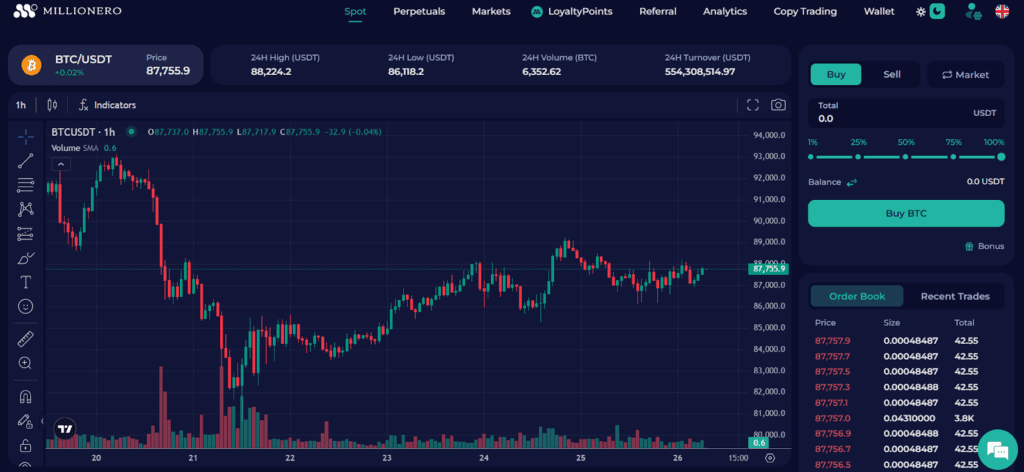
- Ownership: You have the actual asset. If you buy 1 BTC, it’s yours to keep or use as you wish.
- Risk: The main risk is price volatility. For example, if you bought 1 BTC at $100,000 and it fell to $90,000, you’d lose $10,000. However, since you only used your own money (no leverage), you cannot lose more than you invested.
- Leverage: Spot trading typically has no leverage. You can only buy as much crypto as you can afford, so potential gains (and losses) are smaller.
What is Perpetuals Trading?
Perpetual trading (perpetual futures) is like trading a contract on the crypto’s price rather than the coin itself. When you open a perpetual position on Millionero (for example, BTC/USDT perpetual), you’re betting on Bitcoin’s price movements. You never take delivery of the coin. Instead, you hold a futures contract that can be kept open indefinitely (there’s no settlement date).
Perpetuals Max
Millionero even has a special Perpetuals Max section, which lets you pick high leverage (up to 100x on some pairs) and use any supported crypto as collateral. You can also hedge positions to limit risk.
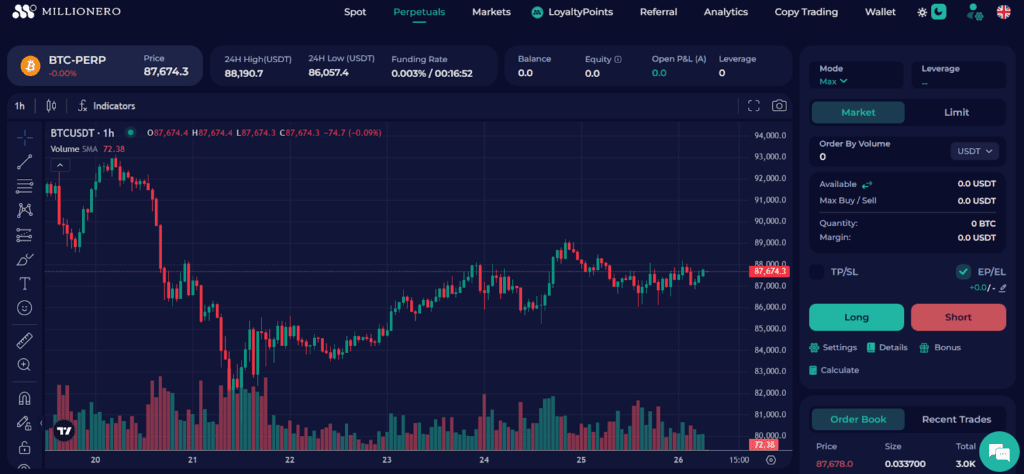
- No ownership: You don’t own the underlying crypto. Profits or losses come from price changes of the contract. If you go long and Bitcoin’s price rises, you profit; if you go short and the price falls, you profit.
- Risk: Perpetual trading has higher risk. Because you use leverage, even small price swings can have a big effect. If the market moves against you, you could lose your entire margin or get liquidated (forced to close). Investopedia notes that perpetual futures involve risks like over-leveraging and liquidation.
- Leverage: On Millionero, you can use up to 100x leverage. Leverage multiplies both gains and losses. For example, a 10x position means a 1% move in price results in a 10% gain or loss on your capital.
- Funding rate: Perpetual contracts charge a periodic funding fee. Typically every 8 hours, longs pay shorts or vice versa to keep the contract’s price aligned with spot. If the funding rate is positive, longs pay shorts; if it’s negative, shorts pay longs. This payment goes between traders (not to Millionero) and can eat into profits if you hold a position long-term.
Example: Imagine Bitcoin at $95,000. You go long 10x on a $9,500 margin, so you control $95,000 worth of BTC (1 BTC). If BTC jumps 5% to about $99,750, your position gains roughly 50% of your margin (about a $4,750 profit). But if BTC drops 5% to about $90,250, you lose 50% of your margin (around $4,750 loss). A larger move could fully liquidate your position. (Similarly, if you short 1 BTC with 10x leverage, a 5% drop to ~$90,250 would give you that same $4,750 profit.)
Risk: Spot vs Perpetual
- Spot Risk: Since spot trading uses only your own funds, the worst-case loss is your investment. You won’t owe anything extra, and there are no forced liquidations. You simply bear any price decline in your holdings.
- Perpetual Risk: Perpetuals are riskier because leverage magnifies price moves. A small adverse move can wipe out your margin. There’s also liquidation risk (the exchange closes your position if your margin is too low) and funding risk (ongoing fees can turn a winning trade into a loss).
- Real-world example: On 10th of October 2025, roughly $20 billion of crypto futures positions were liquidated in just 24 hours. This shows how volatile leveraged markets can be. Spot holders simply saw losses on paper; futures traders actually lost their positions.
Leverage: Spot vs Perpetual
- Spot (Millionero): You only trade with the crypto or USDT you have. If you have $500 USDT, you can buy $500 worth of ETH. No borrowing means moves affect you one-for-one.
- Perpetual (Millionero): You can control larger positions with smaller capital. Millionero’s Perpetuals Max lets you choose your leverage (1x up to 100x). For example, 10x leverage means a 1% price move becomes a 10% change in your equity. Perpetual futures “offer the advantage of leverage, allowing traders to control larger positions with less capital,” but they also “amplify both gains and losses”.
- Which matters? If you prefer steady growth and small risk, spot’s no-leverage approach may suit you. If you want bigger swings (and can handle bigger risk), perpetual leverage might be useful.
Fees and Costs
- Spot Fees: On Millionero, spot trades cost as low as 0.07% for makers and 0.075% for takers. That’s all you pay per trade, no ongoing fees. (If you withdraw crypto, you pay the usual network fee to move it out.)
- Perpetual Fees: Perpetual trades on Millionero have maker/taker fees down to ~0.008%–0.01% depending on your VIP level, plus the funding rate. For example, if the funding rate is +0.01% and you have a $10,000 long position, you’d pay $1 to the shorts each 8-hour period. The trading fee on opening or closing this $10,000 position would now be $0.80–$1.00 per side (because 0.008%–0.01% of $10,000 = $0.80–$1.00). Over a week, the funding payments alone could total around $20–$25, depending on the rate changes, and this is in addition to your trading fees. In contrast, a spot trade only pays the one-time fee when buying or selling, with no periodic funding charges at all.
Millionero Platform (Spot vs Perpetual)
Millionero’s exchange is built for beginners. The Spot and Perpetual markets are accessible from one account with a clear interface. The Spot page is very user-friendly.Millionero even calls it their “simplest and easiest” interface, with buy/sell fields preset to avoid confusion. A new trader can go to BTC/USDT (spot), enter an amount, and trade without hassle.

The Perpetuals Max page offers advanced control. You can switch leverage and use hedging features. Millionero shows margin requirements and funding rates clearly. You can trade using any crypto as collateral (not just USDT). For instance, if you have ETH, you could use it as margin in a BTC perpetual trade.
Spot vs Perpetual: Pros & Cons
- Spot Trading – Pros: Easy to understand; you directly own the crypto. No risk of liquidation, and it’s safer for long-term holding. You can only lose what you invest.
- Spot Trading – Cons: Lower profit potential (no leverage). You only profit if prices rise. Large positions require lots of capital. Also, you bear all security responsibility for holding the coins. Crypto’s volatility means it can still be risky.
- Perpetual Trading – Pros: High leverage (small capital, big trades). You can profit when prices fall by shorting. No expiration means you can hold positions indefinitely.
- Perpetual Trading – Cons: Much higher risk, gains and losses are magnified. Rapid liquidations can occur. More complex (funding fees, margin rules). Ongoing funding payments can eat into profits.
Which Should You Choose?
It depends on you. If you’re new or risk-averse, spot trading is usually the safer start. You avoid the complexities of leverage and learn the market at your own pace. If you have some experience and can manage risk, perpetual trading offers tools for bigger moves. Remember Millionero’s advice: spot trading is great for “those just starting their crypto journey”. Use perpetuals only if you fully understand leverage and funding.
Many traders use both: they might hold core BTC/ETH in spot for the long term and trade small perpetual positions for short-term opportunities. Whichever you pick, start small, practice, and only risk what you can afford to lose.
Bottom line: For beginners, spot trading is usually the easier, lower-risk choice. Perpetual trading can supercharge gains (and losses) with leverage, so only try it with caution. Each trader’s goals and tolerance are different. Use Millionero’s tools in the way that fits you.
This article is for educational purposes only and is not financial advice. Crypto markets are risky and unpredictable. Please DYOR (do your own research). You can explore more guides on blog.millionero.com, and when you’re ready, you can trade spot and perpetuals on Millionero.