


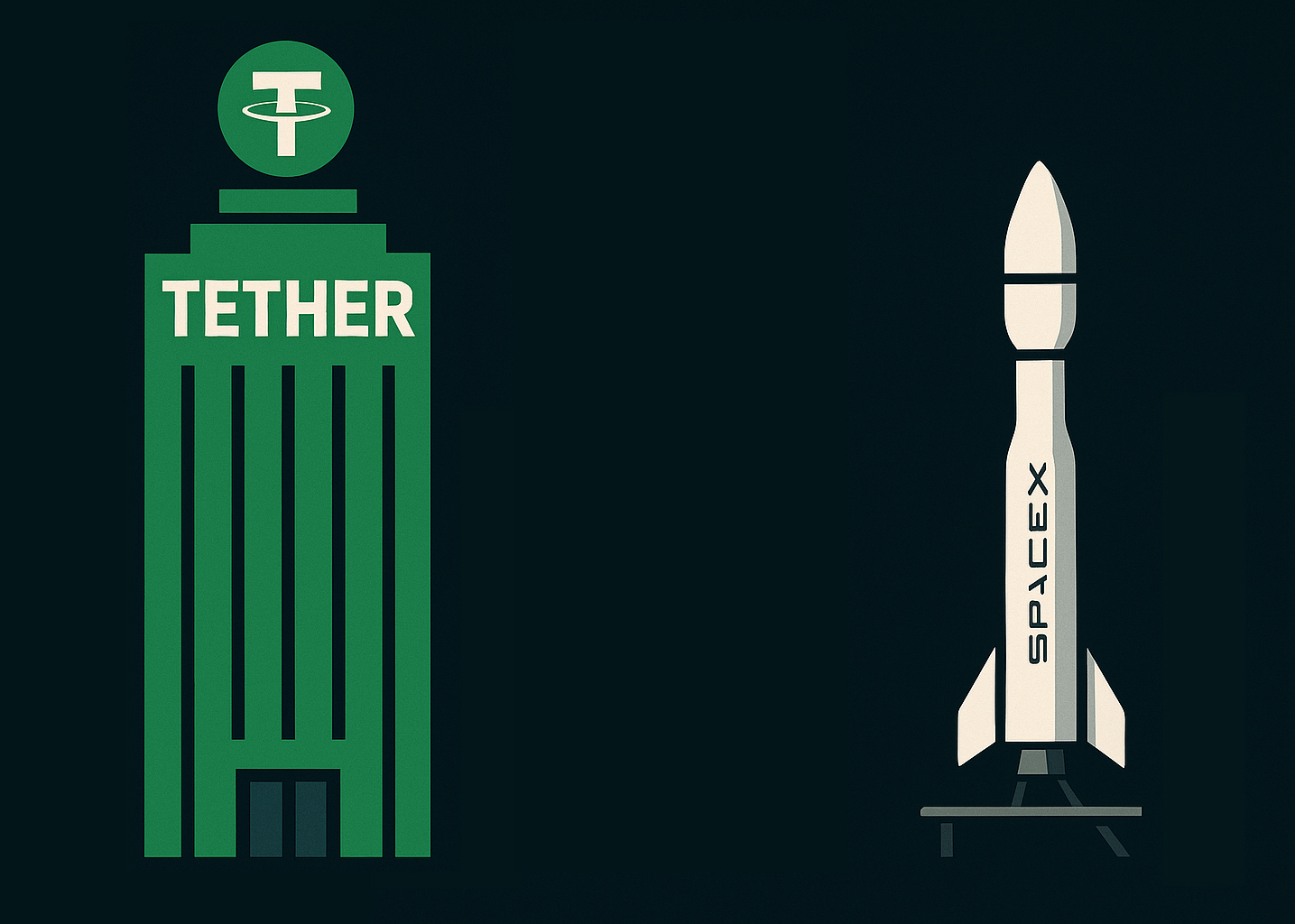
Tether is worth more than SpaceX, at least on paper, and that should terrify every traditional finance executive on Wall Street.
Let that sink in for a moment. A company that essentially prints digital IOUs backed by Treasury bills just valued itself at $500 billion. For context, that puts Tether in the same league as Elon Musk’s rocket empire and Sam Altman’s AI juggernaut.
Meanwhile, Circle, Tether’s closest competitor and a company that actually went public, submits to regulatory oversight, and operates with full transparency, trades at a measly $30 billion market cap on the New York Stock Exchange.
The math is staggering. If Tether’s private fundraising rumors prove true, they’re claiming to be worth seventeen times more than their publicly traded rival. It’s like your neighborhood lemonade stand claiming it’s worth more than Coca-Cola because it sold more cups last summer.
The Money Machine That Ate Wall Street
To understand how we got here, you need to grasp the beautiful simplicity of the stablecoin business model. It’s almost embarrassingly easy:
• Take customer dollars • Issue digital tokens in return • Invest those dollars in risk-free Treasury bonds • Keep the interest for yourself
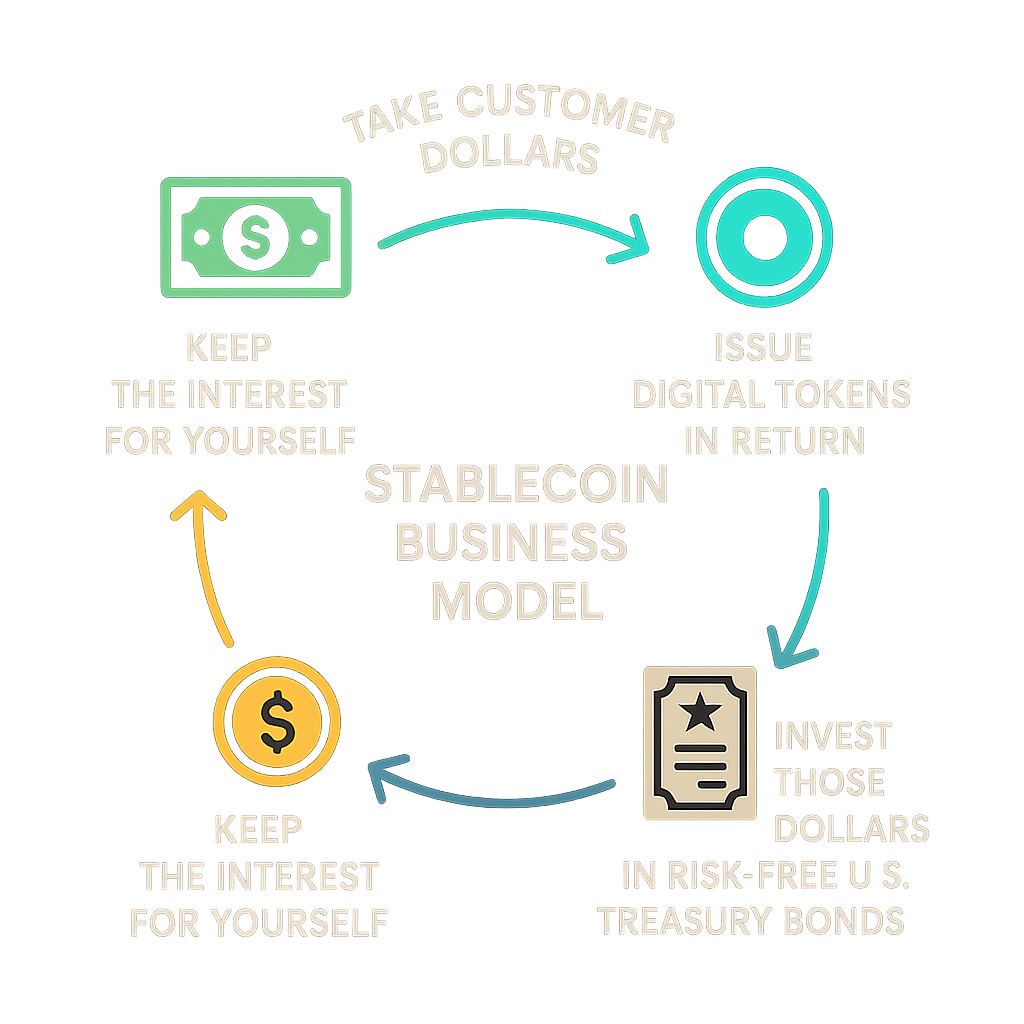
When interest rates soared over the past two years, this became the most profitable arbitrage in financial history.
The numbers are jaw-dropping. Tether generated approximately $13 billion in profit in just the fourth quarter of 2024, roughly half from interest on bonds. Their profit margins reportedly hit 99%, making them more profitable than any major corporation on earth. Google’s parent company, with all its technological wizardry and global reach, would kill for margins like that.
Circle rode the same golden wave, though with more regulatory breathing down their necks. Their playbook was identical: collect dollars, issue USDC tokens, invest the reserves, pocket the interest spread. When rates were high, everyone won. Customers got stable digital dollars, issuers got filthy rich from Treasury yields, and the crypto world got the liquidity it desperately craved.
But every golden age has an expiration date.
The Federal Reserve’s Accidental War
Jerome Powell probably didn’t wake up one morning planning to destroy the most profitable business model in cryptocurrency. But when the Fed started cutting interest rates this year, that’s exactly what happened.
The math is brutal and precise: • Every 25 basis-point rate cut slashes Tether’s annual interest income by roughly $318 million • A 75 basis-point cut would cost them nearly $1 billion per year • Circle faces similar carnage, a 25 basis-point reduction costs them around $122 million annually
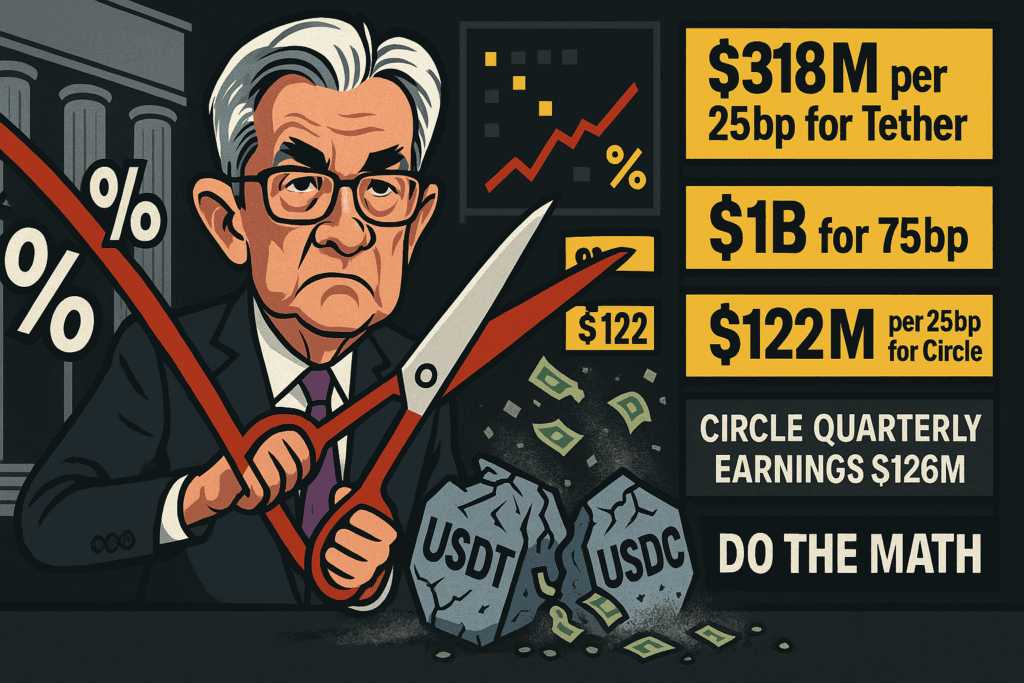
Here’s the kicker: Circle’s recent quarterly earnings were only $126 million. Do the math. A few more rate cuts could wipe out their entire business.
This isn’t some distant theoretical problem brewing in economics textbooks. It’s happening right now. The easy money era that allowed stablecoin issuers to print profits by simply holding Treasury bonds is ending, and these companies are scrambling like hell to find new revenue streams before their golden goose stops laying eggs.
The Billion-Dollar Tea Leaves
While Tether and Circle figure out their post-rate-cut futures, something fascinating is happening on the blockchain, and it might be the most important signal in crypto markets today.
In late August 2025, these companies went on a minting spree that made every trader’s head turn. On August 20, Tether created $1 billion worth of new USDT tokens in a single Ethereum transaction. Ten days later, Tether and Circle together minted roughly $4 billion in just three days.
These weren’t gradual increases in supply. They were massive, coordinated injections of new digital dollars into the crypto ecosystem.
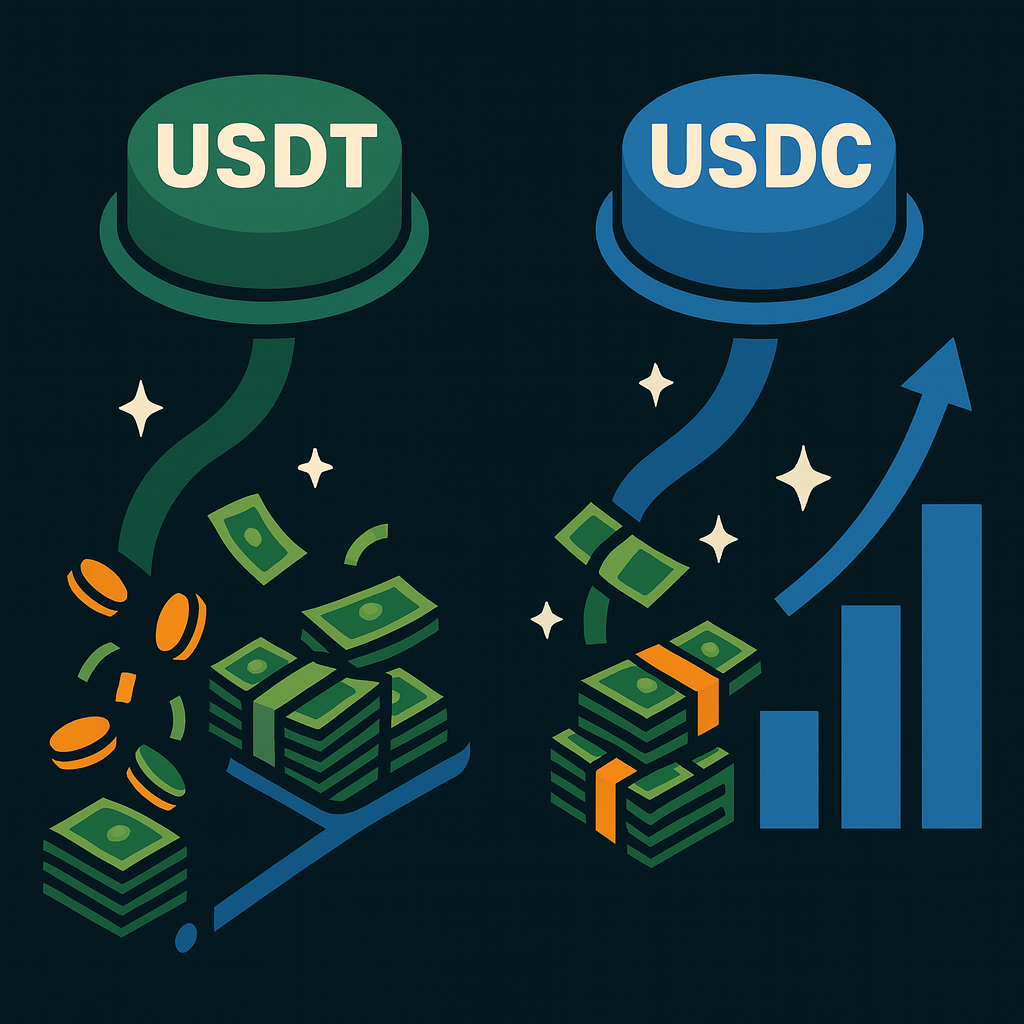
Seasoned traders know exactly what this means. Stablecoins are “dry powder”, cash sitting on the sidelines of crypto markets, waiting to pounce. When issuers suddenly mint billions of dollars worth of tokens, it signals that major players are positioning for something big.
Historically, these large mint events precede significant bull market moves.
The current numbers are mind-bending: • Tether’s USDT supply: approximately $169.5 billion • Circle’s USDC supply: around $74 billion
• Combined market dominance: roughly 90% of all stablecoins • Total stablecoin ecosystem: approaching 1% of the entire US money supply
The Concentration Problem
Here’s where the story gets deeply uncomfortable for anyone who believes in competitive markets. Two companies control nearly a quarter-trillion dollars in digital money. Tether alone processes over $100 billion in daily trading volume, making it more liquid than many national currencies.
This concentration would be troubling enough if both companies were transparent, regulated entities. But Tether has spent years dodging regulatory oversight, refusing detailed audits, and operating with a level of opacity that would make Swiss bankers blush.
Their recent attestations show primarily cash and Treasuries backing their tokens, which sounds reassuring. But here’s the thing: attestations aren’t audits, and transparency isn’t the same as regulatory compliance.

Circle chose the harder path. They went public, submit to New York financial oversight, maintain audited reserves, and operate with the kind of transparency that traditional finance demands.
Their reward? A market cap that suggests investors value regulatory compliance at exactly zero.
The Plot Thickens
The valuation gap becomes even more puzzling when you consider what’s coming down the regulatory pipeline. The US Senate has passed legislation that would require dollar stablecoins to:
• Hold 100% reserves in high-quality liquid assets • Obtain federal licensing for all issuers • Submit to regular audits and oversight
Both companies have already started moving toward these standards, but Circle’s head start on compliance should theoretically give them a massive competitive advantage.
Instead, the market is betting that Tether’s first-mover advantage, network effects, and sheer size trump regulatory compliance entirely. It’s a fascinating test case: In the long run, do markets reward transparency and regulatory adherence, or do they simply follow liquidity and incumbency?
The smart money seems to be betting on the latter.
The Innovation Scramble
Faced with shrinking interest income, both companies are scrambling to reinvent themselves. Circle is “transitioning toward a payment network model,” building new blockchain infrastructure, and chasing transaction fees over interest income. They’re essentially trying to become the Visa of cryptocurrency.
Tether is taking a different approach, expanding into bitcoin mining, precious metals trading, and other ventures that leverage their massive cash flows. They’re also preparing a regulated token specifically for US markets, a hedge against potential regulatory crackdowns on their main product.
The broader industry is evolving too. New models are emerging that share interest directly with users rather than hoarding it for issuers. Traditional finance giants like JPMorgan are piloting their own digital currencies.
The days when two companies could dominate an entire market through simple Treasury arbitrage may be numbered.
The Reckoning
We’re witnessing a pivotal moment in the evolution of digital money. Stablecoins have grown from a crypto curiosity to a quarter-trillion-dollar market that rivals small nations’ entire monetary systems.
The recent headlines, $500 billion valuations, billion-dollar minting sprees, looming regulatory changes, aren’t just crypto news. They’re previews of how money itself might work in the coming decades.
The valuation gap between Tether and Circle will eventually resolve itself, but probably not in the way traditional finance expects. Markets have a ruthless way of rewarding what works over what looks proper on paper.
If Tether’s $500 billion valuation holds up, it won’t be because investors believe in their corporate governance. It will be because they bet on the raw power of network effects, first-mover advantage, and this simple reality: in digital markets, liquidity is everything.
The rules of traditional finance don’t necessarily apply to digital money. Value isn’t always tied to revenue multiples, regulatory compliance, or transparent operations.
Sometimes it’s just about who showed up first and who users trust with their money, even if that trust seems completely irrational by conventional standards.
The age of easy money from Treasury yields may be ending, but the age of digital money is just beginning. And right now, a secretive company that prints digital IOUs is claiming to be worth more than humanity’s most ambitious space venture.
Whether that makes sense depends entirely on what you think money will look like in the future, and who you trust to build it.
This Millionero analysis is for educational purposes only and does not constitute financial advice. Always conduct your own research and consult with qualified financial advisors before making investment decisions.
For more crypto insights and market analysis, visit our Millionero blog. Ready to trade? Access spot and perpetual futures trading on the Millionero platform.