


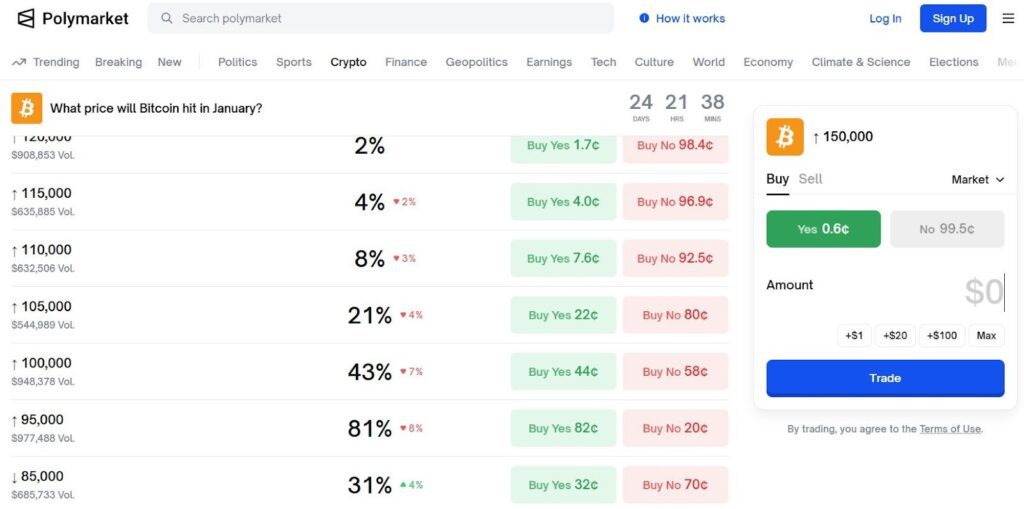
Prediction markets look simple at first glance: you buy a “Yes” or “No” share about a future event, priced between $0 and $1, and that price acts like a live probability. A “Yes” share at $0.70 reads like the crowd saying “about a 70% chance.”
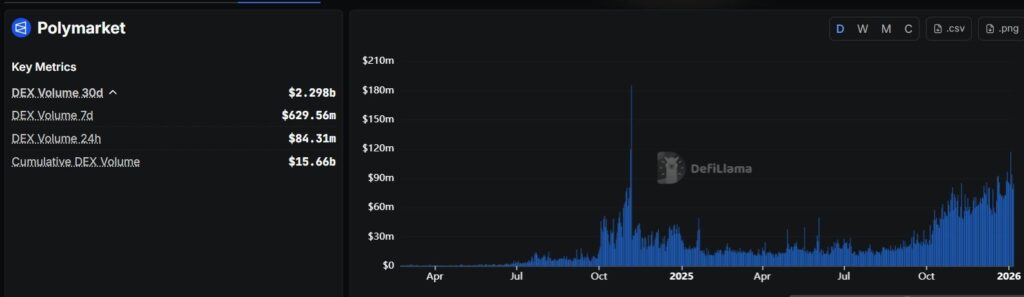
But what’s happening now is bigger than novelty. In 2023–2024, these markets jumped in popularity, helped by smoother apps, global access through crypto rails, and a culture that has gotten more comfortable with wagering on real-world outcomes. Polymarket, in particular, crossed $9 billion in trading volume in 2024 and drew hundreds of thousands of active traders.
The result is a weird but real new corner of finance: part information market, part trading pit, part internet carnival.
Why Polymarket matters: scale, speed, and a new kind of “price”
Polymarket didn’t invent prediction markets, but it made them feel modern. It launched in 2020, used USDC for trading, and leaned on low-fee blockchain infrastructure to make constant small trades realistic.
It also ran into the wall that prediction markets always hit: regulation. After a CFTC enforcement action in 2022, Polymarket paid $1.4 million, agreed to block U.S. users, and wind down non-compliant markets.
Yet the bigger story is what happened after. Outside the U.S., volumes grew dramatically, with monthly volume later described as exploding to over $3 billion by October 2025. And as the broader mood shifted, Polymarket moved toward a more “grown-up” posture, pursuing compliance and even relaunching for U.S. residents under CFTC regulation by the end of 2025, after acquiring a registered exchange/clearinghouse (QCEX).
The traders changed: from opinions to strategy
Here’s the blunt truth: most participants are not “winning the future.” They’re donating liquidity. One study found only 0.5% of Polymarket wallets netted more than $1,000 in profit, meaning the market is increasingly shaped by a small group of sharp traders and bots.
So, what do the winners actually do?
Strategy 1: Arbitrage (the cleanest money, the hardest to catch)
Arbitrage is the closest thing prediction markets have to free lunch, but the lunch is usually eaten by machines.
In a simple Yes/No market, prices should add up to $1. If you can buy Yes + No for less than $1, you lock in profit no matter what happens. The paper gives a clean example:
- Yes at $0.27
- No at $0.71
- Total cost $0.98, guaranteed payout $1.00
That’s a risk-free $0.02 per bundle, if you can execute fast enough.
The catch: bots are built for this. One analysis cited notes that bots executing in under 0.3 seconds captured 90% of available arbitrage profit on Polymarket.
And it’s not small money anymore. Researchers estimate that between April 2024 and April 2025, arbitrageurs extracted about $40 million in near risk-free profits, with top accounts earning millions via “bot-like” behavior.
Strategy 2: News trading (speed beats “being right”)
Some traders don’t aim to hold until resolution. They trade the reaction.
When a big headline hits, court rulings, election polling shifts, surprise announcements, the price can lag reality for seconds or minutes. Fast traders buy early and sell into the wave once everyone else catches up. The edge is not wisdom; it’s pipeline: alerts, feeds, APIs, automation, and discipline.
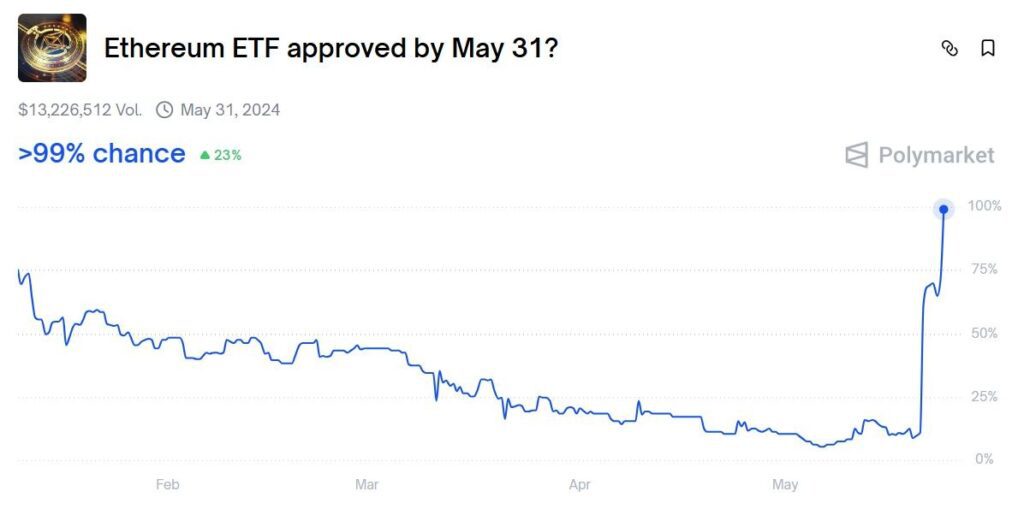
This is where prediction markets start to resemble modern markets everywhere else: information arrives, price snaps, and the quickest hands get paid.
Strategy 3: “Read the rules, not the headline”
A prediction market is not just a question. It is a question plus a resolution process.
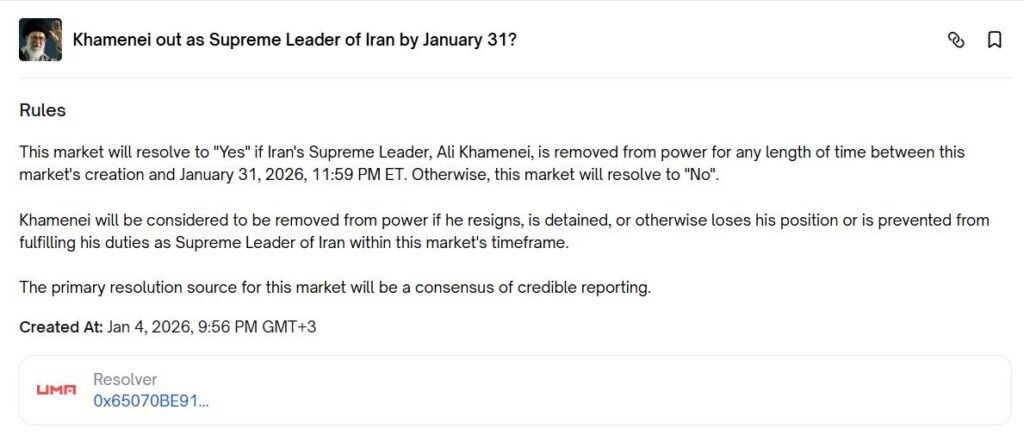
That creates a common retail mistake: trading the vibe instead of the actual settlement criteria. Sophisticated traders look for markets where the title sounds broad or dramatic, but the official resolution rules are narrow and technical. When casual traders overprice “Yes” because the headline feels plausible, rule-focused traders fade it and wait. (This is the prediction-market version of reading the fine print before signing anything.)
Strategy 4: The absurd-bet yield trade (yes, people short Jesus)
Polymarket’s openness creates markets that are serious, and markets that are basically internet jokes. The funny part is that jokes can still be mispriced, and mispricing can become a yield product.
The now-famous market on “Will Jesus Christ return to Earth?” In 2025 drew about $3.3 million in bets, and “Yes” odds didn’t go to zero. That kept “No” priced around $0.97, letting rational traders earn a steady return by taking the “safe” side.
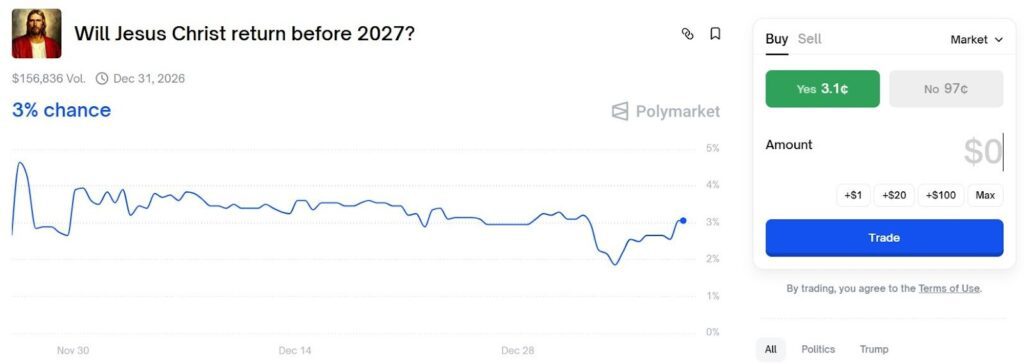
Those who sold that “Christ returns” hype in April 2025 earned about 5.5% annualized, and a new version of the market (“before 2027”) appeared afterward, offering another small yield to skeptics.
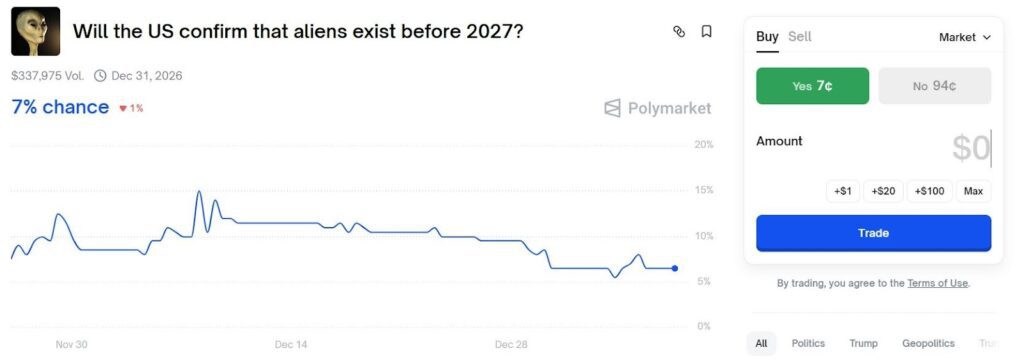
The same logic shows up in other long-shot markets, aliens, civil war, the EU dissolving, where “No” becomes a kind of high-yield bond with tail risk.
Strategy 5: Whale tracking and “follow the flow”
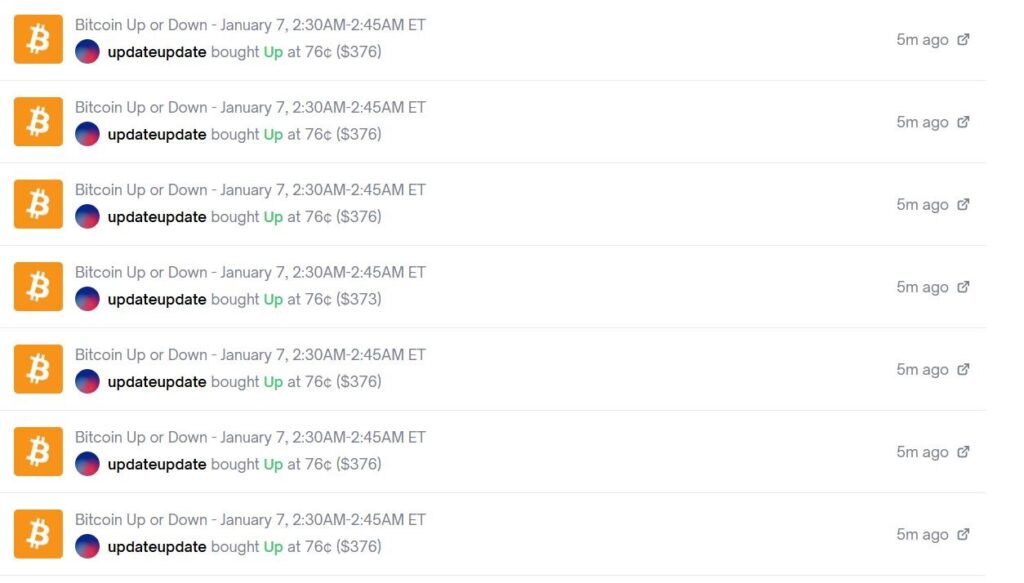
Because Polymarket activity is visible on-chain, traders can watch for unusual positioning: new wallets placing large bets, clusters of buys, or addresses with a strong win history.
That transparency creates a new behavior: copy trading, but for event contracts. The upside is obvious. The danger is also obvious: you might be late, you might be used as exit liquidity, and you might be following confidence rather than truth.
The headline markets are now huge, and they bring new problems
The 2024 U.S. presidential election was Polymarket’s largest ever, with roughly $3.7 billion traded on the winner question. An anonymous French trader (“Théo”) reportedly made about $85 million, using many addresses, raising questions about influence, sentiment, and compliance across borders.
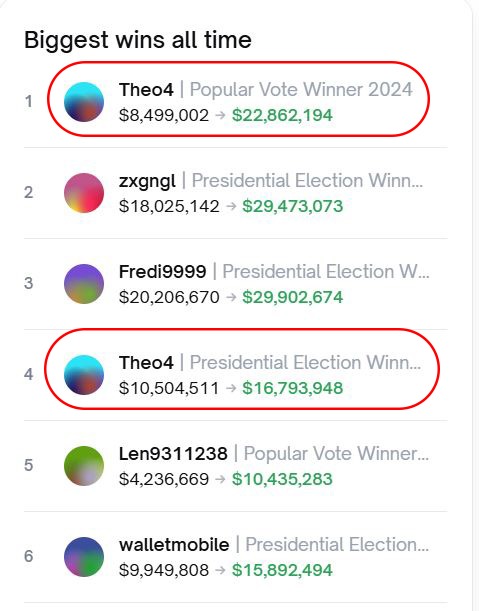
When markets get that large, three concerns get louder:
- Manipulation risk: big money can move thin markets and shape perception.
- Insider-style behavior: sharp, well-timed bets can look like information leakage.
- Retail harm: people confuse “probability” with “truth,” and treat fun bets like investments.
What this all means
Prediction markets are maturing because they are becoming useful in a way that forces professionalism. They don’t just host opinions. They produce a price that people trade, hedge, arbitrage, and sometimes treat like alternative data. Polymarket’s growth, along with its shift toward compliance, shows the direction: bigger volumes, more serious money, and more strategies that look like traditional trading, just applied to real-world outcomes.
If you’re a retail trader, the key lesson is simple: the market is not a poll anymore. It’s a battlefield.
This article is for education and market observation only. It is not financial advice. Always do your own research, size risk carefully, and never trade money you can’t afford to lose. If you want to read awesome articles like this, find us at blog.millionero.com