


The Day Markets Stood Still
October 10-11, 2025 will be remembered as one of the most dramatic days in financial market history. What began as a typical trading day transformed into a catastrophic cascade that wiped out trillions in market value and triggered the largest liquidation event in cryptocurrency history. This wasn’t just another market crash, it was a perfect storm of geopolitical tension, excessive leverage, and structural vulnerabilities converging in real-time.
The Trigger: Trump’s Tariff Bombshell
The Timeline That Shook Markets
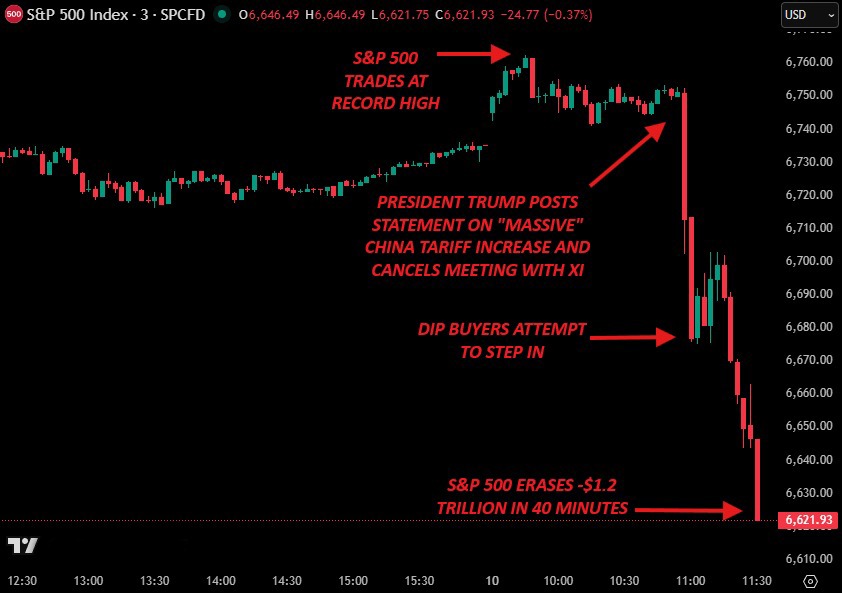
At 10:57 AM ET on October 10th, US President Trump abruptly canceled his scheduled meeting with Chinese President Xi Jinping and announced that “massive” tariff increases were coming. Just 40 minutes later, the S&P 500 had erased $1.2 trillion in market capitalization.
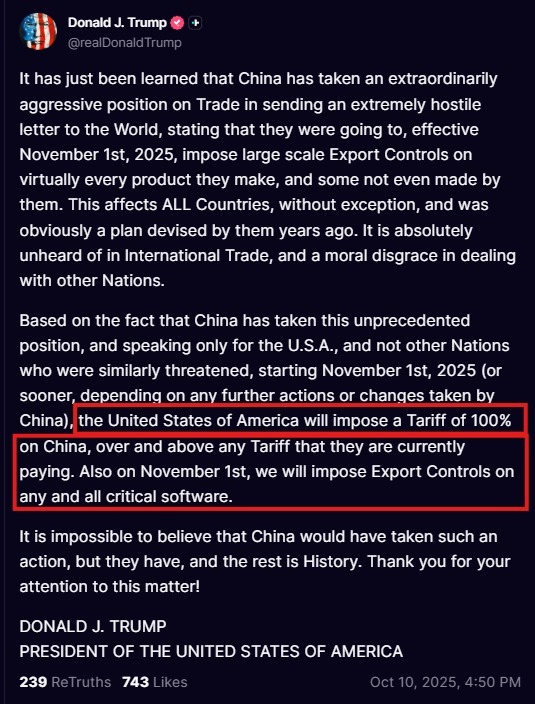
By late evening, the situation escalated dramatically. US President Trump announced a 100% tariff on China starting November 1st, along with export controls on “any and all critical software.” The market’s response was immediate and brutal.
The Rare Earth Conflict
The catalyst centered on rare earth metals, crucial materials for weapons, semiconductors, AI infrastructure, and strategic military applications. Trump accused China of “lying” and attempting to impose export controls on these critical resources. Given that the US sources approximately 70% of its rare earths from China, the implications were staggering.
Rare earths had been a cornerstone of the initial US-China trade deal signed on May 12th. Trump’s accusation that China was reneging on these commitments struck at the heart of global supply chain stability and national security concerns.
The Carnage: By The Numbers
Traditional Markets
The destruction across traditional financial markets was swift and merciless:
- S&P 500 futures plunged -3.5% in a single day
- Total market cap loss: $2.5 trillion in just 6 hours
- The VIX (volatility index) spiked nearly 30%
- This marked the first 2%+ decline in the S&P 500 in 6 months
The context makes this even more remarkable: the S&P 500 had surged +34% in just 6 months, a move seen only 10 times since 1930. Markets were technically overbought, leverage was at extreme levels, and investors were desperately seeking a catalyst to take profits.
Cryptocurrency Apocalypse
The cryptocurrency markets experienced what can only be described as a historic obliteration:
Official figures initially reported:
- Officially, $19 billion got liquidated in 24 hours, the largest single-day event ever recorded
- Bitcoin crashed -10%, falling below $110,000
The Real Numbers Were Far Worse:
Market analysts quickly revealed that the actual liquidation figures were catastrophically underreported. The true scale was closer to $30-40 billion+.
Hyperliquid Exchange Alone:
- $6.7 billion total liquidations since 20:45 UTC
- $4.35 billion in backstop liquidations
- $2.35 billion in market liquidations
Top Asset Liquidations:
- BTC: $781.8 million
- ETH: $539.7 million
- SOL: $246.0 million
- HYPE: $116.7 million
- DOGE: $76.8 million
- XRP: $73.1 million
Historical Context
To understand the magnitude: this liquidation event was nearly 20 times larger than the COVID crash of March 2020, worse than the FTX collapse, and worse than the brutal bear market of 2018. Some altcoins like ATOM essentially went to zero during the crash.
The Perfect Storm: Why This Crash Was Different
1. Hidden Leverage Everywhere
The market had accumulated dangerous levels of leverage that weren’t immediately visible on the surface. While euphoria indicators and funding rates seemed manageable, the reality was far more precarious:
- Investors had shifted heavily from spot holdings to leveraged positions
- Many were chasing perpetual DEX airdrops, including major institutional funds
- Cross-margined positions meant that liquidations in one asset triggered cascading failures across entire portfolios
- CEX (centralized exchange) auto-liquidation mechanisms amplified the crash velocity
2. The Altcoin Liquidity Mirage
A critical vulnerability became devastatingly apparent: market capitalization does not equal liquidity. Many altcoin valuations were “fugazi”, inflated numbers disconnected from actual underlying liquidity. When forced selling began, there simply weren’t enough buyers at any reasonable price level.
This mismatch between perceived value and actual liquidity meant that even modest selling pressure could crater prices by 50-80% within minutes.
3. The Yen Carry Trade Unwind
Perhaps the most sophisticated analysis points to a deeper structural cause: the unwinding of the yen carry trade.
How The Yen Carry Trade Works:
- Investors borrow yen at ultra-low Japanese interest rates
- Convert to dollars and invest in higher-yielding assets (US stocks, Bitcoin, bonds)
- Profit from the interest rate differential plus asset appreciation
Why It Became A Nuclear Trigger:
When USD/JPY suddenly strengthened (the yen appreciated against the dollar), billions in leveraged positions went underwater simultaneously. The yen isn’t just a currency, it’s the world’s cheapest collateral source. A relatively small FX move created massive margin calls across the global financial system.
This created a reflexive feedback loop:
- Yen strengthens → carry trades go underwater
- Forced liquidations of liquid assets (stocks, crypto)
- Falling asset prices trigger more margin calls
- More forced selling accelerates the crash
- Risk models force algorithmic deleveraging
This wasn’t emotional panic, it was mechanical, autonomous deleveraging driven by collateral requirements and risk management systems all firing simultaneously.
4. The Tariff Timing
The tariff announcement hit at the worst possible moment:
- Markets were already overbought after a 6-month rally
- Leverage ratios were at historic highs
- No significant pullback had occurred for half a year
- Global liquidity conditions were already tightening
As analysts noted: markets were “LOOKING for a catalyst to pull back on.” Trump’s announcement became THE REASON to sell in what remains a broader uptrend.
Suspicious Activity: The $1.1 Billion Short
Adding intrigue to an already dramatic situation, on-chain data revealed extraordinary trading activity just before the crash:
October 10th, 10:00 AM (before the tariff announcement):
- A wallet identified as “#BitcoinOG” deposited $30M USDC into Hyperliquid
- Opened massive leveraged short positions totaling $1.1 billion:
- 10x short on 6,189 BTC ($752.9M) with liquidation at $130,810
- 12x short on 81,203 ETH ($353.1M) with liquidation at $4,589.3
The Results:
- By 6:29 PM, unrealized profits exceeded $27 million
- Within 30 hours, the trader closed most positions with over $160 million in profit
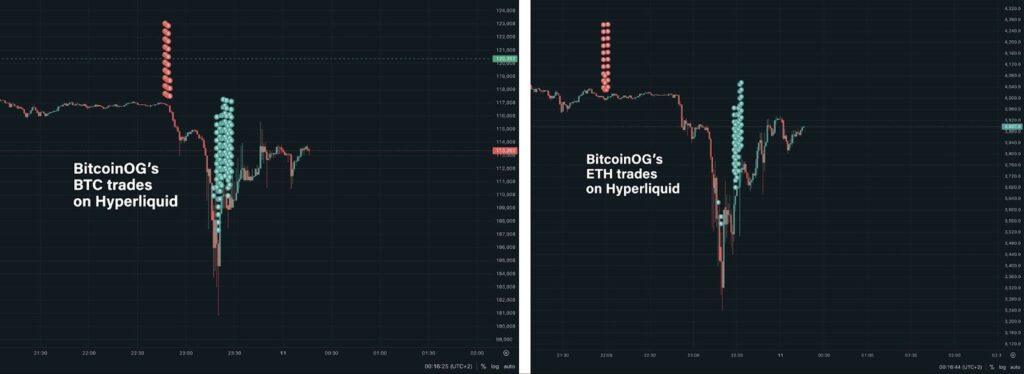
The Question: Did this trader have insider information about the impending tariff announcement? The timing, establishing billion-dollar short positions just hours before a major market-moving geopolitical event, raised serious concerns about potential information leakage.
Notably, $WLFI (World Liberty Financial) flash-crashed approximately 30% a couple hours before the main market crash, suggesting some traders had advance warning.

The Broader Economic Context
Why This Matters Beyond One Day
This crash didn’t occur in isolation. Several macroeconomic factors created the conditions for this volatility:
1. Deteriorating Labor Market
- Underemployment reached 8.1%, the highest since 2021
- Fed rate cuts are expected to resume as economic data weakens
2. Persistent Inflation
- 60% of CPI components are rising by at least 3% annually
- This creates a challenging environment for Federal Reserve policy
3. Dollar Collapse
- The USD is down -10% year-to-date
- On track for its worst annual performance since 1973
- This typically supports nominal asset prices but creates currency instability
4. AI Investment Boom
- Magnificent 7 tech companies are investing $100B+ per quarter in CapEx
- AI now represents ~40% of S&P 500 CapEx spending
- This unprecedented investment wave continues despite market volatility
5. Trade War Escalation
- US effective tariff rate stands at 17.3%, the highest since 1935
- Most tariff impacts were already priced in, but new escalations create fresh uncertainty
6. Government Shutdown
- Adding to market uncertainty and political instability
Market Structure Failures Exposed
What Went Wrong
This event revealed critical vulnerabilities in modern market structure:
1. Liquidity Illusion
- High market caps masked dangerously thin order books
- When everyone tried to exit simultaneously, there were no bids
2. Cross-Margin Contagion
- Liquidation in one position triggered forced selling across entire portfolios
- This amplified volatility and prevented rational price discovery
3. Algorithmic Amplification
- Risk management systems and automated liquidation engines created cascading failures
- Human intervention was impossible at the speed of execution
4. Systemic Leverage
- The financial system had accumulated far more leverage than surface indicators suggested
- This “hidden leverage” in carry trades and derivatives magnified the crash
Expert Analysis: Is This The End Or A Reset?
The Bear Case
Lark Davis (Crypto Analyst): “Worst liquidation event ever in the history of crypto today. Worse than FTX, worse than Covid, worse than 2018… This is an extremely rare event and might need some time to recover from.”
Multiple analysts noted that “something blew the fuck up”, likely market makers, exchanges, or major funds. The scale of damage suggested institutional failures, not just retail panic.
The Bull Case
Despite the carnage, many analysts maintain that this represents a healthy reset rather than a cycle ending event:
Key Bullish Arguments:
- Leverage Flush Was Necessary
- Excessive positioning had made markets fragile
- This purge creates healthier conditions for sustainable growth
- “Fear and Greed are the most powerful emotions in the market; the scale had tipped too far toward greed”
- Tariffs As Bargaining Chip
- Many analysts believe Trump’s announcement is negotiating theater
- The trade deal remains focused on China, suggesting eventual resolution
- Markets may have overreacted to what’s ultimately a political strategy
- Structural Bull Market Intact
- The AI revolution continues accelerating
- Fed rate cuts are coming as labor markets weaken
- Dollar decline supports nominal asset prices
- “Asset owners will continue to be rewarded”
- Technical Reset
- Markets hadn’t seen a 2%+ pullback in 6 months
- The rally was technically overbought
- This creates a healthier foundation for the next leg up
- Opportunity In Crisis
- “Embrace volatility; it’s opportunity”
- Major bottoms are often formed during maximum fear
- Those with dry powder and patience can capitalize
Lessons From The Crash
Critical Takeaways For Investors
1. Prices ≠ Risk
- Markets can appear calm while systemic risks accumulate beneath the surface
- Volatility compression often precedes explosive moves
2. Market Cap ≠ Liquidity
- High valuations don’t guarantee you can exit at those prices
- Always consider actual depth of the order book
3. Leverage Is Dangerous
- Unless you have a sophisticated strategy, leverage amplifies losses catastrophically
- Using leverage to substitute for spot holdings is a recipe for liquidation
4. Always Set Stink Bids
- Extreme volatility creates generational buying opportunities
- Having limit orders at absurd levels can capture incredible value
5. Survival Is Goal #1
- Every crypto OG has endured countless days like this
- Staying in the game is more important than maximizing any single trade
- Capital preservation enables participation in the inevitable recovery
6. Diversification Across Exchanges
- Concentration risk extends beyond assets to platforms
- Exchange failures can lock up capital regardless of asset performance
What Happens Next?
Short-Term Outlook (Days to Weeks)
The immediate aftermath will likely involve:
- Damage assessment as funds, market makers, and exchanges reveal losses
- Potential exchange insolvency revelations (some entities likely failed)
- Regulatory scrutiny of leverage limits and liquidation mechanisms
- Continued volatility as markets digest the leverage flush
- Potential dead cat bounces as short-covering and bargain hunting occur
Medium-Term Outlook (Months)
Several scenarios are possible:
Scenario 1: Trade Deal Resolution If Trump’s tariff threats are indeed negotiating tactics, a deal could spark a sharp recovery. Markets would price in reduced trade war risks and return to the AI-driven growth narrative.
Scenario 2: Escalation If the 100% tariffs actually take effect November 1st, expect further economic deterioration, supply chain chaos, and potential recession fears.
Scenario 3: Grinding Recovery Most likely: a “bumpy road higher” as the structural bull market remains intact but faces periodic volatility spikes from trade war news, Fed policy shifts, and geopolitical developments.
Long-Term Implications
This crash may mark an inflection point:
- De-leveraging cycle creates healthier market structure
- Regulatory reforms for crypto leverage and liquidation practices
- Supply chain restructuring away from China dependence
- Fed policy recalibration as economic data deteriorates
- Continued AI investment driving long-term growth despite volatility
The Bigger Picture: A Market At A Crossroads
This event encapsulates the extraordinary moment we’re living through in financial markets:
✓ Unprecedented AI investment transforming the economy ✓ Historic trade war reshaping global commerce
✓ Currency instability with dollar collapse ✓ Fed policy uncertainty amid conflicting inflation and employment data ✓ Government dysfunction with shutdowns amid crisis ✓ Extreme leverage throughout the financial system ✓ Geopolitical tension between the world’s two largest economies
As one analyst perfectly captured: “There has never been and there will never be a more exciting time to be in the market than now. Anything can happen on any day amid the trade war, AI Revolution, government shutdown, Fed rate cuts, and the list goes on.”
This crash was simultaneously a warning and an opportunity:
- A warning that systemic leverage and structural vulnerabilities can trigger catastrophic deleveraging events with little warning
- An opportunity for those with capital preservation, risk management discipline, and patience to capitalize on forced selling by over-leveraged participants
Conclusion: Natural Disaster In The Markets
This wasn’t a normal correction. As multiple analysts noted, this was “like a natural disaster in the market”, a rare, extreme event that will take days or weeks to fully assess the damage.
The combination of:
- Geopolitical shock (100% China tariffs)
- Structural vulnerabilities (yen carry trade unwind)
- Extreme leverage (hidden in derivatives and cross-margin)
- Liquidity illusion (thin altcoin order books)
- Algorithmic amplification (automated liquidation cascades)
Created the perfect storm for the largest liquidation event in cryptocurrency history and a trillion-dollar equity market crash.
Yet within this destruction lies the seeds of the next opportunity. Markets that purge excess leverage become stronger. Crises that reveal structural weaknesses lead to reforms. Extreme fear creates asymmetric risk-reward for those with capital and courage.
The key insight: ignore the noise and follow the trend. The structural drivers of this bull market, AI revolution, Fed easing, dollar decline, technological innovation, remain intact. But the road higher will be bumpier, with periodic volatility spikes testing investor conviction.
For those who survived with capital intact, the opportunities emerging from this reset may define the next phase of their investment journey. For those who were liquidated, the painful lessons learned will inform decades of future decision-making.
The October 2025 crash will be studied for years as a case study in market structure, leverage risks, and the dangerous interplay between geopolitics and modern financial plumbing.
Note:
“Keep your head up! We will be ok.”
The markets always recover. The question is whether you’ll be positioned to participate when they do.
This article is for informational and educational purposes only and does not constitute financial advice. The content presents analysis of historical market events but should not be interpreted as investment recommendations. Cryptocurrency and traditional markets involve substantial risk, including the potential loss of all invested capital.
Always Do Your Own Research (DYOR). Before making any investment decisions, conduct thorough research and consider your own financial situation, risk tolerance, and investment objectives. Visit blog.millionero.com for more educational content and market analysis.
When you’re ready to trade, Millionero offers both spot and perpetual trading platforms. Trade responsibly, use appropriate position sizing, and never invest more than you can afford to lose.