


The negotiations never happened. Neither the US delegation nor the Iranian team boarded a plane. And then, with minutes of trading left on Wall Street, the US President reopened the question everyone thought was about to be answered with bombs.
What Actually Happened on April 21
Tuesday was supposed to be the day the second round of US/Iran talks began in Islamabad. Vice President JD Vance, special envoy Steve Witkoff, and senior adviser Jared Kushner were the same trio that had flown into Pakistan for the April 11 first round, and the White House had publicly committed all three to a return trip before the two-week ceasefire expired. Pakistani security had already locked down a red zone around the negotiation site, and US communications aircraft had landed at Nur Khan airbase days earlier.
Then none of it happened.
A White House official confirmed mid-afternoon ET that Vance would not be traveling, citing Trump’s own Truth Social post saying Washington was still “awaiting a unified proposal from the Iranians.” Witkoff and Kushner, who had flown from Miami back to D.C. rather than onward to Islamabad, ended the day at the White House in policy meetings instead. On the Iranian side, the delegation led by parliament speaker Mohammad Bagher Ghalibaf never left Tehran either. The Islamic Revolutionary Guard Corps had reportedly pressured the negotiating team to refuse any return to the table while the US naval blockade of Iranian ports remained in place, and the supreme leader never issued the green light mediators had been waiting for.
The Ceasefire Extension Itself
With the truce set to expire Wednesday evening Washington time and US stocks closing down roughly 0.6% across the Dow, S&P 500, and Nasdaq on fears the bombing was about to resume, Trump posted the pivot shortly after the closing bell. Crypto wasn’t doing that well either. He said the Iranian government was “seriously fractured,” that Pakistani Prime Minister Shehbaz Sharif and Field Marshal Asim Munir had personally asked him to hold fire, and that he had directed the military to continue the blockade and extend the ceasefire “until such time as their proposal is submitted, and discussions are concluded, one way or the other.”
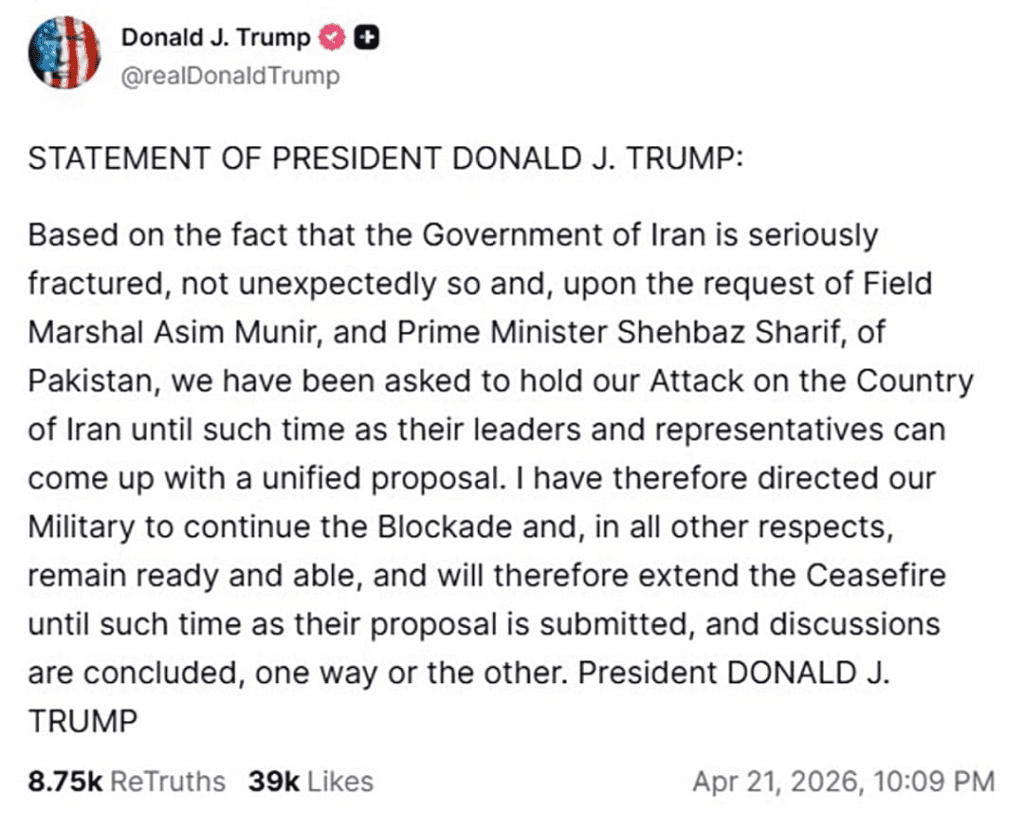
The structure of the announcement is worth reading carefully. There is no new deadline. There is no reopening of the Strait of Hormuz. The naval blockade stays, Treasury Secretary Scott Bessent’s “economic fury” campaign continues, and the military remains, in Trump’s own phrasing, “ready and able.” What changed is only the kinetic timer.
Pakistani PM Sharif thanked Trump publicly on X, while a senior adviser to Ghalibaf dismissed the extension as meaning “nothing,” reflecting exactly the kind of fracture inside Tehran that the White House is now openly citing as the reason a deal cannot be signed.
The Market Reaction
The equity tape on Tuesday told the story of a market that priced a breakdown too early and then had to unwind it in after-hours. During the regular session, indices faded steadily as the Vance trip unraveled: the S&P 500 closed near 7,064, the Nasdaq Composite near 24,260, and the Dow down 293 points to 49,149. Only three S&P sectors (energy, tech, and consumer discretionary) finished green, with defensives like utilities and real estate leading the decline.
Then Trump posted, and the repricing happened across every risk-sensitive asset class essentially at once.
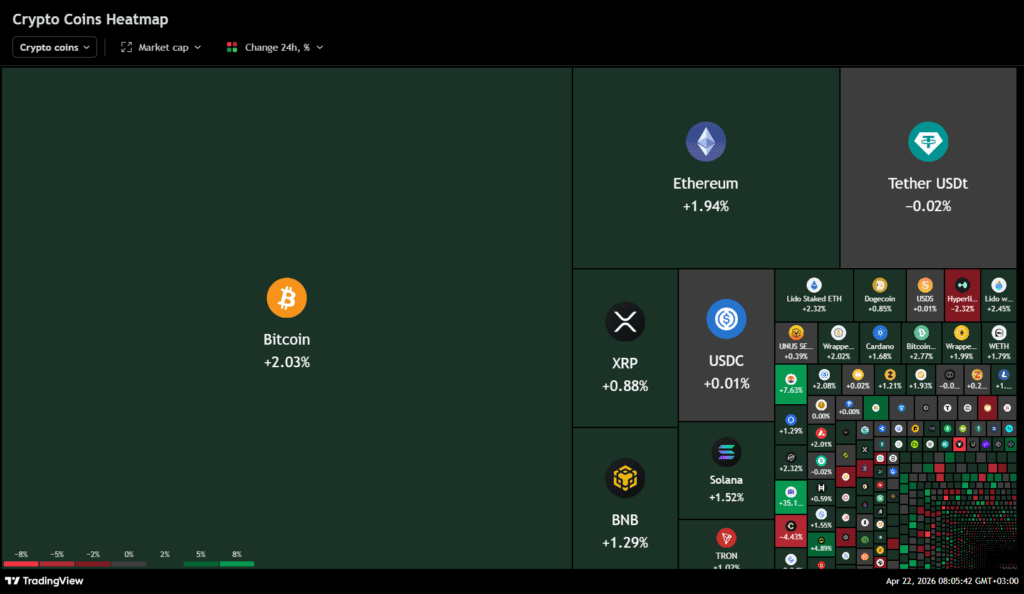
Crypto Snaps Back Green
Bitcoin had spent the session oscillating between roughly $75,000 and $76,600, caught between the Fed chair nominee Kevin Warsh’s pointedly independent confirmation testimony and the collapsing Islamabad optics. Once the extension hit the wire, BTC pushed up through the $77,000 zone on a visible short-squeeze, with altcoins following. Ethereum reclaimed the $2,200 handle, and Solana, XRP, and the majors all flipped green on the day. The mechanical driver is straightforward: short positions were over-represented in the recent liquidation cascade, with roughly $140 million of short liquidations out of $217 million total, so any headline that pushed the war-resumption probability lower was going to force covering.
Gold Softens, Oil Drops Hard, Indices Recover in Futures
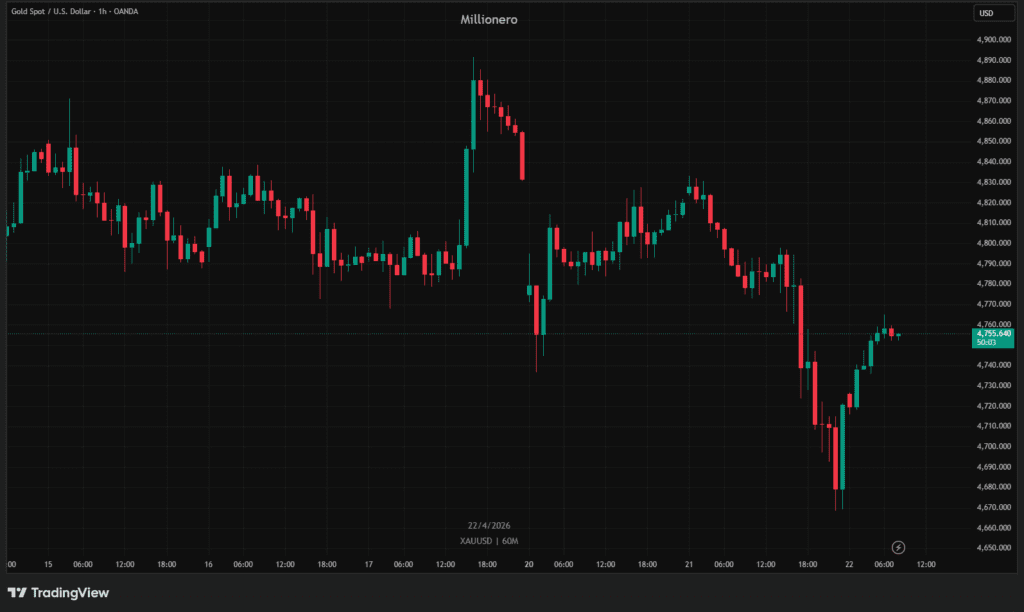
Precious metals did the mirror-image move. Gold held near $4,750 an ounce in early Asia trading after falling more than 2% in the prior session, as the safe-haven bid that had been building for days into the ceasefire deadline was partly unwound. The move is modest rather than dramatic, and that restraint is itself informative: gold is not pricing the crisis as resolved, only as postponed.
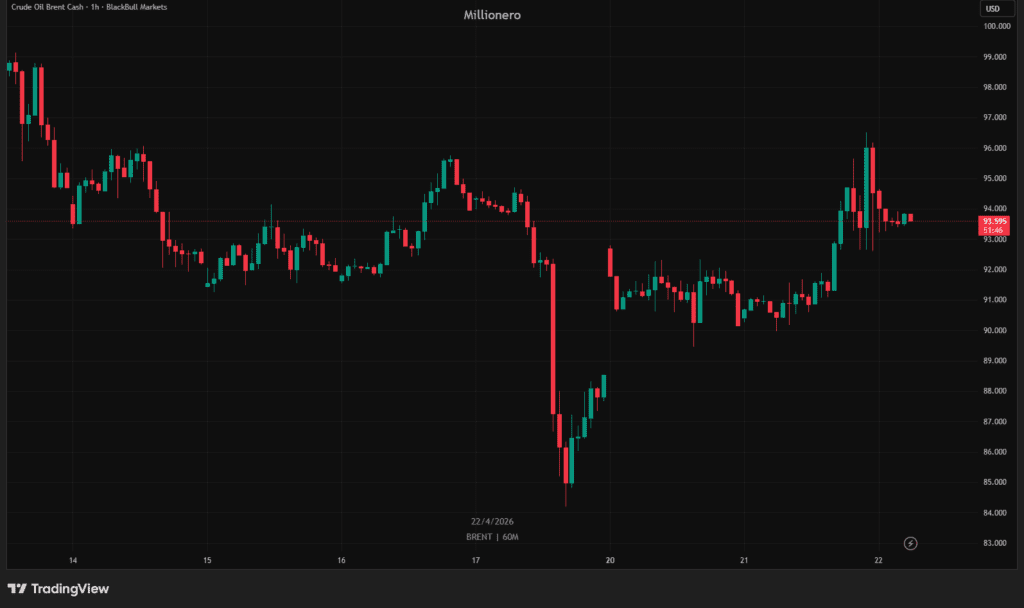
Oil was the cleanest tell. Brent had spiked toward $101 in late afternoon on the peace-talks-collapsing narrative, and US crude to around $95. Within minutes of Trump’s post, Brent pulled back to roughly $98 and WTI slid to about $88, shedding the war-restart premium. Equity futures turned positive overnight on the same logic. The working takeaway from every desk’s Tuesday-evening note was the same one: the clock was reset, the risk was not removed.
Why Polymarket Says This Isn’t Over
This is the part of the story that most of the mainstream coverage is underplaying. If you read only Trump’s post, you would think a crisis had been defused. If you read the prediction markets, you would think one had been deferred by a few weeks at most.
The two largest Iran-related books on Polymarket are “Iran x Israel/US conflict ends by…?”, which has traded over $58 million in volume, and the “US x Iran permanent peace deal by…?” market with over $33 million in volume.
The resolution criteria matter here. The conflict-ends market requires a clean 14-day window with zero qualifying military action between Iran and the US/Israel: no airstrikes, no naval engagements, no ground incursions, with cyber and sanctions actions explicitly excluded. A blockade that produces another vessel seizure like the Touska incident over the weekend, or another Iranian firing on commercial shipping in the Gulf of Oman, would break that window immediately.
A few things stand out in how the books are pricing this
- The permanent peace deal market remains deeply skeptical of near-term resolution. Traders see the two sides as wide gaps apart on nuclear curbs, regional security, and economic terms, with Iran’s demands including sanctions relief, a reversal of the nuclear concessions extracted by the US/Israeli strikes, and reparations, terms Trump has publicly ruled out.
- The ceasefire extended sub-market was pricing an in-principle extension as likely before Trump’s post, but the structural read from traders is that an indefinite extension with blockade intact is operationally a frozen conflict, not a resolved one. Every day the Strait stays closed is another day either side can break the truce via a shipping incident.
- The Trump announces ceasefire end by…? market, which had roughly $5.7 million in volume as of Tuesday afternoon, still shows meaningful probability mass on near-term end-dates even after the extension, because the market resolves on announcement rather than actual hostilities, and Trump’s own pattern over the past 72 hours has been to toggle between “we’re going to end up with a great deal” and “I expect to be bombing” on alternating news cycles.
Risk has been repriced down, not removed. The asymmetry Polymarket is flagging is that the downside tail (resumed strikes, a closed Hormuz beyond another month, Brent toward $110 on the Citi scenario) is still live, and the upside tail of a real permanent deal remains distant.
What to Watch Next
Three things will determine whether Tuesday’s extension actually holds or just buys a week.
The first is whether Tehran sends the “unified proposal” Trump has demanded. The framing of the White House post, that Iran’s government is fractured and cannot speak with one voice, is effectively an ultimatum to the supreme leader to overrule the IRGC.
If that proposal arrives and is workable, Vance, Witkoff, and Kushner will be on a plane within 48 hours. If it does not arrive, or arrives with the preconditions Ghalibaf has repeatedly insisted on (full lifting of the blockade before any talks), the extension becomes a holding pattern that can be ended by a single Truth Social post.
The second is the Strait of Hormuz. The EIA puts average daily oil flow through the Strait at around 20 million barrels, roughly 20% of global petroleum liquids consumption, and the short reopening last week saw only eight tankers transit before Iran slammed it shut again. Any further vessel seizure by the US Navy, or any firing by Iran on a ship flagged by a third country, is the most likely trigger for the ceasefire to break in practice regardless of what the post says.
The third is Iran’s internal politics. The public split between the diplomatic track led by Ghalibaf and Foreign Minister Abbas Araghchi and the military track led by the IRGC is no longer a rumor. It is the explicit premise of the US negotiating position. If the supreme leader resolves that split in favor of the diplomats, a deal is possible. If he resolves it in favor of the IRGC, the blockade becomes indefinite and so does the probability of another round of strikes.
The Bottom Line
Tuesday looks, at first glance, like de-escalation. A ceasefire was extended rather than allowed to expire, Wall Street got its overnight bounce, crypto ripped, oil relaxed, and gold paused its ascent. All of that is real, and in the near term it is tradeable.
But the underlying structure of the confrontation did not change. The blockade is still on. Hormuz is still closed. The negotiators never sat down in the same room. Iran’s government is, by the US’s own public description, too divided to sign anything. And the prediction markets, which priced the first ceasefire, the first round of talks, and this week’s collapse of the second round with more accuracy than most professional desks, are still pricing meaningful probability on a return to kinetic conflict before the summer.
The ceasefire was extended. The issue is not over.
Millionero does not provide financial advice. Please DYOR (do your own research). You can also DYOR on blog.millionero.com. When ready, trade spot and perps on Millionero.