



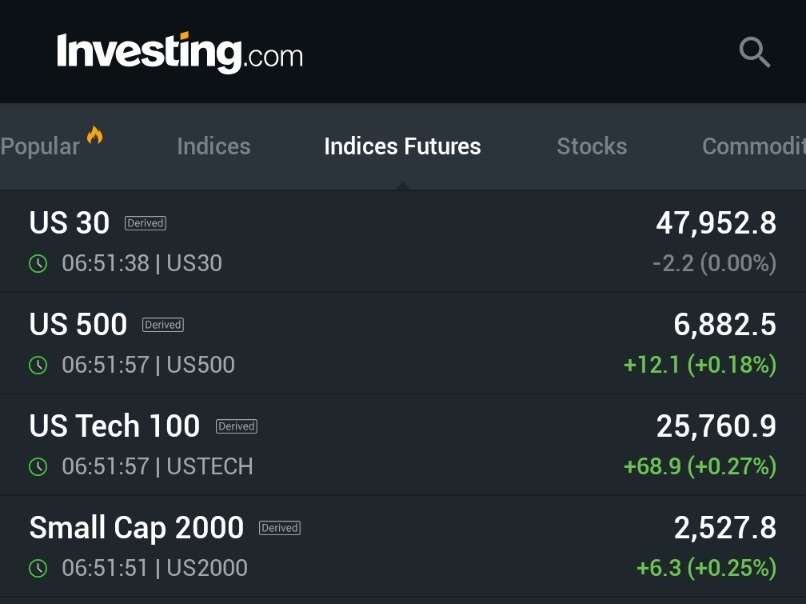
Bitcoin enters the new week in a strange calm. After a sharp flush down to around 87.7k, BTC opened the new week green near 91.5k, while U.S. stock futures are flat near record highs for both SP500 and Nasdaq. The market feels like it is holding its breath before a very heavy macro week, especially Wednesday’s Fed Decision.
Below is a look at what happened over the weekend in crypto and macro, and what is coming next.
Politics, narratives, and the macro noise around Bitcoin
Peter Schiff vs. Donald Trump: an economic fight with a Bitcoin subtext
Over the weekend, Peter Schiff fired back after Donald Trump publicly called him “a fool and a loser.” Schiff challenged Trump to a live economic debate.
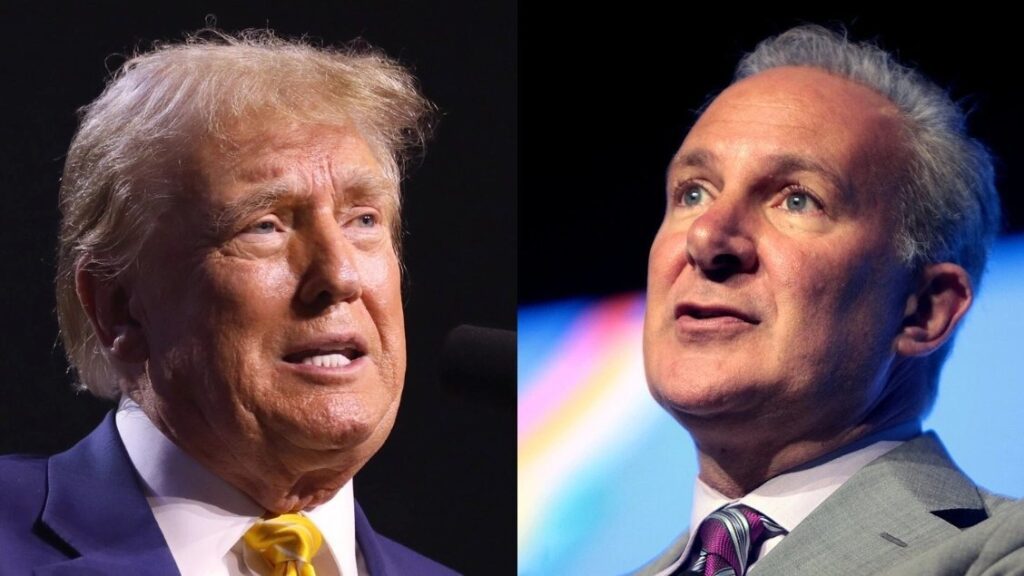
This is not just personal drama. Schiff is one of the loudest Bitcoin critics, while Trump is openly trying to position himself as pro-crypto and pro-Bitcoin.
If this debate ever happens, it will likely become a major stage for two opposite narratives:
- Schiff: hard gold, anti-Bitcoin, skeptical of Trump’s policies.
- Trump: strong dollar rhetoric, but also courting Bitcoin and crypto voters.
Even if nothing is scheduled yet, the tension itself is another sign that Bitcoin is now part of mainstream political fights, not just a niche asset.
“Everything on-chain”: regulators and big banks step further into crypto
“All U.S. markets will be on blockchain in two years”
The SEC chairman Paul Atkins was quoted saying that all U.S. markets will be on the blockchain within two years.
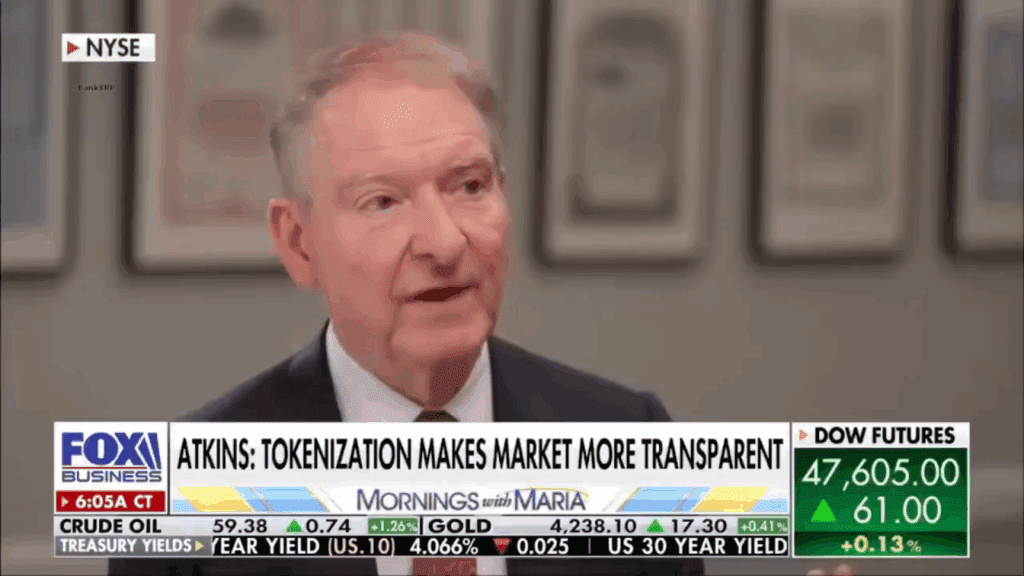
This kind of statement does not mean an exact date where every stock suddenly moves on-chain, but it shows a very clear direction:
regulators and market architects are thinking about blockchain as market infrastructure, not just as a playground for tokens. If even part of this vision comes true, it could:
- Make settlement faster and more transparent.
- Make traditional finance and crypto much more tightly linked.
- Support the long-term case for assets that live natively on-chain.
French giant BPCE: from pilot to real retail crypto access
One of the biggest moves this weekend came from BPCE, one of the largest banks in France.
First, the short headline:
One of the largest French banks, BPCE, has officially launched crypto buy/sell services for its clients.
Then, more detail from the last 72 hours:
- BPCE will offer crypto trading directly inside its Banque Populaire and Caisse d’Épargne apps.
- At launch, about 2 million retail customers can access it, with plans to expand to 12 million customers by 2026.
- Supported assets: BTC, ETH, SOL, and USDC.
- The service uses a separate digital asset account managed by Hexarq.
- Pricing: €2.99 monthly fee plus 1.5% transaction commission.
This means a normal French bank user can interact with Bitcoin, Ethereum, Solana and USDC without ever touching a crypto exchange directly. It does not guarantee heavy buying, but it lowers friction and shows how traditional banks are slowly turning into crypto gateways.
Institutions, ETFs, and how they’re positioning
Grayscale moves on SUI: from BTC/ETH to “next generation” assets
Grayscale has formally filed for a Spot SUI ETF. If approved, this would make SUI one of the first “new generation” assets to get a spot ETF structure, not just futures.

The signal here:
- Grayscale is not limiting itself to large caps like BTC and ETH.
- Regulators are being asked to treat L1 / L2 tokens more like mainstream financial products.
Approval is not guaranteed, but even the filing shows where big ETF issuers think demand might go.
Michael Saylor and the “green dot”
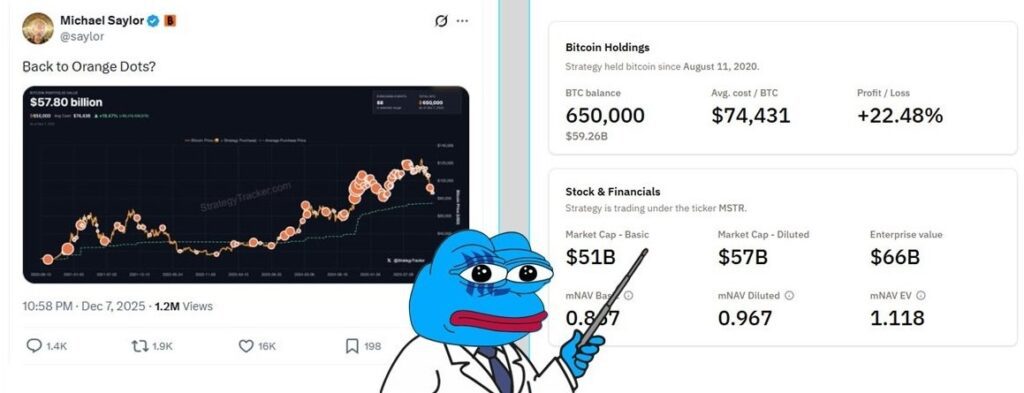
Michael Saylor hinted that MicroStrategy may be ready to buy more Bitcoin soon.
According to bitcointreasuries.net, MSTR’s mNAV is now at 1.118. Saylor previously said, during their December 1 company update call, that “a green dot could appear” if certain conditions are met. He suggested that they might even sell Bitcoin if mNAV drops below 1, but right now, with mNAV above that level, the implication is more on the accumulation side.
Curtesy of @Layerggofficial on X
Parallel to that, Canadian institutions are also choosing the “Saylor route”:
- One of the largest Canadian banks (the sixth biggest in the country) bought 1.47 million shares of MSTR.
- The position is worth around $273 million and gives the bank indirect exposure to Bitcoin via MicroStrategy.
So while Bitcoin’s price is volatile, institutional players are still using MSTR as a proxy instead of holding BTC directly. That tells us that Bitcoin exposure is not fading from balance sheets; it is just being packaged through listed companies and ETFs.
DeFi dominance, exploits, and where the “smart money” goes
Aave’s near-monopoly and the quiet build-up before v4
Data over the weekend shows an overwhelming dominance for Aave in crypto lending:
- Aave now captures 87% of total lending revenues,
- Equivalent to about $98 million per month.
This is almost a monopoly over the lending revenue sector. The important part is who is using it and why:
- This is not short-term trading.
- It looks more like large, patient positions being built.
- The main narrative is anticipation of Aave v4, expected next quarter.

Aave v4 aims to unify liquidity across different networks, turning Aave into an even more powerful lending engine. So, while retail traders chase short-term moves, the “smart money” here seems to be locking in long-term exposure to DeFi blue chips.
The USPD exploit: over 1 million dollars and a broken collateral model
On the other side of DeFi, there was a major exploit on the USPD protocol, with losses over $1 million.
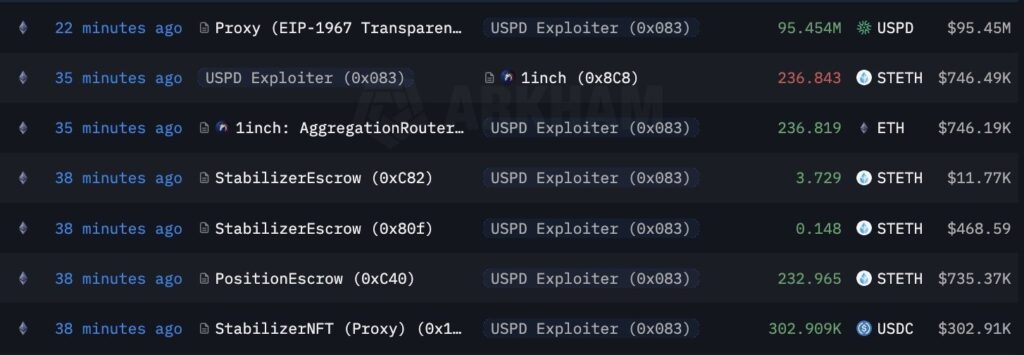
Key details:
- The attacker deposited about 3,122 ETH as collateral.
- They exploited a logic bug that let them mint tokens at 10× the allowed amount in a single move.
- This produced roughly 98 million USPD from just one deposit.
- The attacker then:
- Withdrew 237 stETH as collateral, and
- Dumped the USPD on Curve, getting about $300k in USDC.
- Withdrew 237 stETH as collateral, and
This is not a small technical glitch; it shows a deep problem in collateral accounting and how the protocol handled minting limits. The lesson for users is simple: smart contract risk is still very real, even outside the big, battle-tested names like Aave.
On-chain positioning: mid-size whales quietly accumulate BTC
On-chain data from CryptoQuant over the weekend shows that addresses holding between 100 and 1,000 BTC are now in accumulation mode again.
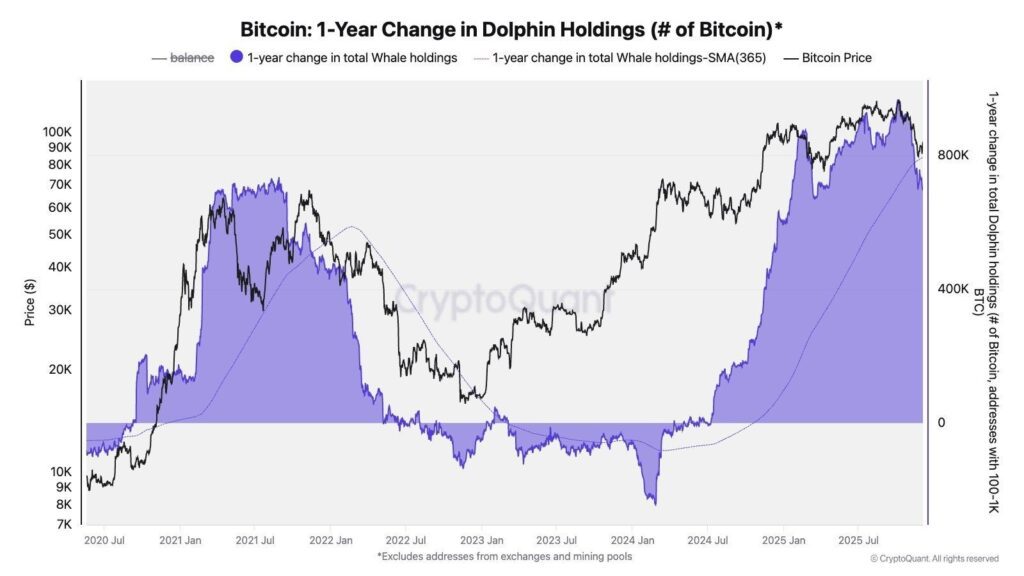
This class of holders is important because:
- They usually move before large institutions.
- They often buy in deep pullbacks, when sentiment is weak.
- Their accumulation often marks the start of new cycle phases or quiet re-accumulation ranges.
So, while retail traders may feel exhausted after every dip, this “mid-whale” group seems to be buying the fear, which fits with the idea of a silent accumulation phase, not from small wallets, but from serious players.
AI, geopolitics, and chips: the Nvidia–China risk
Macro-wise, one of the most important headlines was about Nvidia and China:
- A new U.S. Senate bill could ban sales of advanced Nvidia chips to China for 30 months.
If such a measure passes, it will:
- Hit AI hardware supply in China.
- Keep more high-end computing power under U.S. control.
- Add another layer of geopolitical tension around semiconductors and AI.
For crypto, this matters because:
- AI and high-performance computing are closely tied to tech stocks that often move together with Bitcoin in risk-on phases.
- Any shock to Nvidia’s growth story can affect broader market risk appetite, which then feeds back into crypto sentiment.
Projects, protocols, and infrastructure moves
Galaxy Digital and Liquid Collective: institutional liquid staking
Galaxy Digital announced that it has become the Development Company for Liquid Collective, an enterprise-grade liquid staking protocol, by acquiring Alluvial Finance, the firm that previously developed it.
Now, Galaxy will:
- Use its institutional connections to expand Liquid Collective to more assets and networks.
- Try to deepen validator participation.
- Give institutions more compliant access to liquid staking products worldwide.
The bigger picture is that liquid staking is moving from a retail DeFi niche to something designed for funds, banks, and corporates.
Vitalik: a trustless on-chain gas futures market
Vitalik Buterin highlighted the need for a trustless, on-chain gas futures market.
His main points:
- Gas fees are low right now, but future fees remain uncertain.
- A gas futures market could:
- Reveal market expectations for future gas costs.
- Let users hedge against spikes in gas fees.
- Enable prepayment of gas for a defined time period.
- Reveal market expectations for future gas costs.
If such markets become real, it would make using Ethereum more predictable for both users and developers, especially for long-term planning.
ZKsync: saying goodbye to ZKsync Lite
ZKsync announced it will deprecate ZKsync Lite (also known as ZKsync 1.0), which launched in June 2020.
They describe Lite as a “first step”, and now want to focus fully on the ZK Stack, Prividiums, and the broader ZKsync network.
In practice, this means:
- Old infrastructure will be wound down.
- New development and support will move to the newer modular stack.
Users and projects that still rely on ZKsync Lite will eventually have to migrate or upgrade.
Farcaster: from “social-first” to wallet-focused growth
Dan Romero, co-founder of Farcaster, announced a big strategy shift:
- For 4.5 years, Farcaster tried a “social-first” model.
- Dan said this failed to find product-market fit.
- Now, the project will fully pivot to a “wallet-focused” model.
He also said that the core function of the wallet will center on trading. This means Farcaster wants to live at the intersection of identity, social presence, and direct on-chain trading, rather than being “just another crypto social network.”
Aztec Network: a different token sale model
Aztec Network, a privacy-focused Ethereum Layer 2, closed its public AZTEC token sale on Saturday.
Key details:
- They raised 19,476 ETH.
- There were more than 16,700 participants.
- The team framed this as a move away from insider-heavy token launches, aiming for a broader public base.
Whether it stays truly “non-insider dominated” will depend on on-chain data over time, but this is at least a step in that direction.
Legal pressure: Do Kwon faces 12-year sentence
On the regulatory and legal side, U.S. federal prosecutors are seeking a 12-year prison sentence for Do Kwon, founder of Terraform Labs, the company behind UST, the algorithmic stablecoin that collapsed more than three years ago.
The request comes ahead of his sentencing on December 11 in Manhattan federal court. This is another sign that failed or fraudulent stablecoin experiments now carry heavy personal legal risk, not just financial losses for users.
Digital Asset Treasury stocks under pressure
According to Bloomberg, shares of U.S. and Canadian Digital Asset Treasury (DAT) companies have dropped sharply this year:
- Median decline is about 43%,
- Some names are down more than 99%.
These companies previously pumped when they borrowed or raised capital to buy crypto, but now:
- Their tokens pay no yield.
- They face debt interest and dividend costs.
This has flipped investor mood from enthusiasm to skepticism, even while major players like MicroStrategy continue to attract institutional inflows.
The macro calendar: a Fed-heavy week and why Wednesday matters
This week is loaded with U.S. economic data, and almost everything orbits the Federal Reserve’s rate path.
Key upcoming events:
- Tuesday
- ADP private payrolls
- JOLTS job openings
- ADP private payrolls
- Wednesday – the main event
- Employment Cost Index (ECI)
- Fed policy decision on interest rates
- The Dot Plot, where each Fed member shows their expected future rate path
- Jerome Powell’s press conference
- Employment Cost Index (ECI)
- Thursday
- Initial jobless claims
- Initial jobless claims
Why is Wednesday so important?
- Markets expect the Fed to hold rates, not hike.
- The debate is about when cuts will start, and how fast they will come.
- ECI, job data, and the Dot Plot will tell us if the Fed still fears inflation, or if it is more worried about growth and employment.
For Bitcoin and crypto:
- If the Fed signals earlier or faster rate cuts, that is usually seen as bullish for risk assets, including crypto.
- If the Fed stays hawkish and hints that cuts are far away, it can pressure risk assets, especially those that already rallied hard.
Right now, with BTC back near 91.5k after a fast bounce from 87.7k and stock futures flat at record levels, the market is clearly waiting for Powell and the Dot Plot before making its next big move.
This week’s token unlocks
These are the token unlocks for this week:
Connex (CONX)
Date: December 15, 2025
Unlock Value: 21.74M USDT
% of Circulating supply: 1.61%
Number of Tokens: 1.32M CONX
Aptos (APT)
Date: December 11, 2025
Unlock Value: 19.91M USDT
% of Circulating supply: 0.8%
Number of Tokens: 11.31M APT
Starknet (STRK)
Date: December 15, 2025
Unlock Value: 14.32M USDT
% of Circulating supply: 5.07%
Number of Tokens: 127M STRK
Cheelee (CHEEL)
Date: December 13, 2025
Unlock Value: 10.86M USDT
% of Circulating supply: 2.86%
Number of Tokens: 20.81M CHEEL
LINEA (LINEA)
Date: December 10, 2025
Unlock Value: 10.98M USDT
% of Circulating supply: 6.76%
Number of Tokens: 1.38B LINEA
BounceBit (BB)
Date: December 9, 2025
Unlock Value: 2.59M USDT
% of released supply: 3.42%
Number of Tokens: 29.93M BBIn the end, this week is all about positioning before the Fed speaks and before new supply from token unlocks hits the market.
This is not financial advice. Please do your own research, and you can start by reading more deep-dive articles on blog.millionero.com. When you feel ready, you can trade spot and futures on Millionero, but always with your own plan and your own risk limits.