



Big moves and stress over the weekend
Crypto liquidations: The last ~72 hours were messy across crypto.
Bitcoin opened the first day of December around 91k after the long Thanksgiving break, then sold off fast to about 86k within a few hours.
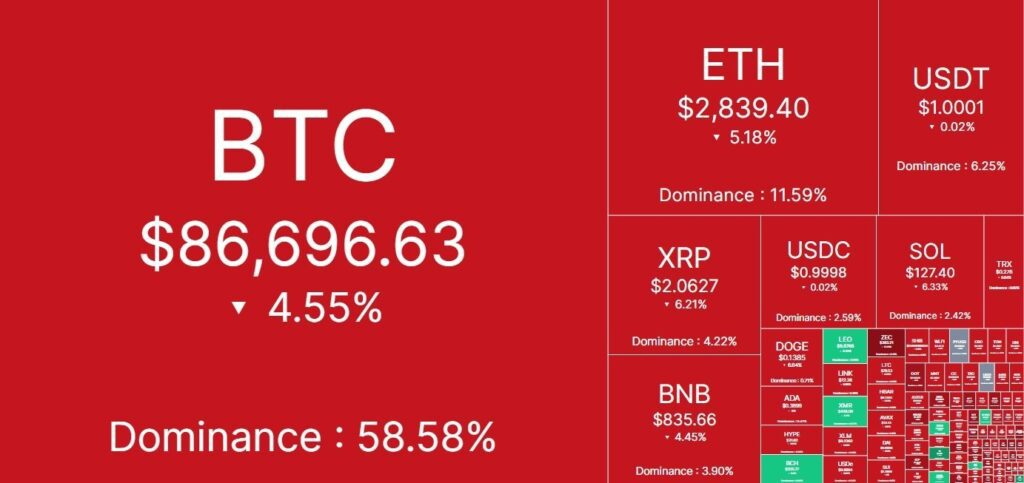
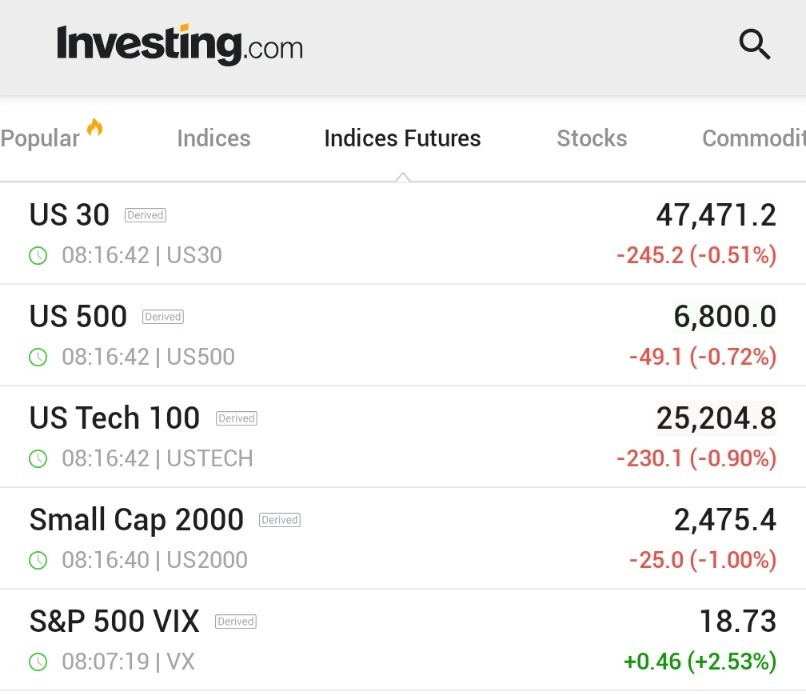
This move came with a sharp jump in fear: stock futures fell in Sunday night trading, and the VIX spiked as traders prepared for a very busy macro week.
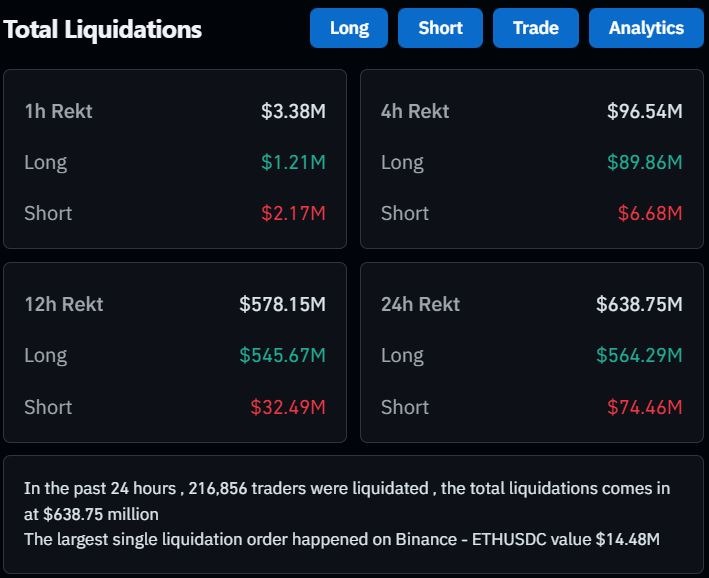
At the same time, leverage in the crypto market washed out, in the past 24 hours, 216,866 traders were liquidated, with total liquidations of about $638.76 million.
This set the tone for the week: less “euphoria”, more risk management.
MicroStrategy and Bitcoin as “last resort collateral”
Over the weekend, MicroStrategy’s CEO Phong Le clarified how the company thinks about selling Bitcoin. He said that Bitcoin would only be sold as a last resort, and only if:
- mNAV (modified net asset value) falls below 1, and
- Funding becomes unsustainable or unavailable.
He stressed this is a contingency plan for extreme stress, not an active intention to dump BTC. Right now, their mNAV is around 1.18, based on a Bitcoin price of about $87,300. In simple words: MicroStrategy is still very far from the line where they would start selling.
This matters because MicroStrategy is one of the largest corporate holders of BTC. The market wanted to know: Will they become forced sellers if prices fall? For now, the answer is no, unless things get really bad.
Stablecoins, risk, and regulation
Arthur Hayes vs Tether: can USDT survive a big drawdown?
Arthur Hayes shared a rough calculation: if there was about a 30% drop in the combined gold + Bitcoin position that backs part of Tether’s reserves, then USDT could be “in theory insolvent”. He links this to his view that the Fed will cut rates, which reduces interest income for Tether and other large holders of Treasuries.
Tether CEO Paolo Ardoino answered with numbers. He said that, at the end of Q3 2025, Tether had:
- ~$184.5B in stablecoin reserves,
- ~$7B in excess equity,
- plus ~$23B in retained earnings as part of the Tether Group equity.
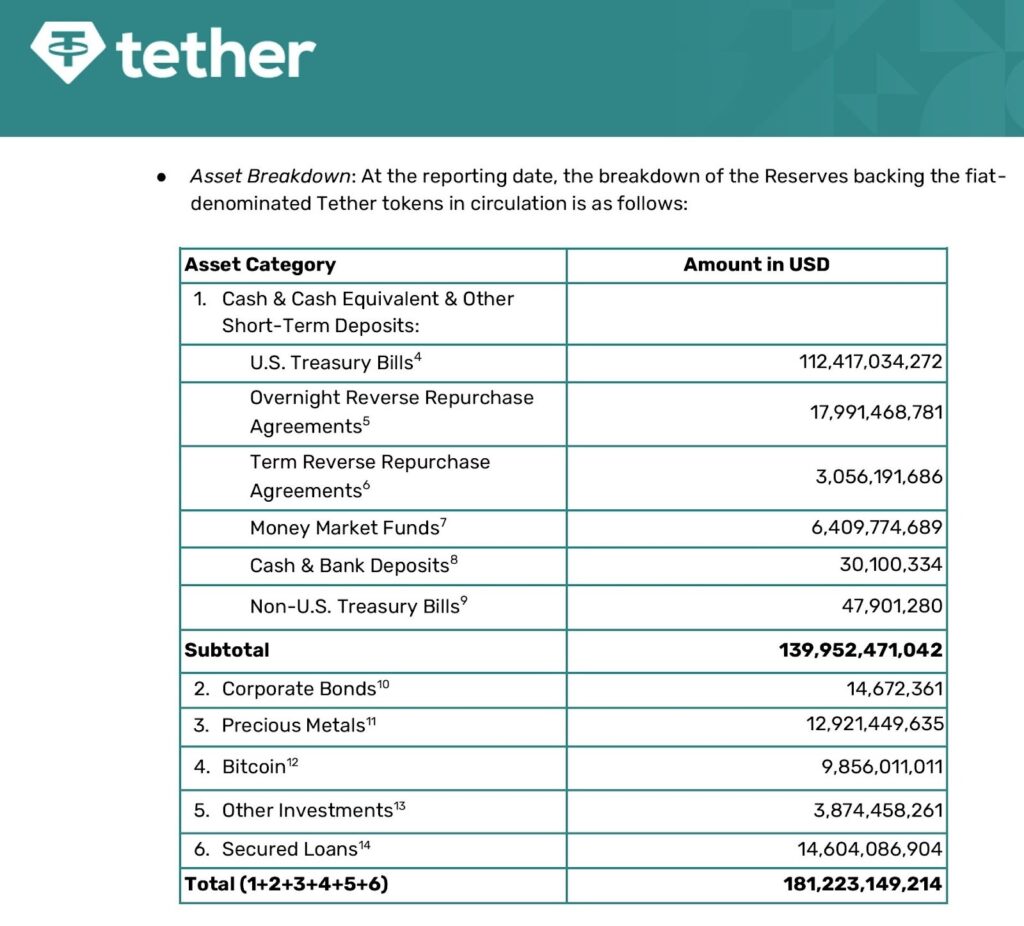
The debate here is not just math. It is about trust. Arthur is pointing at tail risk if markets crash hard. Tether replies that they have a big buffer and are far from insolvency. The market will keep watching their reports, especially if volatility returns.
China prepares a new crackdown on crypto payments
Chinese regulators are again talking about cracking down on crypto payments and stablecoins. Even after earlier bans, they see renewed risks to the financial system and want stricter enforcement to block the use of digital assets in day-to-day payments and transfers.
For global markets, this is not new, but it reminds everyone that large regions are still hostile to open crypto payments, especially when it touches capital controls and banking.
RLUSD gets greenlisted in Abu Dhabi
On the other hand, Ripple’s RLUSD had a positive week. Abu Dhabi’s FSRA has greenlisted RLUSD as an “Accepted Fiat-Referenced Token” inside the Abu Dhabi Global Market (ADGM). That means:
- Licensed firms in ADGM can use RLUSD for regulated activities.
- RLUSD is issued under a New York DFS (NYDFS) framework.
- It has already reached over $1.2 billion in market cap since launch.
This is a clear example of regional regulatory fragmentation: while China tightens, some Gulf jurisdictions are moving to integrate selected stablecoins into their financial system.
SEC commissioner backs self-custody as a “right”
In the US, SEC commissioner Hester Peirce made a strong public statement: self-custody of digital assets is a basic right for users, and it should not be restricted by intermediaries or institutions.
In practice, this adds weight to the argument that keeping your own keys is part of financial freedom, not something regulators should try to ban.
Platforms, tokens, and protocol drama
Hyperliquid: cliff unlock, business model, and losing traders
Hyperliquid was in focus for two reasons.
First, $HYPE (Hyperliquid) had its first scheduled cliff unlock, releasing about $354M of HYPE (2.66% of circulating supply) to core contributors and team members. The next unlock is set for December 29.
At the same time, a detailed analysis argued that Hyperliquid is “the biggest liquidity vacuum machine in crypto”:
- It controls around 50% of all perpetuals open interest in the market.
- It earns roughly $90M per month in fees.
- About 86% of traders lose, with the average losing trader down around $5,600 per day.
- Only five market makers were said to control 68% of open positions.
- The HYPE token is down about 40%, and the analysis claims the token does not capture much value, while the platform captures a lot from users.
The conclusion from that post: Hyperliquid looks more like a professional trading firm wearing a DeFi mask than a protocol that shares long-term value with its community. Taken together with the unlock, this raises questions about how sustainable the current model is for small traders and for the token.
Yearn’s yETH exploit
Yearn Finance faced a serious problem with $yETH. An attacker found a way to mint almost unlimited yETH in one transaction, drained the pool, and walked away with about 1,000 ETH (~$3M), sending some funds to Tornado Cash.
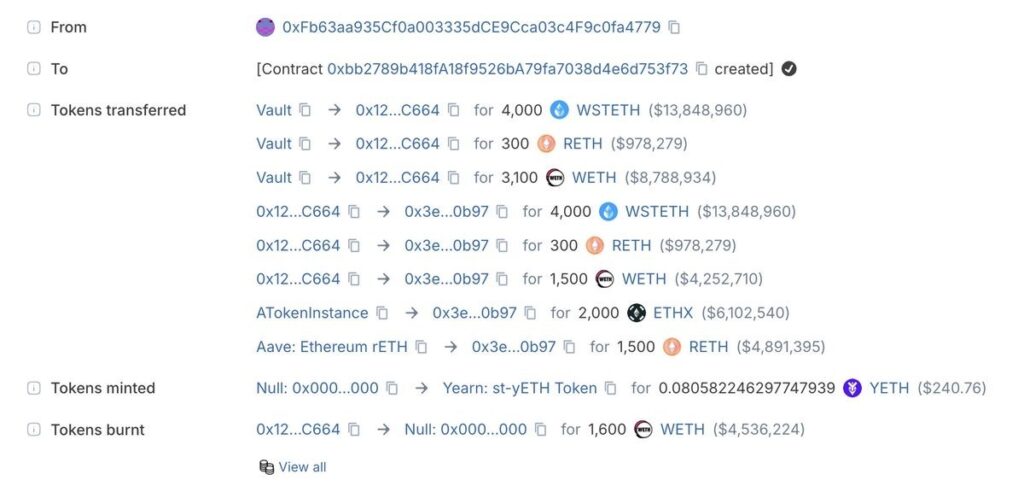
Important detail: Yearn’s V2 and V3 Vaults are not affected, but the exploit still hurts confidence and reminds everyone that complex yield products are only as safe as their smart-contract logic.
HumidiFi and $WET litepaper
HumidiFi released a litepaper for its $WET token, ahead of its TGE on December 3, which will take place on Jupiter’s Decentralized Token Formation (DTF) platform. The details are still early-stage, but this marks another attempt to use structured token launches on Solana rather than simple meme launches.
Telegram, TON, and Cocoon
Telegram CEO Pavel Durov announced that Cocoon is now live. Cocoon is a TON-based decentralized AI inference platform. In simple terms:
- It connects GPU providers to apps that need to run AI models.
- It focuses on privacy-preserving AI, so user data stays confidential.
- Over the coming weeks, they plan to add more GPU supply and more developer demand, aiming to bring “fully private AI” to Telegram’s huge user base.
This sits at the intersection of TON, AI, and privacy, three very hot narratives.
Zcash and governance: Vitalik’s warning
Vitalik Buterin commented on $ZEC (Zcash) governance. He said he hopes ZEC resists token voting. In his view:
- Token voting tends to push power toward the median token holder.
- For a privacy coin, that could slowly erode privacy priorities over time.
- He wants token holders to “not be top dog”, meaning they should not be the only or main governance layer.
This is part of a broader debate around how to govern protocols without just giving everything to whoever owns the most tokens.
Ethereum valuation models and “undervalued ETH”
On the valuation side, Ki Young Ju pointed to ETHval, a platform by Hashed CEO Simon Kim that aggregates 12 different Ethereum valuation models. According to the data he shared:
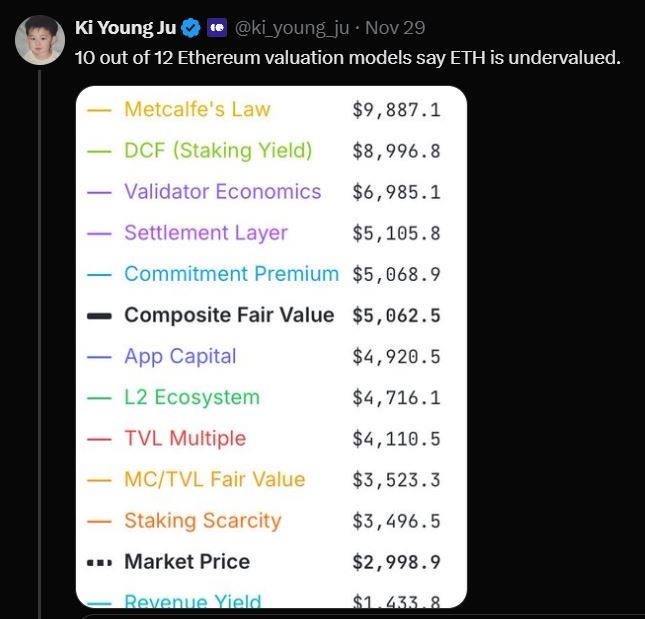
- 10 out of 12 models say ETH is undervalued.
- ETH is trading around $2,820, below its estimated fair value on these models.
Of course, models can be wrong. But this shows a growing effort to treat ETH more like a “cash-flow and activity driven asset” than just a speculative coin.
Monad post-launch: noise vs real activity
An analysis looked at Monad a week after mainnet launch. The picture is mixed:
- Many airdrop recipients started selling aggressively, and the airdrop was widely seen as disappointing.
- Meme coins on Monad have cooled down, and the early hype around new launches has faded.
- But in the background, TVL has doubled despite price volatility.
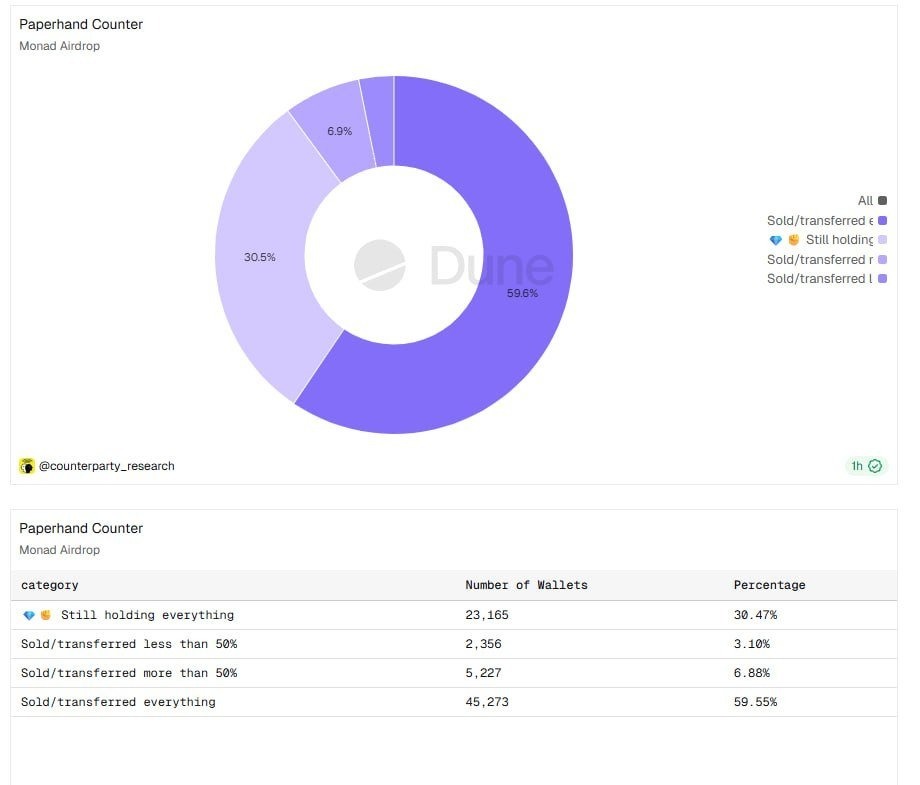
The takeaway: the launch hype is fading, but longer-term capital is starting to position on the chain, which might matter more than short-term memecoin noise.
Institutions, politics, and policy narratives
Bitcoin ETFs now a core revenue engine for BlackRock
Another tweet highlighted how deep institutions are now in the Bitcoin trade:
- BlackRock’s Bitcoin ETF (IBIT) has generated over $245M in annualized fees by October 2025.
- It is the fastest-growing ETF in history.
- IBIT now holds about 3% of all Bitcoin supply.
- Bitcoin ETFs have become the number one revenue driver for BlackRock in this area.
The message is simple: institutions are in, and they have built real business models around Bitcoin. This makes a full “exit” unlikely in the near term.
US politics: Trump’s $2,000 checks plan meets internal resistance
Inside the US, Republican Party tensions surfaced in a Bloomberg report. Trump has floated a plan to send $2,000 checks to people next year, but many Republicans oppose this direct spending idea.
Why does this matter for crypto and markets? Because fiscal policy (big checks, deficits, extra money in the system) interacts with the Fed’s decisions and with inflation. More direct spending could support risk assets in the short term but also keep inflation sticky, which then shapes how far the Fed can cut rates.
Market structure stress: liquidations and weekend risk-off
Putting all of this together:
- Bitcoin dropped from 91k to ~86k on the first day of December trading.
- Stock futures fell, and VIX jumped, showing fear for the week ahead.
- Over 216k traders were wiped out in $638M of liquidations.
Some of this is just positioning after holidays. Traders came back from Thanksgiving, saw a big list of upcoming data, and de-risked, especially on high leverage perps. The rest is tied to the macro shift we talk about next.
The macro backdrop: QT ends and a data-heavy week
QT officially ends
The Federal Reserve’s quantitative tightening (QT), the process of shrinking its balance sheet, officially ends today, December 1, 2025. From now on, the Fed stops letting Treasuries roll off and will reinvest principal payments instead.
In simple words:
- Before: the Fed was slowly draining liquidity from the system.
- Now: it will keep the balance sheet roughly stable, no longer tightening via QT.
This shift came together with a recent 25 bps rate cut, bringing the policy rate to about 3.75–4%.
For crypto, this is important because liquidity is the fuel. Less tightening usually supports risk assets like stocks and Bitcoin, especially if markets believe more cuts are coming.
Powell’s speech at the Hoover Institution
Jerome Powell is also scheduled to speak today (Dec 1) at 8:00 p.m. ET, which is 6:00 a.m. UTC on Dec 2. Markets will listen for:
- How he frames the end of QT, is it a one-off technical adjustment or the start of a more dovish phase?
- Whether he signals more cuts, or keeps the door open but data-dependent.
- Any mention of financial stability, bank funding stress, or asset bubbles.
Given the big move in Bitcoin and the stress in leveraged positions, traders will definitely re-price risk based on his tone.
Upcoming US data – and why it matters for rate cuts
This week is packed with US numbers. All of them feed into the same main question: can the Fed keep cutting, and how fast?
Here is what is coming, and what it means in simple terms.
1. ISM Manufacturing PMI (November) – Monday
- Measures factory activity.
- Level above 50 = expansion, below 50 = contraction.
If this number is weak, it supports the idea that the economy is slowing, which gives the Fed more room to cut rates without re-igniting inflation. A strong PMI means the economy is still hot, which could slow or limit future cuts.
2. JOLTS Job Openings (September) – Tuesday
- Shows how many jobs are open but unfilled.
If job openings drop, it means the labor market is cooling, which reduces wage pressure. That makes it easier for the Fed to keep cutting. If openings stay very high, the Fed may worry that inflationary pressure from wages will continue.
3. ADP Nonfarm Employment (November) – Wednesday
- A private jobs report that gives an early signal before the official payroll data.
A soft ADP print (fewer new jobs) supports the case for more rate cuts. A strong number does the opposite.
4. S&P Global Services PMI (November) – Wednesday
- Tracks activity in services like finance, tech, tourism, etc.
- The US is a services-heavy economy, so this is very important.
Weak services PMI = slowdown → easier for the Fed to stay dovish.
Strong PMI = resilient demand → more pressure to go slow on cuts.
5. ISM Non-Manufacturing PMI (November) – Wednesday
- Another big services sector indicator, watched closely by macro funds.
Again, soft = support for cuts, hot = caution on cuts.
6. Initial Jobless Claims – Thursday
- Weekly data on how many people are filing for unemployment benefits for the first time.
If claims trend higher, it signals rising unemployment, which pushes the Fed toward more easing to avoid a hard landing. Low claims mean the labor market is still strong, which can slow the path of cuts.
7. PCE Inflation (September) – Friday
- The Fed’s preferred inflation measure.
If PCE shows inflation falling toward the Fed’s 2% target, it opens the door for more cuts in 2026. If PCE is sticky or re-accelerates, the Fed may have to pause or slow down the easing cycle, even after ending QT.
8. Michigan Consumer Sentiment (December) – Friday
- Measures how households feel about the economy and their finances.
Higher sentiment can support spending, which is good for growth but can keep prices up. Weak sentiment points to demand slowing, which reduces inflation pressure but raises fears of recession.
All of these numbers now sit in a new regime: QT has stopped, and one rate cut is already behind us. If data comes in weak, markets will price more cuts and easier financial conditions, which usually helps crypto. If data is strong and inflation sticky, markets may think “one and done” on cuts, and we could see more volatility like the drop from 91k to 86k.
This week’s big unlocks
Sui (SUI)
Date: December 1, 2025
Unlock Value: 82.81M USDT
% of Circulating supply: 0.56%
Number of Tokens: 55.54M SUI
Ethena (ENA)
Date: December 2, 2025
Unlock Value: 26.87M USDT
% of Circulating supply: 0.63%
Number of Tokens: 94.19M ENA
EigenLayer (EIGEN)
Date: December 1, 2025
Unlock Value: 21.82M USDT
% of Circulating supply: 2.08%
Number of Tokens: 36.82M EIGEN
Audiera (BEAT)
Date: December 1, 2025
Unlock Value: 20.84M USDT
% of Circulating supply: 2.12%
Number of Tokens: 21.25M BEAT
COCA (COCA)
Date: December 3, 2025
Unlock Value: 14.71M USDT
% of Circulating supply: 1.84%
Number of Tokens: 18.38M COCA
XION (XION)
Date: December 5, 2025
Unlock Value: 10.22M USDT
% of Circulating supply: 12.5%
Number of Tokens: 25.09M XION
Capx AI (CAPX)
Date: December 5, 2025
Unlock Value: 6.96M USDT
% of Circulating supply: 2.86%
Number of Tokens: 28.57M CAPX
These unlocks can add extra selling pressure around the dates if early investors or teams decide to take profit, especially for projects where a large % of circulating supply is being released (like XION). Traders will likely match these dates with broader macro risk: weak data + big unlock can make liquidity gaps worse.
This article is for information and education only and is not financial advice. Please always do your own research (DYOR). You can also DYOR on blog.millionero.com. When you’re ready, you can trade spot and futures on Millionero.