


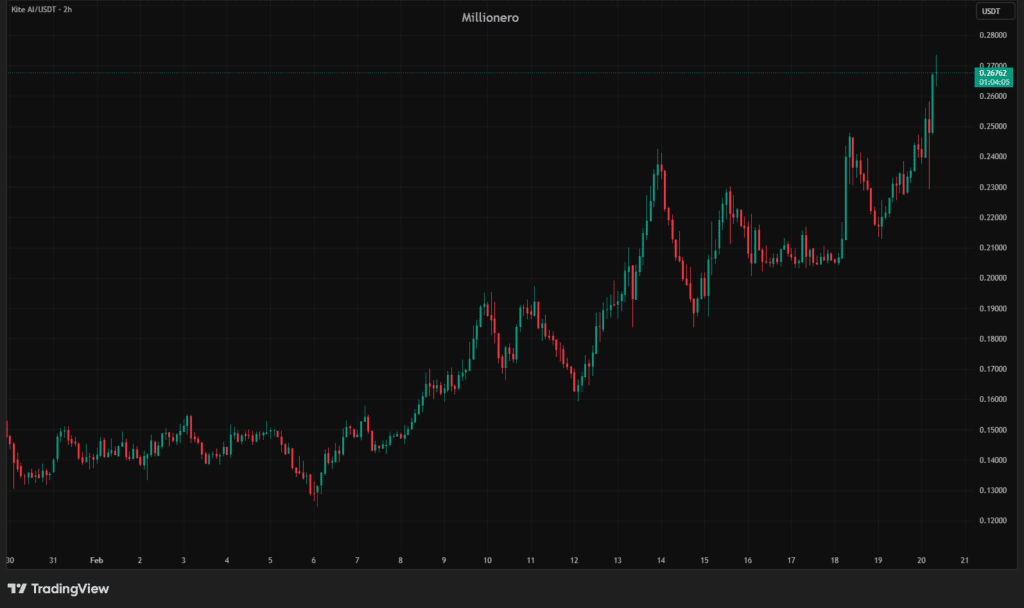
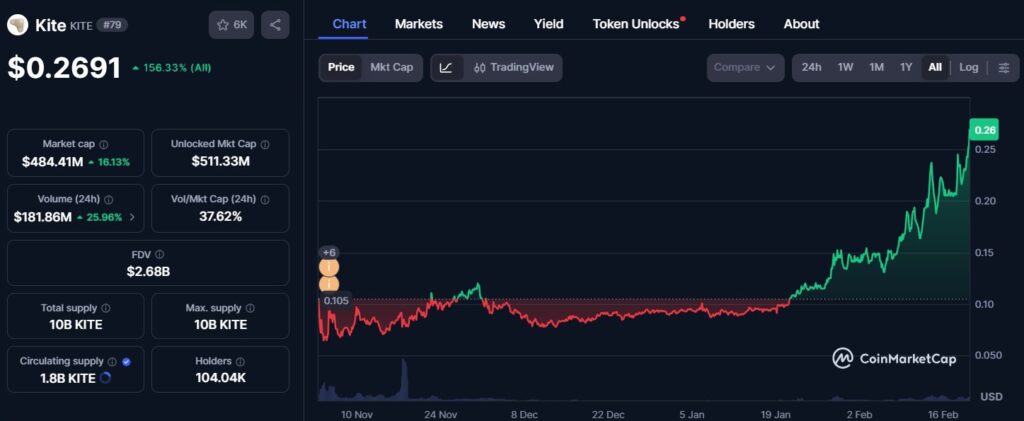
If you’ve been watching the crypto markets this week, you’ve probably noticed $KITE popping up on your radar. The token hit a fresh all-time high today, sitting around $0.27, up roughly 18% in 24 hours, with over $175 million in trading volume. That’s not noise. So what’s going on?
Let’s break it down.
What Is Kite AI?
Kite AI is building infrastructure for AI agents, specifically, the infrastructure that lets AI agents pay for things on the internet.
Think about it this way: AI agents are getting smarter every day, but they still can’t easily handle payments, prove who they are, or stay within a budget while operating autonomously. Kite is trying to fix that.
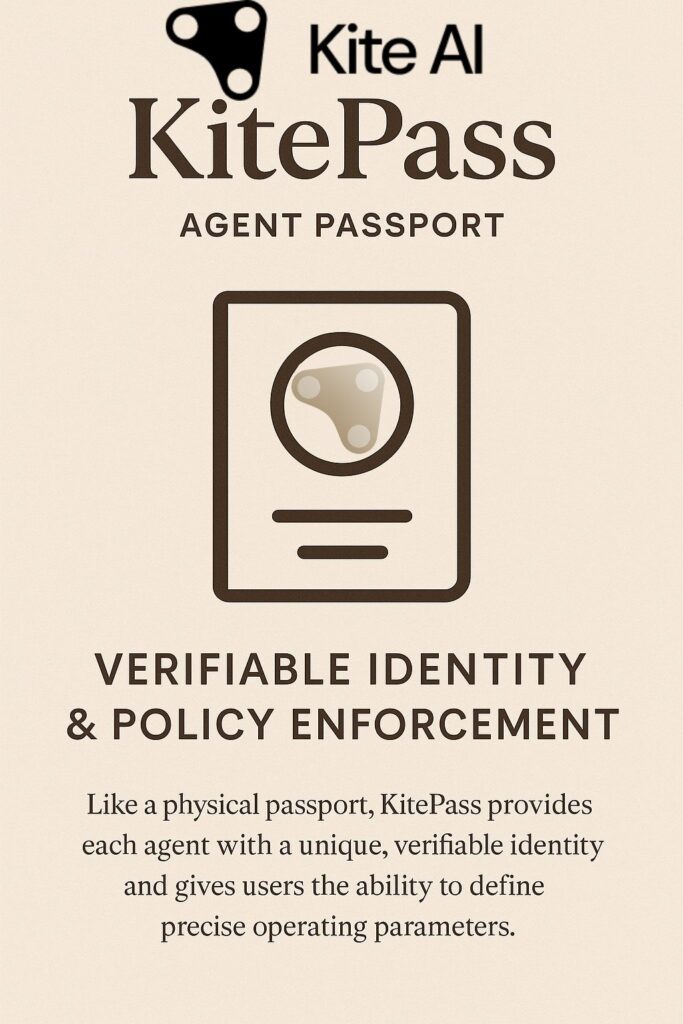
Their core product is called the Agent Passport, basically a digital identity and payment system for AI agents. It lets agents:
- Verify who they are on-chain
- Get permission to spend within pre-set limits
- Pay for services automatically without a human stepping in every time
The tech runs on their own blockchain (an EVM-compatible layer 1), uses stablecoins like USDC for fees instead of a volatile gas token, and relies on something called state channels to handle tiny, rapid payments cheaply and fast, without clogging up the main chain.
So Why Is the Price Flying Right Now?
A few things came together at the right time.
1. ETHDenver 2026
Kite has been all over ETHDenver this week, one of the biggest Ethereum developer conferences of the year. They’re a sponsor, they’re running a $10,000 bounty for developers building agent-native payments, and they even set up a branded coffee bar at the event.
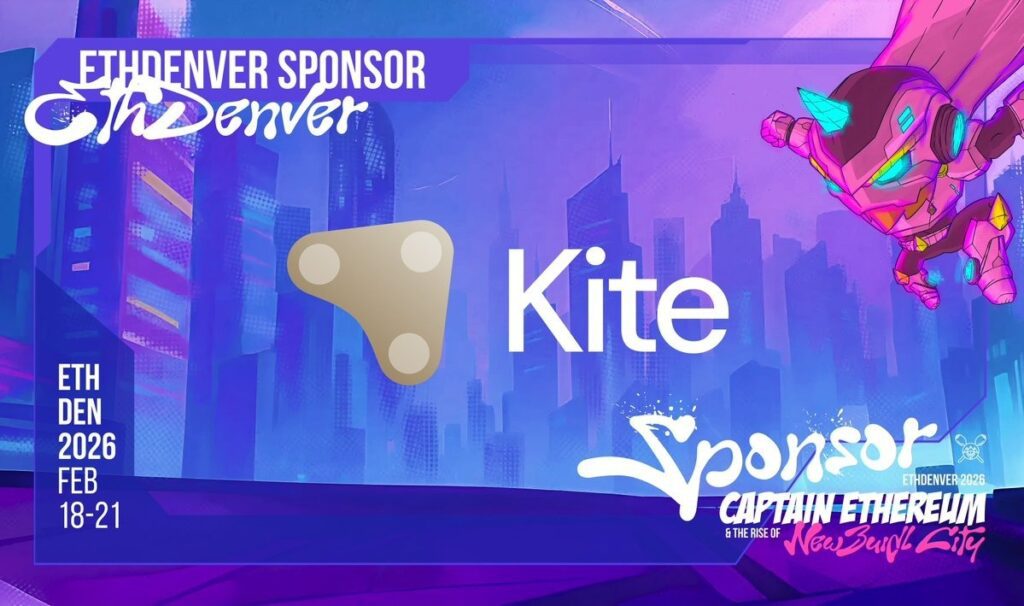
That kind of visibility in front of thousands of crypto developers and investors creates real buzz. When attention spikes in crypto, prices tend to follow, at least in the short term.
2. Big-Name Backers
Back in September 2025, Kite raised an $18M Series A led by PayPal Ventures and General Catalyst. Then in October, Coinbase Ventures also came in with a strategic investment specifically tied to Kite’s integration with the x402 payment standard.
PayPal Ventures even published a whole essay explaining why they invested, talking about how AI agents need “passports” and how micropayments are the new fuel for the internet economy. When PayPal and Coinbase put their names on something, the market pays attention.
3. The x402 Narrative
This is the part that has the crypto-tech crowd genuinely excited. x402 is a payment standard that revives an old forgotten HTTP status code (HTTP 402, “Payment Required”) and turns it into a real working protocol for automatic stablecoin payments over the internet.
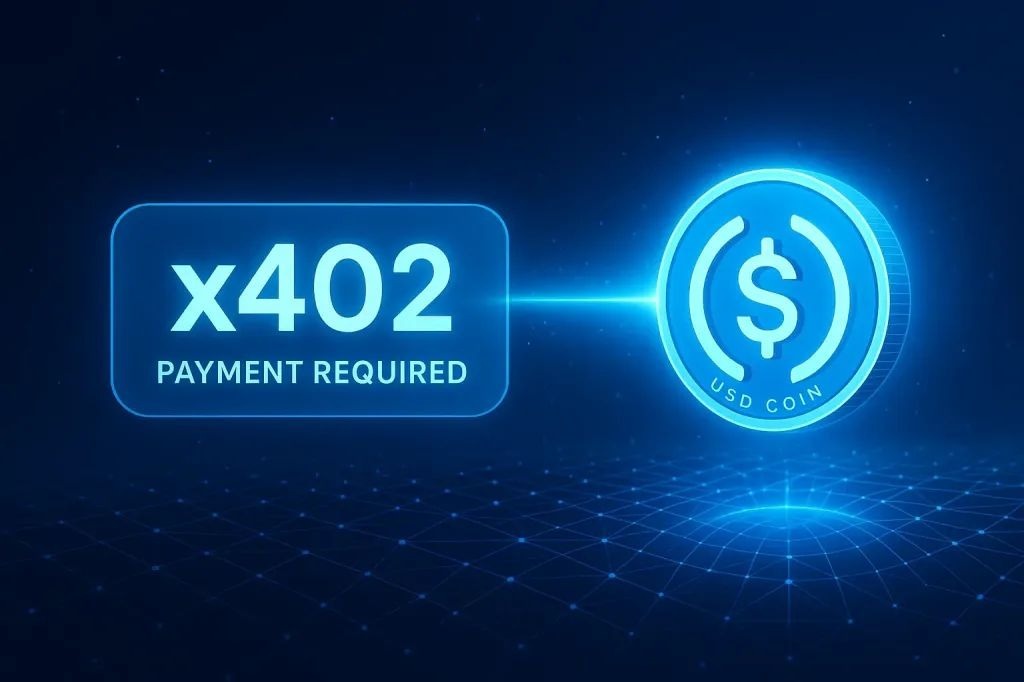
The idea: any website or API can charge AI agents tiny amounts of crypto automatically, with zero human interaction. Cloudflare is already championing it. Coinbase built developer tools for it. And Kite is positioning itself as a primary execution layer for x402, a real narrative with real adoption momentum, not just a whitepaper dream.
4. Low Float
Here’s the market mechanics piece that many people miss. Out of a total supply of 10 billion KITE tokens, only 1.8 billion (18%) are currently in circulation. That low float means when demand picks up, there aren’t that many tokens available to absorb the buying pressure, so the price moves faster and harder than it would with a full float.
The Token Itself, What Does $KITE Actually Do?
This is worth understanding clearly, because it’s different from a typical gas token.
$KITE is not used to pay transaction fees. Fees on the Kite network are paid in stablecoins. Instead, $KITE is mainly a staking and coordination asset:
- Module owner: 30,000,000 KITE required to stake
- Validator: 1,000,000 KITE required to stake
- Delegator: ~166,000 KITE to participate at the smallest level
Staking rewards start in KITE and are planned to gradually shift toward stablecoin rewards as the network generates real revenue. The target yield is around 4% annually.
The honest implication: $KITE’s value isn’t directly tied to transaction volume the way ETH’s is. Its value depends on whether people actually want to stake to participate in the network. If usage grows and staking roles become valuable, demand for $KITE follows. If usage stalls, it doesn’t.
What Are the Real Risks?
No honest analysis skips this part.
- Testnet, not mainnet. Parts of Kite’s system are still in testnet or invitation-only phases. There’s a real gap between roadmap promises and what’s live and verifiable today.
- Future token unlocks. Only 18% of tokens are circulating. The other 82% will eventually hit the market, team and investor allocations typically unlock over time, creating potential sell pressure.
- Stablecoin gas weakens the “usage = price” logic. Because people pay fees in stablecoins rather than KITE, the traditional “more transactions = more token bought/burned” dynamic doesn’t apply cleanly here.
- Attention fades. ETHDenver ends. Conferences wrap up. If Kite can’t convert developer interest into real deployed applications, the current momentum could cool quickly.
The Bottom Line
$KITE is flying right now because several things aligned: a major conference, credible institutional backers, a compelling real-world narrative (x402 + AI agents), and a low-float token structure that amplifies price moves during high-attention moments.
The underlying idea, infrastructure for AI agents to handle payments and identity, is genuinely interesting and backed by serious investors who understand the space.
But the honest truth is that most of the excitement is still forward-looking. The tech needs to graduate from testnet to real-world deployment, developers need to actually build on it, and the staking economy needs to demonstrate genuine demand beyond speculation.
Watch the ETHDenver bounty submissions. Watch whether developers actually ship things using Kite’s tools. That’s where the real signal will be.
This article is not financial advice. Crypto markets are highly volatile and things can change fast, in both directions. Always do your own research before putting any money on the line.
You can DYOR and stay ahead of the market at blog.millionero.com, and when you’re ready to act, trade spot and perpetuals on Millionero.