


World Liberty Financial’s token, WLFI, sits at the intersection of DeFi, stablecoins, and headline-making politics.
What WLFI is (and isn’t)
WLFI is a governance token for the World Liberty Financial (WLF) protocol. According to the project’s own legal pages, its sole utility lies in voting on governance proposals. In other words, holders are only able to influence the direction of the protocol through participation in these votes. Moreover, they have no economic rights to the protocol itself, and therefore, they should not expect any profits from simply holding WLFI.
WLF’s “Gold Paper” details the voting design (including a 5% per-wallet cap on votable supply to limit concentration), positioning WLFI as a community steering wheel for future features, parameters, and product direction.
Tokenomics at a glance
- Chain & supply. WLFI is issued on Ethereum (ERC-20) with a max supply of 100,000,000,000 WLFI. Contract: 0xDa5e…CBeF6
- Presale rounds. Public sales ran at $0.015 and $0.05 per token (widely reported across industry press).
- Unlock schedule (Sept 1). At 8:00 a.m. ET (12:00 UTC) on Sept 1, 20% of tokens purchased by early supporters become claimable; the remaining 80% unlocks only if/when the community votes for it.
Projected circulating supply on day one (with sources)
The two public rounds account for an estimated 25B WLFI of the 100B total. Unlocking 20% of that allotment implies roughly 5B WLFI entering circulation at the token-generation event, about 5% of total supply. Industry briefs and education portals summarize it this way; some also note the actual float depends on how many presale holders activated the on-chain Lockbox contract in time.
Bottom line: ~5B WLFI (~5%) is the best-supported projection for initial float, subject to Lockbox participation.
USD1: why the stablecoin matters
The project’s USD1 stablecoin is designed to be redeemable 1:1 for USD and to be fully backed by short-term U.S. Treasuries, cash, and cash equivalents. Company statements and coverage note reserves are custodied by BitGo Trust and that USD1 is designed to live cross-chain (initially Ethereum and BSC).
WLF also executed a no-claim airdrop on June 4, 2025, sending $47 worth of USD1 to each of ~85,106 eligible WLFI wallets, signaling a push to put USD1 into user hands early.
Why USD1 is the project’s strength:
- Policy: a fiat-redeemable, fully-backed design is legible to institutions, and reserves are described (Treasuries/cash).
- Flywheel narrative: a widely-held, on-chain dollar can funnel activity to WLF apps; governance via WLFI lets holders shape fees, incentives, and integrations that could reinforce USD1 usage. (Design intent per WLF materials.)
- Distribution momentum: the “push” airdrop (no links to click, funds just appeared) demonstrated operational muscle and created broad wallet-level surface area for future USD1-centric products.
Caveat: “fully backed” stablecoins still sit within a fast-moving policy debate; benefits and risks hinge on transparency, custody, and market conduct as the sector scales.
Who’s behind it: the Trump connection
WLF consistently markets itself as inspired by President Donald J. Trump, listing him as “Chief Crypto Advocate,” with Eric, Donald Jr., and Barron Trump billed as Web3 Ambassadors. Coverage also notes a family-linked entity is entitled to a large share of protocol revenues.
As part of a related treasury strategy, Nasdaq-listed ALT5 Sigma moved to hold about 7.5% of total WLFI supply, with Eric Trump joining its board and WLF co-founder Zach Witkoff set to chair.
Top backers, capital moves & strategic deals
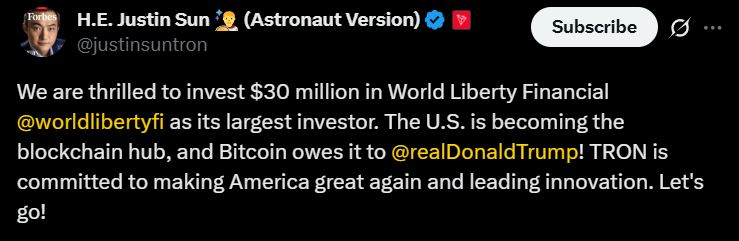
- Justin Sun invested $30M in WLFI tokens, a purchase that, per The Defiant’s reporting, crossed a threshold enabling a Trump-affiliated entity (DT Marks DEFI LLC) to begin claiming up to 75% of project revenues after the first $30M is earmarked for operating expenses.
- Aqua 1 (UAE) announced a $100M WLFI purchase; Reuters highlighted both the scale of the buy and questions about the fund’s limited public footprint.
- ALT5 Sigma: via a $1.5B stock-and-token deal, ALT5 says it will hold roughly 7.5% of WLFI as corporate treasury exposure, creating a public-equity proxy for WLFI’s performance.
Taken together, these moves underscore the project’s ability to attract large, brand-name or headline-making counterparties, useful for distribution and narrative, but also inviting scrutiny around governance and related-party economics.
Security & unlock mechanics: the Lockbox
Claiming/unlocking uses the on-chain Lockbox contract on Ethereum, which was audited by Cyfrin (per the auditor and project channels). Users who activated Lockbox before Sept 1 could claim their first 20% at the event, with future releases controlled by governance.
How to frame WLFI in one paragraph
WLFI is a governance token (not a cash-flow instrument) for a DeFi suite whose flagship dollar, USD1, aims to be fully backed and broadly distributed. The initial float is small (~5%), which can amplify volatility, while future supply is explicitly gated by community vote.
Fast facts
- Total supply: 100,000,000,000 WLFI (Ethereum)
- Projected day-one float: ~5B WLFI (~5% of supply), assuming broad Lockbox activation
- Unlock time: Sept 1, 2025, 08:00 ET (12:00 UTC)
- USD1 design: redeemable 1:1; backed by Treasuries, cash & equivalents; BitGo Trust custody referenced in company materials/PRs
- June 4 airdrop: ~$4M USD1 sent; $47 per ~85,106 eligible wallets
- Trump family roles: Chief Crypto Advocate (President Trump); sons listed as Web3 Ambassadors; revenue-share entity noted in coverage
And finally — the Millionero note
For readers asking “where can I trade?”, save the venue list for another article. Here’s the point: Millionero will also list WLFI. Millionero has carefully tracked both the unlock cadence and the go-live timing. As a result, the WLFI listing on Millionero is now confirmed. Furthermore, the exact go-live time along with the available trading pairs will be announced through Millionero’s official channels.
This is not financial or legal advice. All token interactions carry risk, especially around unlocks and early liquidity. Always verify contracts and rely on official links.