


We need to talk about ASTER, the token that’s been making waves in the DeFi space and catching the attention of both retail traders and whales alike.
You know how sometimes a project comes out of nowhere and suddenly everyone’s talking about it? That’s ASTER right now. This isn’t just another token launch, it’s the result of a strategic merger that’s got the backing of some pretty big names, including CZ himself. Let me break down what makes this one interesting.
What Exactly Is ASTER?
Here’s the deal: ASTER is the native token of Aster, a decentralized exchange that’s trying to solve one of DeFi’s biggest headaches, fragmented liquidity across different chains. The platform emerged from a late-2024 merger between Astherus (a yield farming platform) and APX Finance (a perpetuals DEX). Think of it as combining the best of both worlds: yield strategies and leveraged trading.
But what really caught my attention is the multi-chain approach. Instead of being stuck on one blockchain like most DEXs, Aster aggregates liquidity across BNB Smart Chain, Ethereum, Solana, and Arbitrum. That means you can trade without the usual hassle of bridging tokens manually, something that honestly should have been standard years ago.
The Technology That Actually Makes Sense
Let’s talk about what sets Aster apart from the crowded DEX space. First up: leverage up to 1001x in their “Simple” mode. Now, before you roll your eyes about another degen casino, hear me out. They’ve built in MEV resistance, which means you’re less likely to get sandwiched or front-run by bots. That’s huge for retail traders who are tired of getting rekt by sophisticated MEV strategies.
The platform has two modes: a one-click simple interface for newcomers and a professional orderbook with advanced tools like grid trading and hidden orders. The hidden orders feature is particularly clever, it’s essentially a built-in dark pool that keeps your order size and direction private until execution. This helps prevent the kind of predatory trading that plagues most DEXs.
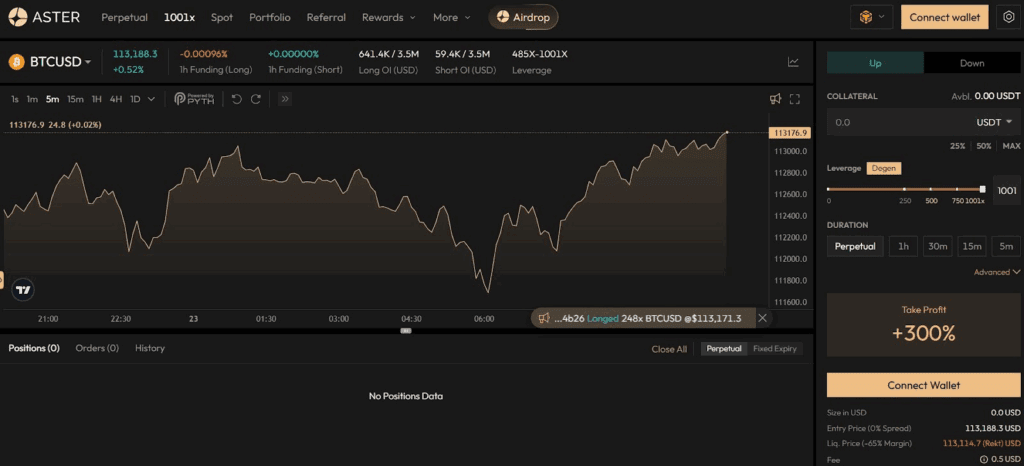
But here’s where it gets really interesting: their “Trade & Earn” model. You can use liquid-staked BNB (asBNB) or yield-bearing stablecoins (USDF) as collateral, which means your margin continues earning yield even while you’re trading. It’s like having your cake and eating it too, you’re not giving up passive income just to take a leveraged position.
Tokenomics: The Good, The Bad, and The Ugly
ASTER has a fixed supply of 8 billion tokens on BNB Smart Chain. The distribution actually looks pretty community-friendly on paper: 53.5% went to airdrops and community rewards, which is honestly refreshing in a space where most projects keep the majority for themselves.
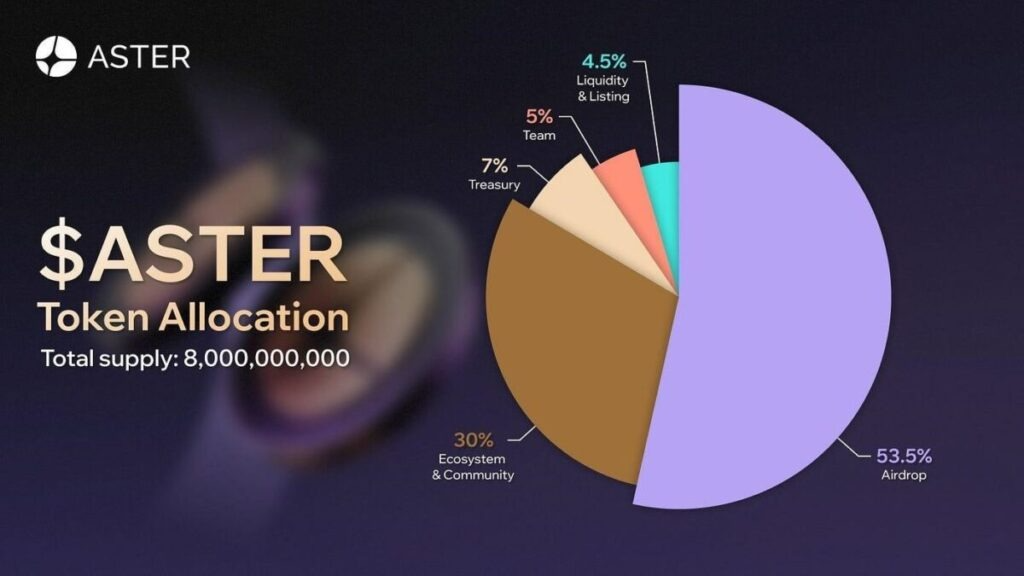
The Token Generation Event happened in September 2025, where existing APX tokens were swapped 1:1 for ASTER. What’s notable is that 8.8% of the supply unlocked immediately at launch for active community participants. That’s a significant amount hitting the market right away, which explains some of the volatility we’ve seen.
The token serves the usual purposes: governance voting, fee discounts, and revenue sharing. DefiLlama shows they’re pulling in about $66M annually in fees, which isn’t bad for a relatively new platform. The economics are designed to be deflationary post-launch, with no new inflation, just vesting releases.
But here’s the catch: a significant portion is still held by insiders and subject to vesting schedules. This has created some uncertainty about future sell pressure, and it’s something to keep in mind if you’re thinking about a position.
The Performance That Turned Heads
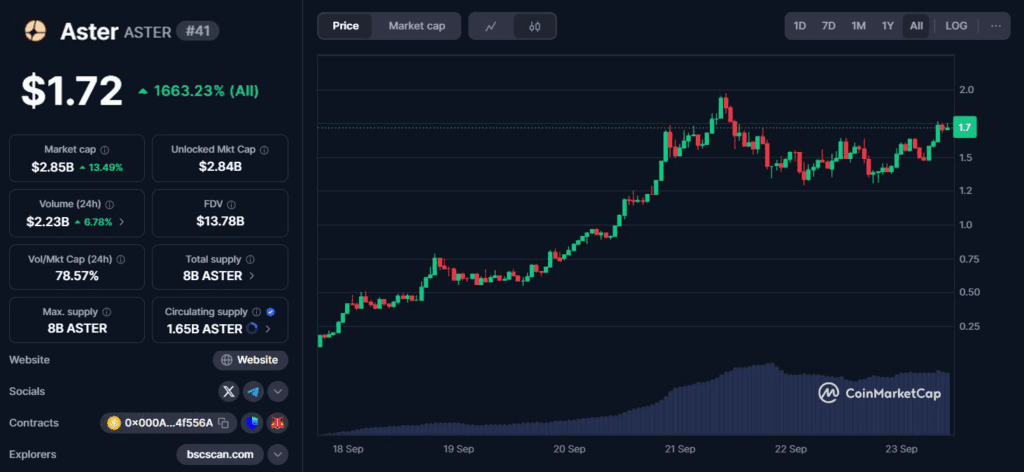
Let’s be real about the price action, it’s been absolutely wild. ASTER launched from virtually zero in mid-September 2025 and immediately went parabolic. We’re talking about a 400% spike within hours of CZ’s endorsement tweet, followed by thousands of percent gains over the following week.
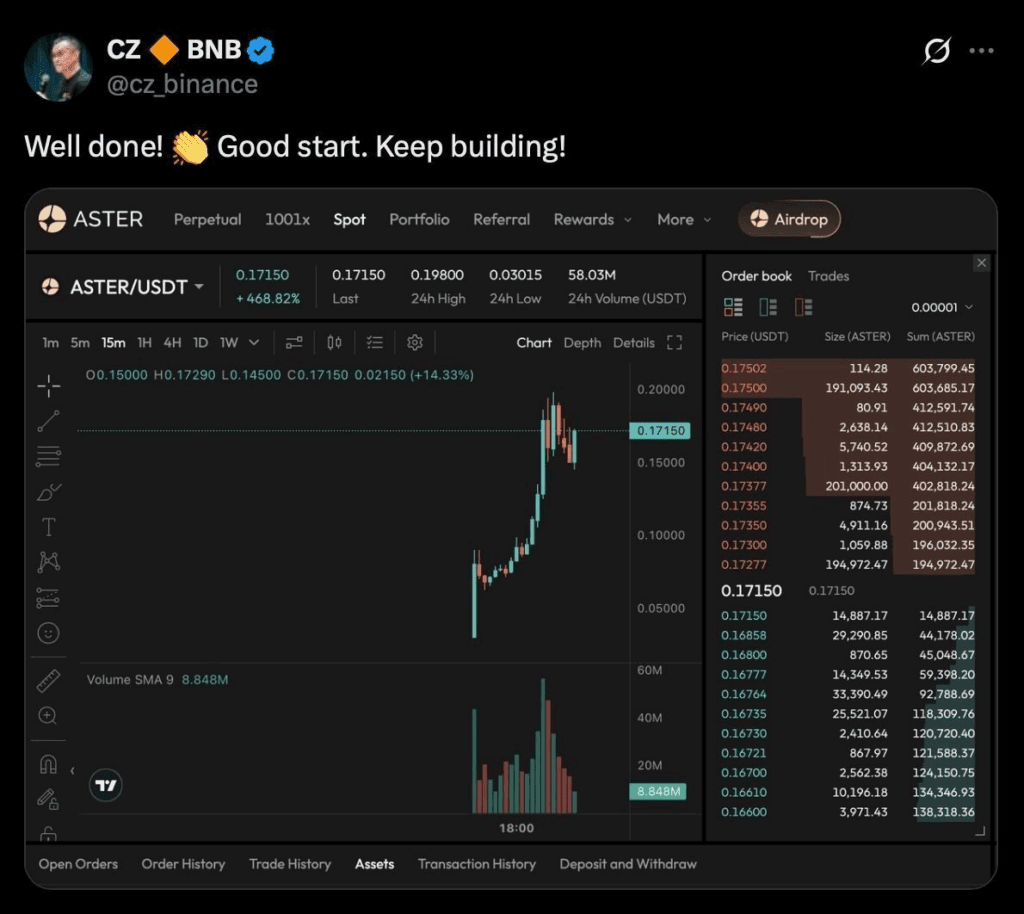
At its peak, ASTER was trading near $1-2, giving it a multi-billion dollar market cap. There was even that famous wallet that threw $114K into ASTER (apparently attributed to MrBeast, though take that with a grain of salt).
But what goes up that fast usually comes down just as quickly. The token has seen some sharp corrections as early investors took profits. The concentration of supply in large wallets has definitely contributed to the volatility, and it’s something that makes me a bit cautious about the long-term price stability.
The Ecosystem Play
What really impresses me about ASTER is the ecosystem support. Having YZI Labs (formerly Binance Labs) as a backer isn’t just about money, it’s about legitimacy and connections. The fact that Binance launched a 50x perpetual futures contract for ASTER just two days after the TGE shows serious institutional interest.
The partnerships are solid too: SafePal, Trust Wallet, and PancakeSwap are all routing trades through Aster’s orderbooks. This kind of integration means real usage, not just speculation. When major wallets add native DEX support, that’s when you know adoption is happening.
The community engagement has been impressive as well. Their airdrop campaigns saw over 527,000 wallets generate nearly $38 billion in trading volume. Those aren’t just vanity metrics, that’s actual platform usage.
How It Stacks Up Against Competitors
ASTER’s main rival is Hyperliquid (HYPE), another Binance-affiliated perp DEX. While Hyperliquid has its own optimized Layer-1, Aster takes the multi-chain aggregator approach. Aster offers higher leverage and that unique yield-earning collateral feature, which gives it an edge for capital efficiency.
The fact that Aster’s trading volume briefly surpassed Hyperliquid’s in just days after launch is pretty remarkable, though HYPE still has the larger long-term TVL. It’s shaping up to be an interesting competition between two different approaches to decentralized derivatives.
The Bottom Line
ASTER represents an interesting evolution in DeFi infrastructure. The multi-chain approach, MEV protection, and yield-earning collateral solve real problems that traders face daily. The backing from major players and rapid adoption suggest this isn’t just another flash-in-the-pan project.
That said, the extreme volatility and concentration of supply among insiders are legitimate concerns. This is still very much an early-stage, high-risk play. The platform works well, the team is executing, and the partnerships are real, but crypto being crypto, anything can happen.
If you’re considering a position, maybe think of it as a bet on the future of decentralized derivatives rather than a quick flip. The fundamentals are there, but patience will probably be required to see how this plays out in the longer term.
This article is for educational purposes only and does not constitute financial advice. Always do your own research (DYOR) before making any investment decisions. For more in-depth crypto analysis and market insights, visit blog.millionero.com. When you’re ready to trade, explore spot and perpetual contracts on millionero.com, but remember, only invest what you can afford to lose.