


A Monday Morning That Shook DeFi
The $128M Balancer Hack: On November 3, 2025, just around 9:30 AM UTC, DeFi’s calm surface cracked. Balancer’s V2 Vaults, once a symbol of composable liquidity, were struck by a coordinated exploit. Within hours, roughly $128 million in tokens vanished from Ethereum and its connected Layer 2s.
It began with quiet transfers: about $70.9 million worth of osETH, WETH, and wstETH slipped into a fresh wallet. Then came the panic. CoinDesk broke the story mid-morning, citing losses already crossing $110 million. By afternoon, PeckShield and Cyvers confirmed what traders feared, it wasn’t a glitch, it was a breach.

The Flaw That Opened Pandora’s Vault
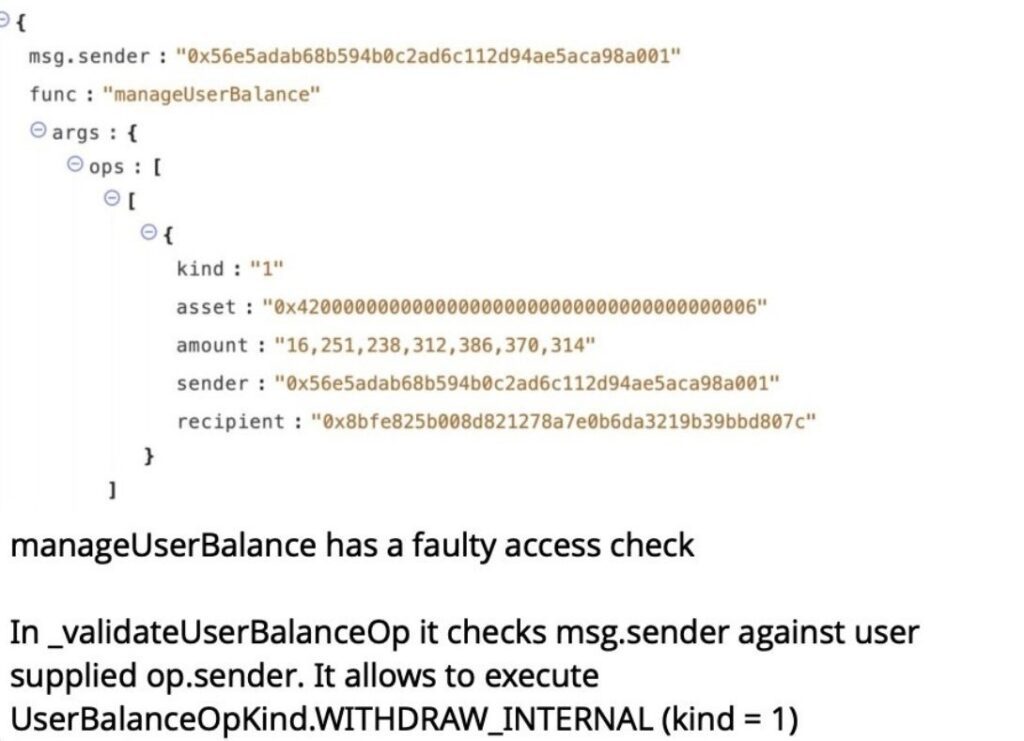
At the heart of the chaos was a flaw in Balancer V2’s Vault, the shared engine powering all its pools. Security firm Decurity pointed to a faulty permission system in manageUserBalance, which allowed attackers to withdraw funds that weren’t theirs.
Other researchers from Nansen and Decrypt found a second possible weakness: a rounding and precision bug in Balancer’s Composable Stable Pools. By looping swaps, the attacker artificially devalued Balancer Pool Tokens (BPT), minted them at a discount, and redeemed them for more assets than deposited.
In simple terms: one miscalculated variable in Balancer’s “brain” let thieves drain its “body.” Once the Vault was breached, every connected V2 pool became fair game.
The Toll Across Chains
The numbers tell a chilling story:
| Chain/Protocol | Loss (USD) | Notes |
| Ethereum (Balancer V2) | ~$70–99M | osETH, WETH, wstETH |
| Arbitrum | ~$6M | Balancer V2 pools |
| Base | ~$4M | Stable pools |
| Fantom (Beets Finance/Sonic) | ~$3.4M | BeethovenX pools |
| Optimism | ~$0.28M | BeethovenX |
| Polygon | ~$0.12M | Minor pools |
| Berachain (BEX) | ~$12.9M | Balancer fork |
| Total | ≈$128M | Across 8 chains |
Ethereum bore the brunt, nearly three-quarters of the losses. But forked protocols like BeethovenX and BEX on Berachain also fell victim, proving how shared code can multiply a single mistake across an entire ecosystem.

A Chain Reaction in Prices
The market’s reaction was swift and brutal.
Balancer’s token (BAL) dropped roughly 10%, from $0.98 to $0.88. Ethereum slid 8%, dipping below $3,900 as fear rippled through DeFi. Even Berachain’s BERA fell 10% after the chain halted all operations.
What began as a technical exploit quickly became a crisis of confidence, investors pulled liquidity, protocols paused vaults, and on-chain scanners lit up with warnings.
The Human Panic Behind the Screens
While machines executed the exploit, humans scrambled to save what they could.
A three-year dormant whale withdrew $6.5 million from a Balancer pool within half an hour of the attack, just in time.
Projects rushed to pause vaults, revoke approvals, and block attacker addresses.
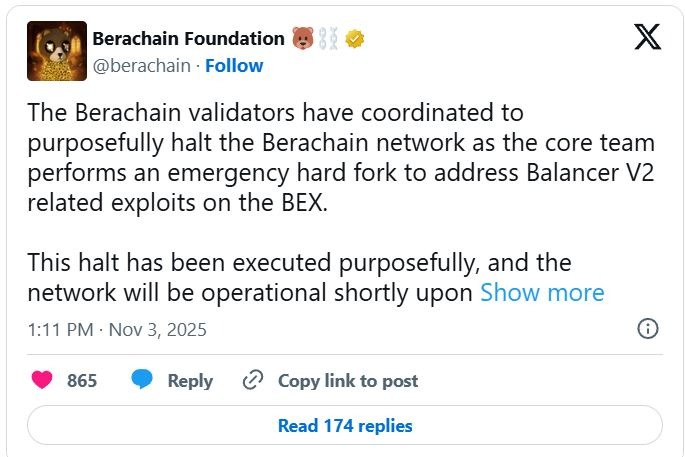
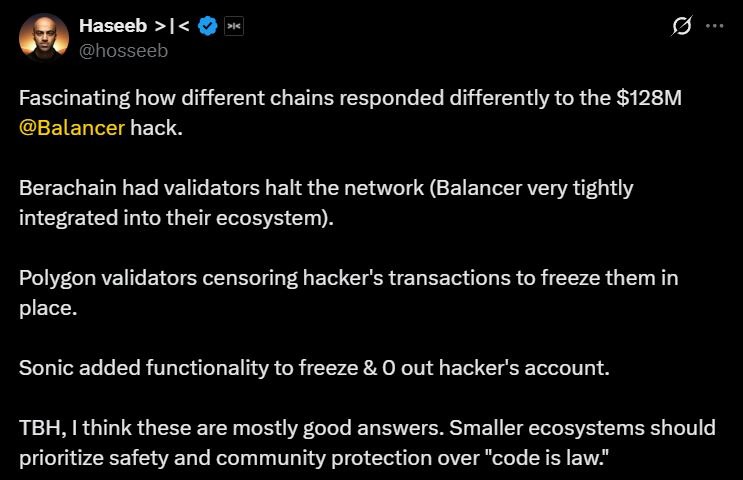
On Arbitrum, Polygon, Base, and Optimism, developers coordinated to limit contagion. Beefy Finance froze all Balancer-based products, while Sonic Labs on Fantom even changed token logic to freeze stolen funds.
The Response: Containment and Hope
By midday, Balancer’s official X (Twitter) account confirmed:
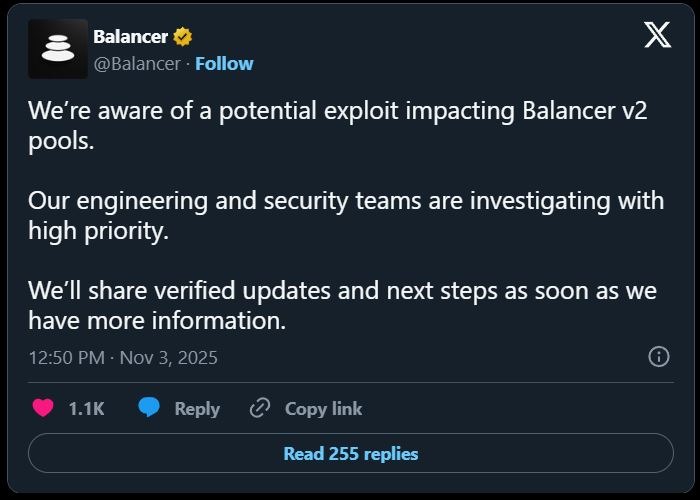
All affected pools were paused. Auditors, partners, and legal experts were called in. But the most remarkable recovery came from StakeWise, an ETH-staking protocol that had supplied osETH and osGNO to Balancer pools.
Using an emergency multisig, StakeWise reclaimed $21 million, about 73% of its stolen assets. This included 5,041 osETH (~$19M) and 13,495 osGNO (~$1.7M), which helped calm the market and nudged ETH slightly higher the next day.
A Lesson in Centralization and Composability
The Balancer exploit exposed a hard truth: even decentralized finance can suffer from centralized architecture.
One Vault. One bug. Dozens of protocols compromised.
While Balancer had passed multiple audits, the incident reminded everyone that composability, DeFi’s superpower, is also its Achilles’ heel. When one piece breaks, every dependent system follows.
The irony wasn’t lost on regulators and critics. As Polygon validators censored hacker transactions and Berachain halted its blockchain, many asked: If blockchains can freeze at will, how decentralized are they, really?
Aftermath and Reflection
The hack triggered $360 million in outflows from digital-asset funds that week. Analysts blamed not just the exploit but also a tightening macro backdrop, fears of slower Fed rate cuts and fading risk appetite.
Still, there was resilience. Communities mobilized, audits intensified, and the DeFi world united under one quiet realization: transparency doesn’t guarantee safety.
In Closing
The Balancer V2 exploit will be remembered as DeFi’s November reckoning.
A small bug in a trusted protocol set off a storm across chains, drained millions, and questioned the foundations of decentralization itself.
But in its aftermath, something vital also surfaced, a reminder that even in chaos, the blockchain community fights back fast.
This article is for informational purposes only and does not constitute financial advice. Trade responsibly at blog.millionero.com. Explore spot and perpetuals trading on Millionero.