


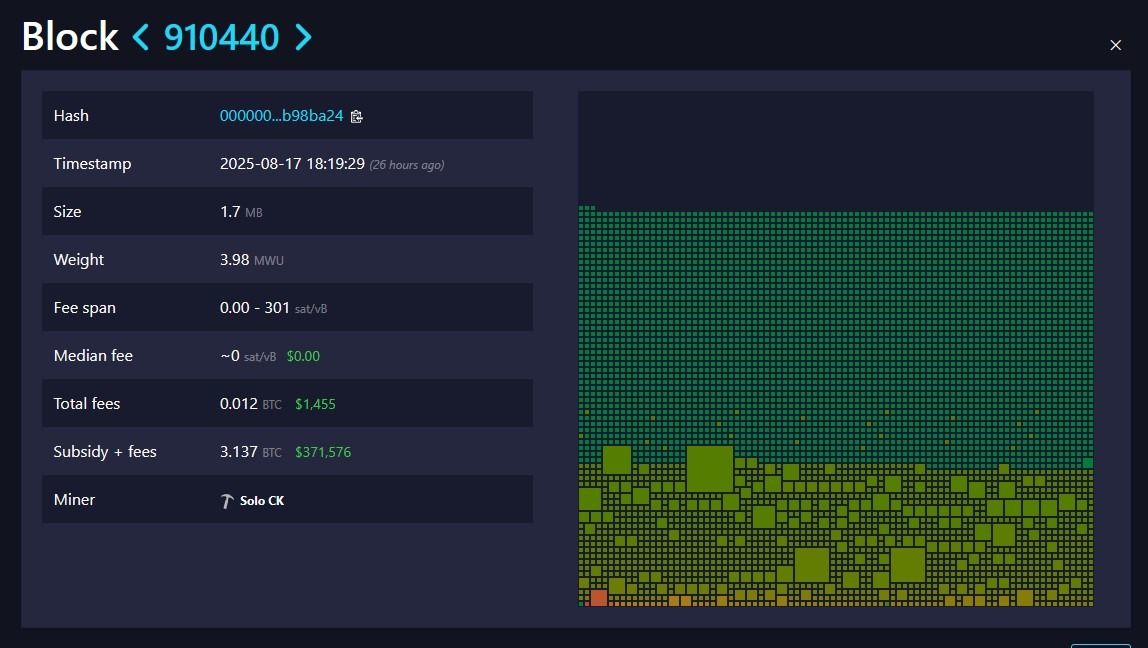
Yesterday a solo miner of bitcoin found block #910,440. They got the full reward: 3.137 BTC (about $371,576 at the time). That reward is made of:
- Subsidy: 3.125 BTC (the fixed block reward after the 2024 halving)
- Transaction fees: ~0.012 BTC (about $1,455)
Other block facts: size ~1.7 MB, weight ~3.98 MWU, median fee ~0 sat/vB (so many transactions paid almost nothing), timestamp 2025-08-17 12:19:29.
First: what is “solo mining”?
Most miners join pools. In a pool, many people combine their machines, find blocks together, and split the money. It’s steady.
Solo mining is the opposite. You point your own machine at your own node (or at a “solo pool” that pays 100% to whoever finds the block). You either win everything or get nothing. It’s like buying one lottery ticket and hoping your number hits.
Why this is cool
- Bitcoin stays open. You don’t need permission from a big company to add a block. If your computer finds a valid one, the network accepts it.
- Decentralization in action. Most blocks come from large pools, but a solo hit proves the little guy can still win.
- Censorship resistance. A solo miner chooses which transactions to include. That spreads power and reduces the chance that any single group controls what gets into the chain.
How unlikely is a solo win?
Very. Imagine the whole Bitcoin network is a giant ocean of computing power. Your single ASIC is a cup of water in that ocean.
As a rough idea: a hobby machine around 100–120 TH/s is competing with a network in the hundreds of EH/s (that’s millions of times bigger). Odds per block can be around 1 in several million for a home miner. That’s why people pool together. But rare wins do happen, like this one.
What the tiny fees tell us
This block’s fees were only ~0.012 BTC, less than 0.5% of the payout. Two simple takeaways:
- The mempool wasn’t busy. When the network is quiet, users can get into blocks with very low fees (even near zero).
- Miners still rely on the subsidy when fees are low. In busy times (NFT spikes, big market moves), fees can rise and sometimes rival the subsidy. Not here.
For traders, fee trends matter because they affect miner revenue. Healthy revenue helps miners keep machines on, which supports network security.
Does this move price?
Not really. One block doesn’t change Bitcoin’s supply schedule or the big picture. But it signals a healthy network:
- The long tail of small miners still exists.
- Power is not fully concentrated in a few pools.
- The system’s “lottery” is working exactly as designed.
Simple miner economics (two lines)
- Revenue = subsidy + fees.
- Profit = revenue – (electricity + hardware + maintenance).
When fees are low and difficulty is high, inefficient machines turn off. When price or fees jump, more rigs turn on. That push-pull sets the mining landscape.
What to watch next
- Difficulty: Adjusts roughly every two weeks. If lots of hash power stays online, difficulty rises and mining gets harder.
- Fees: Quiet weekends and bear vibes push fees down; hype and high activity push them up fast.
- Miner behavior: On-chain data (miner balances, exchange deposits) can hint at selling pressure or stress.
Together, these items shape the background for liquidity and volatility.
Bottom line
Block #910,440 is a feel-good, real-world reminder of what makes Bitcoin different. A lone miner, likely with far less power than the big pools, still won the block and took home 3.137 BTC. The fees were tiny, so almost all the money came from the fixed 3.125 BTC reward. It shows that Bitcoin remains open, permissionless, and decentralized, exactly what long-term users want to see.
This article is for educational purposes only. Always do your own research (DYOR). For market education, visit the Millionero blog. When you’re ready, you can trade spot and perpetuals on Millionero.