


Bitcoin fell hard this year. It slid below $60,000 by late June 2026, its lowest level since 2024. That is down more than 50% from its 2025 record high. On paper, that looks like chaos. Bitcoin volatility, though, tells a more interesting story.
The ride down felt calmer than past bear markets. Daily swings stayed smaller. The panic was quieter. Analysts have a phrase for it: the worst bull market, and the best bear market.
This is no accident. Bitcoin’s volatility has been shrinking for years. The reasons reveal where the asset sits in its life cycle, and they carry a warning. Lower volatility is not the same as lower risk. Traders who confuse the two tend to pay for it.
First, what volatility actually measures
Volatility measures how much a price swings around its average. It captures the size of the moves, not their direction. A market can be highly volatile while falling, rising, or going nowhere.
Analysts express it in two main ways. Realized volatility describes what already happened. Implied volatility reflects what options traders expect ahead. Both are usually annualized, so you can compare different assets on one scale.
Hold on to one point here. Volatility tells you how violent the swings are. It says nothing about whether you are about to lose money. That distinction matters later.
The long downtrend is real and measurable
Bitcoin began life as one of the most volatile assets on earth. That has steadily changed. Research from Block Scholes shows a clear pattern: crypto has become less volatile over its history, as infrastructure improved and liquidity deepened.
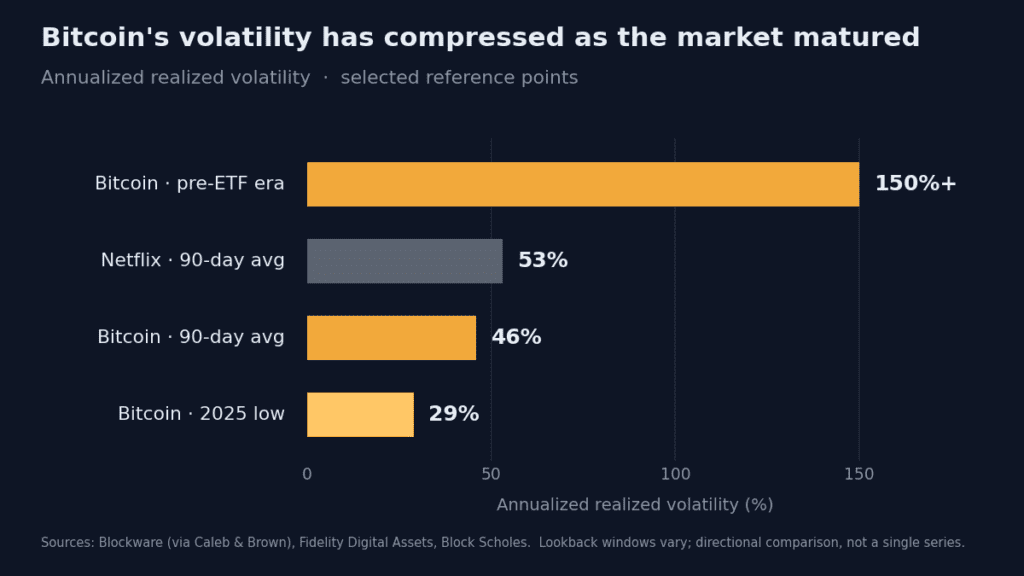
The numbers back this up. Block Scholes noted that bitcoin’s realized volatility fell to around 29% in 2025. That level has acted as a floor since before the US spot ETFs launched in January 2024. Compare that to the triple-digit readings of bitcoin’s early years.
It is now even competitive with big tech. Fidelity Digital Assets found that bitcoin’s 90-day realized volatility averaged 46%, below Netflix at 53% over the same window. BlackRock’s iShares research reaches the same conclusion. Bitcoin’s volatility has declined notably since 2014, even if it still swings more than stocks and bonds.
Why a maturing market swings less
Several forces push volatility down as an asset grows up. They tend to reinforce each other.
Deeper liquidity and better plumbing
Size changes everything. When an asset is worth billions, one large order can jolt the price. When it is worth trillions, the same order barely registers. Block Scholes ties bitcoin’s falling volatility directly to deeper liquidity and stronger infrastructure. More venues, tighter spreads, and better custody all smooth the swings.
A larger and stickier holder base
The owners have changed too. Bitcoin was once held mostly by reactive retail traders. Today a growing share sits with long-term institutions that rarely sell in a panic.
The scale is striking. By mid-2026, US spot ETFs held roughly 1.25 million bitcoin, according to figures compiled by ValueAdd. Public companies held over 750,000 more. Together that is more than 9% of all the bitcoin that will ever exist. Before the January 2024 ETF approval, regulated institutional ownership was effectively zero. Coins locked in these vehicles cannot fuel a panic sell-off.
Regulated access through ETFs
The spot ETFs did more than absorb supply. They gave large allocators a compliant, low-friction way in. KuCoin’s 2026 outlook frames the logic plainly: more institutionalization tends to mean less volatility. Some forecasters now expect bitcoin’s volatility to keep converging toward that of gold over time.
The catch: calmer is not safer
Here is the part the maturation story tends to bury. A smoother path is not a safe one.
The drawdown record makes this clear. BlackRock’s iShares research notes that bitcoin has suffered four declines of more than 50% since 2014. The three largest averaged around an 80% fall. In three of those four cases, the price took close to three years to recover. Lower daily volatility did nothing to prevent those losses.
The current move fits the pattern. Bitcoin is down more than half from its peak, yet the daily swings stayed relatively contained. Maturation softened the texture of the decline. It did not cancel the decline.
Institutional flows also cut both ways. As IG has pointed out, heavy ETF outflows can amplify volatility just as easily as inflows support rallies. More than $2 billion left US spot funds over a two-week stretch this year as risk appetite faded. The same investor base that calms the market can also concentrate the moves on the way out.
What this means for how you trade
Treat the calm with respect, not trust. A quiet tape tempts traders into oversized positions and tight stops, right before volatility returns. Block Scholes has noted that bitcoin’s low-volatility floors often precede a jump in volatility soon after.
Size your positions against the drawdown risk, not just the recent calm. Bitcoin remains a high-volatility asset next to stocks and bonds, even on its best behavior. The maturation trend is real, and it is bullish for long-term adoption. It is not a promise of an easy ride.
The smart read is simple. Bitcoin is growing up, and its swings are shrinking. Your risk management still has to assume the cliffs are there.
Disclaimer: This article is for informational and educational purposes only. It does not constitute financial, investment, or trading advice. Crypto assets are volatile and carry significant risk. Always do your own research and consider your risk tolerance before trading. Read more on Millionero Blog.
Trade on Millionero exchange.