



Every perpetual trade asks one quiet question: how much pain can your account survive if you are wrong?
Most beginners enter a trade while staring at the reward. They picture the green candle, the clean breakout, the fast profit, the perfect move. In crypto, that feeling grows quickly. Perpetual trading gives small accounts access to larger positions, and one strong candle can make the market feel full of opportunity.
The market tests something deeper than direction.
It tests size.
A trader can choose the right coin, read the trend correctly, and still lose badly because the position is too large. The idea may be strong, the direction may be right, and the chart may later move exactly as expected. Still, the account can suffer first. A normal pullback can feel like danger. A small move against the trade can create panic. A position that is too heavy can force the trader out before the trade has time to breathe.
This is why position sizing matters. It decides how much capital is exposed before the result is known. It turns a trade from a hope into a measured decision.
What Position Sizing Means
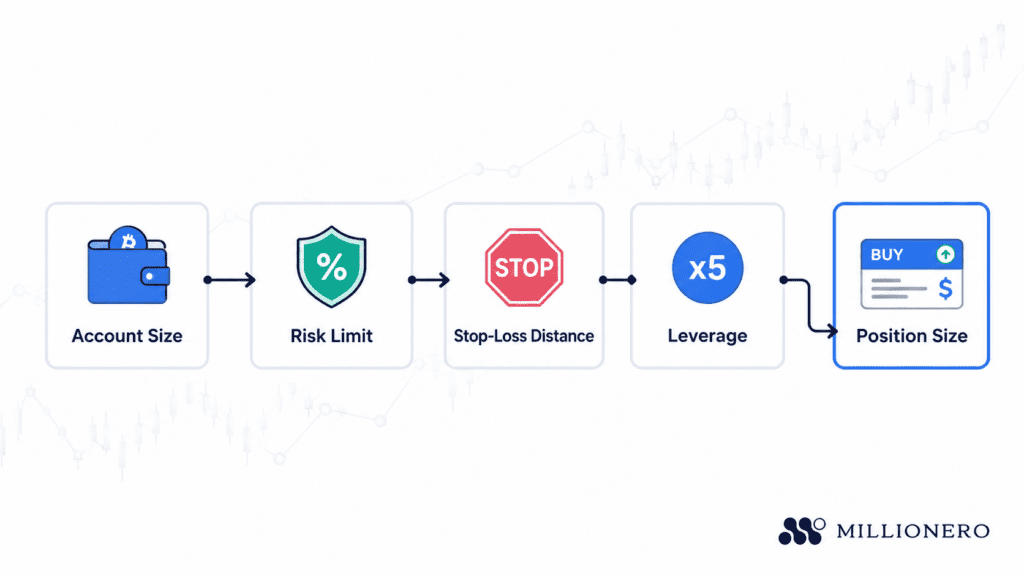
Position sizing means choosing the size of a trade based on account size, risk limit, stop-loss distance, and leverage.
It starts with one practical question:
If this trade fails, how much money am I willing to lose?
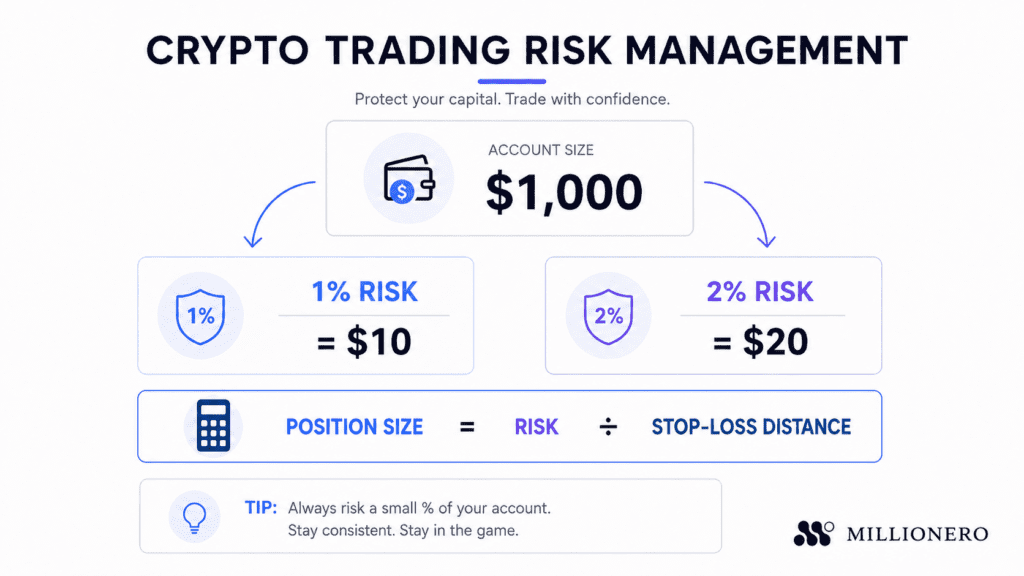
A beginner with a $1,000 account may decide to risk 1% per trade. That means the maximum planned loss is $10. A 2% risk means the planned loss is $20. Some traders prefer a fixed amount, such as $10 or $15 per trade, because it feels easier to manage.
The goal is control. The trader defines the possible damage before entering. The loss has a shape, a number, and a limit. That simple act protects the account from one emotional decision.
Losses belong to trading. Large, unplanned losses belong to poor risk management.
Why Being Right Is Still Not Enough
Perpetual trading separates direction from survival.
A trader may long SUI, BTC, ETH, or SOL because the chart looks strong. The market may still dip first. That dip may be temporary. The broader idea may remain valid. Yet an oversized position can turn that temporary move into a painful loss.
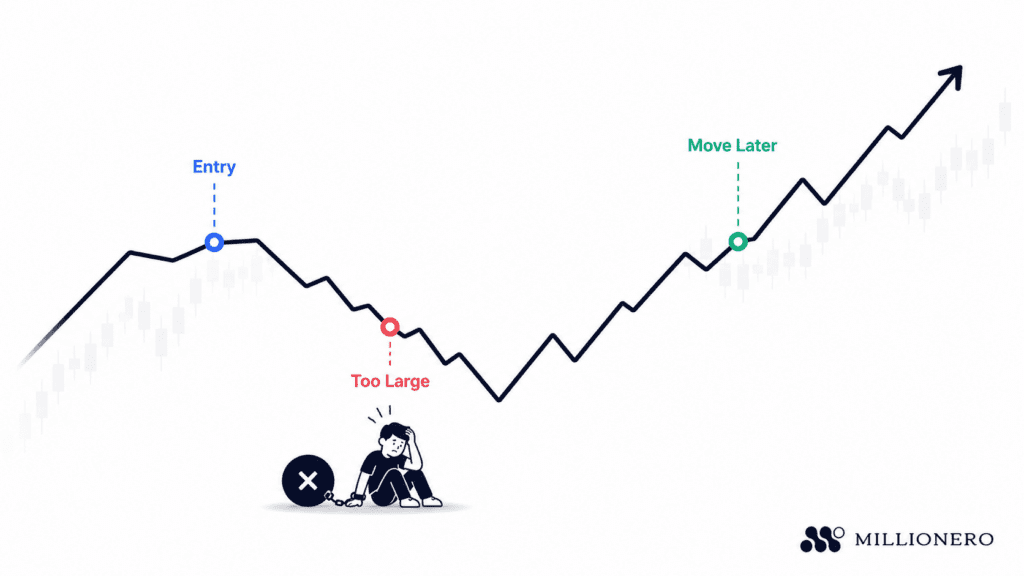
This happens because markets rarely move in a straight line. Price rises, pulls back, shakes out weak positions, and continues later. Overleveraged traders often lose during the noise before the real move arrives.
The issue is not always the coin or the analysis. Often, it is the weight of the position.
A properly sized trade gives the setup room to work. An oversized trade turns every candle into pressure. The trader starts watching every tick, moving the stop-loss, adding margin, or closing too early. The plan disappears. Reaction takes over.
The 1% and 2% Rule
The 1% and 2% rules give beginners a simple foundation.
With a $1,000 account:
1% risk = $10 maximum planned loss
2% risk = $20 maximum planned loss
This does not mean the position size is $10 or $20. It means the trader plans to lose only that amount if the stop-loss is hit.
That difference matters.
A trader can open a $200 position and risk $10 if the stop-loss is 5% away. A trader can open a $500 position and still risk $10 if the stop-loss is 2% away. The position size changes because the stop-loss distance changes.
The basic formula is easy:
Position size = amount willing to risk ÷ stop-loss distance
If a trader wants to risk $10 and the stop-loss is 5% away:
$10 ÷ 5% = $200 position size
If the stop-loss is 2% away:
$10 ÷ 2% = $500 position size
The planned risk stays the same. The trade size adjusts around it.
That is the heart of position sizing: risk first, size second.
Position Size and Leverage
Leverage can make risk feel smaller than it is.
A trader may use $100 of margin with 5x leverage to open a $500 position. The account does not move based on the $100 margin alone. The trade moves based on the full $500 exposure.
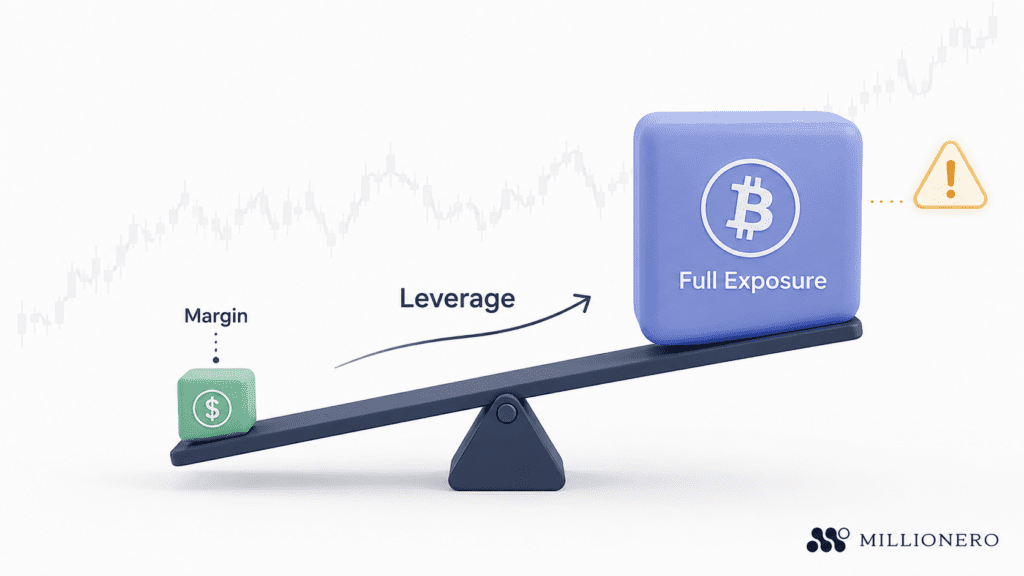
That is why risk should be calculated from the full position size, not only from the margin used.
Leverage can help with capital efficiency when used carefully. It becomes dangerous when it gives the trader permission to hold a position the account cannot carry. A small price move can become a large emotional event. A normal wick can feel like an emergency.
Position sizing keeps leverage under control. It makes leverage a tool for exposure, while risk management remains the real structure of the trade.
Fixed Amount Risking
Some beginners may prefer fixed amount risking because it is less complicated.
A trader with a $1,000 account may decide:
“I will risk $10 per trade.”
Every setup is then measured against that number.
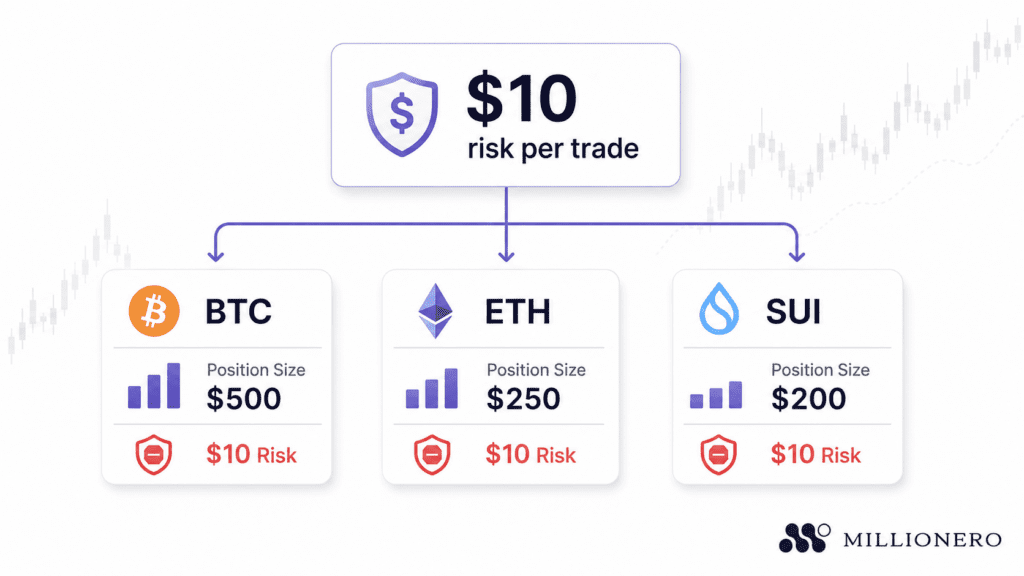
If the stop-loss needs to be wide, the position becomes smaller. If the stop-loss can be closer, the position can be larger. If the setup requires too much risk, the trader skips it.
That final decision is important. Strong risk management sometimes keeps a trader out of the market. Some trades look attractive but demand more risk than the account should carry.
A skipped bad trade is a quiet win.
The Gambling Mindset
Gambling begins when risk becomes vague.
It sounds like: “This looks obvious.”
It feels like: “I need to make back the last loss.”
It grows when the trader increases size without a clear stop-loss.
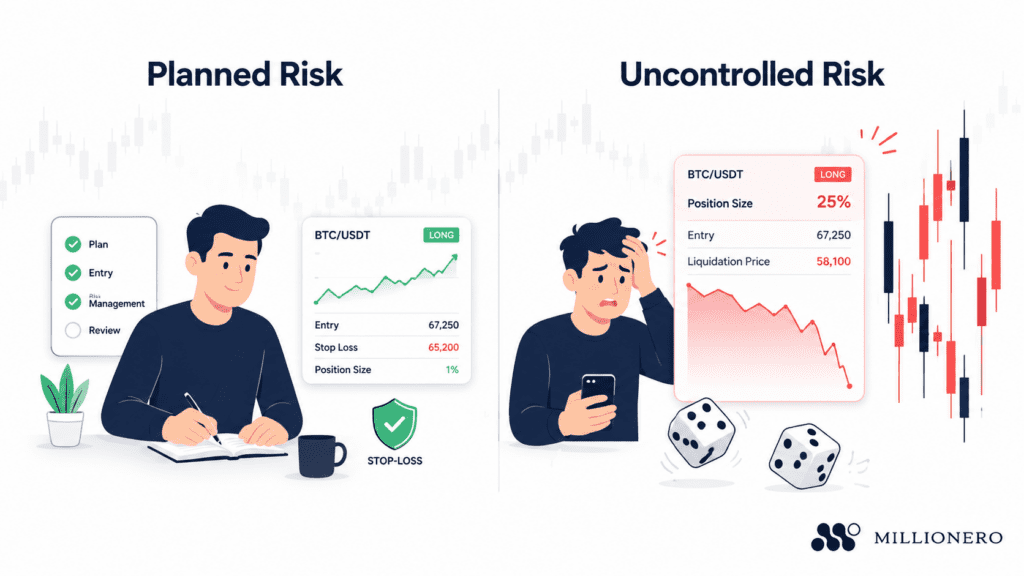
The market rewards discipline more than confidence. Confidence may help a trader enter, but discipline decides whether the account survives. A trader who risks 10% or 20% on one idea gives that trade too much power. One sharp move can damage the account and the trader’s mindset at the same time.
A trader who risks 1% or 2% accepts a healthier truth: no single trade deserves control over the whole account.
That mindset changes the trading experience. Losses become smaller. Decisions become clearer. Mistakes become easier to review. The next trade remains available.
The Real Difference Between Trading and Gambling
The difference appears before the entry.
Trading defines the risk.
Gambling hopes the risk will not matter.
A beginner who understands position sizing begins to treat every perpetual trade as a measured decision. The question changes from “How much can I make?” to “How much can I lose if this fails?”
That question may sound less exciting, but it protects the trader from one of the most common dangers in perpetual markets: being right with a position too large to survive being early.
Position sizing gives the trader something more useful than excitement. It gives structure. It gives patience. Most importantly, it gives another chance.
This article is for educational purposes only and is not financial advice. Always do your own research and manage risk carefully before trading. You can read more beginner-friendly crypto guides on the Millionero Blog, and when you are ready, explore spot and perpetual trading on Millionero Exchange.